Have you ever received a simple text like “okay” and wondered, “Wait… are they actually okay?”
That tiny word can carry different feelings depending on the person, timing, and situation. This is where emotional meaning comes in.
Emotional meaning explains the feelings and personal connections hidden behind words, actions, symbols, and experiences. A message is not always just about what someone says — it is often about what they feel while saying it.
In today’s world of texting, emojis, social media comments, and quick conversations, understanding emotions has become more important than ever. A single emoji, punctuation mark, or phrase can completely change the mood of a conversation.
This updated 2026 guide explores what emotional meaning really is, how people use it in communication, real-life examples, common misunderstandings, and how emotions shape the way we connect with others.
Whether you are decoding a confusing text, improving relationships, or learning how humans express feelings, understanding emotional meaning gives you a clearer view of what people truly intend to say.
What Does “Emotional Meaning” Mean?
Quick Answer
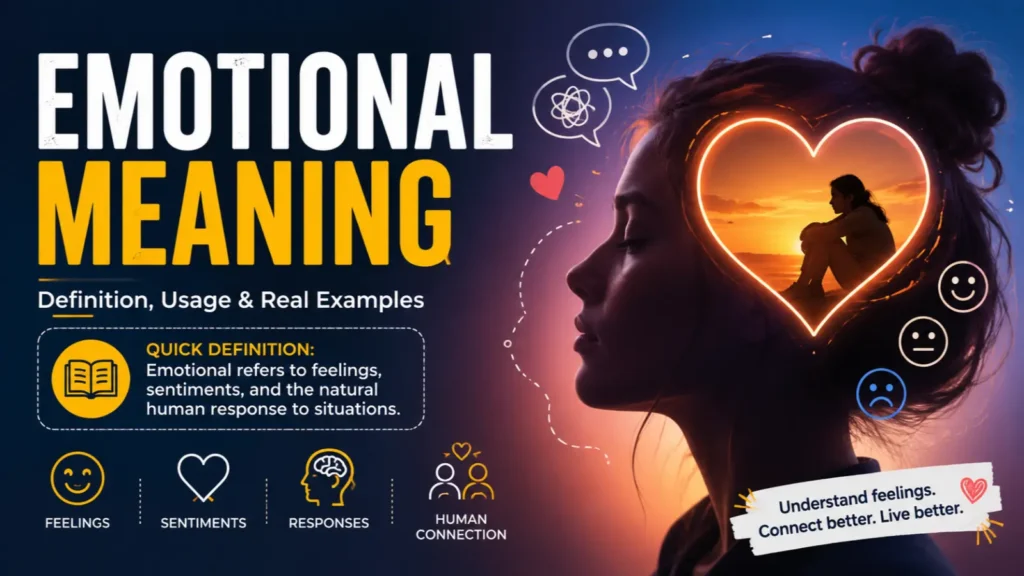
Emotional meaning is the feeling or emotional response connected to a word, phrase, action, object, or experience. It represents the deeper message behind something and explains how it affects people emotionally rather than just what it literally means.
The simplest way to understand it is this:
Literal meaning = what something says.
Emotional meaning = what something makes you feel.
For example:
The word “home” literally refers to a place where someone lives.
But its emotional meaning may include:
- comfort
- safety
- love
- memories
- belonging
That deeper emotional connection is what gives ordinary words their power.
The Origin of Emotional Meaning
The idea of emotional meaning comes from the study of language, psychology, and human behavior. Researchers have long explored how people attach feelings and personal experiences to words and situations.
Language is not just a collection of definitions. Humans naturally connect words with memories, relationships, and emotions.
For example:
- “Childhood” may create feelings of happiness for one person.
- The same word may bring sadness or nostalgia for another.
The word stays the same, but the emotional meaning changes based on personal experience.
How Emotional Meaning Has Evolved Over Time
In earlier communication, emotions were often expressed through face-to-face conversations, voice tone, and body language.
Today, digital communication has changed everything.
People now use:
- emojis 😊
- punctuation choices!!!
- abbreviations
- memes
- reaction buttons
- typing styles
to communicate emotions.
For example:
“Thanks.”
This may sound neutral.
But:
“THANK YOU!!! ❤️”
feels much more excited and emotionally positive.
The words are similar, but the emotional meaning changes completely.
Emotional Meaning vs Literal Meaning
Many people confuse these two concepts, but they are not the same.
| Type | Meaning | Example |
|---|---|---|
| Literal meaning | The direct definition | “Rain” means water falling from clouds |
| Emotional meaning | The feeling connected to it | Rain may feel peaceful, romantic, or depressing |
Another example:
The phrase “I miss you” literally means someone feels the absence of another person.
Emotionally, it may express:
- love
- loneliness
- attachment
- longing
- sadness
The emotion behind the words often matters more than the words themselves.
Pronunciation Guide
Emotional meaning is pronounced:
ee-MOH-shuh-nuhl MEE-ning
Breaking it down:
- Emotional → connected to feelings
- Meaning → the idea, message, or significance behind something
Together, the phrase refers to the feelings or emotional value attached to something.
How to Use “Emotional Meaning” Correctly in Texts & Chat
In modern digital conversations, understanding emotional meaning helps you read between the lines. A message is not only about the words someone types — it is also about the emotion, intention, and tone behind those words.
A short reply, emoji, or punctuation choice can completely change how a message feels.
For example:
“Sure.”
Depending on the context, it could mean:
- “Yes, I agree.”
- “I don’t really care.”
- “I’m annoyed but I won’t argue.”
- “I’m accepting it reluctantly.”
The emotional meaning depends on the situation, relationship, and communication style.
Correct Context and Tone
The phrase emotional meaning is usually used when discussing:
- feelings behind words
- hidden messages
- relationship communication
- psychology
- literature analysis
- social interactions
- personal experiences
It can describe positive, negative, or neutral emotions.
Positive Emotional Meaning Examples
Words or messages that often carry positive emotional meaning:
- “Congratulations!” → happiness and support
- “I’m proud of you” → appreciation and love
- “You did amazing” → encouragement
- “I’m here for you” → care and emotional support
Negative Emotional Meaning Examples
Some messages may carry negative emotions:
- “Whatever.” → frustration, dismissal, or anger
- “Fine.” → possible disappointment or irritation
- “Leave me alone.” → emotional distance or frustration
The actual meaning depends on the speaker’s intention.
Emotional Meaning in SMS and Text Messages
Texting removes many emotional signals that exist in face-to-face conversations.
When people talk in person, they use:
- facial expressions
- voice tone
- gestures
- pauses
But texts rely heavily on:
- word choice
- emojis
- capitalization
- punctuation
- response time
For example:
Message A:
“Okay”
Message B:
“Okay 😊”
The first may feel neutral or cold.
The second feels warmer because the emoji adds emotional information.
Emotional Meaning on WhatsApp
WhatsApp conversations often depend heavily on emotional signals.
People use:
- ❤️ heart emojis for affection
- 😂 laughing emojis for humor
- 👍 thumbs-up for agreement
- 😭 crying emojis for strong emotions
- voice notes for emotional tone
Example:
Friend: “I finally passed my exam!”
Reply: “Nice.”
The reply is positive but emotionally weak.
A warmer response:
“That’s amazing!! I knew you could do it 🎉👏”
shows excitement and support.
The words create a stronger emotional connection.
Emotional Meaning on Instagram DMs
Instagram communication often uses a more casual and expressive style.
People communicate emotions through:
- reactions
- memes
- GIFs
- story replies
- emojis
Example:
Someone posts a vacation photo.
Reply:
“Cool place.”
This sounds simple.
Reply:
“This view is incredible 😍🔥”
shows excitement and admiration.
The emotional meaning changes because of the language style.
Emotional Meaning on Twitter/X, Discord, and Reddit
Different online communities develop their own emotional communication styles.
Twitter/X
Users often express emotions through:
- sarcasm
- humor
- short reactions
- trending phrases
Example:
“Absolutely not 😭”
The crying emoji does not always mean sadness. It can show dramatic humor.
Discord
Gaming and community chats often use:
- memes
- slang
- reaction emojis
- inside jokes
Example:
“Bro really thought he could win 💀”
The skull emoji often means “that was hilarious” rather than actual death.
Reddit users often communicate emotional meaning through:
- detailed comments
- storytelling
- humor
- voting reactions
A highly upvoted comment often signals agreement or emotional connection with a community.
When to Use “Emotional Meaning” vs. When Not To
Good Situations to Use It
The term works well when discussing:
✅ relationships
✅ psychology
✅ communication skills
✅ writing analysis
✅ emotional intelligence
✅ social media behavior
Examples:
- “What is the emotional meaning behind this message?”
- “The emotional meaning of this song is powerful.”
- “Words can have different emotional meanings.”
Situations Where It May Not Fit
Avoid using the phrase unnecessarily in:
❌ quick casual chats
❌ simple dictionary questions
❌ technical instructions
❌ formal business messages without context
For example, telling a coworker:
“Please explain the emotional meaning of this deadline.”
sounds unusual.
A better phrase might be:
“Can you explain the reason behind this deadline?”
Formatting Tips: Capitalization, Emojis, and Tone
Small details can completely change emotional meaning.
Capital Letters
Compare:
“I love this.”
vs.
“I LOVE THIS!!!”
The second message feels more energetic.
Punctuation
Compare:
“Really?”
This may show curiosity.
“Really!!!”
This shows excitement.
“Really…”
This may suggest doubt or disappointment.
Emojis
Emojis add emotional clues.
Examples:
| Emoji | Common Emotional Meaning |
|---|---|
| ❤️ | Love, care, affection |
| 😂 | Humor, amusement |
| 😭 | Sadness or dramatic laughter |
| 😍 | Admiration or excitement |
| 🙃 | Sarcasm or awkwardness |
| 😐 | Neutral or uncomfortable feeling |
Remember: emoji meanings can change between communities and generations.
Real Conversation Examples Using Emotional Meaning
Example 1: Between Friends
Context: Friendship
Alex: “I got the job!”
Sam: “OMG congratulations!! 🎉 I knew you would get it!”
Emotional meaning:
The message communicates excitement, pride, and genuine happiness. The extra words and celebration emojis show emotional support.
Example 2: In a Relationship Chat
Context: Dating
Jamie: “I had a rough day.”
Taylor: “I’m sorry ❤️ Want to talk about it?”
Emotional meaning:
The reply shows empathy and emotional availability. The heart emoji adds warmth and care.
Example 3: Family Conversation
Context: Family Group Chat
Mom: “Be safe on your trip.”
Reply: “I will ❤️”
Emotional meaning:
The short response carries affection and reassurance. The heart changes a basic confirmation into a loving message.
Example 4: Work Chat
Context: Professional Conversation
Manager: “Great work on the presentation.”
Employee: “Thank you, I appreciate it.”
Emotional meaning:
The message shows gratitude and professionalism without being overly casual.
Example 5: Gaming Group Chat
Context: Online Gaming
Player 1: “I carried the whole team 😂”
Player 2: “Bro thinks he’s the legend 💀”
Emotional meaning:
The conversation uses humor and teasing. The emotional meaning is playful, not aggressive.
Common Mistakes & Misunderstandings
Understanding emotional meaning is useful, but people often misread emotions online.
Mistake 1: Assuming Every Short Reply Is Negative
A short message does not always mean someone is angry.
Example:
“Okay.”
Possible meanings:
- agreement
- distraction
- tiredness
- quick confirmation
The surrounding conversation matters.
Mistake 2: Ignoring Cultural Differences
Different cultures express emotions differently.
Some people communicate warmly with many words and emojis.
Others show care through actions rather than emotional language.
A person who writes short messages may still care deeply.
Mistake 3: Taking Emojis Too Literally
Emojis can have multiple meanings.
Example:
😭
It may mean:
- sadness
- extreme laughter
- embarrassment
- dramatic reaction
The emotional meaning depends on the conversation.
Emotional Meaning Across Different Platforms & Demographics
The way people express emotions changes depending on age, online platform, and communication habits. The same phrase can carry a different emotional meaning when used by different generations or communities.
Understanding these differences helps prevent unnecessary misunderstandings.
How Gen Z Uses Emotional Meaning
Gen Z has grown up with digital communication, so they often express emotions through:
- emojis
- memes
- slang
- abbreviations
- reaction images
- ironic humor
For Gen Z users, emotional meaning is often hidden behind playful language.
Example:
“I’m crying 😭”
Literal meaning: Someone is crying.
Modern emotional meaning: Something is extremely funny or overwhelming.
Another example:
“That’s wild 💀”
Literal meaning: Something is dead.
Online emotional meaning: “That is unbelievably funny or shocking.”
Gen Z often uses exaggeration as a way to show emotion rather than communicate the literal meaning.
How Millennials Use Emotional Meaning
Millennials often combine traditional communication styles with digital expressions.
They commonly use:
- emojis
- GIFs
- longer messages
- supportive language
Example:
“You’re doing great! Keep going 😊”
The emotional meaning shows encouragement and positivity.
Many millennials also use emojis to soften messages and make texts feel more friendly.
How Older Generations Interpret Emotional Meaning
Older generations may rely more on direct wording and traditional communication signals.
A message like:
“K.”
might feel normal to one person but seem rude or dismissive to another.
This creates a common digital communication gap.
A younger person may see a short reply as efficient.
An older person may interpret it as emotionally negative.
Emotional Meaning on TikTok Comments
TikTok has created unique emotional communication patterns.
Users often express feelings through:
- trends
- memes
- repeated phrases
- exaggerated reactions
Examples:
“This healed something in me.”
Emotional meaning:
The content created comfort, happiness, or a strong personal connection.
“I can’t 😭”
Emotional meaning:
The person is overwhelmed by humor, surprise, or emotion.
TikTok culture often depends on shared understanding. Without context, these phrases can seem confusing.
Emotional Meaning in Instagram Captions
Instagram captions frequently use emotional language to create connection.
Examples:
“Making memories ✨”
Possible emotional meaning:
- happiness
- gratitude
- nostalgia
“New chapter begins 🤍”
Possible emotional meaning:
- personal growth
- hope
- change
Captions are often less about information and more about creating a feeling.
Is Emotional Meaning Formal or Informal?
The phrase emotional meaning itself is neutral and can be used in both casual and professional discussions.
However, the examples used to explain emotions are often informal.
Professional Uses:
✅ Psychology research
✅ Education
✅ Communication training
✅ Literature analysis
✅ Workplace discussions
Example:
“Understanding emotional meaning improves workplace communication.”
Casual Uses:
✅ Text conversations
✅ Social media discussions
✅ Relationship advice
✅ Personal reflection
Example:
“What’s the emotional meaning behind this message?”
Understanding related concepts can make emotional communication easier.
| Term | Meaning |
|---|---|
| Emotional intelligence | The ability to understand and manage emotions |
| Tone | The attitude or feeling behind words |
| Vibe | The overall emotional feeling of a person or situation |
| Subtext | The hidden meaning behind a message |
| Context | The situation that affects interpretation |
| Sentiment | The emotion or attitude expressed in communication |
| Empathy | Understanding another person’s feelings |
| Nonverbal cues | Emotional signals shown without words |
| Body language | Physical expressions of emotions |
| Emotional expression | The way people show their feelings |
Synonyms and Related Ideas
Depending on the situation, emotional meaning may also be described as:
- emotional significance
- deeper meaning
- hidden feeling
- emotional connection
- personal meaning
- emotional impact
Antonyms of Emotional Meaning
Opposite concepts include:
- literal meaning
- factual meaning
- objective meaning
- surface meaning
- technical definition
For example:
A dictionary explains the literal meaning of a word.
A person’s experience explains its emotional meaning.
FAQs:
What is the emotional meaning of a word?
The emotional meaning of a word refers to the feelings, memories, or reactions people associate with it. A word can have the same dictionary definition but create different emotions depending on personal experiences, culture, and context.
Why do words have emotional meanings?
Words develop emotional meanings because humans connect language with memories, relationships, and experiences. A simple word can remind someone of a person, place, event, or feeling, giving it a deeper meaning beyond its definition.
Can emotional meaning change over time?
Yes. Emotional meanings can change as society, culture, and personal experiences change. A phrase that once had one emotional association may gain a new meaning through internet culture, trends, or social changes.
How can I understand the emotional meaning behind a text?
Look at the full context, including word choice, punctuation, emojis, timing, and your relationship with the sender. Avoid judging a message based only on one short phrase because emotions are often hidden.
What is the difference between emotional meaning and emotional intelligence?
Emotional meaning refers to the feelings connected to words, actions, or experiences. Emotional intelligence is the ability to recognize, understand, and manage emotions in yourself and others.
Conclusion:
Emotional meaning helps us understand the feelings behind communication. Words are powerful, but the emotions attached to those words often create the real message.
In today’s digital world, where conversations happen through screens, understanding emotional signals can prevent confusion and build stronger connections.
From a simple text message to a viral social media comment, emotional meaning explains why the same words can make one person smile and another person feel hurt.
Want to explore more fascinating communication concepts? Share your favorite emotional phrase, emoji, or slang expression and discover the deeper meaning behind it!

I’m Lina Roys, a passionate writer behind Storevian, where I make words, phrases, slang, and everyday expressions easy to understand. I create clear, engaging, and reader-friendly content to help people find the meanings they’re looking for, quickly and confidently.


2 thoughts on “Emotional Meaning Explained Clearly (Ultimate Guide )”