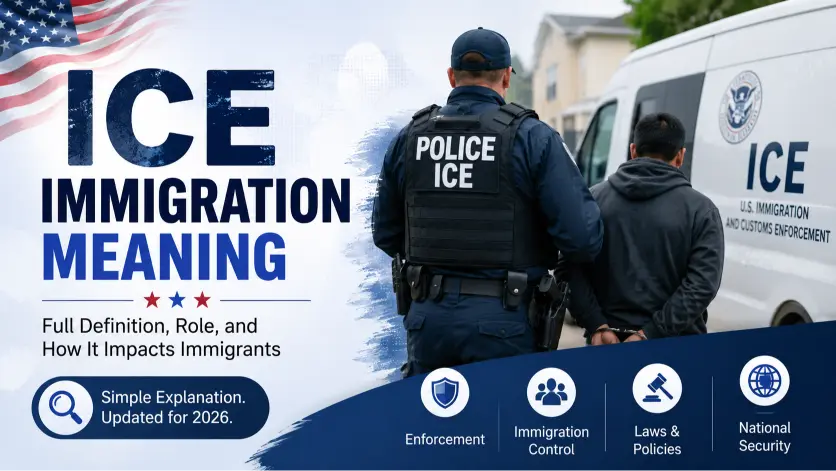
Have you ever seen “ICE” mentioned in a news headline, social media post, or immigration debate and wondered what it actually means? The term appears frequently in conversations about U.S. immigration, deportations, and government policies, but many people are unsure about the agency behind the abbreviation.
The ICE immigration meaning refers to Immigration and Customs Enforcement, a federal agency responsible for enforcing specific immigration and customs laws in the United States.
Unlike internet slang abbreviations that change meanings overnight, ICE has a formal government meaning. However, the way people discuss ICE online can vary widely depending on their political views, personal experiences, and understanding of immigration laws.
This updated 2026 guide explains what ICE stands for, what the agency does, how it operates, common misconceptions, and why the term appears so often in public conversations.
Whether you are a student, immigrant, journalist, researcher, or simply someone trying to understand the news better, this guide breaks down ICE in simple language without complicated legal terms.
What Does “ICE Immigration Meaning” Mean? (Definition + Origin)
Quick Answer
ICE immigration meaning: ICE stands for Immigration and Customs Enforcement, a U.S. government agency created to enforce immigration and customs laws. It operates under the Department of Homeland Security and handles investigations, immigration enforcement actions, detention management, and certain deportation-related activities.
What Does ICE Stand For?
ICE is an abbreviation for:
I — Immigration
C — Customs
E — Enforcement
The official name is U.S. Immigration and Customs Enforcement.
The agency is part of the Department of Homeland Security (DHS) and was established in 2003 after the creation of DHS following the September 11, 2001 attacks.
Its creation combined parts of several previous government agencies to create a department focused on national security, border-related issues, and enforcement responsibilities.
What Is the Purpose of ICE?
ICE’s main purpose is enforcing federal laws connected to immigration and customs.
The agency has several major responsibilities, including:
1. Immigration Enforcement
ICE identifies and takes action against individuals who may be violating U.S. immigration laws.
This can include people who:
- Entered the country without authorization
- Stayed beyond the period allowed by their visa
- Have certain criminal convictions
- Are subject to immigration court orders
However, immigration cases involve legal procedures, and ICE actions must operate within U.S. law.
2. Investigating Immigration-Related Crimes
ICE investigates activities connected to immigration violations and international crime.
Examples may include:
- Human trafficking
- Document fraud
- Smuggling networks
- Certain customs violations
3. Managing Immigration Detention
ICE oversees detention operations for some individuals involved in immigration proceedings.
Detention decisions can depend on factors such as:
- Immigration status
- Legal history
- Court decisions
- Enforcement priorities
How Has the Meaning of ICE Changed Over Time?
Originally, ICE was mainly a government abbreviation used by officials, lawyers, and news organizations.
Over time, it became a widely recognized term in everyday conversations because immigration became a major topic in politics, media, and online discussions.
Today, when people say:
- “ICE is involved”
- “ICE detained someone”
- “ICE enforcement increased”
they are usually referring to immigration enforcement actions by the agency.
The term has also gained emotional and political meaning. Some people view ICE primarily as a necessary law enforcement organization, while others criticize certain enforcement policies and practices.
Understanding the difference between the agency itself and opinions about its policies helps avoid confusion.
How ICE Fits Into the U.S. Immigration System
The U.S. immigration system involves several different agencies, and many people mistakenly assume they all perform the same role.
Here is a simple comparison:
| Agency | Main Responsibility |
|---|---|
| ICE | Interior immigration enforcement, investigations, detention, removals |
| CBP (Customs and Border Protection) | Border security and inspections at ports of entry |
| USCIS (U.S. Citizenship and Immigration Services) | Immigration applications, visas, citizenship, and benefits |
| Immigration Courts | Legal decisions on many immigration cases |
How to Use “ICE” Correctly in Conversations & Online Discussions
Unlike internet slang terms that are mainly used for jokes, memes, or casual texting, ICE is a formal abbreviation connected to U.S. government and immigration topics.
The way you use the term depends heavily on the context.
For example:
- In a news discussion: “ICE announced new enforcement priorities.”
- In a classroom: “ICE is a federal agency under DHS.”
- In a casual conversation: “My cousin had an ICE appointment.”
The abbreviation itself is neutral, but discussions around it can become sensitive because immigration affects people’s lives, families, and communities.
Correct Contexts for Using ICE
1. News and Political Discussions
ICE frequently appears in:
- News reports
- Government statements
- Political debates
- Immigration policy discussions
Example:
“The article explained how ICE enforcement policies have changed over the years.”
Here, ICE refers specifically to the government agency.
2. Legal or Immigration Conversations
Lawyers, immigrants, and advocates often use ICE when discussing:
- Immigration cases
- Detention
- Removal proceedings
- Enforcement actions
Example:
“The attorney explained that ICE issued a notice related to the immigration case.”
3. Educational Content
Students researching immigration topics may use ICE when learning about:
- U.S. government agencies
- Immigration history
- Federal law enforcement
Example:
“ICE was created in 2003 as part of the Department of Homeland Security.”
When Should You Avoid Using ICE?
Although the abbreviation itself is simple, careless wording can create confusion or appear insensitive.
Avoid:
❌ Using ICE as a joke about immigration situations
Example:
“Better watch out, ICE is coming 😂”
This can be harmful because immigration enforcement can be a serious personal issue for many people.
❌ Treating ICE as the same thing as every immigration agency
ICE is not:
- The entire U.S. immigration system
- The same as border patrol
- The agency that approves citizenship applications
❌ Using emotionally loaded statements without facts
Statements like:
“ICE always does this”
or
“ICE never does that”
often oversimplify a complex agency with different divisions, policies, and responsibilities.
Formatting Tips When Writing About ICE
Because ICE is an acronym, it is normally written in capital letters:
✅ Correct:
- ICE
- ICE agents
- ICE enforcement
❌ Incorrect:
- ice immigration
- Ice agents
- ice agency
The lowercase word “ice” usually refers to frozen water, not the government agency.
Context matters.
Real Conversation Examples Using “ICE”
Example 1: Between Friends Discussing News
Alex:
“Did you see the immigration story on the news?”
Maria:
“Yeah, it mentioned ICE increasing enforcement in some areas.”
Meaning:
Maria is referring to Immigration and Customs Enforcement and its activities.
The conversation is informational and focuses on current events.
Example 2: Family Conversation
Parent:
“I heard ICE has been mentioned a lot recently. What does it mean?”
Student:
“It stands for Immigration and Customs Enforcement. It’s part of DHS.”
Meaning:
The speaker is explaining the abbreviation, not expressing an opinion about immigration policy.
Example 3: Workplace Discussion
Coworker:
“The company updated its immigration compliance guidelines.”
Manager:
“Yes, especially because ICE investigations can involve employment records.”
Meaning:
ICE is being used in a professional compliance context.
Example 4: Online Discussion
Commenter:
“People are debating ICE policies again.”
Reply:
“Many people have different opinions about immigration enforcement.”
Meaning:
The word refers to public debate about the agency and its policies.
Example 5: Student Research Group
Student 1:
“We need information about ICE for our government project.”
Student 2:
“Let’s compare ICE with USCIS and Border Patrol.”
Meaning:
ICE is being studied as one part of the larger immigration system.
Common Mistakes & Misunderstandings About ICE
Many people hear the term ICE but misunderstand what the agency actually does.
Here are the most common mistakes.
Mistake 1: Thinking ICE Means Border Patrol
This is one of the biggest misconceptions.
While both agencies deal with immigration enforcement, they have different responsibilities.
Border Patrol primarily focuses on:
- Border security
- Preventing unauthorized entry
- Patrol operations near U.S. borders
ICE focuses more on:
- Interior enforcement
- Investigations
- Immigration detention
- Removal operations
They are separate agencies.
Mistake 2: Believing ICE Handles All Immigration Applications
ICE does not process:
- Green card applications
- Citizenship applications
- Visa approvals
Those responsibilities belong mainly to USCIS.
For example:
Someone applying for U.S. citizenship usually deals with USCIS, not ICE.
Mistake 3: Assuming Every ICE Contact Means Immediate Deportation
Another common misunderstanding is that any interaction with ICE automatically leads to removal.
Immigration cases can involve:
- Court hearings
- Appeals
- Legal representation
- Individual circumstances
The process depends on the details of each case.
Generational and Cultural Differences in Understanding ICE
Different groups may understand and discuss ICE differently.
Gen Z and Younger Audiences
Younger people often encounter ICE through:
- TikTok discussions
- Instagram posts
- Online activism
- Political conversations
For many Gen Z users, ICE is not just a government abbreviation—it is also connected to broader discussions about immigration rights and policy.
Millennials
Millennials often recognize ICE through:
- News coverage
- Political discussions
- Workplace immigration topics
- Social media debates
The term became much more widely known during major immigration policy discussions in the 2010s.
Older Generations
Some older adults may know ICE mainly from:
- Television news
- Government announcements
- Newspaper articles
They may be less familiar with how the term is used in online discussions.
ICE Across Different Platforms and Communities
TikTok
On TikTok, ICE often appears in:
- Immigration education videos
- Political discussions
- Personal stories
- News commentary
Creators may explain the agency’s role or discuss experiences related to immigration.
Instagram usage often includes:
- Infographics
- Advocacy posts
- News summaries
- Educational content
The term is usually accompanied by explanations because many viewers may not know the abbreviation.
Reddit discussions about ICE vary widely depending on the community.
Common topics include:
- Immigration law questions
- Personal experiences
- Policy debates
- News analysis
Because Reddit communities have different rules and viewpoints, conversations can range from technical legal discussions to emotional personal stories.
Workplace Communication
In professional settings, ICE should generally be used carefully and accurately.
Appropriate:
“The company reviewed immigration compliance requirements.”
Less appropriate:
“ICE is after everyone.”
Professional communication should avoid rumors and focus on verified information.
Related Immigration Terms, Abbreviations & Alternatives
Understanding ICE immigration meaning becomes easier when you know the other common immigration terms people often mention alongside it.
| Term | Meaning |
|---|---|
| DHS | Department of Homeland Security, the federal department that oversees agencies including ICE. |
| USCIS | U.S. Citizenship and Immigration Services, the agency responsible for immigration applications and benefits. |
| CBP | Customs and Border Protection, the agency responsible for border security and inspections. |
| Border Patrol | A division of CBP focused on securing U.S. borders between official entry points. |
| Visa | Official permission allowing someone to enter or stay in a country for a specific purpose. |
| Green Card | A document showing lawful permanent resident status in the United States. |
| Deportation | The legal process of removing a person from a country under immigration law. |
| Immigration Detention | Holding individuals while immigration cases or removal processes are reviewed. |
| Removal Proceedings | A legal process where immigration authorities seek an order to remove someone from the U.S. |
| Undocumented Immigrant | A person living in a country without the immigration status required by law. |
FAQs:
What does ICE mean in immigration?
ICE immigration meaning refers to Immigration and Customs Enforcement, a U.S. federal agency responsible for enforcing certain immigration and customs laws.
ICE operates under the Department of Homeland Security (DHS). Its responsibilities include investigating immigration-related crimes, managing detention operations, and carrying out some immigration enforcement actions.
What does ICE stand for in the United States?
ICE stands for U.S. Immigration and Customs Enforcement.
The agency was created in 2003 after the formation of the Department of Homeland Security. It combines immigration enforcement and customs investigation responsibilities that were previously handled by different government organizations.
What does ICE do to immigrants?
ICE may investigate immigration violations, arrest individuals in certain situations, manage detention facilities, and carry out removal processes after legal procedures.
However, each immigration case is different. Factors such as legal status, court decisions, and individual circumstances can affect what happens.
Why is ICE controversial?
ICE is controversial because people have different opinions about immigration enforcement policies.
Supporters argue that ICE helps enforce immigration laws and protect national security.
Critics raise concerns about issues such as detention practices, enforcement priorities, and the impact of immigration actions on families and communities.
The debate often focuses on how immigration laws should be enforced rather than simply the existence of the agency itself.
Is ICE a police agency?
ICE is a federal law enforcement agency, but it is different from local police departments.
ICE officers have specific federal authorities related to immigration and customs enforcement.
Local police officers generally handle state and local laws, while ICE focuses on federal immigration-related responsibilities.
Conclusion:
Understanding ICE immigration meaning helps you better follow news reports, immigration discussions, and government information.
ICE stands for Immigration and Customs Enforcement, a U.S. federal agency under the Department of Homeland Security that focuses on immigration enforcement, investigations, detention management, and related responsibilities.
The term can carry different meanings depending on who is using it. For some people, ICE represents law enforcement and immigration policy. For others, it represents debates about immigration rights and enforcement practices.
The most important thing is knowing the facts: ICE is one agency within a much larger immigration system.
Want to understand more government and immigration abbreviations? Explore related terms, learn their meanings, and stay informed.
Have a confusing abbreviation you want explained? Share it and discover what it really means.

I’m Lina Roys, a passionate writer behind Storevian, where I make words, phrases, slang, and everyday expressions easy to understand. I create clear, engaging, and reader-friendly content to help people find the meanings they’re looking for, quickly and confidently.


