Have you ever watched a romantic movie and thought, “That line was so cheesy!” Or maybe someone sent you a pickup line like, “Are you French? Because Eiffel for you.” Whether it made you laugh, roll your eyes, or secretly smile, you’ve already experienced the true cheesy meaning.
The word cheesy appears everywhere today—from TikTok captions and Instagram comments to dating apps, memes, and everyday conversations. Yet many people, especially non-native English speakers, wonder what it actually means and whether it’s a compliment or an insult.
The answer isn’t as straightforward as you might think.
In this guide, you’ll learn the exact cheesy meaning, where the word came from, how native English speakers use it, when it’s appropriate, and when you should avoid it. You’ll also see plenty of real-life examples so you can confidently recognize and use “cheesy” in conversations.
Whether you’re improving your English, decoding internet slang, or simply curious, this guide has you covered.
What Does “Cheesy” Mean?
Quick Answer
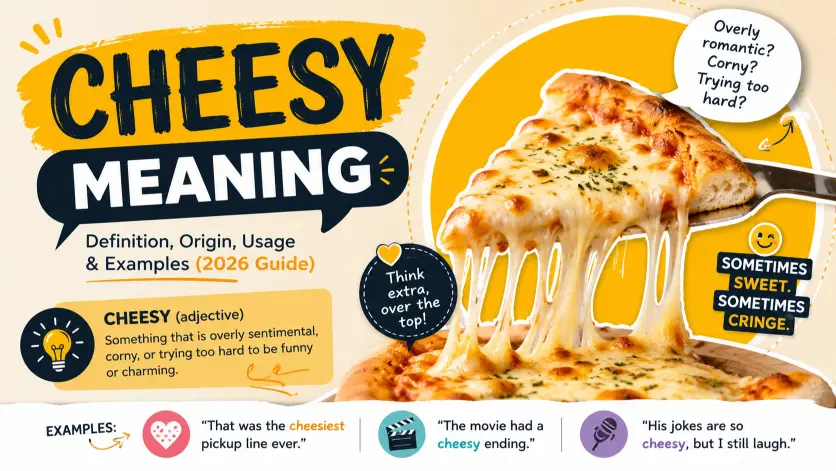
Cheesy means overly sentimental, corny, predictable, or exaggerated in a way that feels awkward, funny, or charming. It usually describes jokes, pickup lines, movies, compliments, songs, or romantic gestures that try a little too hard to create emotion or laughter.
In simple English:
- Too romantic
- Too predictable
- Overly dramatic
- Corny but sometimes lovable
Unlike many negative words, cheesy isn’t always an insult. People often use it affectionately.
For example:
That proposal was so cheesy… but honestly, it was adorable.
Here, “cheesy” actually carries a positive feeling despite acknowledging that the proposal was cliché.
Pronunciation
Cheesy
/ˈtʃiːzi/
Sounds like:
CHEE-zee
Dictionary Definition
Most English dictionaries describe cheesy as:
- Cheap or low quality (older meaning)
- Overly sentimental
- Corny
- Full of clichés
- Trying too hard to be funny or romantic
Modern English speakers overwhelmingly use the second meaning.
The Origin of “Cheesy”
Interestingly, cheesy didn’t originally refer to romance or jokes.
During the late 1800s and early 1900s, English speakers sometimes used cheesy to describe something that looked cheap, poor-quality, or tacky.
By the mid-20th century, the meaning expanded into entertainment.
Critics began describing movies, television shows, songs, and advertisements as cheesy when they relied on:
- predictable endings
- exaggerated emotions
- obvious dialogue
- overused storytelling
Eventually, people started applying the word to everyday conversations.
Today, someone might call:
- a Valentine’s Day card
- a romantic text
- a dad joke
- a pickup line
- a motivational quote
“cheesy.”
How the Meaning Has Evolved
Today’s internet culture has softened the word.
Years ago:
“Cheesy” mostly meant low-quality.
Today:
It often means:
“Yes, it’s corny…
…but I kind of like it.”
That’s why you’ll often see comments like:
- “This movie is cheesy and I love it.”
- “Your pickup line is so cheesy 😂”
- “That was the cheesiest proposal ever ❤️”
Notice how none of these are necessarily negative.
Instead, they describe something that’s intentionally over-the-top.
Things Commonly Described as Cheesy
People frequently describe these as cheesy:
Romantic Gestures
- Love letters
- Roses
- Candlelight dinners
- Surprise proposals
Example:
“He brought flowers to our first date. It was cheesy but sweet.”
Pickup Lines
Example:
“Did it hurt when you fell from heaven?”
That’s one of the most famous cheesy pickup lines ever.
Dad Jokes
Example:
“I’m reading a book about anti-gravity.
It’s impossible to put down.”
People usually call jokes like this cheesy because they’re predictable.
Movies
Romantic comedies often receive this label.
Example:
“The ending was cheesy, but everyone loved it.”
Motivational Quotes
Example:
“Believe in yourself because the universe believes in you.”
Some readers find inspirational quotes heartfelt, while others think they’re cheesy.
Is Cheesy Always Negative?
No.
That’s one of the biggest misconceptions.
The meaning depends entirely on tone.
Positive
“Your anniversary speech was cheesy—in the cutest way.”
Meaning:
It was sweet and heartfelt.
Neutral
“That movie is pretty cheesy.”
Meaning:
It uses familiar clichés.
Negative
“Stop sending cheesy messages.”
Meaning:
The messages feel forced or overly dramatic.
Words Similar to Cheesy
Depending on the situation, cheesy can mean:
- Corny
- Clichéd
- Over-the-top
- Predictable
- Mushy
- Sentimental
- Sappy
- Tacky (sometimes)
- Overdramatic
Each word has a slightly different nuance, but they often overlap.
How to Use “Cheesy” Correctly in Texts & Chat
Knowing the cheesy meaning is only half the story. The real skill is understanding when and how to use it naturally.
In modern English, cheesy is most often used as an adjective to describe something that feels overly romantic, corny, predictable, or intentionally dramatic. Native speakers use it casually in conversations, texts, social media comments, and even memes.
Casual Conversations
You’ll hear “cheesy” frequently among friends.
Example:
Emma: “Jake wrote me a poem.”
Lily: “That’s so cheesy… but honestly, it’s adorable.”
What it conveys: Light teasing mixed with affection.
Text Messages
In texting, cheesy often reacts to romantic messages, jokes, or compliments.
Example:
Alex: “You light up my entire world.”
Sam: “Lol that’s so cheesy ❤️”
The heart emoji changes the tone from criticism to playful appreciation.
Instagram & TikTok
Users commonly call captions, couple videos, or wedding reels “cheesy.”
Example Comment:
“This is the cutest and cheesiest video I’ve seen today.”
It’s often meant positively, especially when paired with laughing or heart emojis.
WhatsApp & Messenger
Friends may jokingly tease each other for sending dramatic messages.
Example:
“Bro, stop being so cheesy 😂”
The laughing emoji signals friendly banter rather than genuine criticism.
Discord & Gaming Chats
While less common, cheesy can describe overly dramatic reactions or predictable strategies.
Example:
“That victory speech was cheesy, but it was hilarious.”
Here, the word adds humor rather than negativity.
X (formerly Twitter)
On X, users often label quotes, advertisements, or viral posts as cheesy when they rely on clichés or emotional appeal.
Example:
“This commercial is so cheesy that I couldn’t stop watching it.”
When NOT to Use “Cheesy”
Avoid using cheesy in:
- Business emails
- Academic writing
- Legal documents
- Professional presentations
- Formal reports
Instead, choose more precise words like:
- clichéd
- overly sentimental
- predictable
- exaggerated
These alternatives sound more appropriate in professional contexts.
Emoji Pairings That Change the Tone
The emojis you use can completely shift how “cheesy” is interpreted:
- ❤️ = affectionate
- 😂 = playful teasing
- 🥹 = emotionally touched
- 😅 = awkward but funny
- 🙄 = mild annoyance
For example:
“You’re so cheesy ❤️”
feels very different from:
“You’re so cheesy 🙄”
The first is warm and loving; the second suggests irritation or eye-rolling.
Quick Tips for Using “Cheesy”
- Use it with friends, family, or in casual chats.
- Pair it with emojis if you want to soften the tone.
- Be mindful that not everyone interprets “cheesy” negatively.
- Avoid it in formal or professional communication unless you’re intentionally being humorous.
Real Conversation Examples Using “Cheesy”
One of the easiest ways to understand the cheesy meaning is by seeing it in real conversations. Native English speakers use the word naturally in many situations, from romantic texts to workplace jokes.
Below are realistic examples showing how cheesy sounds in everyday English.
Example 1: Between Friends
Alex: Did you buy flowers again?
Ryan: Yeah, she loves roses.
Alex: Bro… that’s so cheesy.
Ryan: Maybe, but she smiled.
Meaning:
Alex is playfully teasing Ryan for being overly romantic. The comment isn’t meant as an insult.
Example 2: Dating Text Messages
Chris: Every day with you feels like a dream.
Emma: 😂 That’s the cheesiest thing you’ve ever said.
Chris: But you liked it.
Emma: Maybe a little. ❤️
Meaning:
Emma recognizes the message as overly romantic but appreciates the effort.
Example 3: Family Conversation
Dad: Why don’t eggs tell jokes?
Kids: Why?
Dad: Because they’d crack each other up!
Kids: Dad… that’s so cheesy!
Meaning:
The joke is predictable and corny—a classic “dad joke.”
Example 4: Office Chat
Manager: Teamwork makes the dream work!
Employee: That’s a little cheesy…
Manager: I know, but it’s true.
Meaning:
The phrase sounds cliché, but it’s harmless and often used to encourage people.
Example 5: Gaming Friends
We won because friendship always wins!
That speech was incredibly cheesy.
Still… it was funny.
Meaning:
The speech was overly dramatic, but everyone understood it was said jokingly.
Example 6: Instagram Comments
Caption:
“You’re my favorite person in every universe.”
Comment:
“So cheesy… and I absolutely love it. ❤️”
Meaning:
Many people intentionally embrace cheesy captions because they’re sweet and heartfelt.
Example 7: Wedding Speech
Guest: That speech made everyone cry.
Friend: It was super cheesy—but perfect for the occasion.
Meaning:
At weddings, being a little cheesy is often expected and appreciated.
Example 8: Movie Night
Friend: That ending was unbelievably cheesy.
You: Yeah… but that’s exactly why I loved it.
Meaning:
Cheesy movies often become fan favorites because they’re comforting and fun.
Common Mistakes & Misunderstandings
Even native English speakers sometimes misuse the word cheesy. Here are the most common mistakes and how to avoid them.
Mistake 1: Thinking “Cheesy” Always Means Bad
Many English learners assume that cheesy is purely negative.
That’s not true.
Compare these examples:
❌ “That proposal was cheesy.”
This could sound critical.
✅ “That proposal was cheesy—in the sweetest way.”
Now it sounds affectionate.
Key takeaway: Context and tone matter.
Mistake 2: Confusing “Cheesy” with “Cringe”
These words overlap, but they aren’t identical.
| Word | Meaning | Typical Feeling |
|---|---|---|
| Cheesy | Corny, sentimental, cliché | Amused, affectionate |
| Cringe | Embarrassing or awkward | Discomfort, secondhand embarrassment |
Example:
- “That pickup line was cheesy.” ✅
- “That public proposal was cringe.” ✅ (if it made people uncomfortable)
Something can be cheesy without being cringe.
Mistake 3: Using It in Formal Settings
Imagine writing this in a business email:
“Your presentation was cheesy.”
That could sound rude or unprofessional.
Instead, say:
- It felt overly sentimental.
- It relied on clichés.
- It could be more original.
Reserve cheesy for casual conversations.
Mistake 4: Forgetting Cultural Differences
Some cultures value expressive romance.
Others prefer subtle communication.
Because of this, what one person calls cheesy, another may see as thoughtful or sincere.
For example:
- Large public proposals
- Singing love songs
- Writing long love letters
These gestures may feel wonderfully romantic to some people and overly dramatic to others.
Mistake 5: Assuming Everyone Understands the Slang
If you’re speaking with someone learning English, they might think “cheesy” has something to do with actual cheese.
If they seem confused, simply explain:
“Cheesy means overly romantic or corny—not related to cheese.”
A quick clarification avoids misunderstandings.
“Cheesy” Across Different Platforms & Demographics
The cheesy meaning stays largely the same across platforms, but how people use it varies by age group and online community.
Gen Z
Gen Z often uses cheesy positively.
Examples include:
- romantic TikToks
- wholesome memes
- heartfelt friendship videos
- dramatic captions
Typical comment:
“This is so cheesy and I’m obsessed.”
Rather than mocking the content, they’re celebrating its charm.
Millennials
Millennials frequently use cheesy to describe:
- romantic comedies
- motivational quotes
- wedding speeches
- dad jokes
- nostalgic TV shows
They’re often comfortable embracing cheesy moments with a sense of irony.
Older Generations
Older adults may use cheesy to criticize:
- unrealistic movies
- overly emotional advertisements
- exaggerated acting
For them, the word sometimes retains its older meaning of “cheap” or “tacky.”
TikTok
TikTok has helped make cheesy content cool again.
Popular examples include:
- proposal videos
- anniversary surprises
- wholesome family reunions
- heartfelt graduation speeches
Comments often say:
- “So cheesy 😭❤️”
- “This healed my heart.”
- “I’m crying.”
The emotional response is usually positive.
Instagram captions frequently embrace cheesiness.
Examples:
- “Forever starts today.”
- “You complete me.”
- “Every love story is beautiful.”
These captions may be cliché, but they’re widely accepted for weddings, engagements, and anniversaries.
Reddit users tend to use cheesy more critically.
Examples:
- cheesy dialogue
- cheesy advertisements
- cheesy movie endings
Discussions often analyze whether something feels authentic or forced.
Discord
In gaming communities, cheesy can describe:
- dramatic speeches
- overly emotional roleplay
- predictable storylines
- humorous victory messages
It’s generally playful rather than insulting.
Is “Cheesy” Safe for Work?
Generally:
Casual Workplace
✅ Usually acceptable.
Example:
“That slogan sounds a little cheesy.”
Professional Reports
❌ Better avoided.
Choose words like:
- clichéd
- predictable
- sentimental
- formulaic
Is “Cheesy” Formal or Informal?
| Situation | Appropriate? |
|---|---|
| Friends | ✅ Yes |
| Family | ✅ Yes |
| Text Messages | ✅ Yes |
| Social Media | ✅ Yes |
| Dating Apps | ✅ Yes |
| School Essays | ⚠ Sometimes |
| Job Interviews | ❌ Avoid |
| Academic Papers | ❌ No |
| Business Emails | ❌ No |
Related Slang, Abbreviations & Alternatives
If you’re exploring the cheesy meaning, you’ll likely come across several similar words. While they overlap, each has its own nuance.
| Word | Meaning | When to Use It |
|---|---|---|
| Corny | Old-fashioned, predictable humor | Dad jokes, puns |
| Clichéd | Overused idea or phrase | Writing, speeches, movies |
| Sappy | Excessively emotional or sentimental | Romantic stories, songs |
| Mushy | Very affectionate or emotional | Love messages, greeting cards |
| Cringe | Embarrassing or awkward | Viral videos, awkward moments |
| Tacky | Poor taste or flashy | Fashion, decorations, design |
| Over-the-top | Excessive or dramatic | Celebrations, reactions |
| Campy | Intentionally exaggerated for fun | Classic films, theater |
| Wholesome | Kind, sincere, uplifting | Family content, friendships |
| Dad Joke | Simple, predictable pun | Family conversations |
Similar Words
- Corny
- Sappy
- Sentimental
- Romantic
- Overdramatic
- Predictable
- Old-fashioned
- Clichéd
Opposite Words
- Original
- Sophisticated
- Genuine
- Subtle
- Elegant
- Authentic
- Cool
- Minimalist
FAQs:
What does cheesy mean in slang?
In slang, cheesy means something that is overly romantic, corny, sentimental, or full of clichés. It often describes pickup lines, jokes, compliments, or movies that try a little too hard to be emotional or funny. Depending on the context, it can be either affectionate or mildly critical.
Is calling someone cheesy a compliment?
It depends on the situation. If you call someone’s romantic gesture or joke cheesy, it often means it’s sweet but predictable. Among friends or couples, it’s usually playful. However, if said with an annoyed tone, it can suggest their behavior feels forced or unoriginal.
Why are dad jokes called cheesy?
Dad jokes are called cheesy because they’re intentionally simple, predictable, and filled with puns. The humor comes from how obvious the punchline is, making people laugh and groan at the same time. That’s exactly the kind of playful exaggeration “cheesy” describes.
Is cheesy the same as corny?
They’re very similar, but not always identical. Corny usually emphasizes old-fashioned or predictable humor, while cheesy often highlights excessive romance, sentimentality, or dramatic expression. Many native speakers use the two words interchangeably in casual conversation.
Can a movie be cheesy and still be good?
Absolutely. Many popular romantic comedies, holiday films, and family movies are proudly cheesy. They rely on familiar storylines, emotional moments, and happy endings that audiences enjoy even if they’re predictable. For many viewers, that’s part of the charm.
What does a cheesy pickup line mean?
A cheesy pickup line is an intentionally corny or exaggerated way to start a conversation with someone you’re interested in. Most people don’t expect these lines to be taken seriously—they’re meant to break the ice with humor.
Is cheesy a negative word?
Not necessarily. Cheesy can be positive, neutral, or negative depending on tone and context. A cheesy wedding speech might be heartfelt and memorable, while a cheesy advertisement could feel overly dramatic or unoriginal.
Conclusion:
The cheesy meaning goes far beyond simply describing something as “corny.” In modern English, it usually refers to expressions, jokes, movies, compliments, or romantic gestures that are overly sentimental, predictable, or delightfully cliché. Depending on the tone, calling something cheesy can be affectionate, humorous, or mildly critical.
The key is understanding the context. A cheesy pickup line might make someone laugh, a cheesy movie might become your comfort favorite, and a cheesy love letter could end up being the most meaningful gift someone receives. What feels cliché to one person may feel genuinely heartfelt to another.
Now that you know the full cheesy meaning, you’ll be able to recognize it in conversations, social media, films, and everyday English—and even use it naturally yourself.
What’s the cheesiest joke, movie, or pickup line you’ve ever heard? Drop it in the comments below and share the laughs!