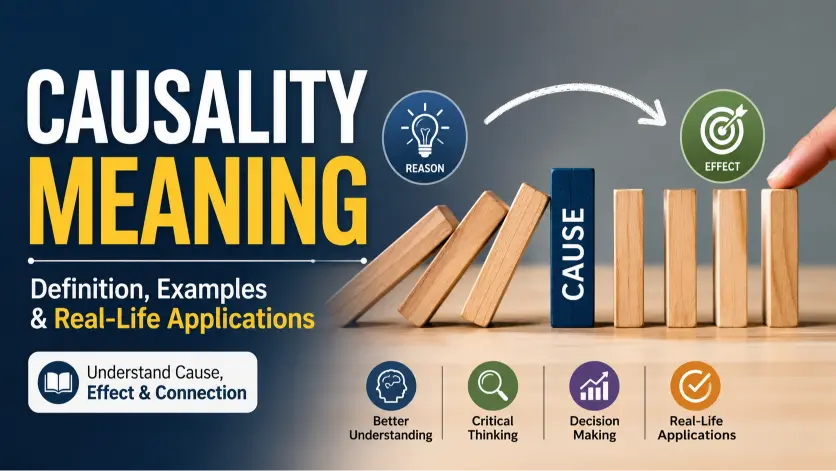
Have you ever wondered whether one event actually causes another or if it’s simply a coincidence? Imagine drinking coffee before every productive workday. Does the coffee make you productive, or is something else responsible? Questions like these revolve around causality.
Understanding causality meaning isn’t just for scientists or philosophers. It’s a practical concept that affects everyday decisions, from reading health headlines and interpreting statistics to making business choices and understanding world events. Whether you’re a student, researcher, professional, or simply curious, knowing the difference between cause and coincidence can help you think more critically.
Updated for 2026, this guide explains causality meaning in simple language with real-world examples, common misconceptions, and practical applications. By the end, you’ll understand what causality is, why it matters, and how to recognize it in everyday life.
What Does Causality Meaning Mean?
Quick Answer
Causality meaning refers to the relationship between two events where one event (the cause) directly produces another event (the effect). In simple terms, if one thing happens because of another, that relationship is called causality.
For example:
- Pressing a light switch turns on the light.
- Heating water to 100°C causes it to boil (under normal atmospheric pressure).
- Regular exercise improves cardiovascular health over time.
Each example demonstrates a direct cause and effect relationship.
Simple Definition
The word causality comes from the idea that every effect has a cause. It answers questions like:
- Why did this happen?
- What caused this outcome?
- Which action produced this result?
Unlike coincidence, causality requires evidence that one event truly influences another.
For instance:
❌ Ice cream sales increase when drowning incidents increase.
Although both happen during summer, buying ice cream doesn’t cause drowning. The real cause influencing both is warmer weather.
This classic example highlights why understanding causality is so important.
Word Origin (Etymology)
The term causality originates from the Latin word causa, meaning reason, cause, or motive.
Over centuries, philosophers and scientists adopted the word to describe the relationship between events.
Important milestones include:
- Ancient Greek philosophers explored why events happen.
- Aristotle proposed four different kinds of causes.
- David Hume questioned whether humans can truly observe causation.
- Modern science uses experiments and statistical methods to establish causal relationships.
Today, causality is one of the foundations of scientific research.
Pronunciation
Causality
US: kaw-ZAL-uh-tee
UK: kaw-ZAL-ih-tee
Phonetic spelling:
/kɔːˈzæləti/
How the Meaning Has Evolved
Historically, causality was mostly discussed in philosophy.
Today, it’s used across many disciplines, including:
- Science
- Medicine
- Psychology
- Economics
- Artificial Intelligence
- Statistics
- Data Science
- Law
- Business Analytics
Modern researchers often distinguish between:
- Association
- Correlation
- Causation
This distinction helps prevent false conclusions based solely on observed patterns.
Why Understanding Causality Matters
Knowing causality meaning helps you:
- Evaluate news reports critically.
- Understand scientific studies.
- Make smarter personal decisions.
- Interpret medical advice accurately.
- Avoid believing misleading statistics.
- Improve analytical thinking.
For example:
A headline might say:
“People who sleep longer earn higher salaries.”
Without evidence of causality, this statement only shows a possible association—not proof that sleeping more causes higher income.
Understanding this difference protects you from misleading claims.
How to Use Causality Correctly
Although “causality” appears frequently in academic writing, it’s also useful in everyday conversations.
Here are some common contexts.
In Everyday Conversation
People often use the idea of causality without mentioning the word itself.
Example:
Person A: Why is the plant dying?
Person B: Too much water caused the roots to rot.
Here, overwatering is the cause.
Another example:
Teacher: Why did your grade improve?
Student: Studying every day made a big difference.
The studying is presented as the cause.
In Science
Scientists rarely claim causality without evidence.
Instead, they conduct:
- Controlled experiments
- Clinical trials
- Long-term studies
- Randomized testing
Example:
Researchers test whether a new medicine actually lowers blood pressure rather than merely appearing alongside lower blood pressure.
In Business
Businesses analyze causality to understand customer behavior.
Example:
Did lowering prices increase sales?
Or was the increase caused by holiday shopping?
Good businesses try to isolate the real cause before making decisions.
In Psychology
Psychologists study questions such as:
- Does stress cause poor sleep?
- Does exercise improve mood?
- Does social media affect mental health?
Because many factors interact, proving causality requires careful research.
In Economics
Economists often investigate whether:
- Higher interest rates reduce inflation.
- Tax cuts increase investment.
- Government spending boosts employment.
Since economies involve many variables, establishing causality can be challenging.
In Everyday Writing
You might naturally use the word in sentences like:
- “Researchers found evidence of causality.”
- “The study failed to prove causality.”
- “Correlation alone doesn’t establish causality.”
- “Scientists continue investigating the causal relationship.”
These expressions are common in academic papers, news articles, and research reports.
When NOT to Use “Causality”
Avoid claiming causality when you only have a coincidence or correlation.
Instead of saying:
❌ “Using blue notebooks causes better grades.”
A more accurate statement would be:
✅ “Students with blue notebooks tended to earn higher grades, but the study did not prove causality.”
This careful wording reflects how researchers communicate findings responsibly.
Formal vs. Informal Usage
| Context | Appropriate? |
|---|---|
| Academic paper | ✅ Yes |
| Scientific journal | ✅ Yes |
| Business report | ✅ Yes |
| News article | ✅ Yes |
| Classroom discussion | ✅ Yes |
| Casual conversation | ✅ Sometimes |
| Social media | ✅ Occasionally |
| Text messages | ❌ Rarely |
Real Conversation Examples Using Causality
Understanding causality meaning becomes much easier when you see it in everyday conversations. These examples show how people naturally talk about cause-and-effect relationships in different situations.
Example 1: Between Friends
Alex: I’ve been sleeping eight hours every night, and I feel much more energetic.
Jordan: Better sleep is probably the cause of your extra energy.
What it conveys:
Jordan is identifying a likely cause-and-effect relationship between getting enough sleep and feeling more energetic.
Example 2: Family Conversation
Mom: The flowers are dying again.
Dad: We forgot to water them during the heatwave.
Mom: That explains it. Lack of water caused them to wilt.
What it conveys:
The family correctly identifies the direct cause of the problem instead of guessing.
Example 3: At School
Teacher: Why did your science project receive the highest score?
Student: I spent two weeks researching and testing my experiment.
Teacher: Your preparation clearly contributed to your success.
What it conveys:
The student’s effort is recognized as a major causal factor behind the good result.
Example 4: Workplace Chat
Manager: Website traffic increased by 30% this month.
Employee: Was it because of the new advertising campaign?
Manager: That’s what we’re investigating before claiming causality.
What it conveys:
Businesses rely on evidence before concluding that one action directly caused another outcome.
Example 5: Gaming Community
Player 1: Ever since I lowered my graphics settings, my game runs much smoother.
Player 2: Lower graphics probably reduced the load on your computer.
What it conveys:
Players identify a technical cause that explains improved performance.
Example 6: Medical Discussion
Patient: I’ve been exercising every day, and my blood pressure has improved.
Doctor: That’s encouraging, but we’ll also consider your diet and medication before confirming the exact causes.
What it conveys:
Medical professionals avoid assuming causality without evaluating all contributing factors.
Common Mistakes & Misunderstandings
Although the concept seems simple, many people misunderstand causality meaning. Here are the most common mistakes.
1. Confusing Correlation with Causality
This is by far the biggest misunderstanding.
Just because two things happen together doesn’t mean one causes the other.
Example
Ice cream sales increase during summer.
Drowning accidents also increase during summer.
Did ice cream cause the drownings?
No.
The real factor is hot weather, which leads to more swimming and more ice cream purchases.
This is why researchers often say:
“Correlation does not imply causation.”
It’s one of the most important principles in science and statistics.
2. Assuming One Cause Explains Everything
Many events have multiple causes, not just one.
For example, poor exam results could be influenced by:
- Lack of sleep
- Poor study habits
- Stress
- Illness
- Difficult exam questions
Looking for a single cause can oversimplify complex situations.
3. Ignoring Hidden Variables
Sometimes an unseen factor influences both events.
Example:
People who own more umbrellas often wear raincoats.
Owning umbrellas doesn’t cause people to wear raincoats.
Rain causes both.
These unseen influences are called confounding variables.
Researchers spend significant effort identifying and controlling them.
Generational Differences
Gen Z
Gen Z often encounters discussions about causality through:
- TikTok science creators
- YouTube explainers
- Reddit discussions
- Educational content on Instagram
They frequently hear phrases like:
- “Correlation isn’t causation.”
- “The study doesn’t prove causality.”
Millennials
Millennials often see the concept in:
- News articles
- Health studies
- Personal finance blogs
- Workplace analytics
Older Generations
Older adults may simply describe it as:
- Cause and effect
- Reason and result
- Why something happened
The underlying idea is the same, even if the terminology differs.
Cultural Differences
Different cultures explain causality in different ways.
Some focus primarily on:
- Scientific evidence
- Logical reasoning
- Experimental proof
Others may also consider:
- Historical context
- Religious beliefs
- Social traditions
- Personal experiences
Understanding these perspectives can improve communication across cultures.
How to Clarify When Someone Doesn’t Understand
If someone asks,
“What does causality mean?”
Try explaining it simply:
“It means one thing directly causes another to happen.”
Or use an everyday example:
“Touching a hot stove causes your hand to burn.”
Simple examples are often more effective than technical definitions.
Causality Across Different Fields & Demographics
Unlike internet slang, causality is a formal concept used by people of all ages. However, the way it’s discussed varies across platforms and professions.
Students
Students encounter causality in subjects like:
- Science
- Mathematics
- Statistics
- Psychology
- Economics
- History
Teachers often use practical experiments to demonstrate causal relationships.
Researchers
Scientists require strong evidence before claiming causality.
They commonly use:
- Randomized controlled trials
- Double-blind studies
- Statistical modeling
- Longitudinal research
Because scientific conclusions can influence healthcare, public policy, and technology, researchers avoid making unsupported causal claims.
Business Professionals
Companies constantly ask questions like:
- Did our marketing campaign increase sales?
- Did the software update improve customer satisfaction?
- Did lower prices attract more buyers?
Answering these questions correctly helps businesses make better decisions.
Healthcare Professionals
Doctors, nurses, and medical researchers rely on causality every day.
Examples include:
- Does this medicine reduce symptoms?
- Does smoking increase cancer risk?
- Does exercise lower blood pressure?
These questions require careful clinical research rather than assumptions.
Social Media Discussions
You’ll occasionally see causality mentioned on platforms such as:
Users often debate whether studies prove actual causation or merely show correlations.
X (formerly Twitter)
Journalists and researchers frequently remind readers that viral headlines don’t always establish causality.
Business analysts discuss causality when interpreting company performance and market trends.
YouTube
Educational creators often explain why scientific studies must distinguish between correlation and causation.
Is “Causality” Formal or Informal?
| Setting | Appropriate? |
|---|---|
| Academic writing | ✅ Yes |
| Scientific research | ✅ Yes |
| Business reports | ✅ Yes |
| Legal documents | ✅ Yes |
| News articles | ✅ Yes |
| Classroom discussions | ✅ Yes |
| Everyday conversation | ✅ Sometimes |
| Social media discussions | ✅ Occasionally |
| Casual texting | ❌ Rare |
Related Terms, Synonyms & Alternatives
Learning related vocabulary can help you better understand causality meaning and recognize similar concepts in academic and everyday discussions.
| Term | Meaning |
|---|---|
| Cause | The event or action that produces another event. |
| Effect | The result that follows a cause. |
| Cause and Effect | A relationship where one event directly influences another. |
| Causation | Another word for the process of causing something. |
| Correlation | Two events occur together but may not have a causal relationship. |
| Association | A general connection between two variables without proving one causes the other. |
| Consequence | The outcome of an action or event. |
| Influence | The ability to affect something, though not always directly causing it. |
| Determinant | A factor that significantly affects an outcome. |
| Chain Reaction | A sequence where one event triggers another, leading to multiple effects. |
Synonyms
- Cause-and-effect relationship
- Causal connection
- Causal relationship
- Direct influence
- Causation
Related Concepts
- Scientific method
- Critical thinking
- Experimental design
- Data analysis
- Logical reasoning
These concepts are frequently discussed alongside causality in science, economics, psychology, and
FAQs:
What is the simple meaning of causality?
Causality is the relationship between a cause and an effect. It means that one event directly leads to another. For example, flipping a light switch causes the light to turn on. This concept helps explain why things happen in everyday life and scientific research.
Is causality the same as cause and effect?
Yes, they’re closely related. Cause and effect describes the relationship itself, while causality is the principle or concept behind that relationship. In most everyday contexts, the two terms can be used interchangeably.
What is the difference between causality and correlation?
Correlation means two events or variables occur together, but it doesn’t prove that one causes the other. Causality, however, shows that one event directly produces the other. Scientists often conduct controlled experiments to distinguish true causation from simple correlation.
Why is causality important in science?
Science relies on causality to determine whether one factor truly affects another. Without establishing causal relationships, researchers couldn’t confidently develop medicines, improve technologies, or explain natural phenomena. Strong evidence is required before claiming causality.
Can there be more than one cause?
Absolutely. Many real-world events have multiple causes. For example, traffic accidents may result from speeding, poor weather, distracted driving, and road conditions. Understanding all contributing factors provides a more accurate explanation than assuming a single cause.
What is a real-life example of causality?
A simple example is watering a plant. Providing enough water helps the plant grow, while failing to water it can cause it to wilt. Here, the amount of water directly influences the plant’s health, demonstrating a clear cause-and-effect relationship.
Conclusion:
Understanding causality meaning is more than learning a dictionary definition it’s about developing a clearer way of thinking. Whether you’re reading a news headline, interpreting a scientific study, or making everyday decisions, recognizing true cause-and-effect relationships helps you separate facts from assumptions.
Remember, not everything that happens together is connected by causality. Two events may occur at the same time without one causing the other. That’s why researchers emphasize evidence before making causal claims, especially in science, medicine, and economics.
The next time you come across a surprising statistic or claim, ask yourself: “Does this prove causality, or is it just a correlation?” That simple question can help you become a more informed reader and a stronger critical thinker.
If you found this guide helpful, explore more educational articles on language, terminology, and communication concepts to continue expanding your knowledge.

I’m Lina Roys, a passionate writer behind Storevian, where I make words, phrases, slang, and everyday expressions easy to understand. I create clear, engaging, and reader-friendly content to help people find the meanings they’re looking for, quickly and confidently.


