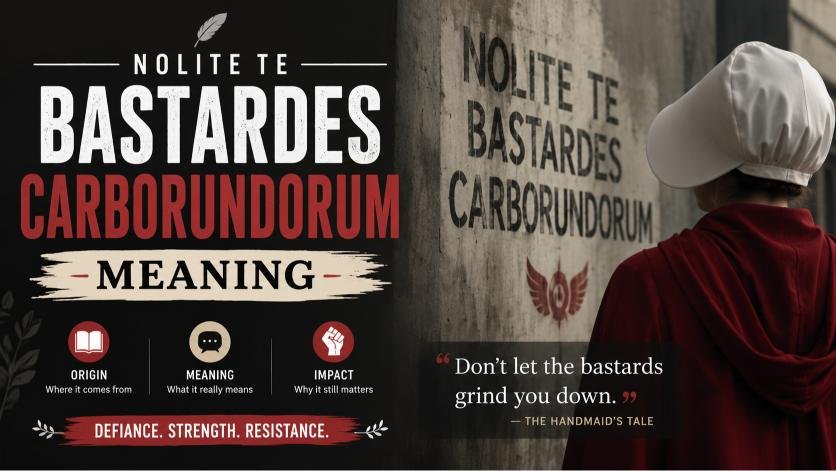
Have you ever come across the phrase “Nolite Te Bastardes Carborundorum” in a book, tattoo, social media post, or TV show and wondered what it actually means? At first glance, it looks like an ancient Latin proverb packed with wisdom. Surprisingly, the story behind it is even more interesting.
The **nolite te bastardes carborundorum meaning is commonly understood as “Don’t let the bastards grind you down.” It’s a bold message about staying resilient when facing criticism, hardship, or unfair treatment. While the phrase isn’t genuine classical Latin, it has inspired millions through literature, pop culture, and motivational quotes.
Updated for 2026, this guide explains the phrase’s meaning, origin, pronunciation, modern usage, common misconceptions, and why it continues to resonate with readers around the world.
What Does “Nolite Te Bastardes Carborundorum” Mean?
Quick Answer
Nolite Te Bastardes Carborundorum is commonly interpreted as “Don’t let the bastards grind you down.” Although it isn’t authentic Latin, the phrase has become a universal reminder to remain strong, confident, and determined when dealing with difficult people or challenging circumstances.
In everyday English, the phrase encourages perseverance. Rather than giving up when faced with criticism, failure, or negativity, it reminds you to keep moving forward.
Whether you’re dealing with workplace pressure, online trolls, academic challenges, or personal setbacks, its message remains timeless:
Don’t let negativity define you.
Simple Definition
The nolite te bastardes carborundorum meaning can be summed up in one sentence:
Refuse to let negative people destroy your confidence or determination.
It’s less about revenge and more about resilience.
Word-by-Word Breakdown
Although the expression isn’t proper Latin, its parts loosely resemble Latin words.
| Word | Approximate Meaning |
|---|---|
| Nolite | Do not (plural command) |
| Te | You |
| Bastardes | Bastards (not classical Latin) |
| Carborundorum | A playful invented word inspired by “Carborundum,” an abrasive material |
Together, they humorously imitate a Latin sentence while conveying a memorable message.
Origin of the Phrase
One of the biggest misconceptions is that this saying dates back to ancient Rome.
It doesn’t.
Instead, Nolite Te Bastardes Carborundorum belongs to a tradition known as dog Latin or mock Latin—phrases that imitate Latin for humorous or memorable effect.
The expression likely originated in the early 20th century, appearing in military circles and schools as a tongue-in-cheek motivational motto. Over time, it spread into popular culture and became widely recognised.
Its greatest surge in popularity came after Margaret Atwood’s novel The Handmaid’s Tale (1985), where the phrase appears as a hidden message offering hope and resistance to the story’s protagonist.
Since then, it has become synonymous with courage, perseverance, and quiet rebellion.
Is It Real Latin?
No.
Linguists generally classify it as pseudo-Latin or mock Latin, meaning it deliberately resembles Latin without following classical grammar perfectly.
Some words are genuine Latin.
Others are invented or adapted for humorous effect.
That’s part of its charm.
The phrase sounds scholarly while delivering a simple, unforgettable message.
How the Meaning Has Evolved
Originally, the phrase functioned as a humorous saying shared among students and soldiers.
Today, its meaning has broadened significantly.
People now use it to represent:
- Personal resilience
- Mental strength
- Standing up to bullies
- Overcoming adversity
- Recovering from failure
- Surviving toxic environments
- Female empowerment
- Emotional perseverance
Its association with The Handmaid’s Tale has also linked it closely with themes of resistance against oppression and maintaining hope in difficult circumstances.
Pronunciation Guide
One common English pronunciation is:
noh-LEE-teh tay bas-TAR-days kar-bor-un-DOR-um
Pronunciation can vary depending on whether someone follows English pronunciation rules or attempts a more Latin-inspired style.
Fortunately, because the phrase is mock Latin, there isn’t a single universally accepted pronunciation.
Why People Love This Phrase
Unlike many motivational quotes, Nolite Te Bastardes Carborundorum combines humour with encouragement.
People appreciate it because it:
- Sounds timeless and sophisticated
- Delivers a memorable message
- Encourages resilience
- Works well as a tattoo or artwork
- Has literary significance
- Sparks curiosity whenever someone encounters it
It’s a rare example of a phrase that is simultaneously witty, inspirational, and culturally iconic.
How to Use “Nolite Te Bastardes Carborundorum” Correctly
Understanding the nolite te bastardes carborundorum meaning is one thing—knowing when to use it is another.
Although the phrase resembles an ancient Latin proverb, modern speakers use it as a motivational expression rather than a formal quotation. It’s most appropriate when encouraging someone to stay resilient in the face of criticism, setbacks, or toxic behaviour.
Think of it as a more memorable way of saying:
- “Stay strong.”
- “Don’t give up.”
- “Keep your head up.”
- “Don’t let negative people get to you.”
When to Use the Phrase
Use Nolite Te Bastardes Carborundorum when someone needs encouragement or a reminder to stay mentally strong.
It fits situations such as:
- Recovering from failure
- Handling workplace stress
- Dealing with online hate
- Overcoming personal setbacks
- Supporting a friend after a difficult experience
- Motivating yourself during challenging times
Example
“You’ve made it through harder things before. Nolite Te Bastardes Carborundorum.“
Here, the phrase reminds someone not to let difficult people or circumstances wear them down.
Tone and Emotional Meaning
The phrase carries several emotional tones depending on the situation.
| Tone | Appropriate? | Example |
|---|---|---|
| Encouraging | ✅ Yes | Supporting a friend |
| Inspirational | ✅ Yes | Graduation speech or caption |
| Defiant | ✅ Yes | Responding to criticism |
| Humorous | ✅ Yes | Playful use among friends |
| Sarcastic | ⚠️ Sometimes | Only if everyone understands the joke |
| Professional | ❌ Usually No | Better to use plain English |
Overall, the expression feels positive, resilient, and empowering.
Platform-Specific Usage
SMS
Because text messages are short, the phrase works well as a quick motivational sign-off.
Example
“Keep believing in yourself. Nolite Te Bastardes Carborundorum.”
Friends often use it alongside supportive messages.
Example
“Ignore the negativity—you’ve got this. Nolite Te Bastardes Carborundorum 💪”
The phrase frequently appears in:
- Motivational captions
- Graduation photos
- Tattoo pictures
- Fitness transformations
- Mental health awareness posts
Example Caption
“Still standing. Still fighting. Nolite Te Bastardes Carborundorum.”
X (Twitter)
Its short length makes it ideal for inspirational posts.
Example
“Some days are harder than others. Keep going. Nolite Te Bastardes Carborundorum.”
Discord
Gaming communities sometimes use it after repeated defeats.
Example
“We lost again, but Nolite Te Bastardes Carborundorum—we’ll get the next win.”
You’ll often find the phrase in discussions about:
- Literature
- Tattoos
- Motivational sayings
- Mental resilience
- The Handmaid’s Tale
- Latin phrases
Many Reddit users also point out that it’s intentionally mock Latin, which often sparks interesting discussions about its history.
When Not to Use It
Even though the phrase is popular, it isn’t suitable everywhere.
Avoid using it in:
- Academic papers about classical Latin
- Legal documents
- Business contracts
- Formal workplace reports
- Official government communications
- Professional client emails
Instead, choose clear alternatives such as:
- “Stay resilient.”
- “Keep going.”
- “Don’t let setbacks discourage you.”
- “Remain confident.”
Formatting Tips
The most common written version is:
Nolite Te Bastardes Carborundorum
You’ll occasionally see:
- Nolite Te Bastardes Carborundorum
- NOLITE TE BASTARDES CARBORUNDORUM
- “Nolite Te Bastardes Carborundorum”
For articles, books, and social media, title case is generally preferred.
Emoji Pairings
People often combine the phrase with emojis that reinforce perseverance.
Popular choices include:
- 💪 Strength
- 🔥 Determination
- ❤️ Support
- ✨ Hope
- 🌟 Success
- 🛡️ Protection
- ⚔️ Courage
- 📚 Literary reference
Example:
“Another obstacle overcome. Nolite Te Bastardes Carborundorum 💪✨”
Real Conversation Examples Using “Nolite Te Bastardes Carborundorum”
Example 1 — Between Friends
Emma: I didn’t get the internship.
Liam: That’s disappointing, but don’t stop applying.
Liam: Nolite Te Bastardes Carborundorum.
What it conveys: Liam reminds Emma not to let one rejection affect her confidence or future goals.
Example 2 — Dating
Sophia: That breakup completely destroyed my confidence.
Ava: One person’s opinion doesn’t define your worth.
Ava: Nolite Te Bastardes Carborundorum.
What it conveys: Emotional support and encouragement to move forward with confidence.
Example 3 — Family Conversation
Dad: University can be stressful.
Son: I feel like giving up.
Dad: You’ve overcome bigger challenges before. Nolite Te Bastardes Carborundorum.
What it conveys: A reassuring reminder that perseverance often leads to success.
Example 4 — Workplace Chat
Sarah: The client rejected our proposal.
David: We’ll improve it and try again.
David: Nolite Te Bastardes Carborundorum.
What it conveys: Team encouragement after a professional setback.
Example 5 — Gaming Discord
We lost six games in a row.
It’s all practice.
Nolite Te Bastardes Carborundorum—we’ll win the next match.
What it conveys: Maintaining morale and determination after repeated losses.
Common Mistakes & Misunderstandings
1. Thinking It’s Authentic Latin
This is the most common misunderstanding.
Although the phrase resembles classical Latin, scholars generally describe it as mock Latin or dog Latin because it intentionally mixes genuine Latin with invented or adapted words.
2. Assuming It Literally Means “Never Give Up”
That’s close—but incomplete.
The message is more specific.
Instead of simply encouraging persistence, it advises people not to allow cruel, difficult, or negative individuals to wear them down emotionally.
3. Believing It Originated in The Handmaid’s Tale
Many readers assume Margaret Atwood invented the phrase.
She didn’t.
The expression existed decades before the novel, although The Handmaid’s Tale made it internationally famous and gave it new symbolic meaning.
Generational Differences
Gen Z
- Shares it in TikTok edits
- Uses it in aesthetic posts
- Pairs it with motivational memes
Millennials
- Commonly recognise it from The Handmaid’s Tale
- Often use it in inspirational social media captions
Gen X and Baby Boomers
- Some know it from military humour or school mottos
- Others mistake it for authentic Latin
Cultural Differences
In English-speaking countries, the phrase is widely recognised because of literature, television, and internet culture.
In countries where Latin is taught more formally, teachers often explain that it’s intentionally incorrect while still appreciating its clever construction.
How to Explain It Simply
If someone asks what it means, you can say:
“It’s a famous mock-Latin phrase that means ‘Don’t let the bastards grind you down.’ In other words, don’t let difficult people destroy your confidence or determination.”
This explanation is clear, accurate, and easy for anyone to understand, even if they’ve never encountered the phrase before.
Related Slang, Quotes & Alternatives
While there isn’t another phrase with the exact same meaning as nolite te bastardes carborundorum, several expressions communicate a similar message of resilience, perseverance, and confidence.
| Phrase | Meaning | When to Use |
|---|---|---|
| Keep your chin up | Stay optimistic during difficult times | Everyday conversations |
| Stay strong | Remain emotionally resilient | Supporting friends and family |
| Never give up | Continue despite setbacks | Motivation and encouragement |
| This too shall pass | Difficult times are temporary | Comforting someone |
| When the going gets tough, the tough get going | Strong people keep moving forward | Inspirational speeches |
| Fortune favours the bold | Courage often leads to success | Taking risks or new opportunities |
| Carpe Diem | Seize the day | Personal growth and motivation |
| Per Aspera Ad Astra | Through hardships to the stars | Graduation, achievement, perseverance |
| Ad Astra Per Aspera | Success comes through struggle | Inspirational quotes and tattoos |
| No guts, no glory | Great rewards require courage | Sports, work, and personal challenges |
Similar Expressions
If Nolite Te Bastardes Carborundorum feels too obscure for your audience, these modern alternatives are easier to understand:
- Don’t let negativity win.
- Keep pushing forward.
- Rise above the hate.
- Stay resilient.
- Believe in yourself.
- Keep fighting.
- Hold your head high.
- You are stronger than you think.
Internal Link Opportunities
These anchor texts fit naturally into a language or meaning website:
- Learn more about Carpe Diem Meaning
- Read our guide on Per Aspera Ad Astra Meaning
- Discover the Chef’s Kiss Meaning
- Explore Sigma Meaning
- Understand Daebak Meaning
FAQs:
What does Nolite Te Bastardes Carborundorum literally mean?
Although it isn’t authentic Latin, the phrase is commonly interpreted as “Don’t let the bastards grind you down.” Rather than being a literal translation, it’s a humorous mock-Latin expression that encourages resilience and determination.
Is Nolite Te Bastardes Carborundorum real Latin?
No. Most linguists classify it as mock Latin or dog Latin. It imitates the appearance of Latin but doesn’t follow classical grammar perfectly, making it a playful rather than authentic Latin phrase.
Why is Nolite Te Bastardes Carborundorum famous?
The phrase became internationally recognised after appearing in Margaret Atwood’s The Handmaid’s Tale. In the novel, it symbolises hope, resistance, and perseverance during extremely difficult circumstances.
How do you pronounce Nolite Te Bastardes Carborundorum?
A common English pronunciation is:
noh-LEE-teh tay bas-TAR-days kar-bor-un-DOR-um
Different pronunciations exist because the phrase isn’t genuine classical Latin.
Can I use Nolite Te Bastardes Carborundorum in everyday conversation?
Yes. People commonly use it in conversations, text messages, social media captions, and motivational posts. However, it isn’t suitable for formal writing, legal documents, or academic discussions about Latin.
Is Nolite Te Bastardes Carborundorum appropriate for tattoos?
Absolutely. It has become one of the most popular literary-inspired tattoo phrases because it represents resilience, courage, and refusing to let adversity define you. Many fans of The Handmaid’s Tale also choose it for its symbolic meaning.
Who first created the phrase?
The exact origin isn’t certain, but versions of the phrase appeared decades before The Handmaid’s Tale. Margaret Atwood popularised it rather than inventing it, giving it new cultural significance through her novel.
Conclusion:
The **nolite te bastardes carborundorum meaning goes far beyond its unusual appearance. Even though it isn’t authentic Latin, its message has inspired generations of readers, students, professionals, and anyone facing difficult circumstances.
Whether you discovered the phrase through The Handmaid’s Tale, a tattoo, a social media post, or simple curiosity, its core message remains timeless: don’t let negativity, criticism, or difficult people wear you down.
Now that you understand its meaning, origin, pronunciation, and modern usage, you’ll recognise why this mock-Latin expression continues to resonate around the world.
What’s your favourite motivational phrase? Drop it in the comments below, and explore more language guides to uncover the stories behind today’s most fascinating words and expressions.

I’m Lina Roys, a passionate writer behind Storevian, where I make words, phrases, slang, and everyday expressions easy to understand. I create clear, engaging, and reader-friendly content to help people find the meanings they’re looking for, quickly and confidently.


