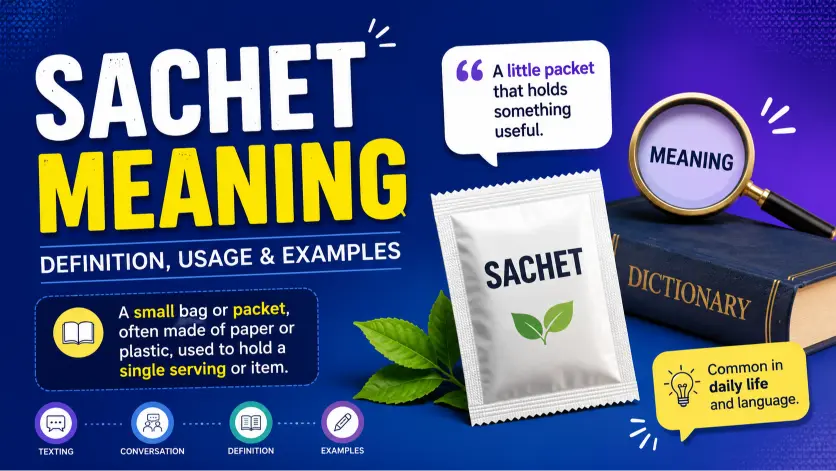
Have you ever opened a tiny shampoo packet at a hotel, squeezed ketchup from a small pouch, or added a little packet of seasoning to your food? That small package has a name — sachet.
The sachet meaning is simple: it refers to a small sealed packet or pouch that holds a specific amount of a product. These tiny packages are everywhere, from beauty products and food items to medicines and fragrances.
But why do companies use sachets so often? And why does this little word appear on product labels around the world?
Understanding this term helps you read packaging information, improve your vocabulary, and communicate more clearly — especially if English is not your first language.
This complete guide explains what sachet means, where the word comes from, how to pronounce it, common examples, and how people use it in everyday life.
Updated for 2026: This guide includes modern examples from today’s packaging, shopping, and consumer trends.
What Does “Sachet” Mean?
Quick Answer
A sachet is a small sealed packet, pouch, or bag that contains a measured quantity of a product, usually intended for individual use. Common sachets contain liquids, powders, creams, spices, or fragrances.
The word sachet describes a compact package that protects and stores a small amount of something.
Unlike large containers, sachets are designed for convenience. They allow people to carry, buy, or try products without needing a full-size bottle or box.
Examples include:
- Shampoo sachets
- Tea bags
- Sugar packets
- Sauce packets
- Instant coffee pouches
- Face cream samples
- Laundry detergent capsules
A sachet can contain almost anything that needs controlled portions and easy storage.
Origin and History of the Word Sachet
The word sachet comes from the French word sac, meaning “bag” or “small pouch.”
Originally, a sachet was not mainly associated with commercial packaging. In French culture, a sachet often referred to a small cloth bag filled with scented materials such as dried flowers, herbs, or perfume ingredients.
People placed these scented sachets inside:
- Clothing drawers
- Wardrobes
- Suitcases
- Rooms
The purpose was to create a pleasant fragrance.
Over time, the meaning expanded. Today, sachet commonly refers to small sealed commercial packages used by brands worldwide.
How the Meaning Has Changed Over Time
The modern meaning of sachet has moved from a decorative fragrance pouch to a practical packaging solution.
Traditional meaning:
A small scented bag containing herbs, flowers, or perfume.
Modern meaning:
A sealed disposable packet containing a portion of a product.
Today, when most people hear “sachet,” they think of items like:
- Shampoo packets in hotels
- Small sauce packages
- Medicine packets
- Cosmetic samples
The idea remains the same: a small container holding something useful.
Sachet Pronunciation
Many English learners wonder how to say sachet correctly.
The correct pronunciation is:
sachet = “sa-SHAY”
(phonetic: sə-SHAY)
The ending sounds like “shay,” not “chet.”
Example:
✅ “I bought a sachet of coffee.”
Pronounced: “I bought a sa-SHAY of coffee.”
How to Use “Sachet” Correctly in Everyday Language
The word sachet is mainly used when talking about packaging, products, shopping, and manufacturing.
It is a noun, meaning it names a thing.
Correct examples:
- “This shampoo comes in a small sachet.”
- “Add one sachet of seasoning to the soup.”
- “The hotel provides coffee sachets in every room.”
- “The product is available in both bottles and sachets.”
Incorrect usage:
❌ “I sachet my shampoo every morning.”
(Here, sachet is not a verb.)
A better sentence would be:
✅ “I use a shampoo sachet every morning.”
Where You Commonly See Sachets
Sachets appear in many industries because they are affordable, lightweight, and convenient.
1. Beauty and Personal Care
This is one of the most common uses.
Examples:
- Shampoo sachets
- Conditioner packets
- Face wash samples
- Moisturizer samples
- Hair oil packets
Many companies use sachets to let customers test products before buying larger sizes.
2. Food and Beverages
Food brands often use sachets for portion control.
Examples:
- Ketchup sachets
- Mayonnaise packets
- Sugar sachets
- Salt packets
- Coffee sachets
- Spice mixes
Restaurants and travel companies use them because they are easy to distribute.
3. Medicine and Healthcare
Some medicines and supplements come in sachet packaging.
Examples:
- Powdered medicine packets
- Electrolyte sachets
- Vitamin supplements
This format helps keep the product sealed and measured.
How to Use “Sachet” Correctly in Texts, Writing & Conversation
Unlike internet slang or chat abbreviations, sachet is a standard English noun used in everyday conversations, product descriptions, shopping, and professional writing.
You will usually see it when someone is describing a small amount of a product stored inside a sealed package.
The word sounds slightly formal, but it is commonly understood worldwide.
Examples of Correct Usage
Example 1:
“The hotel provides shampoo sachets for guests.”
Meaning:
The hotel gives guests small packets of shampoo instead of full bottles.
Example 2:
“Add one sachet of coffee powder to hot water.”
Meaning:
Use one small packet containing a measured amount of coffee.
Example 3:
“The company launched a new skincare product in sachet packaging.”
Meaning:
The product is available in small trial-size packets.
Sachet in Different Contexts
In Shopping
You may hear:
- “Buy three sachets of detergent.”
- “This cream comes in a 10 ml sachet.”
Here, sachet describes the product size and packaging style.
In Travel
Sachets are popular among travelers because they are:
- Lightweight
- Easy to pack
- Convenient for short trips
Examples:
- Toothpaste sachets
- Shampoo sachets
- Lotion samples
In Marketing
Brands often use sachets as a strategy to attract new customers.
A company may offer a small sachet because:
- Customers can test the product
- The price is lower
- Packaging is easier to distribute
A tiny packet can introduce someone to a full product line.
Real Conversation Examples Using “Sachet”
1. Between Friends
Friend A:
“I forgot my shampoo while traveling.”
Friend B:
“No problem. I have an extra shampoo sachet.”
Meaning:
The person has a small single-use shampoo packet available.
2. At a Restaurant
Customer:
“Can I get another ketchup sachet?”
Staff:
“Sure, here you go.”
Meaning:
The customer wants another small ketchup packet.
3. During Shopping
Buyer:
“Is this perfume expensive?”
Seller:
“You can try the sachet version first.”
Meaning:
The seller offers a small sample before buying the full product.
4. Family Conversation
Parent:
“Take some medicine sachets with you before leaving.”
Child:
“Okay, I’ll put them in my bag.”
Meaning:
Small sealed medicine packets are being packed for convenience.
5. Work or Business Chat
Team Member:
“We should sell the new lotion in sachet packaging.”
Manager:
“That could help customers try it easily.”
Meaning:
The team is discussing smaller product packages for marketing.
Common Mistakes & Misunderstandings About Sachet
Even though sachet is a simple word, people sometimes misunderstand its meaning.
Mistake 1: Thinking Sachet Means Any Bag
A sachet is not just any bag.
A normal bag may hold many things, but a sachet usually means:
- Small size
- Sealed packaging
- Specific portion of a product
For example:
✅ Shampoo sachet
❌ Large shopping bag
Mistake 2: Mispronouncing the Word
Many learners pronounce it as:
❌ “Sack-it”
❌ “Sa-chet”
The correct pronunciation is:
✅ sa-SHAY
The French influence changes the ending sound.
Mistake 3: Confusing Sachet With Packet
A sachet is similar to a packet, but there is a small difference.
A packet is a broad term for many types of containers.
A sachet usually refers to:
- Small packaging
- Individual portions
- Sealed pouches
So, every sachet can be called a packet, but not every packet is a sachet.
Sachet Across Different Platforms & Demographics
Unlike trending slang words, sachet is not mainly used on social media. It appears more often in product discussions, shopping conversations, and packaging industries.
However, different groups use the word differently.
Gen Z Usage
Younger users may use sachet when discussing:
- Affordable beauty products
- Travel hacks
- Budget shopping
- Product reviews
Example:
“Those skincare sachets are perfect for trying new brands.”
Millennials Usage
Millennials often encounter sachets through:
- Household shopping
- Personal care products
- Food packaging
Example:
“I bought coffee sachets for my office desk.”
Older Generations Usage
Older users may recognize sachets mainly from:
- Perfume bags
- Medicine packets
- Household products
The word may feel more traditional because of its French origin.
Is Sachet Formal or Informal?
Sachet is considered a standard English word.
You can safely use it in:
✅ Articles
✅ Product descriptions
✅ Business writing
✅ Academic writing
✅ Everyday conversation
It is not slang.
Example:
Professional:
“The product is available in recyclable sachet packaging.”
Casual:
“I grabbed a coffee sachet before work.”
Both are correct.
Related Terms, Synonyms & Alternatives
| Term | Meaning |
|---|---|
| Packet | A general small container or package |
| Pouch | A flexible container often made from plastic or fabric |
| Sample size | A small amount used for testing a product |
| Trial pack | A package designed for first-time users |
| Wrapper | Material covering a product |
| Container | Anything used to store something |
| Capsule | A small enclosed form, often for medicine |
| Portion pack | A measured amount prepared for one use |
| Mini pack | A smaller version of a product |
| Single-use packet | Packaging designed for one-time use |
FAQs:
What is the simple meaning of sachet?
A sachet is a small sealed packet containing a specific amount of a product. It is commonly used for shampoo, food sauces, spices, medicines, and cosmetic samples.
How do you pronounce sachet?
Sachet is pronounced “sa-SHAY.” The word comes from French, which is why the ending does not sound like typical English words ending in “-chet.”
What are common examples of sachets?
Common examples include shampoo sachets, ketchup packets, instant coffee packets, perfume samples, detergent sachets, and spice packets.
Why do companies use sachets?
Companies use sachets because they are affordable, lightweight, easy to transport, and allow customers to try products without purchasing full-size packages.
Is sachet the same as a small packet?
Yes, a sachet is a type of small packet. However, sachet usually refers to a sealed package containing a measured amount of a product intended for convenience or single use.
Conclusion:
The sachet meaning is simple: it is a small sealed packet or pouch designed to hold a specific amount of a product.
From shampoo samples to coffee packets, sachets have become a major part of everyday life because they are affordable, portable, and practical.
Understanding this word helps you read product labels, communicate clearly, and recognize one of the most common packaging terms used around the world.
Have you used a sachet today? Share your favorite everyday product term or packaging word in the comments!

I’m Lina Roys, a passionate writer behind Storevian, where I make words, phrases, slang, and everyday expressions easy to understand. I create clear, engaging, and reader-friendly content to help people find the meanings they’re looking for, quickly and confidently.


