
Imagine receiving a package marked “FRAGILE — HANDLE WITH CARE.” You immediately know that whatever is inside could break if someone handles it roughly. But what happens when the word moves beyond boxes and bubble wrap?
That is where the fragile meaning becomes more interesting.
We use fragile to describe far more than glass, porcelain, or delicate decorations. A person can feel fragile. A friendship can be fragile. Peace can be fragile. Even an economy, agreement, or plan can be described as fragile when it could easily be damaged or collapse.
If English is not your first language, this word can sometimes be confusing because its meaning changes slightly depending on context. It can suggest physical weakness, emotional vulnerability, instability, or something that requires careful handling.
In this guide, you’ll learn what fragile means, how to pronounce it, where it comes from, how to use it naturally, common synonyms, real-life examples, and the difference between fragile, delicate, brittle, and frail.
Updated for 2026: This guide explains the word in simple, everyday English so you can use it confidently.
What Does “Fragile” Mean?
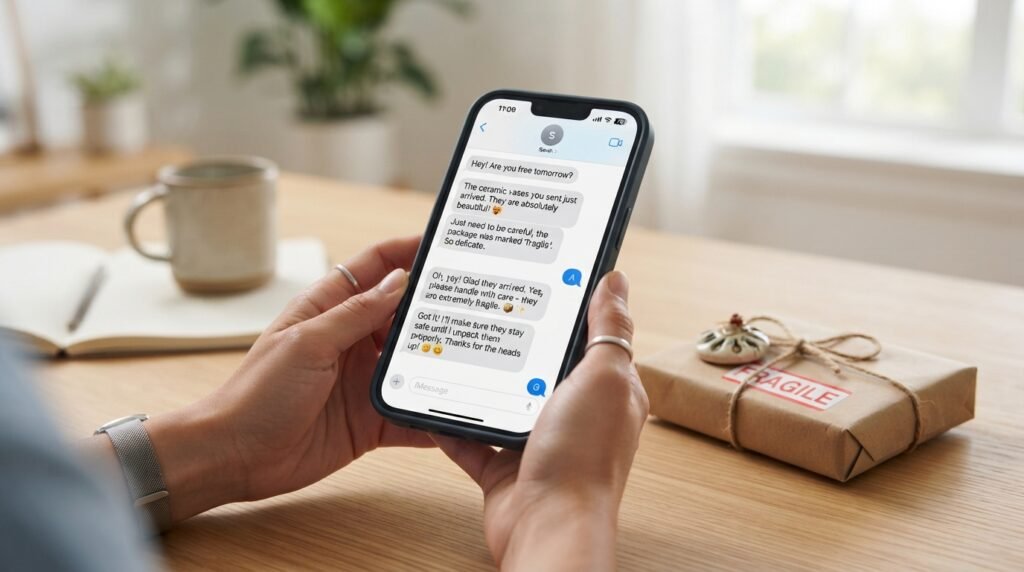
Simple Definition of Fragile
Fragile is an adjective that means easily broken, damaged, harmed, or weakened.
For example:
“Be careful with that glass. It’s fragile.”
Here, fragile means the glass can break easily.
But the word isn’t limited to physical objects. Cambridge Dictionary also defines fragile in broader contexts, including things that are easily harmed or destroyed and people who may be physically or emotionally weak.
Quick Answer
Fragile means easily broken, damaged, harmed, or weakened. It can describe physical objects, people, emotions, relationships, systems, or situations that need care or protection.
Fragile Pronunciation
The pronunciation differs slightly between British and American English.
- British: /ˈfrædʒ.aɪl/
- American: /ˈfrædʒ.əl/ or /ˈfrædʒ.əl/ depending on dictionary pronunciation
You may hear the British pronunciation sounding roughly like “FRAJ-yle”, while American English commonly sounds closer to “FRAJ-uhl.”
Is Fragile an Adjective?
Yes.
Examples:
- a fragile vase
- a fragile relationship
- a fragile person
- a fragile agreement
- a fragile economy
The related noun is fragility, meaning the quality or condition of being easily damaged, broken, or harmed.
Where Did the Word Fragile Come From?
Fragile entered English through French and ultimately traces back to the Latin fragilis, meaning something that can be broken or easily broken.
That history explains why the modern word still carries the basic idea of something that does not withstand force, pressure, or rough treatment very well.
Over time, English speakers expanded the word beyond physical objects. Today, we regularly describe abstract things such as trust, peace, confidence, political stability, and relationships as fragile.
How to Use “Fragile” Correctly in Texts & Chat
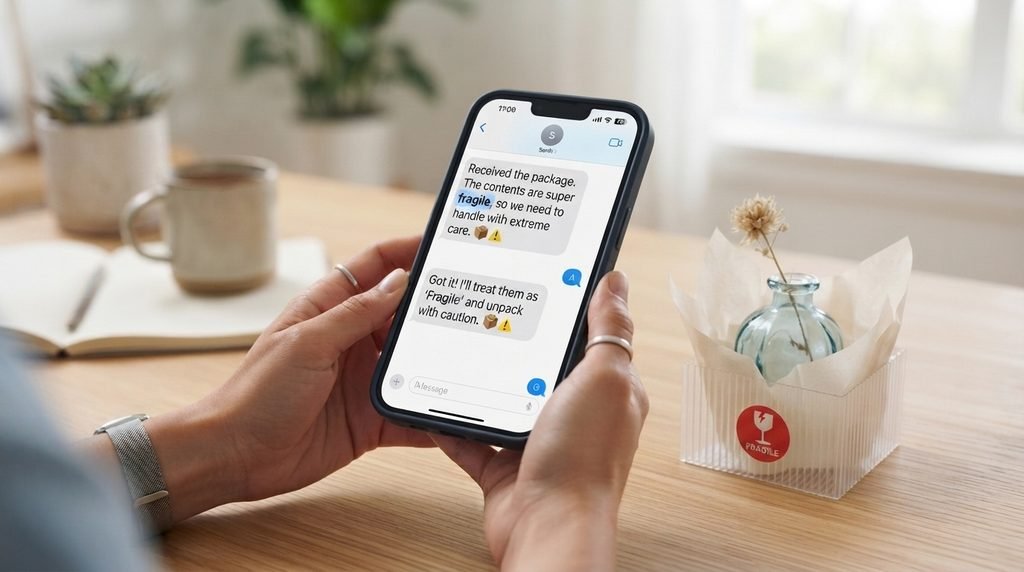
Unlike internet abbreviations or slang, fragile isn’t normally a texting abbreviation. It is a standard English adjective.
That means you can use it in everyday conversations, messages, emails, social media posts, school writing, and professional communication.
Casual Texting Examples
“This package is fragile, so don’t throw it 😭.”
Here, fragile describes an object that can easily break.
“My confidence is fragile today lol.”
Here, the word is being used emotionally and somewhat humorously.
“Their relationship seems fragile right now.”
In this sentence, fragile means the relationship could easily be damaged or end.
Professional Usage
Fragile is also perfectly acceptable in professional English.
Examples:
- “Please place the fragile equipment in a secure container.”
- “The company is recovering from a fragile financial position.”
- “The agreement remains fragile.”
- “The ecosystem is extremely fragile.”
In formal writing, however, make sure you use the word precisely. Calling something fragile suggests that it is vulnerable to damage, disruption, or failure.
When Should You NOT Use Fragile?
Don’t automatically use fragile whenever you mean “small,” “weak,” or “delicate.”
For example:
❌ “The small computer is fragile.”
This could be correct, but small and fragile describe completely different qualities.
Better:
✅ “The small computer is fragile and should be handled carefully.”
The key question is: Can the thing easily be damaged, broken, harmed, or destabilized?
If yes, fragile may be the right word.
Real Conversation Examples Using “Fragile”
1. Between Friends
Mia: “Can you carry this box upstairs?”
Alex: “Sure. What’s inside?”
Mia: “Some old plates. They’re fragile.”
Alex: “Got it. No throwing the box down the stairs.”
Here, fragile describes objects that can break easily. The emotional tone is practical and slightly humorous.
2. In a Family Conversation
Dad: “Why are you holding Grandma’s vase like that?”
Sam: “I’m being careful.”
Dad: “Good. It’s very fragile.”
In this example, fragile warns someone that the object needs careful handling.
3. In Dating or Relationships
Emma: “Are you two okay?”
Liam: “We’re talking again, but things are still fragile.”
Here, fragile does not mean the people can physically break. It means the relationship is unstable and easily damaged.
This is one of the most useful figurative meanings of the word.
4. In a Work Chat
Manager: “How is the new partnership going?”
Employee: “Positive so far, but I’d say it’s still fragile.”
The speaker means that the partnership exists but could easily be damaged by a mistake, disagreement, or unexpected problem.
5. In Gaming
Player 1: “Why didn’t you push the enemy team?”
Player 2: “Our defense was too fragile.”
Here, fragile means the defense was weak or easy to break through.
It is common to use ordinary English words like fragile, weak, solid, and unstable metaphorically when talking about games.
Common Mistakes & Misunderstandings
Mistake 1: Thinking Fragile Only Means “Breakable”
This is the most common misunderstanding.
Yes, fragile can describe something physically breakable, such as glass. But it can also describe abstract things.
Examples:
- fragile trust
- fragile peace
- fragile confidence
- fragile relationship
- fragile economy
In these examples, the thing isn’t literally made of glass. The word describes vulnerability.
Mistake 2: Using Fragile as a Direct Synonym for Weak
Fragile and weak overlap, but they aren’t always interchangeable.
Weak usually means lacking strength or power.
Fragile emphasizes that something is easily damaged, broken, or disrupted.
Compare:
“The bridge is weak.”
This suggests the bridge lacks structural strength.
“The bridge is fragile.”
This emphasizes vulnerability to damage or failure.
The distinction may seem small, but it can change the meaning of a sentence.
Mistake 3: Assuming Fragile Is Always an Insult
Not necessarily.
Calling an object fragile is simply descriptive.
Calling a person fragile can be more sensitive because it may suggest physical or emotional vulnerability. Context matters.
For example:
“She felt emotionally fragile after the stressful week.”
This is different from:
“She’s a fragile person.”
The first describes a temporary emotional state. The second can sound like a judgment about someone’s personality.
Generational and Cultural Differences

The basic meaning of fragile remains stable across English-speaking communities, so it isn’t a Gen Z-only term or a social-media abbreviation.
You might see younger users use it creatively online:
“My sleep schedule is fragile.”
“My motivation is fragile 😂.”
Older speakers may use it more traditionally:
“Please be careful. Those dishes are fragile.”
Both uses are correct.
The difference is mostly tone and context, not dictionary meaning.
“Fragile” Across Different Platforms & Demographics
TikTok
On TikTok and short-form social platforms, fragile may appear in captions or comments as part of emotional or humorous language.
Examples:
“My mental peace is fragile.”
“One minor inconvenience and I’m fragile 😭.”
These are informal, figurative uses.
Instagram captions may use fragile to create an emotional, poetic, or reflective tone.
Example:
“Some things are beautiful because they’re fragile.”
This gives the word a more artistic feeling.
Discord
Gaming communities may use fragile to describe weak defenses, unstable strategies, or easily defeated characters.
Example:
“Their whole strategy is fragile.”
On Reddit, the word can appear in discussions about relationships, politics, technology, economics, psychology, or everyday life.
Its meaning depends heavily on the surrounding sentence.
Workplace Communication
Fragile is safe for professional use when the context is appropriate.
For example:
“The equipment is fragile.”
“The negotiations remain fragile.”
However, describing a colleague as “fragile” can sound judgmental. In professional communication, choose words carefully when talking about people.
Is Fragile Formal or Informal?
Fragile is both formal and informal.
It is a standard English word, not slang.
| Context | Appropriate? |
|---|---|
| Text messages | ✅ Yes |
| ✅ Yes | |
| ✅ Yes | |
| TikTok | ✅ Yes |
| School assignments | ✅ Yes |
| Business emails | ✅ Yes |
| Academic writing | ✅ Yes |
| Professional conversation | ✅ Yes |
| Formal reports | ✅ Yes |
The important thing is not whether fragile is formal. It is whether the specific use fits the situation.
Fragile vs. Similar Words
Understanding synonyms is one of the easiest ways to master the fragile meaning.
| Word | Meaning | Best Used For |
| Fragile | Easily damaged or harmed | Objects, relationships, systems |
| Delicate | Easily damaged or requiring care | Objects, situations, processes |
| Brittle | Hard but likely to break or crack | Glass, bones, materials |
| Frail | Physically weak or delicate | People, health |
| Weak | Lacking strength or power | People, structures, arguments |
| Vulnerable | Open to harm or attack | People, systems, situations |
| Breakable | Able to be broken | Physical objects |
| Sensitive | Easily affected or upset | People, emotions, systems |
| Unstable | Likely to change, fail, or collapse | Situations, systems, relationships |
| Robust | Strong and able to withstand problems | Systems, plans, organizations |
Fragile vs. Delicate
These two words are especially close.
Fragile emphasizes vulnerability to damage.
Delicate can mean easily damaged, but it can also suggest beauty, softness, subtlety, or precision.
“The glass is fragile.”
“She wore a delicate necklace.”
Both words work, but they create slightly different impressions.
Antonyms of Fragile
The opposite of fragile depends on the context.
Common antonyms include:
- strong
- sturdy
- durable
- robust
- tough
- resilient
- stable
- resistant
- hard-wearing
Examples:
“This phone case is durable, not fragile.”
“The organization has become more resilient.”
“The new system is robust enough to handle heavy traffic.”
Notice that resilient is particularly useful when describing people or systems that can recover after difficulties.
Common Phrases With “Fragile”
You will often see fragile paired with certain nouns.
Fragile Relationship
A relationship that can easily be damaged by conflict, mistrust, or other problems.
Fragile Peace
A peaceful situation that could easily be disrupted.
Fragile Health
A condition in which someone’s physical health is vulnerable.
Fragile Economy
An economy that is vulnerable to shocks, instability, or other problems.
Fragile Ecosystem
An ecosystem that can be easily harmed by environmental changes or human activity.
Fragile Trust
Trust that has been damaged or is not yet strong.
Fragile Confidence
Confidence that can easily disappear after criticism, failure, or disappointment.
Fragile State
A situation or system that is unstable and vulnerable to serious disruption.
How to Use Fragile in a Sentence
Here are simple sentence patterns you can copy:
Pattern 1: Physical object
“The ______ is fragile, so handle it carefully.”
Example:
“The antique clock is fragile, so handle it carefully.”
Relationship
“Their relationship is still fragile.”
Situation
“The agreement remains fragile.”
Emotion
“I felt emotionally fragile after the stressful day.”
System
“The system is too fragile to handle a major disruption.”
These patterns make the word easy to use without sounding unnatural.
FAQs:
What does fragile mean in simple words?
Fragile means easy to break, damage, hurt, or weaken. It can describe physical objects such as glass, but it can also describe emotions, relationships, health, peace, or systems. For example, “This glass is fragile” means it can break easily, while “Their friendship is fragile” means the friendship could easily be damaged.
What is an example of something fragile?
A glass ornament is a classic example of something fragile because it can break if dropped. Other examples include porcelain, thin ice, delicate electronics, and some old documents. In a figurative sense, trust, confidence, peace, and relationships can also be fragile when they are easily damaged or disrupted.
What does fragile mean when describing a person?
When describing a person, fragile can mean physically weak or emotionally vulnerable. For example, “He seemed emotionally fragile after the difficult experience” suggests that he was sensitive or easily affected at that time. Because the word can sound personal or judgmental, it is better to use it carefully when talking about someone’s emotional state.
Is fragile the same as weak?
Not exactly. Weak generally means lacking physical strength, power, effectiveness, or resistance. Fragile specifically emphasizes being easily damaged, broken, harmed, or disrupted. A person can be weak without being fragile, while a strong-looking object or system can still be fragile if it fails easily under pressure.
Is fragile a positive or negative word?
Fragile is usually neutral when describing an object, such as fragile glass. When describing a person, relationship, or situation, it can have a slightly negative tone because it highlights vulnerability. However, context matters. In creative writing, something being fragile can also suggest beauty, delicacy, preciousness, or emotional depth.
What is the opposite of fragile?
Common opposites include strong, sturdy, durable, tough, robust, stable, and resilient. The best choice depends on the context. For example, durable works well for physical products, stable works for situations, and resilient works especially well for people, organizations, or systems that can recover after difficulties.
What is the noun form of fragile?
The noun form is fragility. It means the quality or condition of being easily damaged, broken, or harmed. For example, “The fragility of the old documents made them difficult to handle.” Cambridge Dictionary also uses fragility for physical, emotional, and broader forms of vulnerability.
How do you pronounce fragile?
In British English, fragile is commonly pronounced approximately FRAJ-yle (/ˈfrædʒ.aɪl/). In American English, it is commonly pronounced approximately FRAJ-uhl (/ˈfrædʒ.əl/). Both are standard pronunciations, so you may hear the word spoken differently depending on the speaker’s variety of English.
Conclusion:
The simplest fragile meaning is easily broken, damaged, harmed, or weakened. That can describe a physical object, but it can also describe a person’s emotions, a relationship, an agreement, an economy, or another vulnerable situation.
Remember the key idea: fragile = vulnerable to damage. Once you understand that idea, it becomes much easier to recognize the word in conversations, books, social media, news, schoolwork, and professional writing.
Whether you’re talking about a fragile glass, fragile trust, or a fragile peace, the word tells your reader that something needs care because it may not withstand much pressure.
Want to master more everyday English words? Explore our other meaning guides and build your vocabulary one useful word at a time.

I’m Lina Roys, a passionate writer behind Storevian, where I make words, phrases, slang, and everyday expressions easy to understand. I create clear, engaging, and reader-friendly content to help people find the meanings they’re looking for, quickly and confidently.


1 thought on “Fragile Meaning (Clear & Helpful Definition)”