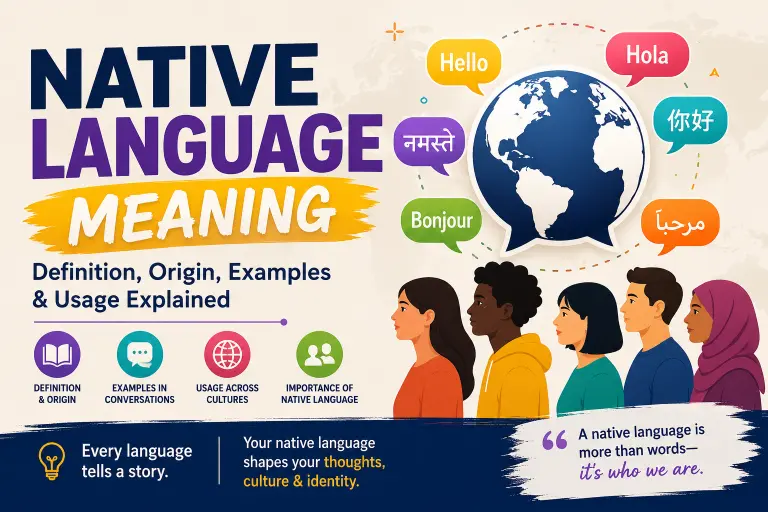
Have you ever filled out an online application and paused when it asked for your native language? Or maybe you’ve heard someone say, “English isn’t my native language,” and wondered exactly what that means.
The phrase native language meaning seems straightforward, but it’s often confused with terms like mother tongue, first language, primary language, and even official language. While they’re closely related, they aren’t always identical.
Understanding this term matters more than ever in today’s multilingual world. Whether you’re applying for a job, completing immigration paperwork, learning a new language, or simply satisfying your curiosity, knowing the correct definition helps you communicate more accurately.
In this updated 2026 guide, you’ll learn what a native language is, where the term comes from, how it’s used in everyday conversations, and how it differs from similar language-related terms. You’ll also see practical examples, common misconceptions, and answers to frequently asked questions.
What Does “Native Language” Mean?
Quick Answer
Native language is the language a person naturally learns during infancy or early childhood, usually from parents or family members. It forms the foundation of communication and is often the language someone understands most intuitively.
In simple words, your native language is the language you grow up hearing before formal education begins.
For example:
- A child born in Japan who grows up speaking Japanese at home usually has Japanese as their native language.
- Someone raised in Brazil typically has Portuguese as their native language.
- A child raised in a bilingual household may have two native languages.
Unlike languages learned later in school or adulthood, a native language develops naturally through everyday interaction.
Definition in Simple English
A native language is:
- the first language you learn
- the language spoken around you during childhood
- the language you naturally understand without formal study
Many dictionaries also define it as the language acquired from birth through regular communication with family and the surrounding community.
Origin of the Term
The adjective native comes from the Latin word nativus, meaning “born” or “innate.”
The phrase native language has been used in English for centuries to describe the language associated with a person’s birth and upbringing rather than one learned later through education.
Today, linguists often use related terms such as:
- First language (L1)
- Mother tongue
- Home language
- Heritage language (in some contexts)
Although these terms overlap, each has slightly different meanings depending on education, linguistics, and immigration settings.
Pronunciation
Native language
IPA: /ˈneɪ.tɪv ˈlæŋ.ɡwɪdʒ/
Easy pronunciation:
NAY-tiv LANG-gwij
How the Meaning Has Evolved
Historically, a native language referred almost exclusively to the language someone learned from birth.
Today, globalization has made the concept more flexible.
Many people:
- grow up speaking two languages equally
- move to another country at a young age
- become more fluent in a second language than their original one
Because of this, linguists sometimes distinguish between:
- native language
- dominant language
- preferred language
For example, someone born in Pakistan may grow up speaking Punjabi at home but use English every day at work. Punjabi remains their native language, while English may become their dominant professional language.
Native Language vs. Mother Tongue
Although they’re often used interchangeably, there are subtle differences.
| Term | Meaning |
|---|---|
| Native Language | First language naturally acquired during childhood |
| Mother Tongue | Traditional term for the first language learned from family |
| First Language (L1) | Academic term commonly used in linguistics |
| Primary Language | The language someone currently uses most often |
In everyday conversation, these terms usually refer to the same idea.
Examples of Native Languages
Here are a few examples:
| Country | Common Native Language |
|---|---|
| Japan | Japanese |
| France | French |
| Germany | German |
| Pakistan | Urdu, Punjabi, Sindhi, Pashto, Balochi (depending on family) |
| Mexico | Spanish |
| China | Mandarin (or another regional language) |
Remember, nationality does not always determine someone’s native language. Family background and early childhood exposure are what matter most.
How to Use “Native Language” Correctly
The phrase native language appears in everyday conversations, school forms, job applications, immigration documents, and language-learning platforms. Using it correctly helps avoid confusion, especially in multicultural or international settings.
Everyday Conversation
People commonly use the term when talking about the language they first learned as children.
Examples:
- “My native language is Spanish.”
- “She speaks three languages, but Arabic is her native language.”
- “English isn’t his native language.”
These sentences sound natural and are widely understood.
In Schools and Universities
Educational institutions often ask students about their native language to better support learning needs.
Example:
Native Language: Bengali
This information helps teachers provide appropriate language assistance when necessary.
On Job Applications
Employers may ask for your native language along with other languages you speak.
Example:
- Native Language: French
- Other Languages: English (Fluent), German (Intermediate)
This helps employers understand your communication skills without implying limitations.
Immigration and Government Forms
Many official documents ask applicants to list their native language for identification, translation, or accessibility purposes.
For example:
- Visa applications
- Census forms
- Passport documentation
- International scholarship applications
Always provide the language you first acquired naturally during childhood unless the form specifies otherwise.
Online Profiles
Professional networking sites and language-learning platforms may include a native language field.
Example:
Native Language: Korean
Learning: English and Japanese
This helps connect users with appropriate communities and language exchange partners.
Platform-Specific Usage
Although native language isn’t internet slang, people mention it frequently across digital platforms.
“Sorry for the typo. English isn’t my native language.”
This politely explains minor language mistakes.
Creators often write:
“My native language is Portuguese, so thanks for understanding.”
It builds authenticity and connects with international audiences.
People commonly ask:
“Is this sentence natural? English isn’t my native language.”
Language-learning communities regularly use this phrase when requesting feedback.
Discord
Gamers may say:
“My native language is Turkish, but I can communicate in English.”
This sets expectations for voice chats and teamwork.
X (formerly Twitter)
Users often include:
“English isn’t my native language.”
before sharing opinions or long threads, signaling that small grammatical errors may occur.
When NOT to Use “Native Language”
Avoid using the phrase to describe:
- A language you’re currently learning.
- A language you only studied in school.
- A language you speak fluently but learned later in life.
For example:
❌ “English is my native language because I learned it in college.”
✅ “English is my second language.”
Even if you’re highly fluent, a language learned later usually isn’t considered your native language.
Writing Tips
When writing the phrase:
- Use lowercase in regular sentences: native language
- Capitalize actual language names: English, Spanish, Arabic, Japanese
- No quotation marks are needed unless you’re referring to the phrase itself.
- Emojis are generally unnecessary because the term is formal rather than slang.
Examples:
✅ My native language is Hindi.
✅ She learned Italian after moving to Rome.
❌ My Native Language is hindi.
Real Conversation Examples Using “Native Language”
Seeing native language in context makes it much easier to understand. Below are realistic conversations from everyday life, each followed by a brief explanation of what the phrase conveys.
Between Friends
Emma: Your English is amazing! Is it your native language?
Lucas: Thanks! No, my native language is Portuguese. I started learning English in middle school.
Emma: I never would have guessed.
What it conveys:
Lucas is explaining that Portuguese is the first language he learned, while English is a language he acquired later.
In a Family Conversation
Mother: What’s your son’s native language?
Father: He actually has two native languages. We speak French at home, and his grandparents speak Arabic with him every day.
Mother: That’s wonderful. He’s growing up bilingual.
What it conveys:
Children exposed to two languages from birth can develop both as native languages.
At Work
Manager: Which languages are you comfortable using with international clients?
Employee: My native language is German, but I’m fluent in English and conversational in Spanish.
Manager: Great. That will be helpful for our European projects.
What it conveys:
The employee distinguishes between their native language and additional languages they have learned.
In an Online Language Forum
User A: Can someone check my grammar?
User B: Sure! Is English your native language?
User A: No, my native language is Korean, so I’m still learning.
User B: You’re doing really well.
What it conveys:
Mentioning a native language helps others provide more constructive and patient feedback.
During Travel
Tour Guide: Which language do you prefer for the tour?
Visitor: My native language is Italian, but English is perfectly fine.
Tour Guide: Excellent. We’ll continue in English.
What it conveys:
The traveler identifies their first language while choosing a language they are comfortable using.
In a Gaming Chat
: Sorry if my messages are slow.
English isn’t my native language.
You’re communicating just fine.
What it conveys:
This statement politely sets expectations and encourages understanding within the group.
During a Job Interview
Interviewer: What’s your native language?
Candidate: My native language is Urdu, but I’ve worked in English-speaking environments for over six years.
Interviewer: Excellent. That’s valuable experience.
What it conveys:
The candidate clearly separates their first language from their professional language skills.
Common Mistakes & Misunderstandings
Although the phrase is simple, many people misunderstand what native language actually means. Here are the most common mistakes.
1. Assuming Native Language Means National Language
This is probably the biggest misconception.
Many people believe everyone born in a country automatically shares the same native language.
That isn’t true.
For example:
- Switzerland has several official languages.
- India has hundreds of languages and dialects.
- Pakistan is home to Urdu, Punjabi, Sindhi, Pashto, Balochi, Saraiki, and many others.
A person’s native language depends on what they learned first at home—not their passport.
Correct thinking:
Your native language is determined by early childhood language exposure, not nationality.
2. Confusing Native Language with the Language You Speak Best
Sometimes a person becomes more fluent in a second language than in their native language.
For example:
A child born in China moves to Canada at age four.
They may grow up speaking English every day and eventually become more comfortable in English than Mandarin.
Even so, Mandarin may still be considered one of their native languages if it was acquired naturally during early childhood.
Language dominance and native language are not always the same thing.
3. Believing You Can Choose Any Fluent Language as Your Native Language
Fluency does not automatically make a language native.
For example:
❌ “English is my native language because I’m fluent.”
If English was learned later through school or work, it is more accurate to say:
- English is my second language.
- English is my strongest language.
- English is my dominant language.
Generational Differences
Different generations sometimes use language-related terms differently.
Baby Boomers
Often prefer the term mother tongue, which has been common for decades.
Generation X
Uses both mother tongue and native language, depending on context.
Millennials
Frequently use native language, especially in education, travel, and professional settings.
Generation Z
Often says:
- first language
- native language
- L1 (in academic discussions)
Among younger speakers, mother tongue is becoming less common in some regions because it may not fully represent multilingual families.
Cultural Differences
Different cultures interpret the phrase slightly differently.
North America
People generally refer to the language first learned at home.
Europe
Many multilingual countries recognize that someone may have more than one native language.
South Asia
It’s common for people to grow up hearing one language at home while studying in another.
For example:
- Home language: Punjabi
- School language: English
- National language: Urdu
All three serve different purposes.
What If Someone Doesn’t Understand?
If someone asks what you mean by “native language,” you can simply explain:
“It’s the first language I learned as a child.”
Or:
“It’s the language I grew up speaking at home.”
These explanations are simple, accurate, and easy for anyone to understand.
Native Language Across Different Platforms & Demographics
Unlike internet slang, native language is a formal linguistic term. However, it appears frequently across online communities where people discuss education, travel, work, and language learning.
Gen Z
Gen Z often uses the phrase when creating multilingual content.
Examples include:
- “English isn’t my native language.”
- “Sorry for any mistakes.”
- “My native language is Vietnamese.”
The phrase is usually followed by an apology for possible grammar errors, even when the writing is excellent.
Millennials
Millennials commonly use the term in:
- LinkedIn profiles
- online courses
- remote work
- international business
- professional networking
Example:
Native language: Spanish
Fluent in English and Portuguese.
Older Generations
Older adults may still prefer expressions like:
- mother tongue
- first language
- home language
The meaning remains largely the same.
On TikTok
Language-learning creators frequently mention their native language.
Typical captions include:
- “Guess my native language.”
- “Can you hear my accent?”
- “Learning my fifth language.”
These videos often encourage viewers to identify pronunciation patterns or accents.
On Instagram
Creators often write:
“English isn’t my native language, so thank you for your patience.”
This helps build trust with international followers and sets realistic expectations.
On Reddit
Language-related communities regularly feature questions such as:
- “Is this sentence natural for native speakers?”
- “English isn’t my native language.”
- “Can someone explain this expression?”
The phrase helps other users tailor their responses appropriately.
On Discord
International gaming communities use the phrase to facilitate communication.
Example:
“My native language is Polish, but I can join English voice chat.”
This helps teammates understand language preferences during gameplay.
Is It Formal or Informal?
One advantage of native language is that it works well in almost every context.
| Situation | Appropriate? |
|---|---|
| School | ✅ Yes |
| Job application | ✅ Yes |
| Visa or immigration forms | ✅ Yes |
| Academic writing | ✅ Yes |
| Social media | ✅ Yes |
| Casual conversation | ✅ Yes |
Unlike internet slang, the term is universally accepted and professional.
Has It Become More Popular?
Yes. Discussions about multilingualism, remote work, global education, and online language learning have made native language more common than ever.
People now interact across borders every day, making it increasingly useful to identify:
- native language
- second language
- fluent languages
- learning languages
As a result, the phrase appears regularly on educational websites, language-learning apps, professional networking platforms, and international communities.
Related Terms, Synonyms & Alternatives
If you’re learning about native language meaning, you’ll often encounter these closely related terms.
| Term | Meaning |
|---|---|
| Mother tongue | Traditional term for the first language learned from family. |
| First language (L1) | Academic term for the language acquired first in life. |
| Home language | The language primarily spoken within the household. |
| Primary language | The language a person uses most often in daily life. |
| Second language (L2) | A language learned after the native language. |
| Bilingual | A person who can communicate effectively in two languages. |
| Multilingual | Someone who speaks three or more languages. |
| Heritage language | A language connected to a person’s family or cultural background but not always their dominant language. |
| Official language | A language recognized by a country’s government for official purposes. |
| Foreign language | A language learned that is not native to the learner’s environment. |
Similar Expressions
You may also hear people say:
- First language
- Home language
- Birth language
- Family language
- Childhood language
These expressions can overlap with native language, but their meanings may vary slightly depending on the context.
Opposite or Related Concepts
While there is no exact antonym, these terms represent contrasting ideas:
- Second language
- Foreign language
- Learned language
- Additional language
- Non-native language
These expressions describe languages acquired after early childhood rather than those learned naturally from birth.
FAQs:
Is native language the same as mother tongue?
In most everyday situations, yes. Both native language and mother tongue refer to the first language a person learns naturally during childhood. However, in linguistics, researchers may use these terms slightly differently when discussing bilingualism, language dominance, or language acquisition. For most readers, they can be used interchangeably.
Can someone have two native languages?
Yes. A child raised in a bilingual or multilingual household can naturally acquire two—or even more—native languages at the same time. For example, a child who hears Spanish from one parent and English from the other from birth may grow up with both as native languages.
What is the difference between a native language and a second language?
A native language is acquired naturally during infancy or early childhood without formal instruction. A second language is learned later through school, work, travel, or self-study. Someone may become fluent in a second language, but it isn’t usually considered their native language unless it was learned naturally from a very young age.
Does your native language determine your nationality?
No. Your nationality and native language are separate concepts. People living in the same country may have different native languages depending on their family background and early childhood environment. For example, many countries have multiple languages spoken by different communities.
Why do job applications ask for your native language?
Employers often ask for your native language to understand your communication skills and language proficiency. This information may help with international collaboration, customer support, translation tasks, or multilingual roles. It does not automatically measure your overall ability to communicate in other languages.
Can your native language change over time?
Generally, no. Your native language is the language you acquired first in childhood. However, your dominant language—the language you use most often—can change over time if you move to another country or use another language daily for work or education.
Is English everyone’s native language if they speak it fluently?
No. Fluency and native language are not the same thing. Millions of people speak English at a near-native level after years of study, but their native language remains the language they first learned as children.
Conclusion:
Your native language meaning is simple at its core: it’s the first language you naturally acquire during childhood. Whether you call it your mother tongue, first language, or L1, it plays a significant role in shaping how you communicate, think, and connect with your culture.
In today’s multilingual world, many people speak several languages fluently. Even so, understanding the difference between a native language, a second language, and a dominant language helps avoid confusion in education, travel, work, and everyday conversations.
The next time you’re asked about your native language on a form or in a conversation, you’ll know exactly what it means and why it matters.
What’s your native language? Share your experience in the comments below, and explore more language guides to expand your vocabulary and communication skills.

I’m Lina Roys, a passionate writer behind Storevian, where I make words, phrases, slang, and everyday expressions easy to understand. I create clear, engaging, and reader-friendly content to help people find the meanings they’re looking for, quickly and confidently.


2 thoughts on “Native Language Meaning (Complete Guide With Easy Examples)”