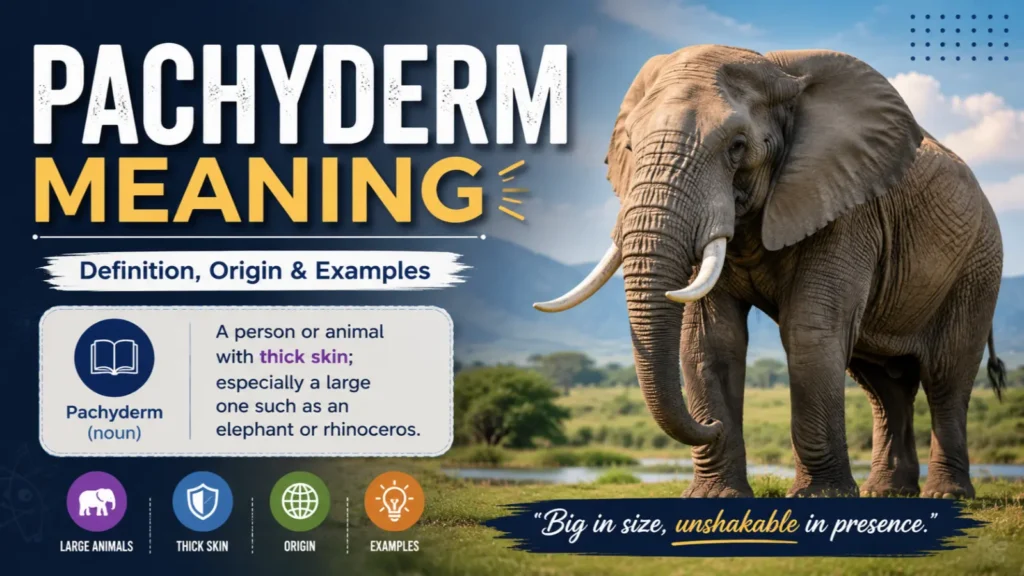
Have you ever heard someone describe an elephant as a pachyderm and wondered what that unusual word actually means? It sounds like a complicated scientific term, but the pachyderm meaning is surprisingly simple. The word refers to large, thick-skinned mammals, especially animals like elephants, rhinoceroses, and hippopotamuses.
The term “pachyderm” has an interesting history. It comes from ancient Greek words that describe one of the most noticeable features of these animals: their thick skin. While the word is still popular in books, documentaries, and everyday discussions about wildlife, modern scientists use more specific classifications when studying animals.
In this guide, Updated for 2026, you’ll learn everything about pachyderms, including the word’s origin, which animals are considered pachyderms, how to use the term correctly, and why this fascinating word is not as simple scientifically as it first appears.
Whether you’re a student, animal lover, or simply curious about unusual vocabulary, this complete explanation will make the meaning clear.
What Does “Pachyderm” Mean?
Quick Answer:
A pachyderm is a large mammal with thick skin, traditionally including elephants, rhinoceroses, and hippopotamuses. The word comes from Greek roots meaning “thick skin.” Today, pachyderm is mostly used as a descriptive term rather than an official scientific classification.
The simplest way to understand pachyderm meaning is to think of a large animal with tough, thick skin. The word is most commonly connected with famous giants of the animal world, such as elephants and rhinos.
However, there is a small twist: not every animal with thick skin is called a pachyderm. The term has a historical meaning rather than a strict modern scientific definition.
Breaking Down the Word Origin
The word pachyderm comes from two Greek roots:
- Pachys → meaning “thick”
- Derma → meaning “skin”
Together, these roots create the meaning:
“Thick-skinned animal.”
The term entered English through scientific and zoological writing when people grouped certain large mammals based on their visible physical features.
Before modern genetics and evolutionary science became common, scientists often classified animals by appearance. If an animal had a large body and thick skin, it was more likely to be placed in the pachyderm category.
How the Meaning Changed Over Time
The meaning of pachyderm has remained fairly consistent, but the way scientists view the term has changed.
In the past, animals were often grouped by physical traits:
- Thick skin
- Large size
- Heavy bodies
- Similar appearances
This made elephants, rhinos, and hippos seem like natural relatives.
Today, scientists classify animals based on:
- Evolutionary history
- Genetics
- Shared ancestry
Because of this, “pachyderm” is no longer considered a formal biological group. Instead, it remains a useful descriptive word for talking about certain large mammals.
Which Animals Are Considered Pachyderms?
Traditionally, three major types of animals are associated with pachyderms:
1. Elephants
Elephants are the most famous examples of pachyderms.
These enormous mammals are known for:
- Thick protective skin
- Long trunks
- Large ears
- Tusks
- Exceptional intelligence
An elephant’s skin can be several centimeters thick in some areas, helping protect it from environmental challenges.
Despite their tough appearance, elephants actually have sensitive skin. They often use mud baths and dust to protect themselves from insects and harsh sunlight.
Because elephants are so recognizable, many people immediately picture an elephant when they hear the word “pachyderm.”
2. Rhinoceroses
Rhinoceroses are another classic example of pachyderms.
They are famous for:
- Thick skin folds
- Powerful bodies
- Horns made of keratin
- Strong defensive abilities
Rhinos live mainly in Africa and Asia, and several species face threats due to habitat loss and illegal hunting.
Their thick skin helped inspire the traditional use of the word pachyderm, although modern science classifies rhinos through their evolutionary relationships.
3. Hippopotamuses
Hippopotamuses have also historically been grouped as pachyderms.
These large semi-aquatic mammals have:
- Thick skin
- Heavy bodies
- Large mouths
- Strong swimming abilities
Although hippos spend much of their time in water, they are not closely related to elephants or rhinos in the way older classifications suggested.
Still, their thick skin and impressive size made them part of the traditional pachyderm group.
How to Use “Pachyderm” Correctly in Writing & Conversation
The word pachyderm is not something people usually use in everyday casual conversations. You probably will not hear someone say, “I saw a pachyderm at the zoo,” instead of “I saw an elephant.”
However, it appears often in:
- Wildlife documentaries
- Educational articles
- Animal magazines
- Nature photography discussions
- Literature and creative writing
The word adds a more descriptive or scientific-sounding style.
Scientific Context
In scientific writing, “pachyderm” is mostly used when discussing historical terminology.
Modern zoologists usually avoid using it as a formal classification because animals are not grouped only by skin thickness.
For example:
- Elephants belong to the order Proboscidea
- Rhinos belong to the order Perissodactyla
- Hippos belong to the order Artiodactyla
These classifications are based on evolutionary relationships rather than appearance.
Everyday Conversation Usage
In normal conversation, pachyderm works best when talking about:
- Wildlife
- Conservation
- Animal documentaries
- Nature education
Example:
“The documentary showed a herd of pachyderms moving across the African plains.”
Here, “pachyderms” creates a dramatic wildlife-writing style.
Formal vs. Casual Usage
Good Places to Use “Pachyderm”:
✅ School projects
✅ Wildlife articles
✅ Educational content
✅ Nature storytelling
✅ Animal discussions
Places to Avoid It:
❌ Casual texting
❌ Professional emails unrelated to animals
❌ Scientific research papers without explanation
If you are writing a biology report, it is better to explain the term first rather than assume everyone knows it.
Real Conversation Examples Using “Pachyderm”
Example 1: Between Friends
Context: Visiting a zoo
Alex: “The elephant was the biggest animal I saw today.”
Sam: “That massive pachyderm was impressive!”
Meaning:
Sam is using “pachyderm” as a more descriptive way to refer to the elephant. It adds a nature-documentary feel to the conversation.
Example 2: Classroom Discussion
Context: Biology class
Student: “Are elephants considered pachyderms?”
Teacher: “Yes, traditionally elephants are called pachyderms because of their thick skin.”
Meaning:
The term is being used as an educational vocabulary word.
Example 3: Wildlife Group Chat
Context: Animal lovers discussing a documentary
Mia: “That documentary showed some incredible pachyderms in Kenya.”
John: “The rhinos were amazing!”
Meaning:
The word refers broadly to large thick-skinned mammals, especially elephants and rhinos.
Example 4: Nature Article Discussion
Context: Reading about conservation
Writer: “Protecting pachyderms is essential for maintaining healthy ecosystems.”
Meaning:
The writer is referring to large mammals such as elephants and rhinos that play important roles in nature.
Example 5: Creative Writing
Context: A wildlife story
“The ancient pachyderm slowly crossed the grassland as the sun disappeared behind the hills.”
Meaning:
The word creates a powerful, majestic image of a large animal.
Common Mistakes & Misunderstandings About Pachyderms
Even though the word seems simple, people often misunderstand what it actually means.
Mistake 1: Thinking Every Thick-Skinned Animal Is a Pachyderm
A common assumption is:
“If an animal has thick skin, it must be a pachyderm.”
That is not correct.
Many animals have thick skin for protection, but the term traditionally refers mainly to large mammals like:
- Elephants
- Rhinoceroses
- Hippopotamuses
The word is based on historical usage, not a complete biological rule.
Mistake 2: Believing Pachyderm Is an Official Scientific Group
Many people assume pachyderm is a scientific classification like:
- Mammalia
- Reptilia
- Carnivora
But it is not.
Modern scientists classify animals using evolutionary relationships, DNA studies, and shared ancestry.
“Pachyderm” is better understood as a descriptive vocabulary term.
Mistake 3: Assuming Pachyderms Are Only Elephants
Because elephants are the most famous examples, some people think pachyderm means “elephant.”
That is only partly true.
Elephants are pachyderms in traditional usage, but the term has also included rhinos and hippos.
Pachyderm Across Different Platforms & Demographics
Students and Learners
Students often encounter the word in:
- Biology textbooks
- Vocabulary lessons
- Animal research projects
For learners, the easiest memory trick is:
Pachy = thick + derm = skin
Wildlife Enthusiasts
Animal lovers often use the term when discussing:
- Conservation efforts
- Endangered species
- Wildlife documentaries
It creates a connection between several iconic large mammals.
Writers and Journalists
Authors use “pachyderm” because it sounds more vivid than simply saying “large animal.”
Compare:
Basic:
“The elephant walked through the forest.”
More descriptive:
“The massive pachyderm moved quietly through the forest.”
The second version creates a stronger image.
Gen Z and Online Usage
Unlike internet slang terms, pachyderm is not a trending social media abbreviation.
You are more likely to see it in:
- Educational posts
- Wildlife videos
- Nature communities
- Documentary captions
It is a traditional vocabulary word rather than a viral internet phrase.
Internal Linking Opportunities
Suggested anchor texts:
- Mammal meaning and classification guide
- Elephant facts and characteristics
- What does herbivore mean?
- Animal kingdom vocabulary explained
- Endangered species explained
FAQs:
What does pachyderm mean?
A pachyderm is a large mammal traditionally described as having thick skin. The word comes from Greek roots: pachys, meaning “thick,” and derma, meaning “skin.” It commonly refers to elephants, rhinoceroses, and hippopotamuses, although modern science does not use pachyderm as an official animal classification.
Why are elephants called pachyderms?
Elephants are called pachyderms because they have thick, tough skin that helps protect them from environmental conditions. The term has historically been used to describe elephants and other large thick-skinned mammals. Today, scientists classify elephants using their evolutionary group rather than the older pachyderm category.
Is a rhinoceros a pachyderm?
Yes, rhinoceroses are traditionally considered pachyderms. Their thick skin, large bodies, and powerful appearance match the original meaning of the word. However, modern zoology places rhinos in a specific evolutionary group rather than using the broad term pachyderm as a scientific category.
Are hippopotamuses considered pachyderms?
Yes, hippopotamuses have historically been included among pachyderms because they have thick skin and massive bodies. Although hippos share some physical traits with elephants and rhinos, modern research shows that they have their own unique evolutionary classification.
Is pachyderm still a scientific term?
Pachyderm is mostly a historical and descriptive term today. Scientists no longer use it as an official classification because modern biology focuses on genetics and evolutionary relationships. However, the word remains popular in educational writing, wildlife discussions, and everyday descriptions.
Conclusion:
The pachyderm meaning is much simpler than it first appears. A pachyderm is traditionally a large, thick-skinned mammal, especially an elephant, rhinoceros, or hippopotamus.
The word comes from Greek roots meaning “thick skin,” giving us a fascinating example of how ancient language continues to influence the way we describe animals today.
Although pachyderm is not a modern scientific classification, it remains a useful and memorable term. It helps people talk about some of the planet’s most impressive creatures in a simple and descriptive way.
Whether you discovered the word in a book, documentary, or classroom, knowing its meaning gives you a better appreciation for both language and the animal world.
Have another interesting animal word you want explained? Share it and explore more vocabulary guides to expand your knowledge.

I’m Lina Roys, a passionate writer behind Storevian, where I make words, phrases, slang, and everyday expressions easy to understand. I create clear, engaging, and reader-friendly content to help people find the meanings they’re looking for, quickly and confidently.


