Have you ever heard someone say, “I need an unbiased opinion”? Maybe a friend wanted honest advice, a company needed a fair review, or a journalist was expected to present facts without taking sides.
The word unbiased meaning is all about fairness, balance, and looking at situations without letting personal feelings control your judgment. In a world full of opinions, social media debates, and endless information, understanding what “unbiased” really means has become more important than ever.
An unbiased person does not automatically support one side. Instead, they examine facts, consider different viewpoints, and make decisions based on evidence rather than personal preferences.
This complete guide, updated for 2026, explains the meaning of unbiased, its origin, examples, common mistakes, and how people use it in everyday conversations, workplaces, media, and online discussions.
Whether you are a student, professional, or simply improving your English vocabulary, this guide will help you understand this powerful word clearly.
What Does “Unbiased” Mean?
The word unbiased describes someone or something that is fair, objective, and free from personal opinions, favoritism, or prejudice.
Simply put, being unbiased means looking at a situation with an open mind.
For example:
- A judge who listens to both sides before making a decision is unbiased.
- A product reviewer who shares both advantages and disadvantages gives an unbiased review.
- A teacher who grades students based on their work instead of personal feelings is unbiased.
Quick Answer Box
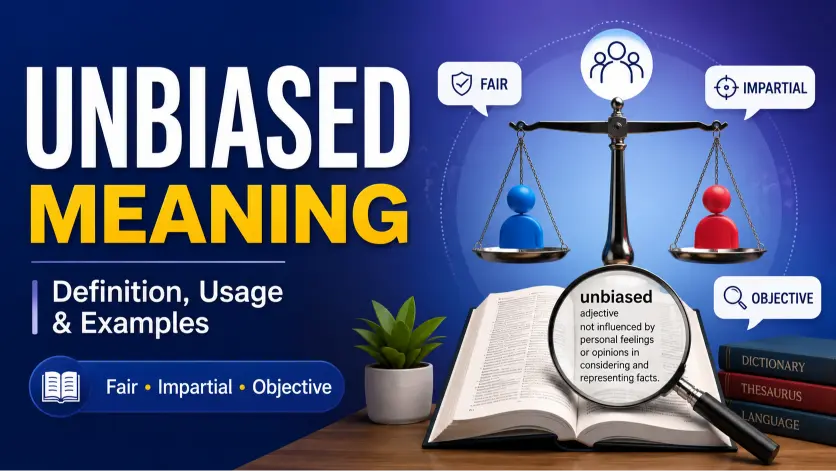
Unbiased meaning: Unbiased means fair and impartial. It describes a person, opinion, or action that is not influenced by personal feelings, favoritism, or prejudice and instead focuses on facts and balanced judgment.
Origin and Etymology of Unbiased
The word “unbiased” comes from combining:
- Un- → meaning “not” or “the opposite of”
- Bias → a preference or tendency that influences judgment unfairly
The word “bias” has roots in the French word biais, meaning a slant or an oblique direction. Over time, it developed into a meaning connected with a mental preference or unfair tendency.
Adding “un-” creates the opposite meaning:
Bias = unfair preference
Unbiased = no unfair preference
How the Meaning Has Evolved
Originally, “unbiased” was mainly used in formal discussions about judgment, law, and decision-making.
Today, the word appears everywhere:
- News reporting
- Online reviews
- Scientific research
- Workplace decisions
- Social media discussions
- Personal advice
With the rise of online opinions, people often look for unbiased information because they want facts rather than exaggerated claims.
Pronunciation Guide
Unbiased pronunciation:
/ʌnˈbaɪəst/
It sounds like:
un-BY-est
Example:
“Her unbiased review helped me choose the right product.”
How to Use “Unbiased” Correctly in Texts & Conversations
The word unbiased is commonly used when discussing fairness, opinions, decisions, or information.
It usually describes:
- People
- Reviews
- Reports
- Research
- Judgments
- Opinions
- Analysis
Correct Contexts for Using Unbiased
1. Giving Opinions
Example:
“Can you give me an unbiased opinion about my presentation?”
Meaning:
“I want your honest opinion without favoritism.”
2. Reviews and Recommendations
Example:
“I read an unbiased review before buying the laptop.”
Meaning:
“The review was balanced and included both positives and negatives.”
3. News and Information
Example:
“A good journalist should provide unbiased reporting.”
Meaning:
“The journalist should present facts without pushing a personal viewpoint.”
When NOT to Use Unbiased
Although “unbiased” works in many situations, avoid using it when:
❌ Someone clearly supports one side
Example:
“My favorite team’s fan gave an unbiased opinion about the match.”
This may be incorrect because a fan may naturally have a preference.
Better:
“My favorite team’s fan gave a passionate opinion.”
❌ You mean “uninterested”
Unbiased does not mean someone does not care.
Example:
“She was unbiased during the discussion.”
This means she was fair, not that she had no interest.
Platform-Specific Usage
SMS and Text Messages
In casual texting, people use “unbiased” when asking friends for honest feedback.
Example:
“Be unbiased. Does this outfit look good?”
WhatsApp Chats
Common uses include:
“Give me an unbiased answer.”
“I need an unbiased opinion.”
Instagram and Social Media
The word often appears in:
- Review captions
- Comparison posts
- Comment sections
Example:
“Unbiased review after using this product for 30 days.”
Reddit and Online Forums
Users often request unbiased answers during debates:
“Looking for unbiased opinions before buying this.”
Professional Communication
“Unbiased” is acceptable in workplaces, especially in:
- Research reports
- Employee evaluations
- Market analysis
- Hiring discussions
Example:
“The committee conducted an unbiased evaluation of all candidates.”
Real Conversation Examples Using “Unbiased”
Understanding the unbiased meaning becomes easier when you see how people actually use it in conversations. The word usually appears when someone wants fairness, honesty, or an opinion without personal influence.
Example 1: Between Friends
Context: Asking for honest advice
Alex: “I need your unbiased opinion. Does this haircut suit me?”
Sam: “Honestly, yes. It looks cleaner and matches your style better.”
Meaning:
Alex wants an honest opinion, not just a compliment. Sam is expected to judge fairly instead of being nice just because they are friends.
Example 2: In a Group Chat
Context: Comparing products
Mia: “Which phone should I buy?”
Jake: “I’ll give you an unbiased answer. Brand A has a better camera, but Brand B has better battery life.”
Meaning:
Jake compares both options instead of promoting his favorite brand.
Example 3: Workplace Conversation
Context: Employee evaluation
Manager: “We need an unbiased review of each employee’s performance.”
HR Member: “I’ll focus only on results, skills, and feedback.”
Meaning:
The review should depend on facts rather than personal relationships or preferences.
Example 4: Family Discussion
Context: Settling an argument
Parent: “Can you give an unbiased opinion about what happened?”
Child: “I’ll listen to both sides before deciding.”
Meaning:
The person is being asked to avoid taking sides immediately.
Example 5: Gaming Community
Context: Online discussion
Player 1: “Is this game actually good?”
Player 2: “Here’s my unbiased review. The graphics are amazing, but the story needs improvement.”
Meaning:
The player gives a balanced opinion by mentioning both strengths and weaknesses.
Common Mistakes & Misunderstandings About “Unbiased”
Even though unbiased meaning seems simple, many people misunderstand how the word works.
Mistake 1: Thinking Unbiased Means Having No Opinion
A common misunderstanding is believing an unbiased person cannot have an opinion.
That is not true.
An unbiased person can have an opinion, but their opinion is based on:
- Evidence
- Facts
- Fair comparison
- Logical reasoning
Example:
❌ “An unbiased person never chooses a side.”
✅ “An unbiased person chooses a side after considering all information.”
Mistake 2: Confusing Unbiased With Neutral
These words are related but not identical.
Neutral:
Someone does not support either side.
Unbiased:
Someone evaluates both sides fairly.
Example:
A referee is usually unbiased because they make fair decisions. They do not need to be emotionally neutral about the sport.
Mistake 3: Assuming Someone Is Unbiased Because They Say So
Simply claiming “I’m unbiased” does not automatically make someone fair.
People can have hidden preferences without realizing it.
A truly unbiased approach requires:
- Checking facts
- Considering multiple viewpoints
- Recognizing personal assumptions
Generational and Cultural Differences
The idea of being unbiased can be understood differently across generations.
Gen Z Perspective
Younger users often use “unbiased” online when asking for honest reviews.
Examples:
- “Unbiased TikTok review”
- “Unbiased ranking”
- “Unbiased opinion please”
For Gen Z, the word often means:
“Don’t exaggerate. Tell me the real truth.”
Millennials
Millennials commonly use “unbiased” in:
- Product research
- Career decisions
- Online reviews
- Financial discussions
Example:
“I need an unbiased comparison before buying a house.”
Older Generations
Older speakers may use the word more in formal situations:
- News reporting
- Politics
- Workplace decisions
- Academic discussions
Example:
“The committee must remain unbiased.”
“Unbiased” Across Different Platforms & Demographics
The use of unbiased changes depending on where people communicate.
TikTok
On TikTok, “unbiased” is often connected with reviews and rankings.
Examples:
- “Unbiased skincare review”
- “Unbiased restaurant rating”
- “Unbiased opinion on this trend”
Creators use it to show viewers that their content is not sponsored or influenced.
Instagram users commonly use the term in:
- Caption reviews
- Product comparisons
- Influencer content
Example:
“An unbiased review after one month of use.”
Discord
Gaming communities use “unbiased” when discussing:
- Game updates
- Character rankings
- Equipment choices
Example:
“My unbiased opinion: this character is overrated.”
Reddit users often request unbiased answers because communities can have strong opinions.
Example:
“Looking for unbiased advice before purchasing this product.”
Is Unbiased Formal or Informal?
The word works in both casual and professional communication.
Casual:
“Give me an unbiased opinion.”
Professional:
“The research team provided an unbiased analysis.”
It is considered a safe word for:
✅ Workplace communication
✅ Academic writing
✅ News discussions
✅ Everyday conversations
Related Words, Synonyms & Alternatives
Here are words connected to unbiased meaning:
| Word | Meaning |
|---|---|
| Objective | Based on facts rather than feelings |
| Fair | Treating people equally |
| Impartial | Not favoring one side |
| Neutral | Not supporting either side |
| Balanced | Including different viewpoints |
| Open-minded | Willing to consider new ideas |
| Rational | Based on logic and reason |
| Independent | Free from outside influence |
| Even-handed | Fair and equal in treatment |
| Non-partisan | Not supporting a political side |
Unbiased vs. Biased: Key Difference
| Unbiased | Biased |
|---|---|
| Looks at all sides | Favors one side |
| Uses evidence | Uses personal preference |
| Focuses on fairness | May involve prejudice |
| Open to different opinions | Resistant to opposing views |
Example:
Unbiased:
“The reviewer explained both the advantages and disadvantages.”
Biased:
“The reviewer only praised the product and ignored problems.”
FAQs:
What does unbiased mean in simple words?
Unbiased means being fair and making decisions without allowing personal feelings, preferences, or prejudices to influence your judgment. An unbiased person considers facts and different viewpoints before forming an opinion.
What is an example of an unbiased person?
An unbiased person could be a teacher who grades students based only on their work, not on personal relationships or preferences. They treat everyone using the same standards.
Is unbiased a positive word?
Yes, unbiased is usually a positive word because it suggests fairness, honesty, and logical thinking. People often value unbiased opinions because they believe they are more trustworthy and accurate.
What is the opposite of unbiased?
The opposite of unbiased is biased. A biased person allows personal feelings, preferences, or beliefs to influence their judgment, which can create unfair decisions.
Can a person be completely unbiased?
Complete unbiased thinking can be difficult because everyone has personal experiences and beliefs. However, people can become more unbiased by checking facts, listening to different views, and questioning their assumptions.
Conclusion:
The unbiased meaning is simple: being fair, objective, and free from unfair influence. Whether you are reviewing a product, giving advice, making decisions, or discussing an important topic, an unbiased approach helps create better results.
In today’s world of online opinions and endless information, knowing how to identify unbiased sources is a valuable skill. It helps you avoid misinformation and make smarter choices.
The next time someone asks for an unbiased opinion, remember — they are not asking you to have no opinion. They are asking you to be fair, honest, and thoughtful.
Have a favorite word or phrase you want explained next? Share it and explore more useful language guides!

I’m Lina Roys, a passionate writer behind Storevian, where I make words, phrases, slang, and everyday expressions easy to understand. I create clear, engaging, and reader-friendly content to help people find the meanings they’re looking for, quickly and confidently.


