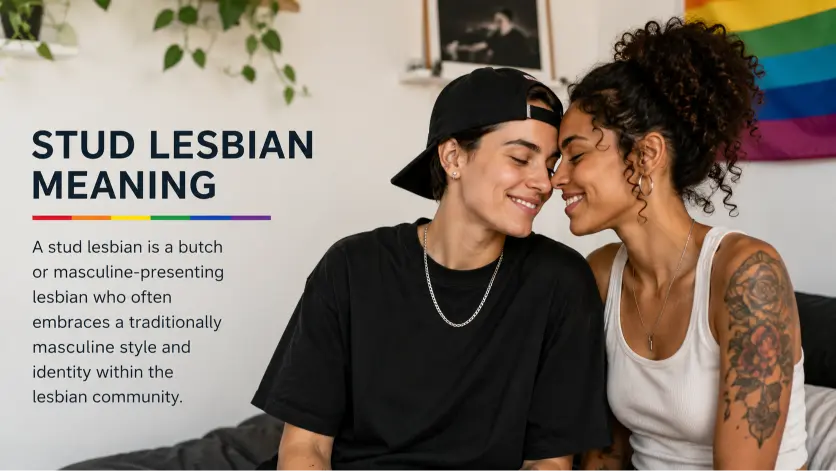
Have you ever come across the phrase “stud lesbian” on TikTok, Instagram, Reddit, or in a conversation and wondered what it actually means?
You’re not alone. As LGBTQ+ terminology becomes more visible online, many identity labels are appearing in everyday conversations. While some are easy to understand, others carry important cultural and historical meanings that aren’t immediately obvious.
Understanding stud lesbian meaning isn’t just about learning another internet term. It’s about recognizing an identity that has deep roots within Black LGBTQ+ communities and using the language respectfully.
In this guide (updated for 2026), you’ll learn the exact definition, where the term came from, how it differs from similar identities like butch, when it’s appropriate to use it, and real-life examples that make the meaning easy to understand.
What Does “Stud Lesbian”?
Definition
A stud lesbian is a masculine-presenting lesbian, most commonly within Black lesbian communities. The term describes someone whose gender expression leans masculine while identifying as a lesbian.
Unlike many internet slang terms, stud isn’t simply a nickname or fashion style. For many people, it represents an identity connected to community, culture, and lived experience.
Quick Answer:
A stud lesbian is a masculine-presenting lesbian whose identity is traditionally rooted in Black lesbian culture. While the term shares similarities with “butch,” it has its own cultural history and meaning.
Pronunciation
Stud
Pronounced:
/stʌd/
Sounds like:
“stud” (rhymes with mud).
Origin of the Term
The word stud has existed in English for centuries, originally referring to a male horse kept for breeding. Later, it became slang describing a confident or attractive man.
Within LGBTQ+ communities, however, the meaning evolved differently.
Beginning in the late 20th century, particularly in Black lesbian communities in the United States, stud developed into a respected identity describing masculine-presenting lesbians whose experiences weren’t always reflected by broader labels like butch.
Today, the identity continues to be recognized within LGBTQ+ communities while retaining its unique cultural significance.
How the Meaning Has Evolved
Years ago, the term was primarily known inside Black LGBTQ+ spaces.
Today, social media platforms—including TikTok, Instagram, YouTube, Reddit, and X—have introduced the word to much wider audiences.
While increased visibility has helped educate more people, it has also led to confusion. Some people mistakenly use stud as a synonym for every masculine lesbian, even though many community members distinguish it as a culturally specific identity rather than a universal label.
Understanding that distinction shows respect for the people who identify with it.
How to Use “Stud Lesbian” Correctly in Texts & Chat
Using identity terms correctly matters just as much as knowing what they mean.
Here are some practical guidelines.
Appropriate Contexts
You might see the term used when:
- Discussing LGBTQ+ identities
- Talking about gender expression
- Describing someone who personally identifies as a stud
- Educational conversations
- Community discussions
Example:
“She identifies as a stud lesbian and talks openly about her experiences.”
This usage is respectful because it reflects how the individual identifies.
Platform-Specific Usage
Text Messages
Usually appears during casual conversations about LGBTQ+ identities.
Example:
“I learned today that stud has a specific meaning in Black lesbian culture.”
Often appears in:
- identity discussions
- creator bios
- educational posts
- Pride Month content
TikTok
You’ll commonly find videos explaining:
- LGBTQ+ terminology
- masc fashion
- dating experiences
- identity discussions
- cultural education
Communities often discuss:
- identity labels
- cultural history
- respectful terminology
- differences between stud, butch, and masc
Discord
Usually appears in LGBTQ+ servers where members discuss identity, relationships, and community experiences.
When NOT to Use It
Avoid using stud:
- as a joke
- as a stereotype
- to label someone without knowing how they identify
- interchangeably with every masculine lesbian
Identity labels are personal. If someone doesn’t use the term for themselves, avoid assigning it to them.
Formal vs Casual Settings
| Situation | Appropriate? |
|---|---|
| LGBTQ+ education | ✅ Yes |
| Academic discussion | ✅ Yes |
| Casual conversation | ✅ Yes |
| Workplace presentation (if relevant) | ✅ Yes |
| Random nickname | ❌ No |
| Insult or stereotype | ❌ Never |
Formatting Tips
The word is normally written in lowercase:
stud
Capitalize only when it begins a sentence.
Unlike texting abbreviations, there are no special punctuation rules.
Emoji sometimes paired with discussions about LGBTQ+ identity include:
🏳️🌈 🖤 ✨ 💜
However, emojis are optional and depend on the tone of the conversation.
Real Conversation Examples Using “Stud Lesbian”
Understanding a definition is one thing. Seeing the term used in real conversations makes it much easier to recognize the meaning and context.
Note: These examples are fictional and intended for educational purposes.
Between Friends
Alex: “Is Maya butch?”
Jordan: “She actually identifies as a stud.”
Alex: “Oh, thanks! I didn’t know there was a difference.”
Meaning:
Jordan politely corrects the label and respects how Maya identifies.
In an LGBTQ+ Community Group
Taylor: “I’m looking for fashion inspiration.”
Chris: “There are lots of stud creators on TikTok who share outfit ideas.”
Taylor: “I’ll check them out!”
Meaning:
Here, “stud” refers to creators who openly identify with that identity rather than describing a clothing style alone.
During a Conversation About Identity
Sam: “I always thought ‘stud’ and ‘butch’ meant the same thing.”
Riley: “They’re similar, but ‘stud’ has roots in Black lesbian culture.”
Sam: “That makes a lot more sense now.”
Meaning:
This conversation highlights the cultural distinction many people don’t realize.
In a Group Chat
Jamie: “Someone called me a stud online.”
Morgan: “Do you identify that way?”
Jamie: “No, I don’t.”
Morgan: “Then they probably shouldn’t assume.”
Meaning:
Identity labels should never be assigned without someone’s consent.
Social Media Comments
Comment: “Love your style!”
Reply: “Thank you! As a proud stud, I appreciate that.”
Meaning:
The speaker is self-identifying, which is the appropriate use of the term.
Educational Discussion
Teacher: “Today’s lesson covers LGBTQ+ identity terms.”
Student: “What does ‘stud’ mean?”
Teacher: “It’s a masculine-presenting lesbian identity with cultural roots in Black lesbian communities.”
Meaning:
The term is used in an educational and respectful context.
Common Mistakes & Misunderstandings
Although the definition seems straightforward, stud lesbian meaning is often misunderstood online. Here are the most common mistakes.
1. Thinking Every Masculine Lesbian Is a Stud
This is probably the biggest misconception.
Not every masculine-presenting lesbian identifies as a stud. Some identify as:
- butch
- masc
- soft butch
- tomboy
- or simply lesbian without any additional label
Identity is personal, so avoid making assumptions based on appearance.
2. Assuming “Stud” Is Just Another Word for “Butch”
People often use these terms interchangeably.
While they share similarities, many LGBTQ+ community members explain that:
| Butch | Stud |
|---|---|
| Broad lesbian identity | Culturally rooted identity |
| Used across many communities | Traditionally associated with Black lesbians |
| Focuses on masculine expression | Includes cultural identity and community history |
Understanding this distinction helps avoid unintentionally erasing cultural context.
3. Using It as a Compliment Without Knowing the Meaning
Some people hear the word online and begin calling anyone with a masculine appearance a “stud.”
This isn’t always appropriate.
Because “stud” represents an identity—not just a fashion style—it should only describe someone who identifies that way.
Generational Differences
Different generations often understand the term differently.
Gen Z
Gen Z is generally the most familiar with LGBTQ+ terminology thanks to TikTok, Instagram, and online creators.
Many younger users understand the cultural context behind the word.
Millennials
Millennials may recognize the term from LGBTQ+ communities or media but might not know all of its historical background.
Older Generations
Many older adults have never encountered the identity label or may confuse it with the older slang meaning of “stud” describing an attractive man.
Educational conversations help bridge this knowledge gap.
Cultural Differences
Although the internet has spread LGBTQ+ terminology worldwide, stud remains most closely connected with Black lesbian communities in the United States.
Outside North America:
- Some English speakers understand the term.
- Others may never have heard it.
- Some cultures use entirely different identity labels.
Because of these differences, it’s helpful to explain the meaning rather than assuming everyone knows it.
How to Clarify the Meaning
If someone seems confused, a simple explanation works best.
For example:
“A stud is a masculine-presenting lesbian identity with cultural roots in Black lesbian communities. It’s similar to—but not exactly the same as—butch.”
Keeping the explanation respectful and concise encourages better understanding.
“Stud Lesbian” Across Different Platforms & Demographics
The internet has introduced many identity terms to new audiences, and stud is no exception. However, how the word is used varies across platforms.
TikTok
TikTok has become one of the biggest sources of LGBTQ+ education.
Videos often discuss:
- identity labels
- fashion
- dating experiences
- cultural history
- myths about LGBTQ+ terminology
Creators frequently explain why stud is more than just a clothing style or aesthetic.
On Instagram, the term often appears in:
- creator biographies
- Pride Month posts
- educational carousels
- fashion inspiration
- relationship content
Many creators openly self-identify as studs while sharing their experiences.
Reddit discussions tend to focus on deeper conversations, including:
- identity history
- respectful terminology
- differences between stud and butch
- community perspectives
Because these conversations are often nuanced, they’re useful for people wanting a broader understanding.
Discord
Within LGBTQ+-friendly Discord communities, members may use the term while discussing:
- identity
- dating
- gaming communities
- friendships
- support groups
The emphasis is usually on self-identification rather than labeling others.
Is It Safe for Work?
Generally:
Yes—when used in educational or respectful discussions.
For example:
- diversity training
- academic writing
- LGBTQ+ education
- news reporting
It is not appropriate if used to stereotype, mock, or make assumptions about someone’s identity.
Is It Formal or Informal?
| Setting | Appropriate? |
|---|---|
| Educational article | ✅ Yes |
| News article | ✅ Yes |
| LGBTQ+ workshop | ✅ Yes |
| Friendly conversation | ✅ Yes |
| Business email (unless relevant) | Usually No |
| Random workplace chat | Depends on context |
Like many identity terms, relevance matters more than formality.
How Different Age Groups Use the Term
Gen Z
- Most familiar with the label
- Often learns about it through social media
- More aware of respectful terminology
Millennials
- Familiar through LGBTQ+ communities and media
- Generally understands the distinction between stud and butch
Gen X and Baby Boomers
- Less likely to know the identity-specific meaning
- May associate “stud” with its older slang definition
- Often benefit from a brief explanation
Has the Term Become More Popular?
Yes. Increased LGBTQ+ visibility in media, online education, and social platforms has made the term more recognizable than it was a decade ago.
However, greater visibility also means more opportunities for misunderstanding. That’s why learning the cultural background—and using the term respectfully—is just as important as knowing the definition.
Related Slang, Abbreviations & Alternatives
If you’re learning about stud lesbian meaning, you’ll probably come across several other LGBTQ+ identity terms. While some are similar, each has its own meaning and context.
| Term | Meaning |
|---|---|
| Butch | A broad term for a masculine-presenting lesbian. Unlike stud, it is not tied to one specific cultural community. |
| Femme | A lesbian whose gender expression is traditionally feminine. |
| Masc | Short for “masculine.” A general descriptor for someone with a masculine style or expression, regardless of identity. |
| Soft Butch | Someone whose presentation is masculine but with a softer or more androgynous style. |
| Stem | A blend of stud and femme, often describing someone who mixes masculine and feminine expression. |
| Chapstick Lesbian | An informal term for a lesbian with a casual, moderately masculine style—not strongly butch or femme. |
| Androgynous | Having a mix of masculine and feminine characteristics or presentation. |
| Gender Nonconforming (GNC) | A person whose gender expression doesn’t fit traditional expectations. |
| Lesbian | A woman or woman-aligned person who is romantically and/or sexually attracted to women. |
| Queer | A broad umbrella term that many LGBTQ+ people use to describe their identity. |
Synonyms and Related Expressions
While there isn’t a perfect synonym for stud, these words are often mentioned in similar discussions:
- Masculine-presenting lesbian
- Masc lesbian
- Butch (not identical)
- Gender-nonconforming lesbian
Terms That Are Not Synonyms
These terms describe different identities and shouldn’t be used interchangeably:
- Femme
- Lipstick lesbian
- Nonbinary
- Trans man
FAQs:
What does stud lesbian mean?
A stud lesbian is a masculine-presenting lesbian whose identity is traditionally rooted in Black lesbian communities. The term represents more than appearance—it also reflects cultural identity and lived experience. Not every masculine lesbian identifies as a stud.
Is a stud the same as a butch?
No. Although both terms describe masculine-presenting lesbians, stud has specific cultural roots within Black LGBTQ+ communities. Butch is a broader identity used across many different communities. Because of this distinction, the two terms shouldn’t automatically be treated as interchangeable.
Can someone who isn’t Black identify as a stud?
This is a topic with differing viewpoints. Many members of the LGBTQ+ community consider stud to be a culturally specific identity rooted in Black lesbian history and believe it should be used with respect for that background. If you’re unsure, it’s best to avoid assigning the label to yourself or others without understanding its cultural context.
Is “stud lesbian” an offensive term?
No. It is generally not offensive when someone uses it to describe their own identity or when it’s used accurately and respectfully. Problems arise when the term is used as a stereotype, insult, or label for someone who doesn’t identify that way.
Why has the term become more common online?
Social media platforms like TikTok, Instagram, YouTube, Reddit, and Discord have made LGBTQ+ education more accessible. As creators share their experiences, identity terms such as stud have become more visible. This increased awareness has also led to more conversations about using the term respectfully and understanding its cultural origins.
Conclusion:
Language evolves, and so do the ways people describe themselves. Understanding stud lesbian meaning is about more than memorizing a definition—it’s about recognizing the history, culture, and identity behind the term.
While stud and butch may seem similar, they are not identical. Knowing the difference helps you communicate more accurately and respectfully, especially in conversations about LGBTQ+ identities.
Whether you discovered this term on social media, in a text conversation, or through a friend, you now have the context to understand and use it appropriately.
Have another slang word you’re curious about? Drop it in the comments or explore more internet slang guides to keep expanding your digital vocabulary.

I’m Lina Roys, a passionate writer behind Storevian, where I make words, phrases, slang, and everyday expressions easy to understand. I create clear, engaging, and reader-friendly content to help people find the meanings they’re looking for, quickly and confidently.


1 thought on “Stud Lesbian Meaning: Examples (2026 Guide)”