Have you ever come across the word “rake” while reading a classic novel, scrolling through social media, or chatting with someone online and wondered what it actually means?
You’re not alone. Although many people immediately think of the garden tool, the word has several fascinating meanings that depend entirely on the context.
The term rake meaning is especially popular among readers of historical romance, English literature, and anyone curious about unusual English vocabulary. In one sentence, it may describe a gardening tool, while in another it refers to a charming but rebellious man with a reputation for pursuing romance and pleasure.
Understanding these different meanings can help you avoid confusion and better understand books, movies, online discussions, and everyday conversations. After all, context is everything when it comes to English words with multiple definitions.
Updated for 2026, this guide explains every major meaning of rake, where the word came from, how people use it today, and when you should or shouldn’t use it yourself.
What Does “Rake” Mean?
Quick Answer:
Rake meaning most commonly refers to either a garden tool with long teeth or a charming but morally irresponsible man, especially in literature. The intended meaning depends entirely on the context.
Unlike many modern slang terms, rake has existed in English for hundreds of years. Because of its long history, it has developed several distinct meanings across literature, gardening, engineering, gambling, and everyday conversation.
1. Rake as a Person (Most Common Figurative Meaning)
In literature and historical writing, a rake is someone who:
- Lives for pleasure
- Flirts with many romantic partners
- Ignores social rules
- Spends money freely
- Often has charm and confidence
Think of the classic “bad boy” character in period dramas.
Example:
“Everyone warned her that he was a rake, but she fell in love anyway.”
Here, rake describes a charismatic but unreliable man—not a gardening tool.
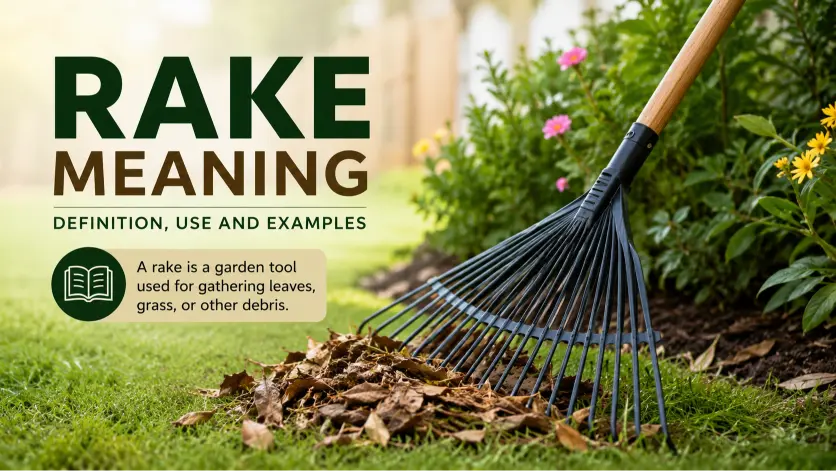
2. Rake as a Garden Tool
This is the meaning most English learners recognize first.
A rake is a tool with a long handle and a row of teeth used to:
- collect leaves
- level soil
- spread mulch
- clean lawns
- gather grass clippings
Example:
“Please put the rake back in the shed after cleaning the yard.”
3. Rake in Gambling
In poker and casinos, rake has a completely different meaning.
It refers to the small percentage or fee that a casino collects from each pot or tournament.
Example:
“The poker room charges a 5% rake.”
4. Rake in Engineering
Engineers use the word to describe an angle or slope.
Examples include:
- tool rake angle
- fork rake on bicycles
- steering geometry
- aircraft design
Here, the meaning has nothing to do with literature or gardening.
5. Rake in Ships and Vehicles
In transportation, rake can describe the angle or tilt of an object.
Examples include:
- the rake of a ship’s mast
- the rake of a windshield
- the rake of train coaches (especially in British English)
Where Did the Word “Rake” Come From?
The literary meaning comes from the older English expression “rakehell.”
A rakehell was someone who:
- wasted money
- ignored morality
- drank heavily
- gambled often
- chased romance
Over time, English speakers shortened rakehell to simply rake.
The character became especially popular during the Restoration period (late 1600s), when playwrights frequently featured witty, wealthy gentlemen who lived extravagant lifestyles.
Many classic novels later adopted this character type, making the literary rake famous around the world.
Pronunciation Guide
Rake
Pronounced: /reɪk/
It rhymes with:
- cake
- lake
- make
- take
How the Meaning Has Changed
Hundreds of years ago, calling someone a rake was a serious criticism.
It implied they were:
- morally irresponsible
- dishonest
- promiscuous
- selfish
Today, the word appears much less often in everyday conversation.
Instead, you’ll mostly find it in:
- historical romance novels
- literature classes
- classic films
- book reviews
- discussions about fictional characters
Modern readers sometimes even use rake positively to describe a confident, charming anti-hero.
How to Use “Rake” Correctly in Texts & Chat
Because rake has several meanings, choosing the right one depends on your audience and the situation.
Casual Conversations
When talking with friends, people may jokingly call someone a rake if they’re always flirting.
Example:
“Jake’s such a rake—he’s been on three dates this week.”
The tone is usually playful rather than insulting.
Online Discussions
You’ll often see rake in:
- BookTok reviews
- Reddit literature communities
- historical romance discussions
- Goodreads reviews
- fan fiction
Readers frequently describe fictional heroes as:
- “He’s the perfect rake.”
- “My favorite romance rake.”
- “A redeemed rake.”
In these communities, the word carries a very specific literary meaning.
SMS & WhatsApp
The word is uncommon in regular texting but may appear when discussing books or joking about someone’s dating habits.
Example:
Emma: Have you finished that romance novel?
Lily: Yes! The hero starts as a total rake.
Here, everyone understands that the conversation is about the character’s personality.
Instagram & TikTok
On social media, you’ll mostly encounter rake in captions like:
- “Enemies to lovers with a rake hero ❤️”
- “Another morally gray rake I can’t stop reading.”
- “Book boyfriend alert!”
The term is especially popular among romance readers.
Reddit & Discord
Gaming communities rarely use rake unless discussing poker games.
Book communities, however, use it frequently when reviewing romance novels or classic literature.
When NOT to Use “Rake”
Avoid using rake in:
- business emails
- job interviews
- academic writing (unless discussing literature)
- professional presentations
- formal workplace communication
Many people may misunderstand the word or assume you’re referring to the gardening tool.
Formatting Tips
There are no special formatting rules.
✅ Correct:
- rake
- a rake
- the rake
There’s usually no need for:
- ALL CAPS
- emojis
- hashtags
Unless you’re posting on social media, simple lowercase works perfectly.
Real Conversation Examples Using “Rake“
One of the easiest ways to understand **rake meaning is to see how the word is used in everyday conversations. Since “rake” has multiple meanings, the context tells you exactly which definition is intended.
Example 1: Between Friends (Dating)
Alex: Have you heard about Ethan’s latest date?
Mia: Another one? He’s becoming quite the rake.
Alex: He definitely has a reputation.
What it conveys:
Here, rake describes someone who constantly flirts or dates multiple people. The tone is playful but hints that the person enjoys romance more than commitment.
Example 2: Book Club Discussion
Emma: What do you think of the duke?
Sophia: He’s the classic rake, charming, wealthy, and impossible to trust.
Emma: That’s exactly why the story is so entertaining.
What it conveys:
In romance novels, a rake is a familiar character archetype. Readers expect him to be charismatic, rebellious, and eventually transformed by love.
Example 3: Family Conversation (Garden Tool)
Dad: Could you grab the rake from the garage?
Son: The metal one or the leaf rake?
Dad: The leaf rake, please.
What it conveys:
Here, rake refers to the gardening tool. This is probably the meaning most people learn first.
Example 4: Poker Night
Chris: How much rake does this poker room charge?
Daniel: Five percent of each pot.
Chris: That’s pretty reasonable.
What it conveys:
In poker, rake means the commission collected by the casino or poker room.
Example 5: Historical Romance Fans
Sarah: I love stories where the hero starts as a rake.
Olivia: Same! Watching him fall in love is the best part.
What it conveys:
Among romance readers, “rake” often has a positive, almost affectionate meaning despite the character’s flawed behavior.
Example 6: Workplace Misunderstanding
Employee: He’s a real rake.
Coworker: Wait… are you talking about gardening?
Employee: No, I meant he’s always flirting with everyone.
What it conveys:
This example shows why context matters. Without enough background, people may assume the gardening tool instead of the figurative meaning.
Common Mistakes & Misunderstandings
Because **rake meaning changes depending on the situation, it’s easy to misunderstand. Here are the mistakes people make most often.
1. Assuming It Always Means the Garden Tool
Many English learners immediately picture a leaf rake whenever they hear the word.
For example:
❌ “He’s a rake.”
Some readers may imagine a gardening tool rather than a description of someone’s personality.
Tip: Always look at the surrounding sentence before deciding what “rake” means.
2. Thinking It’s Modern Internet Slang
Although people occasionally use rake online, it isn’t a new Gen Z abbreviation like:
- FR
- IYKYK
- NPC
- W
- GOAT
Instead, rake is an old English word that became famous through literature long before social media existed.
3. Using It as a Compliment
Calling someone a rake doesn’t always sound flattering.
Historically, it suggested the person was:
- irresponsible
- morally questionable
- selfish
- obsessed with pleasure
Modern romance novels have softened the meaning, but outside literary discussions it can still sound negative.
Generational Differences
Gen Z
Younger users are most likely to encounter rake through:
- BookTok
- historical romance
- fantasy novels
- TikTok recommendations
Many associate it with fictional “bad boys” rather than real people.
Millennials
Millennials usually recognize the literary meaning from:
- classic novels
- period dramas
- Regency romance books
Some may also know the poker definition.
Older Generations
Older English speakers often think of:
- gardening
- farming
- classic literature
before considering modern romance discussions.
Cultural Differences
In the United States, the literary meaning isn’t used very often outside book communities.
In the United Kingdom, readers of classic English literature are generally more familiar with the historical definition.
Non-native English speakers often encounter the word while reading novels and are surprised to discover it has multiple meanings.
How to Clarify the Meaning
If someone looks confused, simply explain which definition you’re using.
For example:
“I mean a literary rake—the charming womanizer from old romance novels.”
or
“I’m talking about the gardening tool.”
A little clarification prevents misunderstandings.
Rake” Across Different Platforms & Demographics
Although rake isn’t among today’s most popular internet slang terms, it still appears regularly in certain online communities.
Here’s how different groups use it.
| Platform | Common Usage | Popularity |
|---|---|---|
| TikTok | Romance book discussions | ⭐⭐⭐⭐☆ |
| Book captions and quotes | ⭐⭐⭐⭐☆ | |
| Literature and romance communities | ⭐⭐⭐⭐⭐ | |
| Discord | Book clubs and niche servers | ⭐⭐⭐☆☆ |
| Rare outside book conversations | ⭐⭐☆☆☆ | |
| SMS | Mostly uncommon | ⭐☆☆☆☆ |
| X (Twitter) | Book reviews and literary discussions | ⭐⭐⭐☆☆ |
How Gen Z Uses “Rake”
Gen Z has largely rediscovered the word through online reading communities.
You’ll often see comments like:
- “He’s such a rake.”
- “I love redeemed rake heroes.”
- “Need more morally gray rakes.”
Here, rake refers almost exclusively to fictional male characters.
How Millennials Use It
Millennials often recognize the word from:
- Jane Austen adaptations
- Regency romance novels
- historical dramas
- classic literature
For many, the word carries nostalgic literary associations rather than everyday slang.
Older Generations
Older adults are more likely to interpret rake literally as the gardening tool unless the conversation clearly involves literature.
This difference sometimes leads to humorous misunderstandings between generations.
Is “Rake” Formal or Informal?
It depends on the context.
Informal
- chatting with friends
- discussing books
- social media
- book clubs
Formal
The literary definition may appear in:
- university essays
- literary criticism
- historical writing
However, describing a real coworker or professional contact as a rake is generally inappropriate.
Safe for Work?
Usually yes—when discussing literature.
However, using it to describe a colleague’s romantic behavior could be considered unprofessional or offensive.
Why Is “Rake” Trending Again?
The resurgence comes largely from:
- BookTok recommendations
- historical romance novels
- Regency-era TV adaptations
- romance book influencers
Related Slang, Abbreviations & Alternatives
If you’re researching **rake meaning, these related words may also interest you.
| Word | Meaning |
|---|---|
| Womanizer | A man who dates many women without commitment. |
| Playboy | Someone known for a luxurious, romantic lifestyle. |
| Casanova | A charming seducer; named after the famous historical figure. |
| Flirt | Someone who enjoys playful romantic attention. |
| Heartbreaker | A person who frequently leaves partners disappointed. |
| Rogue | A mischievous or dishonest but often likable person. |
| Scoundrel | Someone who behaves dishonorably. |
| Libertine | A person who rejects conventional moral standards. |
| Charmer | Someone naturally attractive and persuasive. |
| Bad Boy | A modern phrase for a rebellious, attractive man. |
FAQs:
What does rake meaning refer to?
The term rake has several meanings depending on the context. Most commonly, it refers to a man known for his charming but immoral or promiscuous behavior in literature. It can also mean a gardening tool, a casino fee in poker, or an angle or slope in engineering and transportation.
Is “rake” still used today?
Yes, although it’s not common in everyday speech. Today, you’ll mostly encounter rake in historical romance novels, classic literature, BookTok discussions, book reviews, and conversations about fictional characters. The gardening and poker meanings remain widely used.
Is “rake” considered an insult?
It depends on the context. Historically, calling someone a rake criticized their reckless lifestyle and lack of morals. Today, readers of romance novels often use the term affectionately to describe a charming “bad boy” character, while using it to describe a real person may still come across as insulting.
What’s the difference between a rake and a playboy?
Both words describe men with active romantic lives, but there’s a subtle distinction:
- A rake is a literary figure known for ignoring social and moral expectations while relying on wit and charm.
- A playboy usually emphasizes wealth, luxury, and a glamorous lifestyle.
In modern conversation, the two terms sometimes overlap, but rake carries stronger historical and literary associations.
Why do romance novels feature a “rake”?
The “rake falls in love” storyline has been popular for centuries because it creates compelling character development. Readers enjoy watching a confident, carefree hero gradually become loyal, vulnerable, and emotionally mature through love.
Can “rake” refer to a woman?
Traditionally, rake referred to a man. While modern writers may occasionally use it more broadly, it’s still overwhelmingly associated with male characters. Female characters with similar traits are more often described using different terms depending on the context.
What does “rake” mean in poker?
In poker, rake is the small percentage or fixed fee a casino or poker room takes from each pot or tournament as payment for hosting the game. This meaning is entirely unrelated to the literary or gardening definitions.
Conclusion:
English is full of words with multiple meanings, and rake is a perfect example. Whether you’re reading a historical romance, cleaning your backyard, playing poker, or studying engineering, the same word can mean something completely different.
The most well known literary rake meaning describes a charismatic but irresponsible man who pursues pleasure over duty.
Meanwhile, the everyday meaning of rake as a gardening tool remains the one most people recognize first. Understanding both definitions and the less common technical ones—helps you interpret conversations, books, and online discussions with confidence.
The next time you come across the word rake, don’t jump to conclusions. Pause for a second, look at the context, and you’ll quickly know which meaning fits.
What’s your favorite English word with multiple meanings? Drop it in the comments below and explore more language guides to expand your vocabulary!

I’m Lina Roys, a passionate writer behind Storevian, where I make words, phrases, slang, and everyday expressions easy to understand. I create clear, engaging, and reader-friendly content to help people find the meanings they’re looking for, quickly and confidently.


