Have you ever come across an old movie, history book, or online discussion where someone uses the word “coolie” and wondered what it actually means?
The coolie meaning is more complicated than a simple dictionary definition. While the word once referred to manual laborers, especially workers from Asia during the colonial period, it carries a heavy historical background connected to exploitation, migration, and social inequality.
Words change over time. Some become harmless everyday expressions, while others collect painful histories. “Coolie” belongs to the second category. Understanding its meaning requires looking beyond the basic definition and exploring where it came from and why many people avoid using it today.
In this updated 2026 guide, you’ll learn the origin of the term, how its meaning evolved, examples of its historical use, why it can be offensive, and what words you can use instead.
Whether you found this term online, heard it in a conversation, or encountered it while studying history, this guide will help you understand it clearly and respectfully.
What Does “Coolie” Mean?
Quick Answer: Coolie Meaning
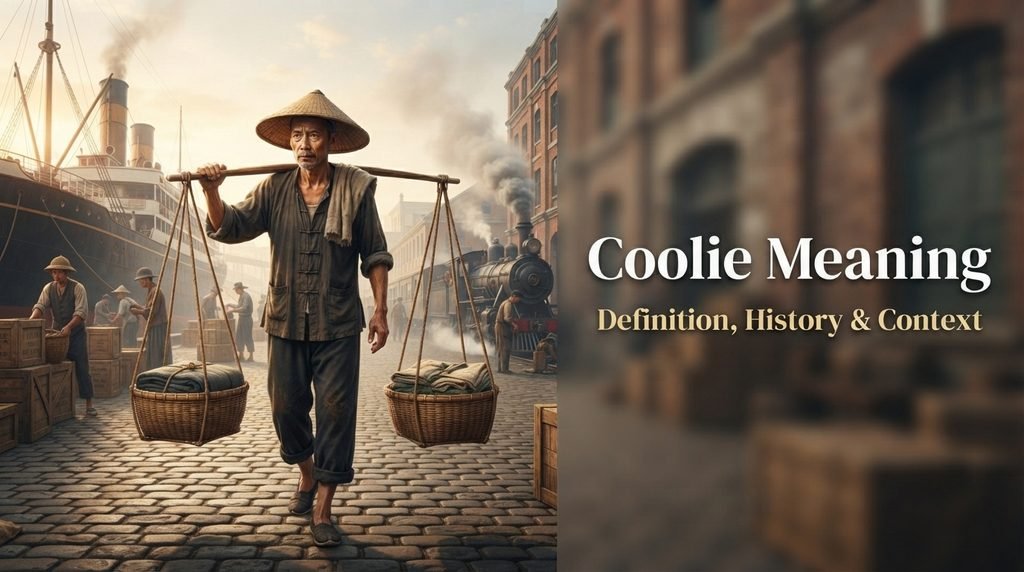
Coolie refers to a manual laborer, especially an Asian worker hired for physically demanding jobs during the 19th and early 20th centuries. The term became associated with colonial labor systems, poor working conditions, and exploitation, making it offensive in many modern contexts.
The word coolie originally described workers who performed hard physical labor for low wages. During the colonial era, European powers commonly used the term for laborers from regions such as India and China who were transported to work on plantations, railways, mines, and other large projects.
Although the word was sometimes used as a general label for workers, it gained negative associations because many of these laborers experienced unfair contracts, harsh treatment, and limited rights.
The Origin and History of the Word “Coolie”
The exact origin of “coolie” is debated among historians and linguists.
Some researchers connect it to Indian languages, suggesting links to words related to labor, wages, or occupational groups. Others believe it may have developed through colonial trade languages as Europeans interacted with Asian workers.
By the 1800s, the word became widely used by British, Portuguese, Dutch, and other colonial powers.
During this period, thousands of Indian and Chinese workers migrated across the world under systems often described as indentured labor. They worked in places such as:
- Caribbean plantations
- African colonies
- Southeast Asian regions
- Pacific islands
- Railway construction projects
Many workers signed contracts promising wages and employment, but conditions were frequently difficult and unequal.
How the Meaning Changed Over Time
Originally, “coolie” functioned as a description of a type of worker. However, language is shaped by social experiences.
Because colonial authorities and employers often used the term in a dismissive way, it gradually became connected with ideas of:
- Low social status
- Racial stereotypes
- Exploitation
- Poverty
- Inferiority
Over time, many communities began viewing the term as disrespectful.
Today, historians may use the word when discussing the past, but using it to describe a person in everyday conversation can be harmful.
Pronunciation Guide
Coolie is usually pronounced:
KOO-lee
/ˈkuː.li/
It sounds similar to the word “cool” followed by “lee.”
How to Use “Coolie” Correctly in Texts & Conversations
The word coolie requires careful handling because its meaning depends heavily on context.
It is not a casual slang term that can be freely used like modern internet expressions. Instead, it is mainly found in:
- Historical discussions
- Academic writing
- Books about colonial history
- Museum descriptions
- Research articles
Appropriate Historical Usage
When discussing history, the term may appear because it accurately describes how workers were categorized in historical records.
Example:
“Many coolie workers migrated during the 19th century under indentured labor systems.”
Here, the word is being used as a historical reference, not as an insult.
When NOT to Use It
Avoid using “coolie” to describe someone’s job, background, or social status today.
For example:
❌ “He works as a coolie at the station.”
This can sound disrespectful.
Better alternatives:
✅ “He works as a porter.”
✅ “He is a manual laborer.”
✅ “He works as a baggage handler.”
Coolie Usage in Modern Digital Communication
Unlike words such as “LOL,” “BRB,” or “IMO,” coolie is not internet slang.
You may see it online in:
- History forums
- Educational websites
- Social media debates about colonialism
- Genealogy discussions
- Cultural conversations
On platforms like Reddit, TikTok, or X (Twitter), people usually mention the term while discussing history rather than using it as everyday language.
Tone and Context Matter
A word’s impact depends on who says it, why they say it, and who hears it.
For example:
Academic context:
“The coolie trade shaped migration patterns in the 19th century.”
This is a historical discussion.
Personal description:
“Those people are coolies.”
This can sound insulting and dehumanizing.
When discussing sensitive historical terms, clarity and respect matter more than simply knowing the dictionary definition.
Real Conversation Examples Using “Coolie”
Because coolie is a historical term rather than modern slang, examples are different from casual chat abbreviations. The following conversations show how the word may appear in educational, historical, or cultural discussions.
Example 1: History Class Discussion
Context: Between students
Student A: “I was reading about migration during the colonial period. What does coolie mean in that context?”
Student B: “It referred to Asian laborers, especially Indian and Chinese workers, who were often recruited for difficult jobs under colonial labor systems.”
Meaning:
Here, “coolie” is being used as a historical term. The speakers are discussing the word academically, not using it to label someone today.
Example 2: Research Conversation
Context: Academic discussion
Researcher A: “This article mentions coolie labor in the Caribbean. Why was that system created?”
Researcher B: “Many colonial economies needed workers after slavery was abolished, so they recruited indentured laborers from different regions.”
Meaning:
The term refers to a specific historical labor system and helps explain migration patterns.
Example 3: Family History Discussion
Context: Genealogy conversation
Person A: “My family records mention ancestors who were called coolies. What does that mean?”
Person B: “It likely refers to workers who migrated under indentured labor agreements. Many families today research this history.”
Meaning:
In this situation, the term appears in historical documents and requires explanation rather than casual use.
Example 4: Online Discussion
Context: Social media comments
User A: “Why do historians still use the word coolie?”
User B: “Because it appears in historical records, but many people avoid using it casually because of its negative associations.”
Meaning:
The conversation recognizes both the historical importance and the modern sensitivity of the term.
Example 5: Workplace Language Discussion
Context: Professional conversation
Employee A: “Should we describe workers in this old document as coolies?”
Manager: “Only when quoting or analyzing the historical source. Otherwise, use terms like laborers or workers.”
Meaning:
The example shows how modern communication often replaces the term with more respectful alternatives.
Common Mistakes & Misunderstandings About “Coolie”
The coolie meaning is often misunderstood because people encounter the word without knowing its history.
Here are the most common mistakes.
Mistake 1: Treating It Like a Normal Job Title
Some people assume “coolie” simply means “worker” and use it as a neutral occupation.
However, the word carries historical baggage because it was often used in systems where workers had limited rights and were treated unfairly.
Better approach:
Use specific modern terms:
- Worker
- Laborer
- Porter
- Employee
- Migrant worker
Mistake 2: Using It as a Joke or Insult
Because some people find old words online and repeat them without context, “coolie” may appear as a joke or insult.
This can be offensive, especially to communities whose ancestors experienced colonial exploitation.
A historical word does not automatically become harmless just because it is old.
Mistake 3: Confusing Historical Accuracy With Modern Acceptability
A common misunderstanding is:
“If historians use the word, anyone can use it.”
That is not always true.
Historians use sensitive terms because they are describing past events accurately. Everyday conversations require more awareness.
For example:
✅ “The book discusses coolie labor in colonial India.”
❌ “Those workers are coolies.”
The first explains history. The second applies an outdated label to people.
Generational and Cultural Differences
Different generations may understand the term differently.
Older Generations
Some older speakers may have encountered “coolie” in:
- Historical books
- Newspapers
- Colonial-era documents
- Regional conversations
They may recognize the word as an old term for laborers.
Younger Generations
Many younger people discover the term through:
- Social media discussions
- History videos
- Online articles
- Educational content
They are often more aware of how certain historical words can carry discrimination.
Regional Differences
The perception of “coolie” can vary depending on location.
In some regions, related words may still appear in place names, historical records, or traditional contexts. However, the social meaning can differ greatly from one community to another.
The safest approach is to consider:
- Who is being described?
- Why is the term being used?
- Is it historical or personal?
Context changes everything.
Coolie Across Different Platforms & Demographics
Unlike modern internet expressions, coolie is not a trending chat abbreviation. Its appearance online is mostly connected to education, history, and cultural discussions.
TikTok
On TikTok, the term may appear in:
- History explainers
- Migration stories
- Colonial history videos
- Educational content
Creators often explain why the word is controversial rather than using it casually.
Instagram discussions may include the term in:
- Heritage posts
- Museum content
- Historical storytelling
- Cultural awareness campaigns
Captions usually provide background because many audiences may not know the word’s history.
Reddit communities often discuss “coolie” in:
- History forums
- Genealogy groups
- Language discussions
- Cultural conversations
Users commonly debate its origin, meaning, and whether it should still be used.
Discord and Gaming Communities
The term is uncommon in gaming spaces.
If it appears, it is usually because someone is discussing history, identity, or language rather than normal gaming conversation.
Is “Coolie” Formal or Informal?
| Context | Usage |
|---|---|
| Academic research | Acceptable when discussing history |
| Historical books | Common |
| Casual conversation | Usually avoided |
| Professional communication | Avoid unless necessary |
| Insults or jokes | Offensive |
Related Slang, Terms & Alternatives
Understanding related words helps explain the difference between historical language and modern respectful vocabulary.
| Term | Meaning |
|---|---|
| Laborer | A person who performs physical work |
| Worker | A general term for someone employed |
| Porter | Someone who carries luggage or goods |
| Migrant worker | A person who travels for employment |
| Indentured laborer | A worker bound by a contract for a period of service |
| Manual worker | Someone whose job involves physical tasks |
| Employee | A person hired by an organization |
| Servant | A person working in a service role (historical meaning varies) |
| Artisan | A skilled worker who creates products |
| Contractor | A person hired for specific work |
Similar Historical Terms
Some related terms appear in discussions of colonial labor:
- Indentured servant: A person who worked under a contract, often in exchange for travel or payment.
- Migrant laborer: A worker who moves to another region for employment.
- Plantation worker: A person employed on agricultural estates.
Modern Alternatives to “Coolie”
Depending on the situation, replace the term with:
- Worker
- Laborer
- Employee
- Porter
- Construction worker
- Farm worker
- Migrant worker
Choosing precise language avoids confusion and shows respect.
FAQs:
What does coolie mean in simple words?
The coolie meaning refers to a manual laborer, especially Asian workers who were recruited during the colonial period for physically demanding jobs. The term became connected with systems of exploitation and unequal treatment, which is why many people consider it outdated or offensive today.
Is the word coolie offensive?
Yes, in many modern situations, “coolie” can be offensive. Although it was historically used to describe laborers, it became associated with colonial exploitation, racial stereotypes, and poor working conditions. Today, it is generally better to use specific terms like worker, laborer, or migrant worker.
Where did the word coolie originate?
The exact origin of “coolie” is uncertain. Some scholars connect it to South Asian languages related to labor or wages, while others suggest it developed through colonial trade languages. The term became widely used during the 19th century to describe Asian workers in colonial labor systems.
Why did people use the term coolie?
During the colonial era, European employers and governments used the term to categorize workers from parts of Asia, especially Indian and Chinese laborers. These workers were often recruited for plantations, mines, railways, and other demanding projects across colonial territories.
What should I say instead of coolie?
The best replacement depends on the situation. Modern alternatives include:
- Worker
- Laborer
- Employee
- Porter
- Migrant worker
- Construction worker
- Farm worker
Using a specific job description is usually clearer and more respectful.
Conclusion:
The coolie meaning goes far beyond a simple dictionary definition. While the word historically referred to manual laborers, especially Asian workers during the colonial era, its connection to exploitation and discrimination changed how people understand it today.
Language carries history. Some words describe the past but should be used carefully in the present. “Coolie” is one of those terms where context matters greatly.
If you encounter this word in a book, movie, or online discussion, understanding its background helps you recognize why it appears and how different communities may interpret it.
Want to explore more historical words and modern language meanings? Keep learning — every word has a story behind it.

I’m Lina Roys, a passionate writer behind Storevian, where I make words, phrases, slang, and everyday expressions easy to understand. I create clear, engaging, and reader-friendly content to help people find the meanings they’re looking for, quickly and confidently.


3 thoughts on “Coolie Meaning: Ultimate Guide to Its History Uses Modern Context”