Have you ever read a sentence that flows smoothly and explains multiple ideas without feeling confusing? Chances are, you were reading a complex sentence.
Whether you’re writing an essay, sending a professional email, creating blog content, or simply improving your English, understanding complex sentence meaning can make your writing sound clearer, smarter, and more natural.
Many people think complex sentences are difficult because of their name. Ironically, they’re one of the easiest grammar concepts once you understand how they work.
Instead of making writing complicated, they actually help readers follow your thoughts more easily by showing relationships between ideas.
Updated for 2026, this guide explains everything you need to know about complex sentence meaning using simple language, practical examples, and real-life situations.
By the end, you’ll know how to identify, write, and use complex sentences with confidence, whether you’re a student, teacher, professional, or English learner.
What Does Complex Sentence Meaning Mean?
Quick Answer
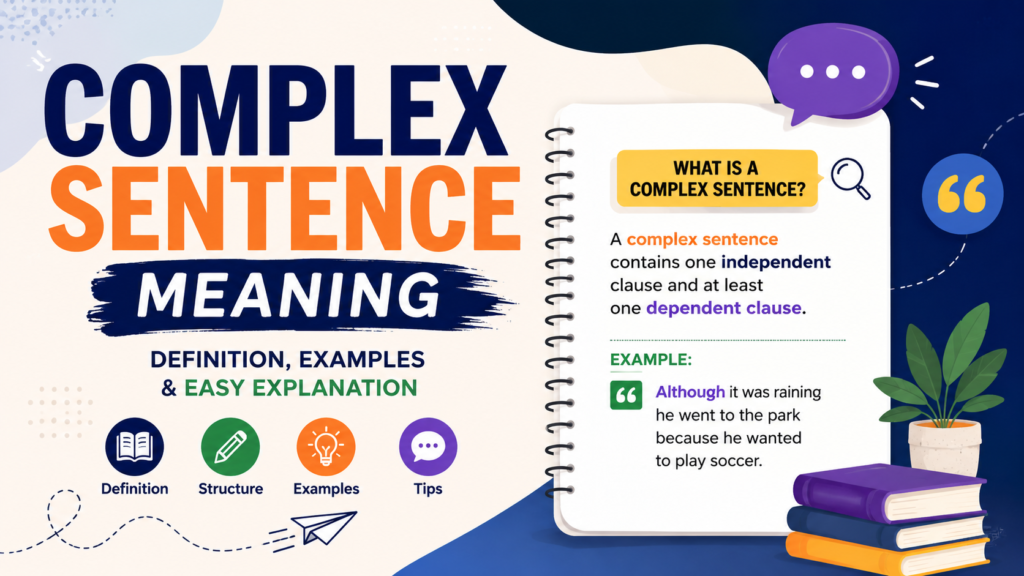
A complex sentence is a sentence that contains one independent clause and at least one dependent clause. The independent clause expresses a complete thought, while the dependent clause adds extra information but cannot stand alone.
Simply put, a complex sentence joins one complete idea with another idea that depends on it.
For example:
Because I studied every day, I passed the exam.
Here:
- Because I studied every day → Dependent clause
- I passed the exam → Independent clause
The second part makes sense by itself.
The first part doesn’t.
Together, they create a complete and meaningful sentence.
Complex Sentence Definition
A complex sentence is one of the four main sentence types in English grammar.
It combines:
- One independent clause
- One or more dependent clauses
These clauses are connected using subordinating conjunctions or relative pronouns.
Common Subordinating Conjunctions
- because
- although
- since
- while
- after
- before
- unless
- if
- until
- even though
- whenever
- whereas
Examples:
- Because I was tired, I went to bed early.
- Although she practiced a lot, she felt nervous.
- If you need help, call me.
- Since it’s raining, we’ll stay indoors.
Understanding Independent vs. Dependent Clauses
The easiest way to understand complex sentence meaning is to know the difference between these two clauses.
| Independent Clause | Dependent Clause |
|---|---|
| Can stand alone | Cannot stand alone |
| Expresses a complete thought | Needs another clause |
| Has a subject and verb | Also has a subject and verb |
| Makes sense by itself | Leaves the reader waiting |
Example:
Independent:
We watched a movie.
Dependent:
Because it was raining.
The second sentence leaves you wondering…
Because it was raining… what happened?
It needs an independent clause.
So we combine them:
Because it was raining, we watched a movie.
Now the idea is complete.
Why Is It Called a “Complex” Sentence?
The word complex doesn’t mean “hard.”
It simply means the sentence has more than one clause working together.
Instead of expressing one simple idea, a complex sentence connects related ideas.
For example:
Simple sentence:
Sarah stayed home.
Complex sentence:
Sarah stayed home because she wasn’t feeling well.
The second sentence answers an important question:
Why did Sarah stay home?
That extra detail makes the writing stronger.
Origin of the Term “Complex Sentence”
The concept of complex sentences comes from traditional English grammar, which classifies sentences into four major types:
- Simple sentences
- Compound sentences
- Complex sentences
- Compound-complex sentences
These categories have been taught in schools for decades because they help writers understand sentence structure rather than vocabulary difficulty.
Today, complex sentences are used everywhere—from novels and newspapers to emails, blogs, business reports, and social media captions.
Pronunciation
Complex sentence
Pronunciation:
KOM-pleks SEN-tuhns
Phonetic spelling:
/ˈkɒm.pleks ˈsen.təns/
Why Complex Sentences Matter
Using only short, simple sentences can make writing sound repetitive.
Example:
I was hungry. I went home. I cooked dinner. I ate.
Now compare:
Because I was hungry, I went home so I could cook dinner before eating.
The second version feels smoother and more natural.
Complex sentences help you:
- explain reasons
- show time relationships
- compare ideas
- express conditions
- describe situations
- improve essay writing
- sound more fluent
This is why teachers, editors, and employers value writers who know how to use them correctly.
How to Use Complex Sentence Meaning Correctly in Writing
Learning the complex sentence meaning is only the first step. The real skill is knowing when and how to use complex sentences naturally.
A well-written complex sentence connects ideas that belong together, making your writing more logical and engaging without sounding overly complicated.
When to Use a Complex Sentence
Use a complex sentence when you want to:
- explain a reason
- describe a condition
- show contrast
- indicate time
- express a result
- provide background information
Examples:
Reason:
Because the traffic was heavy, we arrived late.
Time:
After I finished my homework, I watched television.
Condition:
If you practice every day, you’ll improve quickly.
Contrast:
Although she was nervous, she delivered an excellent speech.
Purpose:
He studied hard so that he could pass the exam.
Each sentence links ideas in a way that feels natural and easy to understand.
Where You’ll Commonly See Complex Sentences
Complex sentences appear in almost every type of writing, including:
Academic Writing
Teachers often encourage students to use complex sentences because they demonstrate stronger writing skills.
Example:
Although the experiment failed, researchers gained valuable information.
Professional Emails
Instead of writing short, disconnected statements, professionals often connect ideas.
Example:
Since the meeting has been rescheduled, please update your calendar.
Books and Stories
Authors use complex sentences to create smoother narratives.
Example:
As the sun disappeared behind the mountains, the village became unusually quiet.
Blog Articles
SEO writers frequently use complex sentences to explain concepts while keeping readers engaged.
Example:
Because search engines value helpful content, detailed articles often rank better.
Common Sentence Patterns
Pattern 1
Dependent clause + Independent clause
Example:
Although he was tired, he finished the project.
Pattern 2
Independent clause + Dependent clause
Example:
He finished the project although he was tired.
Pattern 3
Independent clause + Relative Clause
Example:
The book that you recommended was amazing.
Punctuation Tips
When the dependent clause comes before the independent clause:
✅ Use a comma.
Example:
Because I was busy, I couldn’t answer the phone.
When the independent clause comes first:
No comma is usually needed.
Example:
I couldn’t answer the phone because I was busy.
Knowing this simple rule helps make your writing look polished and grammatically correct.
Real Conversation Examples Using Complex Sentences
Understanding the theory is helpful, but seeing complex sentence meaning in real conversations makes it much easier to remember. Below are examples from everyday situations, along with a brief explanation of what each sentence conveys.
Example 1: Between Friends
Emma: Are you coming to the party tonight?
Liam: Although I have a lot of homework, I’ll try to come for an hour.
Meaning: The dependent clause (“Although I have a lot of homework”) shows contrast. Liam has homework, but he still plans to attend the party.
Example 2: Family Conversation
Mom: Why are you wearing a jacket?
Son: Because it’s getting colder outside, I don’t want to catch a cold.
Meaning: The dependent clause explains the reason for wearing a jacket.
Example 3: At School
Teacher: Did everyone finish the assignment?
Student: Since I was absent yesterday, I need a little more time.
Meaning: The sentence politely explains why extra time is needed.
Example 4: Workplace Chat
Manager: Can you send the report today?
Employee: If I finish the presentation early, I’ll send it before lunch.
Meaning: The employee’s response depends on a condition being met.
Example 5: Gaming Conversation
Player 1: Ready for another match?
Player 2: After I upgrade my character, I’ll join your team.
Meaning: The first action must happen before the second.
Example 6: Text Message
Alex: Where are you?
Jordan: I’m running late because my bus was delayed.
Meaning: The dependent clause explains the cause of being late.
Example 7: Travel
Friend: Did you enjoy your vacation?
Traveler: Even though it rained every day, we had an amazing time.
Meaning: The sentence highlights an unexpected positive outcome despite bad weather.
Example 8: Restaurant
Waiter: Would you like dessert?
Customer: After I finish my meal, I’ll decide.
Meaning: The decision depends on completing another action first.
Common Types of Complex Sentences
Not every complex sentence works the same way. Depending on the subordinating conjunction used, each sentence expresses a different relationship between ideas.
1. Cause and Effect
These explain why something happened.
Examples:
- Because I exercised regularly, I felt healthier.
- Since the store was closed, we ordered online.
- As it was getting late, everyone went home.
2. Time
These show when something happens.
Examples:
- Before you leave, lock the door.
- After she graduated, she moved abroad.
- Whenever it rains, the roads become slippery.
3. Condition
These explain what must happen first.
Examples:
- If you study consistently, you’ll improve.
- Unless you hurry, you’ll miss the train.
- Provided that everyone agrees, we’ll start tomorrow.
4. Contrast
These compare two opposing ideas.
Examples:
- Although he was tired, he kept working.
- Even though they disagreed, they remained friends.
- While I enjoy coffee, my sister prefers tea.
5. Purpose
These explain why someone does something.
Examples:
- She saved money so that she could buy a new laptop.
- He whispered so that nobody would hear him.
- They practiced every day so that they could win the tournament.
Common Mistakes & Misunderstandings
Even experienced writers sometimes misuse complex sentences. Here are the most common mistakes and how to avoid them.
Mistake 1: Writing a Dependent Clause as a Complete Sentence
❌ Because I was tired.
This is not a complete sentence.
✅ Because I was tired, I went to bed early.
Tip: Every dependent clause needs an independent clause to complete the thought.
Mistake 2: Using Too Many Clauses
Trying to include too many ideas can confuse readers.
❌ Although I studied because my teacher told me after class since exams were coming, I still felt nervous.
✅ Although I studied for the exam, I still felt nervous.
Tip: Keep your sentences clear and concise.
Mistake 3: Incorrect Comma Placement
Incorrect:
Because it was raining we stayed home.
Correct:
Because it was raining, we stayed home.
However:
We stayed home because it was raining.
No comma is needed when the independent clause comes first.
Mistake 4: Choosing the Wrong Subordinating Conjunction
Each conjunction has a specific purpose.
Examples:
- Because → reason
- Although → contrast
- If → condition
- After → time
- Since → reason or time (depending on context)
Using the wrong one can change the meaning of your sentence.
Generational Misunderstandings
Unlike internet slang, complex sentences are part of standard English grammar, so they don’t vary much between age groups. However, different generations often use them differently.
Students
Students use complex sentences mainly in:
- essays
- assignments
- exams
- presentations
Teachers often encourage them because they show stronger writing skills.
Professionals
Business professionals use complex sentences in:
- reports
- emails
- proposals
- presentations
Example:
Since the client approved the proposal, we’ll begin the project next week.
Writers and Journalists
Authors and journalists use complex sentences to add detail, explain relationships, and improve the flow of ideas.
Example:
While many people expected the event to be canceled, organizers decided to continue.
Cultural and Regional Differences
The structure of complex sentences remains largely the same in English-speaking countries, including the United States, the United Kingdom, Canada, Australia, and New Zealand.
However, English learners may notice small differences in vocabulary or punctuation preferences.
For example:
American English
I stayed home because I wasn’t feeling well.
British English
I stayed at home because I wasn’t feeling well.
Both are grammatically correct.
How to Clarify If Someone Doesn’t Understand
If someone says they don’t understand your sentence, try these steps:
- Break the sentence into two simpler sentences.
- Explain the relationship between the ideas.
- Replace uncommon conjunctions with simpler ones.
- Avoid unnecessary details.
Example:
Original:
Although the meeting was postponed because the manager was ill, everyone stayed prepared.
Simplified:
The manager was ill. The meeting was postponed. Everyone stayed prepared.
Once the listener understands the ideas, you can combine them into a complex sentence again.
Complex Sentence Meaning Across Different Writing Styles
Complex sentences appear almost everywhere—not just in classrooms. Knowing when to use them helps you write more naturally in different situations.
Academic Writing
Complex sentences are common in essays, research papers, and exams because they connect ideas logically.
Example:
Although renewable energy requires significant investment, it offers long-term environmental benefits.
Business Communication
Professionals often use complex sentences to explain decisions, provide context, or outline conditions.
Example:
If you have any questions, please contact our support team before Friday.
Everyday Communication
In conversations, emails, and text messages, complex sentences make explanations clearer.
Example:
Because I missed the earlier train, I’ll arrive around 8 PM.
Creative Writing
Authors use complex sentences to create atmosphere, build suspense, and describe events in greater detail.
Example:
As the wind howled outside, the old house seemed even more mysterious.
Simple vs. Compound vs. Complex Sentences
| Sentence Type | Structure | Example |
|---|---|---|
| Simple | One independent clause | She smiled. |
| Compound | Two independent clauses joined by a coordinating conjunction | She smiled, and he laughed. |
| Complex | One independent clause + one or more dependent clauses | Although she was tired, she smiled. |
| Compound-Complex | Two independent clauses + at least one dependent clause | Although she was tired, she smiled, and everyone applauded. |
Which One Should You Use?
The best writing uses a mix of sentence types.
- Use simple sentences for emphasis.
- Use compound sentences to connect equal ideas.
- Use complex sentences to explain relationships between ideas.
- Use compound-complex sentences sparingly for advanced writing.
A good balance keeps your writing engaging, natural, and easy to read.
Related Grammar Terms & Alternatives
| Term | Meaning |
|---|---|
| Simple Sentence | Contains one independent clause only. |
| Compound Sentence | Joins two independent clauses with a coordinating conjunction. |
| Compound-Complex Sentence | Combines two independent clauses with at least one dependent clause. |
| Independent Clause | A complete thought that can stand alone. |
| Dependent Clause | A clause that cannot stand alone. |
| Subordinating Conjunction | Words like because, although, since, and if that introduce dependent clauses. |
| Coordinating Conjunction | Words such as and, but, or, so, and yet that join equal ideas. |
| Relative Clause | A dependent clause beginning with who, which, or that to provide more information. |
| Sentence Structure | The arrangement of clauses and phrases within a sentence. |
| Clause | A group of words containing a subject and a verb. |
Suggested Internal Link Opportunities
As you build your grammar content hub, consider linking naturally to articles such as:
- Simple Sentence Meaning
- Compound Sentence Meaning
- Independent Clause Meaning
- Dependent Clause Meaning
- Types of Sentences in English
- What Is a Subordinating Conjunction?
- What Is a Relative Clause?
FAQs:
What is the meaning of a complex sentence?
A complex sentence is a sentence that contains one independent clause and at least one dependent clause. The independent clause expresses a complete thought, while the dependent clause adds extra information such as a reason, condition, time, or contrast. Together, they create a more detailed and meaningful sentence.
What is an example of a complex sentence?
A common example is:
Although it was raining, we went to the park.
In this sentence, “Although it was raining” is the dependent clause, and “we went to the park” is the independent clause. The sentence shows contrast between the weather and the action.
What is the difference between a simple sentence and a complex sentence?
A simple sentence contains only one independent clause.
Example:
She enjoys reading.
A complex sentence contains one independent clause and at least one dependent clause.
Example:
Because she enjoys reading, she visits the library every weekend.
Complex sentences provide more context and show how ideas are connected.
Can a complex sentence start with a dependent clause?
Yes. A complex sentence can begin with either a dependent clause or an independent clause.
Examples:
- Before the movie started, everyone found their seats.
- Everyone found their seats before the movie started.
When the dependent clause comes first, a comma is usually required after it.
Why should I use complex sentences in writing?
Complex sentences make your writing more engaging and informative by connecting related ideas. They help explain reasons, show conditions, compare ideas, and describe sequences of events. Using a variety of sentence structures also improves readability and demonstrates stronger writing skills in academic, professional, and creative contexts.
Conclusion:
Understanding complex sentence meaning is one of the easiest ways to improve your English writing. Despite the name, complex sentences aren’t meant to confuse readers—they’re designed to connect ideas clearly and naturally.
Remember the golden rule: a complex sentence always includes one independent clause and at least one dependent clause. Once you understand how these clauses work together, you’ll be able to write essays, emails, stories, and everyday messages with greater confidence and clarity.
The next time you’re writing, challenge yourself to combine related ideas into a well-structured complex sentence. With a little practice, it will become second nature.
💬 What’s your favorite example of a complex sentence? Share it in the comments below!

I’m Lina Roys, a passionate writer behind Storevian, where I make words, phrases, slang, and everyday expressions easy to understand. I create clear, engaging, and reader-friendly content to help people find the meanings they’re looking for, quickly and confidently.


