
Have you ever wondered why a red heart feels romantic, a blue room feels peaceful, or a yellow warning sign instantly grabs your attention? Color is more than decoration. It can communicate feelings, ideas, warnings, identity, and even social messages without using a single word.
Understanding colors meaning can help you make better choices in clothing, branding, interior design, art, photography, social media, and everyday communication. A color that feels cheerful in one situation might feel serious or even unlucky in another.
That is because color symbolism is not universal. Culture, religion, history, personal experiences, and context can all influence how people interpret a particular shade.
In this guide, you’ll discover the meaning behind major colors, the basics of color psychology, cultural differences, common symbolism, and practical examples of how colors communicate messages.
Updated for 2026: This guide explains color meanings in a modern, easy-to-understand way while separating common symbolism from claims that depend heavily on culture or context.
What Does Colors Meaning Mean?
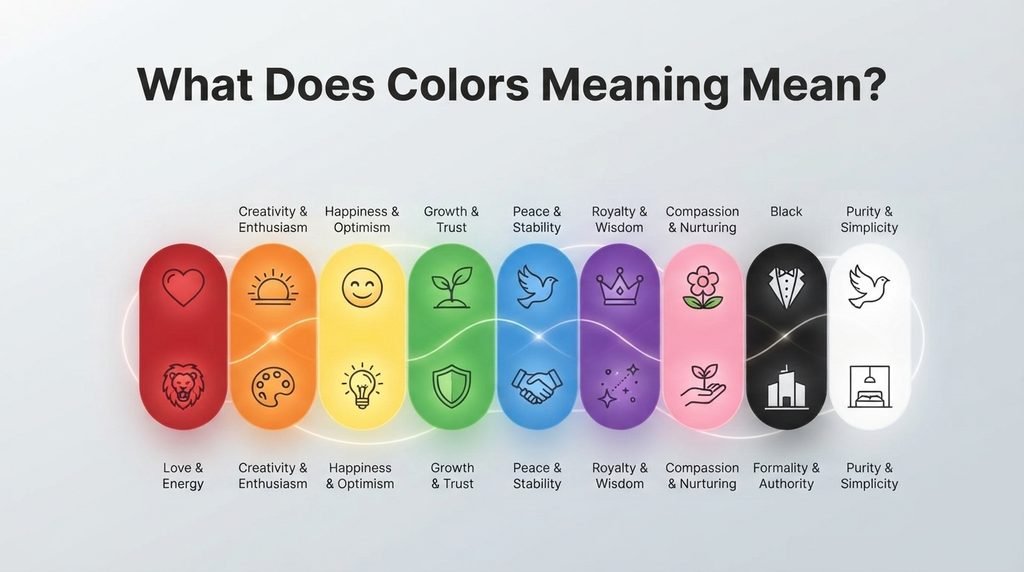
Colors meaning describes the ideas, emotions, qualities, or messages commonly associated with particular colors.
For instance, people often connect red with passion, energy, love, or danger. Blue is frequently associated with calmness, trust, stability, and the sky or ocean. Green commonly suggests nature, growth, health, or renewal.
But there is an important catch: a color does not have one fixed meaning.
The same color can communicate very different things depending on where and how it appears.
Quick Answer
Colors meaning refers to the symbolism and emotional associations connected with different colors. These associations can influence how people interpret clothing, logos, artwork, rooms, websites, signs, and messages. However, color meanings vary by culture, context, personal experience, and situation.
Why Do Colors Have Meanings?
Humans learn color associations from many sources.
Some connections come from nature. Blue may remind us of the sky and water, while green reminds us of plants and forests.
Others develop through culture and society. Certain colors become associated with celebrations, mourning, political movements, holidays, institutions, or traditions.
Personal experience matters, too. Someone may associate yellow with happiness because it reminds them of childhood, while another person may dislike it because of a negative experience.
So color symbolism is best understood as a collection of common associations rather than a universal dictionary of emotions.
Meaning of Major Colors
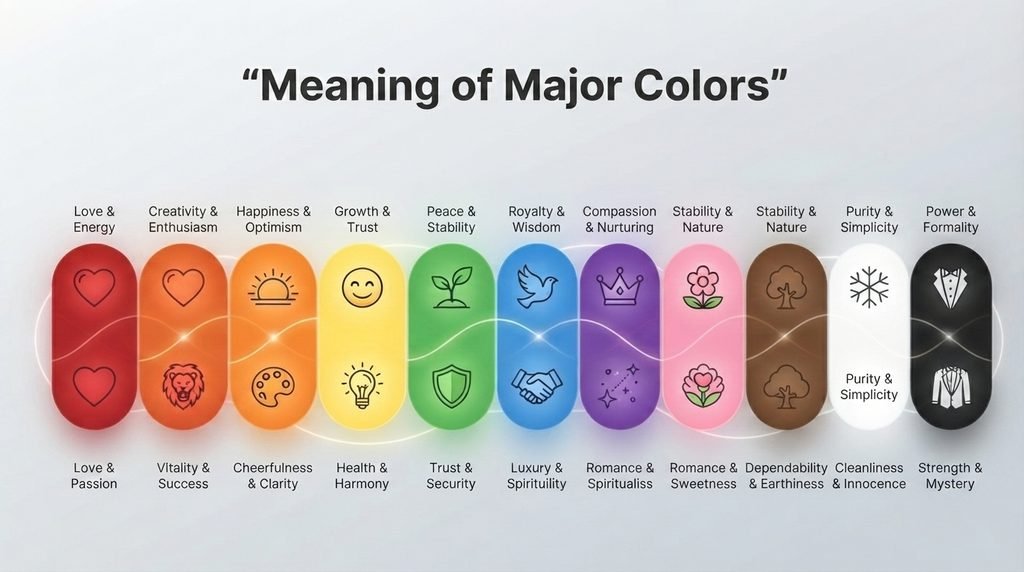
Let’s look at some of the most commonly recognized colors and their potential symbolism.
Red Meaning
Red is one of the strongest attention-grabbing colors.
It can represent:
- Love
- Passion
- Romance
- Energy
- Power
- Danger
- Anger
- Urgency
- Excitement
A red rose can suggest romance, while a red warning sign can communicate danger.
Context changes everything.
Blue Meaning
Blue is often associated with:
- Calmness
- Trust
- Stability
- Loyalty
- Professionalism
- Peace
- Security
- Sadness
Many businesses use blue in branding because it can create associations with reliability and professionalism.
At the same time, phrases such as “feeling blue” connect the color with sadness.
Green Meaning
commonly represents:
- Nature
- Growth
- Renewal
- Health
- Freshness
- Balance
- Prosperity
- Sustainability
strongly connected with plants and the natural world, which helps explain its popularity in environmental and wellness branding.
Yellow Meaning
Yellow often communicates:
- Happiness
- Optimism
- Warmth
- Energy
- Creativity
- Caution
- Attention
Bright yellow can feel playful and cheerful, but intense yellow is also widely used for warning signs because it is highly noticeable.
Orange Meaning
Orange sits between red and yellow, so it is often associated with:
- Enthusiasm
- Creativity
- Warmth
- Adventure
- Confidence
- Energy
- Friendliness
It can feel energetic without being as intense as bright red.
Purple Meaning
Purple has long been associated with:
- Luxury
- Royalty
- Creativity
- Mystery
- Spirituality
- Imagination
- Individuality
Historically, some purple dyes were difficult and expensive to produce, helping create associations between purple and status.
Pink Meaning
Pink is commonly connected with:
- Love
- Affection
- Romance
- Tenderness
- Playfulness
- Compassion
- Softness
Its symbolism has also changed over time and can vary significantly by culture and social context.
Black Meaning
Black can represent:
- Elegance
- Power
- Mystery
- Sophistication
- Authority
- Mourning
- Darkness
In fashion, black is often associated with sophistication. In other situations, it may symbolize grief or seriousness.
White Meaning
White commonly represents:
- Purity
- Cleanliness
- Peace
- Simplicity
- Innocence
- Fresh beginnings
However, white does not symbolize the same thing everywhere. Cultural traditions can dramatically change its meaning.
Brown Meaning
Brown is often associated with:
- Earth
- Nature
- Stability
- Reliability
- Simplicity
- Comfort
- Warmth
Because it resembles soil, wood, and natural materials, brown can create an earthy or grounded impression.
Gray Meaning
Gray can suggest:
- Neutrality
- Balance
- Sophistication
- Practicality
- Seriousness
- Restraint
Too much gray can sometimes feel dull or distant, while carefully used gray can create a clean, professional appearance.
Meaning
commonly represents:
- Wealth
- Success
- Achievement
- Luxury
- Prestige
- Celebration
is frequently used to highlight premium products, awards, milestones, and special occasions.
Silver Meaning
Silver may symbolize:
- Modernity
- Technology
- Elegance
- Sophistication
- Innovation
- Precision
Its metallic appearance makes it particularly common in technology, automotive, and luxury design.
How to Use Colors Correctly
Color symbolism becomes especially useful when you understand the context.
In Branding
A company may choose colors that support its intended personality.
For example:
- Blue can suggest trust.
- Green can suggest nature or sustainability.
- Red can communicate energy.
- Purple can suggest creativity or luxury.
- Orange can feel friendly and energetic.
However, color alone cannot define a brand. Typography, imagery, messaging, industry expectations, and audience preferences also matter.
In Clothing
People sometimes use color to influence the impression their clothing creates.
Dark colors may appear formal or sophisticated, while bright colors can feel energetic and expressive.
But personal style matters more than a simple “color personality” rule.
In Interior Design
Room colors can influence the atmosphere people perceive.
Soft blues and greens may create a relaxed feeling. Warm colors such as orange or yellow can create a lively atmosphere.
Lighting also changes how colors appear, so the same paint can look dramatically different during the day and at night.
In Social Media
Colors can make social posts more recognizable.
Creators often develop consistent color palettes so followers can identify their content quickly. Bright colors may create a playful visual identity, while neutral palettes can feel minimalist and polished.
In Professional Settings
Color symbolism can be useful in presentations, websites, reports, and marketing materials.
Still, avoid assuming that a color automatically creates a specific emotional response in every viewer.
Use color to support your message, not replace it.
Colors Meaning in Real-Life Situations
Between Friends
Friend 1: “Why did you make the group chat theme green?”
Friend 2: “It feels fresh and chill.”
What it conveys: Green can create associations with freshness, nature, and calmness.
In Dating
Person A: “Why did you choose red roses?”
Person B: “I mean... it’s kind of obvious.”
What it conveys: Red is commonly connected with romance, passion, and love.
In a Family Setting
Parent: “Why is everything in your room blue?”
Teen: “Because it makes the room feel calmer.”
What it conveys: Blue is widely associated with calmness and relaxation.
At Work
Designer: “Let’s use blue for the main brand elements.”
Manager: “Why blue?”
Designer: “It can support the trustworthy, professional image we’re trying to create.”
What it conveys: Blue is frequently used to communicate reliability, stability, and professionalism.
In Gaming
Player 1: “Why is the whole interface glowing red?”
Player 2: “Boss fight. Obviously!”
What it conveys: Red can communicate danger, urgency, intensity, and high energy.
Common Mistakes & Misunderstandings
Mistake 1: Assuming Every Color Has One Meaning
There is no universal rule saying, “Blue always means peace” or “red always means love.”
A red traffic signal communicates something very different from a red wedding decoration.
Mistake 2: Ignoring Cultural Differences
Color symbolism varies around the world.
A color associated with celebration in one culture may have completely different associations somewhere else.
If you’re designing content for an international audience, research the cultural context instead of relying on a Western color chart.
Mistake 3: Treating Color Psychology Like a Guarantee
Color psychology can help explain common associations, but it should not be treated as a magic formula.
People don’t automatically feel the same emotion whenever they see a particular color.
Age, culture, environment, personal preference, lighting, and context can all influence perception.
How to Avoid Confusion
When someone interprets a color differently, ask about the context.
For example:
“What does that color represent to you?”
Sometimes the answer reveals a personal or cultural association that a generic color chart would never capture.
Colors Across Different Platforms & Demographics
Color meanings can shift between audiences.
Gen Z
Younger audiences often encounter colors through TikTok, Instagram, gaming communities, memes, digital art, and rapidly changing visual trends.
Color choices may communicate an aesthetic or online identity rather than one fixed symbolic meaning.
Millennials
Millennials may associate certain palettes with branding trends, social media aesthetics, nostalgia, and lifestyle design.
Older Generations
Older audiences may rely more heavily on established cultural, professional, or traditional associations.
Of course, these are broad tendencies, not rules. Individual preferences matter far more than a person’s birth year.
TikTok and Instagram
On visual platforms, color can become part of an account’s identity.
Creators may use:
- Pastel palettes
- Neon colors
- Monochrome designs
- Warm tones
- Vintage filters
- Minimalist neutrals
Here, the combination of colors may matter more than the meaning of any single color.
Discord and Gaming Communities
Digital communities often use color for roles, status indicators, teams, alerts, rarity levels, and interface elements.
In these environments, color can become functional rather than purely emotional.
Is Color Symbolism Formal?
Generally, color symbolism is contextual rather than formal.
You can discuss it in professional writing, design, marketing, education, and art, but avoid presenting subjective associations as universal scientific facts.
Related Slang, Abbreviations & Alternatives
Although “colors meaning” is not internet slang, several related concepts are useful when researching color symbolism.
| Term | Meaning |
|---|---|
| Color symbolism | The use of colors to represent ideas or concepts |
| Color psychology | Study of how color can influence perception and behavior |
| Color theory | Principles explaining how colors interact |
| Color palette | A selected group of colors used together |
| Hue | The basic family or identity of a color |
| Saturation | The intensity or purity of a color |
| Brightness | How light or dark a color appears |
| Warm colors | Colors such as red, orange, and yellow |
| Cool colors | Colors such as blue, green, and some purples |
| Complementary colors | Colors positioned opposite each other on a color wheel |
Related Concepts to Explore
If you’re interested in symbolism, useful topics include:
- Color psychology
- Color theory
- Cultural symbolism
- Emotional associations
- Branding colors
- Spiritual color symbolism
- Meaning of colors in different cultures
- Color symbolism in literature and art
FAQs:
What is the meaning of colors?
The meaning of colors refers to the ideas, emotions, symbols, and associations people connect with different colors. Red may suggest love or danger, blue can suggest calmness or trust, and green may represent nature or growth. These meanings are not universal and can change depending on culture, context, personal experience, and design.
What color represents love?
Red is one of the most widely recognized colors associated with romantic love and passion. Pink can also represent affection, tenderness, and romantic feelings. However, color symbolism varies across cultures and situations. A person’s personal experiences can also influence which color they associate most strongly with love.
What color represents peace?
White and blue are commonly associated with peace. White can symbolize purity, calmness, and peaceful intentions, while blue is often connected with tranquility, openness, and stability. The meaning depends on the context, though, because cultural traditions and specific symbols can give the same color a different interpretation.
What color represents happiness?
Yellow is frequently associated with happiness, optimism, sunshine, warmth, and positive energy. Orange can also communicate enthusiasm and excitement. However, seeing a particular color does not guarantee a specific emotional reaction. Personal preference, culture, lighting, and surrounding colors can all influence how someone experiences it.
Why do colors have different meanings?
Colors develop different meanings through culture, history, nature, religion, language, advertising, traditions, and personal experiences. For example, a color may be connected with a particular ceremony in one culture but have another association elsewhere. This is why color symbolism should always be interpreted within its social and cultural context.
What color represents trust?
Blue is commonly associated with trust, reliability, security, and professionalism. This is one reason blue appears frequently in corporate branding, financial services, technology companies, and professional websites. However, trust does not come from color alone. A brand’s actions, reputation, communication, and customer experience have a much stronger effect.
What color represents growth?
Green is one of the most common colors associated with growth because of its connection to plants, nature, spring, and renewal. It can also symbolize health, sustainability, freshness, and prosperity. The exact interpretation depends on context. In finance, for example, green may have additional associations with money and positive performance.
Can colors affect emotions?
Colors can influence perception and emotional responses, but their effects are not identical for everyone. Context, culture, personal preferences, lighting, combinations of colors, and previous experiences all matter. It is more accurate to say that colors can contribute to an emotional impression rather than claiming that a specific color automatically causes a particular feeling.
Conclusion:
Colors meaning is fascinating because colors communicate without speaking. Red can feel passionate, blue can feel calm, green can suggest growth, and yellow can create an optimistic impression—but context always matters.
The biggest lesson is simple: there is no universal color dictionary. Culture, personal experience, design choices, and surrounding elements can completely change what a color communicates.
Whether you’re choosing a website palette, designing a logo, picking an outfit, decorating a room, or simply wondering why a certain color feels a certain way, understanding color symbolism gives you another useful lens for interpreting the world.
What color has the strongest meaning for you? Drop your favorite color and what it represents in the comments!

I’m Lina Roys, a passionate writer behind Storevian, where I make words, phrases, slang, and everyday expressions easy to understand. I create clear, engaging, and reader-friendly content to help people find the meanings they’re looking for, quickly and confidently.


1 thought on “Colors Meaning in Wedding Card Complete Symbolism Guide”