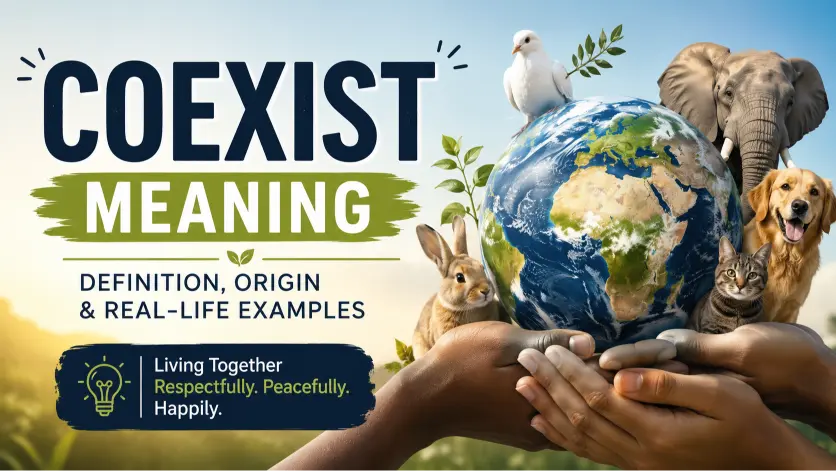
Have you ever heard someone say that different cultures should “coexist,” or read an article discussing how humans and wildlife can live together? While the word may sound simple, many people still wonder about the exact coexist meaning and how to use it correctly in everyday conversations.
The idea of coexistence appears everywhere—from international politics and environmental discussions to friendships, workplaces, schools, and even social media debates. Understanding this word helps you communicate more clearly, especially when discussing diversity, relationships, or shared spaces.
Updated for 2026, this guide explains the meaning of coexist in plain English. You’ll discover where the word came from, how its meaning has evolved, when to use it, common examples, and mistakes to avoid. Whether you’re a student, an English learner, or simply curious, you’ll find everything you need right here.
What Does Coexist Mean? (Definition + Origin)
Quick Answer
Coexist means to live, exist, or operate together at the same time, especially peacefully despite differences. It often refers to people, cultures, religions, animals, ideas, or organizations sharing the same environment without unnecessary conflict.
In simple terms, coexist is about sharing space while respecting differences.
For example:
- Different cultures can coexist within the same country.
- Lions and zebras coexist in the same ecosystem.
- Two competing technologies may coexist for several years before one becomes dominant.
- Friends with different political opinions can still coexist respectfully.
The word doesn’t necessarily mean everyone agrees. Instead, it emphasizes the ability to exist together without constant conflict.
Dictionary Definition
According to standard English dictionaries, coexist means:
- To exist together at the same time.
- To live together peacefully despite differences.
- To function simultaneously within the same environment.
Although peaceful living is the most common interpretation, coexist can also describe things simply existing together without implying harmony.
For instance:
- Print books and e-books coexist in today’s publishing industry.
- Traditional classrooms and online learning coexist in modern education.
Pronunciation
Coexist
IPA: /ˌkoʊ.ɪɡˈzɪst/
Pronounced as:
koh-ig-ZIST
The stress falls on the final syllable:
co · ex · IST
Word Origin (Etymology)
The word coexist combines two Latin elements:
- co- meaning together
- exist meaning to be or continue to live
It first appeared in English during the 17th century, originally describing things that existed simultaneously.
Over time, the meaning expanded beyond simple existence. Today, it frequently refers to peaceful relationships between people, cultures, religions, communities, and even nations.
Modern discussions about coexistence often involve:
- Cultural diversity
- Religious tolerance
- Environmental conservation
- Political cooperation
- Workplace inclusion
- Digital communities
How the Meaning Has Evolved
Originally, coexist simply meant existing at the same time.
Today, the word carries stronger social and emotional meaning.
For example, when someone says,
“People from different backgrounds should coexist.”
they’re usually talking about:
- Respect
- Acceptance
- Cooperation
- Peaceful interaction
This broader meaning has become especially common in discussions about globalization, multicultural societies, and environmental sustainability.
When Is “Coexist” Used?
You’ll encounter the word in many real-life situations.
Relationships
People with different personalities can coexist happily by respecting each other’s boundaries.
Example:
“Although they disagree on many topics, they coexist peacefully as roommates.”
Nature
Scientists often describe how animals coexist within ecosystems.
Example:
“Numerous species coexist in the rainforest.”
Technology
Old and new technologies frequently coexist during transitions.
Example:
“Gas-powered and electric vehicles currently coexist on most roads.”
Society
Communities with diverse languages, cultures, and beliefs aim to coexist respectfully.
Example:
“The city is known for helping many cultures coexist successfully.”
Business
Companies may offer multiple products that coexist in the same market.
Example:
“Both software versions will coexist until customers finish upgrading.”
Examples of “Coexist” in Everyday Sentences
Here are some practical examples that demonstrate the coexist meaning in different contexts.
Education
Students from many countries coexist on the same university campus.
Family
Different generations can coexist peacefully even when they have different opinions.
Environment
Humans and wildlife must learn to coexist if endangered species are to survive.
Technology
Streaming services and cable television continue to coexist for many households.
Workplace
Employees with different working styles often coexist successfully through teamwork.
Coexist vs. Exist
These two words are related but not identical.
| Exist | Coexist |
|---|---|
| Means to be present | Means to exist together |
| Focuses on one person or thing | Focuses on two or more people or things |
| Doesn’t imply interaction | Usually involves sharing the same environment |
| Example: Dinosaurs no longer exist. | Example: Different cultures coexist peacefully. |
A simple way to remember it:
- Exist = be there
- Coexist = be there together
Why “Coexist” Matters Today
In today’s connected world, people interact with individuals from different cultures, religions, languages, and viewpoints more than ever before.
Understanding the coexist meaning helps when discussing topics such as:
- Diversity and inclusion
- Global cooperation
- Environmental protection
- Education
- Workplace communication
- International relations
It’s more than just vocabulary—it represents an important concept in modern society.
How to Use Coexist Correctly in Everyday Communication
Knowing the coexist meaning is only the first step. The next challenge is using the word naturally in conversations, writing, and online discussions.
In most cases, coexist is used to describe two or more people, groups, ideas, cultures, technologies, or living things existing together. Depending on the context, it can suggest peace, cooperation, or simply existing at the same time.
When to Use “Coexist”
Use coexist when talking about sharing the same space, time, or environment.
Common situations include:
- Different cultures living in one country
- Friends with different opinions
- Animals sharing an ecosystem
- Competing products in the same market
- Old and new technologies operating together
- Different religions within a community
Examples
People from many cultures coexist peacefully in the city.”
“Electric cars and gasoline vehicles currently coexist.”
“Several bird species coexist in this forest.”
Traditional classrooms and online learning now coexist.”
When NOT to Use “Coexist”
Although it’s a versatile word, coexist isn’t always the right choice.
Avoid using it when talking about only one person or object.
❌ “My phone coexists.”
✅ “My phone exists.”
Don’t use it when you simply mean someone is alive.
❌ “He coexists in Canada.”
✅ “He lives in Canada.”
Avoid replacing words like agree or cooperate.
❌ “We coexist with your opinion.”
✅ “We agree with your opinion.”
OR
✅ “We can coexist despite different opinions.”
Tone and Context
One reason the word appears so often is that it fits many situations.
Casual
Friends often use it jokingly.
“Coffee lovers and tea lovers can coexist.”
Respectful
This is the most common tone.
“People with different beliefs should coexist peacefully.”
Academic
Teachers and researchers frequently use the word.
“Several theories coexist within modern psychology.”
Professional
Businesses often discuss products or systems that coexist.
“Both software platforms will coexist during the migration.”
Environmental
Scientists regularly describe ecosystems this way.
“Predators and prey coexist through a balanced ecosystem.”
Using “Coexist” on Different Platforms
Although coexist isn’t internet slang, people regularly use it across social media and messaging apps.
SMS & Text Messages
Usually used in casual conversations.
Example
Friend 1:
I love pineapple on pizza.
Friend 2:
That’s okay—we can still coexist. 😂
Meaning:
They’re joking that different tastes don’t have to ruin a friendship.
Often appears during group discussions.
Example
Everyone has different opinions, but we can all coexist respectfully.
Tone:
Friendly and mature.
The word commonly appears in captions about diversity, travel, or nature.
Example Caption
Different cultures, one beautiful world. Let’s coexist. 🌍❤️
X (formerly Twitter)
Often used during debates.
Example:
We don’t have to agree on everything to coexist.
This encourages respectful disagreement rather than conflict.
Reddit users frequently use coexist during discussions involving:
- politics
- religion
- gaming communities
- technology
- environmental issues
Example:
Linux and Windows can coexist depending on your workflow.
Discord
Gaming communities often use the word humorously.
Example:
Casual players and competitive players can coexist on this server.
Common Grammar Patterns
You’ll usually see coexist in these sentence structures.
Coexist with
The most common pattern.
Examples:
- Humans can coexist with nature.
- Dogs and cats can coexist peacefully.
- Different ideas can coexist.
Coexist peacefully
A very common phrase.
Examples:
- Communities should coexist peacefully.
- Nations must learn to coexist peacefully.
Coexist alongside
Used mostly in formal writing.
Examples:
- Modern medicine coexists alongside traditional treatments.
- Digital books coexist alongside printed books.
Coexist in
Used when referring to an environment.
Examples:
- Several species coexist in this habitat.
- Many cultures coexist in New York City.
Capitalization
The word is not an abbreviation.
Always write it in lowercase unless it starts a sentence.
Correct:
We should coexist peacefully.
Also correct:
Coexistence is important.
Incorrect:
We should COEXIST peacefully.
Using all caps is only appropriate when emphasizing emotion online.
Punctuation Tips
The word doesn’t require any special punctuation.
Correct:
We can coexist.
They coexist peacefully.
Different opinions can coexist.
Emoji Pairings
On social media, people often pair coexist with positive or unity-themed emojis.
Popular choices include:
🌍 Earth — global unity
🤝 Handshake — cooperation
❤️ Red heart — kindness
☮️ Peace symbol — peaceful living
🌱 Seedling — environmental harmony
🕊️ Dove — peace
✨ Sparkles — positivity
Example:
Different cultures can coexist. 🌍🤝❤️
Formal vs. Informal Usage
One advantage of coexist is that it works well in both formal and informal English.
| Situation | Appropriate? | Example |
|---|---|---|
| School essay | ✅ Yes | Different cultures coexist in many countries. |
| Business meeting | ✅ Yes | Both systems will coexist temporarily. |
| Scientific paper | ✅ Yes | Species coexist within the ecosystem. |
| News article | ✅ Yes | Communities continue to coexist peacefully. |
| Everyday conversation | ✅ Yes | We can coexist despite disagreeing. |
| Text messages | ✅ Yes | Pizza lovers and sushi lovers can coexist. 😂 |
Real Conversation Examples Using Coexist
Here are realistic conversations showing how native English speakers use the word in different situations.
1. Between Friends
Emma:
I still don’t understand why you like horror movies.
Jake:
That’s okay. Our movie tastes can coexist. 😄
What it conveys
Jake is joking that different preferences don’t have to cause conflict.
2. Dating
Alex:
You’re an early bird, and I’m a night owl.
Taylor:
We’ll figure it out. Opposites can coexist.
What it conveys
The speaker expresses optimism that different lifestyles can work together.
3. Family Conversation
Mom:
Your brother likes quiet evenings.
Daughter:
I know. We just need to coexist respectfully.
What it conveys
The word emphasizes compromise and mutual respect.
4. Workplace Chat
Manager:
We’ll keep the old software for another month.
Employee:
So both systems will coexist until everyone is trained?
Manager:
Exactly.
What it conveys
Here, coexist refers to two systems operating simultaneously.
5. Gaming Community
Player 1:
I only play casually.
Player 2:
No worries. Casual and competitive players can coexist here.
What it conveys
The speaker welcomes different play styles within the same community.
6. Environmental Discussion
Student:
Can humans and wild animals really live together?
Teacher:
Yes. Many conservation projects help them coexist safely.
What it conveys
The word highlights balance and sustainable living.
7. Social Media Comment
User A:
Everyone has different opinions.
User B:
Exactly. We don’t have to agree to coexist.
What it conveys
A reminder that respect matters more than complete agreement.
8. Technology Discussion
Customer:
Can Windows and Linux run together?
Technician:
Yes, both operating systems can coexist on the same computer using certain setups.
What it conveys
Here, coexist simply means functioning together without replacing one another.
Common Mistakes & Misunderstandings
Even advanced English speakers occasionally misuse coexist. Here are the most common mistakes and how to avoid them.
Mistake #1: Confusing “Exist” with “Coexist”
Many learners think the words mean exactly the same thing.
❌ “Dinosaurs coexist.”
✅ “Dinosaurs existed.”
Remember:
- Exist = to be.
- Coexist = to exist together with something else.
Mistake #2: Assuming Coexist Always Means Agreement
Another common misconception is that coexist means everyone shares the same beliefs.
Not true.
People can coexist while having different:
- religions
- political opinions
- hobbies
- cultures
- lifestyles
The word emphasizes peaceful sharing, not identical thinking.
Mistake #3: Using It for Only One Person or Thing
Because the prefix co- means “together,” the word requires at least two entities.
❌ “My laptop coexists.”
✅ “My laptop and tablet coexist in my workflow.”
Generational Differences
Gen Z
Often uses coexist humorously in memes and social posts:
“Android and iPhone users can coexist.”
Millennials
More likely to use it in discussions about work-life balance, relationships, and diversity.
Older Generations
Usually encounter the word in news articles, education, religion, or politics, where it carries a more serious tone.
Cultural Differences
The idea of coexistence is universal, but examples vary by region.
- In multicultural countries, the word often refers to diversity and inclusion.
- In environmental discussions, it commonly describes humans and wildlife.
- In business, it refers to systems, products, or strategies operating side by side.
No matter the context, the core coexist meaning remains the same: existing together peacefully or simultaneously.
Coexist Across Different Platforms & Demographics
The word coexist isn’t internet slang, but it appears frequently in conversations online and offline. Its meaning stays consistent, though the context varies depending on the platform and audience.
How Gen Z Uses “Coexist”
Gen Z often uses coexist with humor, irony, or light sarcasm. Rather than discussing politics or culture, they commonly apply it to everyday preferences and internet debates.
Examples:
- “Android and iPhone users can coexist.”
- “Cats and dogs can totally coexist.”
- “We don’t have to like the same music to coexist.”
On TikTok, Instagram, and X, the word often appears alongside memes that encourage tolerance despite differing opinions.
How Millennials Use “Coexist”
Millennials tend to use the word more literally.
You’ll often see it in discussions about:
- Workplace diversity
- Parenting styles
- Mental health
- Technology
- Relationships
- Social issues
Example:
“Remote work and office work can coexist.”
How Older Generations Use “Coexist”
Older adults are more likely to encounter coexist in:
- Newspapers
- Religious discussions
- Educational content
- Environmental articles
- Political speeches
Example:
“Different faiths should coexist peacefully.”
The tone is generally more formal than on social media.
Usage Across Popular Platforms
| Platform | How “Coexist” Is Commonly Used |
|---|---|
| TikTok | Captions, motivational videos, memes about respecting differences |
| Quotes, travel photos, diversity posts, environmental awareness | |
| Community discussions, family conversations, local events | |
| X (Twitter) | Social commentary, politics, respectful debates |
| Discord | Gaming communities discussing different play styles |
| Technology, philosophy, environment, and community discussions | |
| Workplace diversity, leadership, organizational culture |
Is “Coexist” Formal or Informal?
One of the strengths of the word is its flexibility.
It works well in:
- ✔ Academic writing
- ✔ Business communication
- ✔ Casual conversations
- ✔ News reports
- ✔ Social media
- ✔ Speeches
- ✔ Research papers
Unlike many trendy expressions, coexist is appropriate in nearly every context.
Is It Safe for Work?
Yes.
Coexist is considered completely safe for work (SFW).
It contains:
- No offensive language
- No slang
- No inappropriate meaning
- No hidden internet definition
That makes it suitable for:
- Emails
- Presentations
- School assignments
- Workplace meetings
- Professional publications
Why the Word Became So Popular
Although coexist has existed for centuries, its popularity has grown because of discussions surrounding:
- Cultural diversity
- Globalization
- Climate change
- Wildlife conservation
- Religious tolerance
- Political differences
- Workplace inclusion
Related Words, Synonyms & Alternatives
Depending on the context, several words can express a similar idea to coexist.
| Word | Meaning | When to Use |
|---|---|---|
| Exist | To be present | General situations |
| Live together | Share the same place | People or families |
| Harmonize | Work well together | Music, teams, relationships |
| Cooperate | Work toward a common goal | Business, school, projects |
| Share | Use something together | Everyday situations |
| Integrate | Become part of a group | Society, education |
| Collaborate | Work together | Professional settings |
| Accommodate | Make room for differences | Communities, workplaces |
| Balance | Keep different elements stable | Lifestyle, ecology |
| Coexistence | The noun form of coexist | Formal writing |
Synonyms
- Live together
- Exist together
- Harmonize
- Share space
- Function together
- Operate simultaneously
Near Antonyms
- Conflict
- Clash
- Divide
- Separate
- Oppose
- Fight
Related Topics You May Also Like
If you’re building an English vocabulary or learning common expressions, consider exploring:
- Exist meaning
- Harmony meaning
- Tolerance meaning
- Respect meaning
- Diversity meaning
These topics naturally complement the coexist meaning and deepen your understanding of how people and ideas can interact.
FAQs:
What does coexist mean in simple words?
Coexist means living or existing together peacefully or at the same time. It often describes people, animals, ideas, or technologies sharing the same space without unnecessary conflict.
What is the difference between exist and coexist?
Exist simply means to be present or to have being. Coexist means two or more people, groups, or things exist together in the same place or at the same time.
Can people with different beliefs coexist?
Yes. Coexistence doesn’t require everyone to agree. It means respecting differences and living peacefully despite having different beliefs, values, or lifestyles.
Is coexist a positive word?
Generally, yes. It often carries positive associations with peace, respect, cooperation, and mutual understanding. However, it can also neutrally describe things that simply exist together, such as two technologies operating at the same time.
How do you use coexist in a sentence?
Here are a few examples:
- “Different cultures can coexist peacefully.”
- “Electric and gasoline vehicles coexist on today’s roads.”
- “Humans and wildlife must learn to coexist.”
Conclusion:
Understanding the coexist meaning goes beyond learning a single vocabulary word. It represents the idea that different people, cultures, beliefs, technologies, and even species can share the same world successfully.
Whether you’re writing an essay, having a conversation, or reading the news, knowing how to use coexist correctly will make your English clearer and more natural. Remember that coexistence doesn’t mean everyone thinks the same it means differences can exist without constant conflict.
The next time someone asks, “What does coexist mean?”, you’ll know the answer: it’s about existing together with respect, balance, and understanding.
Have a favorite English word or phrase you’d like us to explain next? Share it in the comments and explore more vocabulary guides to keep growing your language skills!

I’m Lina Roys, a passionate writer behind Storevian, where I make words, phrases, slang, and everyday expressions easy to understand. I create clear, engaging, and reader-friendly content to help people find the meanings they’re looking for, quickly and confidently.


