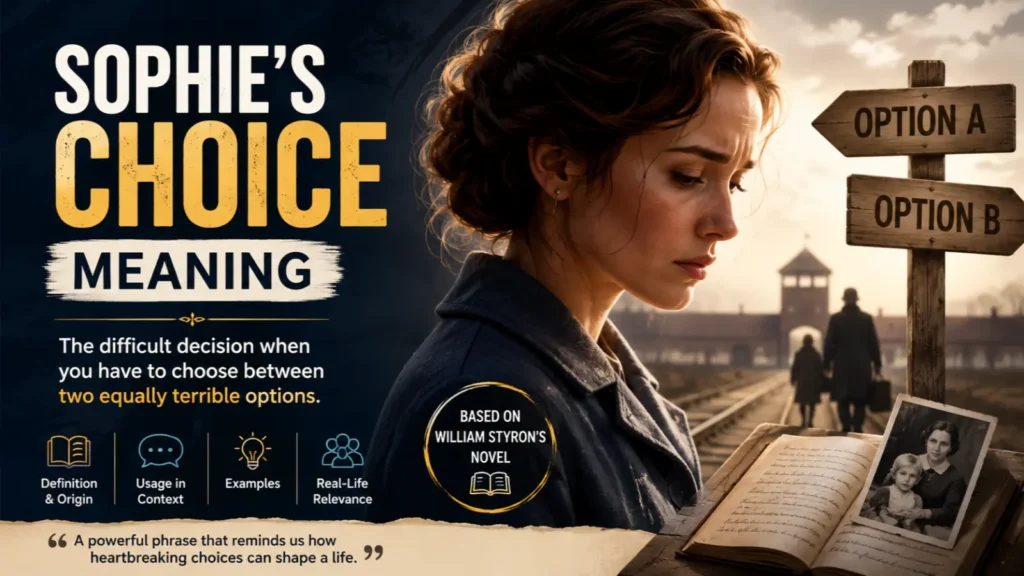
Imagine someone asking whether you’d rather lose your phone forever or delete every photo you’ve ever taken. Neither option feels good, right?
Now imagine a decision that’s far more heartbreaking one where every possible choice carries devastating consequences. That’s the idea behind Sophie’s Choice meaning.
Today, you’ll hear this expression everywhere, from office conversations and Reddit discussions to TikTok comments and family group chats. People often use it to describe situations where choosing either option feels painful, stressful, or unfair.
But here’s something many people don’t realize: the phrase has a deeply emotional origin rooted in literature and history. Understanding where it came from helps you know when it’s appropriate and when it might be insensitive.
You’ll learn the true definition of Sophie’s Choice meaning, where the phrase originated, how it’s used today, and why it remains one of the most powerful expressions in the English language.
What Does “Sophie’s Choice” Mean?
Quick Answer
Sophie’s Choice means an extremely difficult decision in which every available option results in significant loss, sacrifice, or emotional pain.
Unlike ordinary decisions, a Sophie’s Choice offers no happy ending. Whatever you choose, something valuable must be given up.
People commonly use the phrase when describing:
- Two equally painful options
- Impossible personal decisions
- Emotional dilemmas
- Ethical conflicts
- High-stakes situations with no ideal outcome
Although it’s often used figuratively, the expression carries a serious emotional weight because of its tragic literary background.
Definition in Simple English
A Sophie’s Choice is a situation where:
- every option is bad,
- neither choice feels acceptable,
- and making a decision comes with painful consequences.
For example:
“Choosing between accepting my dream job overseas or staying close to my aging parents felt like a Sophie’s Choice.”
The speaker isn’t saying the situations are identical to the novel’s events. Instead, they’re emphasizing how emotionally difficult the decision feels.
Pronunciation
Sophie’s Choice
SO-feez CHOYS
IPA:
/ˈsoʊfiːz tʃɔɪs/
Origin of the Phrase
The expression comes from William Styron’s bestselling 1979 novel Sophie’s Choice.
The story follows Sophie, a Polish woman imprisoned during World War II. In one of literature’s most devastating scenes, she’s forced into an unimaginable decision involving her children by a Nazi officer.
That single moment became symbolic of impossible moral choices.
In 1982, the story reached an even wider audience through the Academy Award-winning film starring Meryl Streep, whose performance introduced millions more people to the phrase.
Over time, Sophie’s Choice evolved from the title of a novel into an everyday idiom used to describe heartbreaking decisions of all kinds.
Why Has the Phrase Become So Popular?
Language constantly borrows memorable moments from books, movies, and history.
Just as people say:
- “Catch-22”
- “Pandora’s Box”
- “Achilles’ heel”
they also say Sophie’s Choice whenever a decision feels impossible.
The phrase has remained popular because almost everyone eventually faces situations where every available option involves some form of sacrifice.
Examples include:
- Choosing between two dream universities
- Deciding which job offer to accept
- Balancing career ambitions with family responsibilities
- Making difficult medical decisions
- Facing major financial trade-offs
Although these situations differ greatly from the novel’s tragedy, the expression has become shorthand for emotionally difficult choices.
How the Meaning Has Evolved
Originally, Sophie’s Choice referred specifically to the horrific event in William Styron’s novel.
Today, however, people use it much more broadly.
Modern usage often includes:
- stressful workplace decisions
- relationship dilemmas
- parenting challenges
- lifestyle trade-offs
- difficult financial choices
For example:
“Choosing between buying a house or traveling the world felt like a Sophie’s Choice.”
or
“My boss gave me a Sophie’s Choice: relocate or leave the company.”
While these examples are common, many writers and historians encourage people to remember the phrase’s tragic origins and avoid using it for trivial inconveniences.
Calling a decision like “pizza or burgers” a Sophie’s Choice can sound exaggerated and may unintentionally diminish the historical significance behind the expression.
Why Understanding the Context Matters
One reason this phrase has lasted for decades is that it combines emotional depth with cultural history.
Knowing Sophie’s Choice meaning isn’t just about understanding a definition it’s about recognizing why some expressions carry more emotional weight than others.
Using it thoughtfully shows awareness of both language and the historical experiences that shaped it.
How to Use Sophie’s Choice Correctly in Texts & Chat
Once you understand Sophie’s Choice meaning, the next step is knowing when it fits naturally in conversation. The phrase is best used when a decision genuinely feels painful, emotionally significant, or impossible not for everyday preferences.
Think of it as a way to express that every option comes with a meaningful sacrifice.
When to Use “Sophie’s Choice”
You can use Sophie’s Choice when:
- Both options have serious downsides.
- There isn’t a clear “good” choice.
- The decision causes emotional stress or conflict.
- You’re describing a difficult moral, personal, or professional dilemma.
Examples
- “Choosing between two dream universities was a real Sophie’s Choice.”
- “It felt like a Sophie’s Choice between my career and my family.”
- “The company gave employees a Sophie’s Choice: relocate or lose their jobs.”
In each example, the speaker highlights the emotional weight of the decision rather than comparing it directly to the novel.
When Not to Use It
Avoid using the phrase for trivial or humorous decisions.
Less Appropriate Examples
❌ “Chocolate or vanilla? Sophie’s Choice!”
❌ “Which Netflix show should I watch? Sophie’s Choice.”
❌ “Blue shirt or black shirt? Total Sophie’s Choice.”
These examples can sound exaggerated because the original phrase refers to an extraordinarily tragic situation.
Instead, use expressions like:
- Tough choice
- Hard decision
- Can’t decide
- I’m torn
- Both are great options
These alternatives fit everyday situations much better.
Tone and Emotional Context
The phrase usually conveys one or more of these emotions:
- 😟 Stress
- 💭 Internal conflict
- ❤️ Emotional attachment
- 😔 Sadness
- 🤔 Deep uncertainty
It is rarely used sarcastically. Most people reserve it for conversations where the decision genuinely matters.
Platform-Specific Usage
Although the meaning stays the same, the way people use Sophie’s Choice varies across different platforms.
SMS & Text Messages
People often use it casually among friends.
Example
Friend:
Which internship are you picking?
You:
Honestly, it’s a Sophie’s Choice. Both are amazing, but choosing one means giving up the other.
The phrase quickly communicates that the decision feels emotionally difficult.
On WhatsApp, the expression often appears in longer conversations about life decisions.
Example
“I’ve been offered jobs in two different cities. It’s a real Sophie’s Choice because both have huge advantages.”
This sounds natural because WhatsApp conversations tend to be more personal.
You’ll usually see the phrase in captions or Stories.
Example captions:
- “Adulting is one long Sophie’s Choice.”
- “Travel or save money? Sophie’s Choice. 😩”
People often pair the phrase with relatable life moments.
X (Formerly Twitter)
Because posts are short, users often employ the phrase for commentary or humor.
Example:
Every streaming service releases new shows on the same weekend. Sophie’s Choice.
This exaggerates everyday frustration, though some readers may feel it’s overused in such contexts.
Reddit users typically reserve the expression for serious discussions involving:
- careers
- relationships
- education
- finances
- ethical questions
For example:
“Choosing between caring for my parents or accepting a promotion abroad feels like a Sophie’s Choice.”
Here, the phrase reflects genuine emotional conflict.
Discord
In gaming communities, the phrase appears during strategic decisions.
Example:
“Our healer or tank? This raid is giving us a Sophie’s Choice.”
Although used humorously, the underlying idea remains the same: every option has a significant downside.
Is It Appropriate at Work?
Sometimes.
If you’re speaking informally with trusted colleagues, it may work.
Example:
“Choosing which project to prioritize feels like a Sophie’s Choice.”
However, avoid using it in:
- client presentations
- academic writing
- legal documents
- official reports
- executive communications
Professional alternatives include:
- difficult trade-off
- challenging decision
- complex choice
- competing priorities
- strategic dilemma
These sound more precise and avoid potential misunderstandings.
Emoji Pairings
People sometimes soften the phrase with emojis in casual chats.
Popular combinations include:
- 😅 (awkward dilemma)
- 🤔 (thinking)
- 😩 (frustration)
- 😭 (emotional conflict)
- 💔 (heartbreaking decision)
- ⚖️ (weighing options)
Example:
“Vacation or paying off my student loans… Sophie’s Choice 😩”
Use emojis sparingly if the conversation is serious.
Real Conversation Examples Using Sophie’s Choice
Example 1 Between Friends
Alex: I got accepted into two universities.
Mia: That’s amazing! Which one are you choosing?
Alex: Honestly, it’s a Sophie’s Choice. One has my dream program, but the other is much closer to home.
Meaning
Alex feels emotionally torn because each option offers important benefits while requiring a significant sacrifice.
Example 2 Dating
Taylor: Would you move for your partner?
Jordan: That’s a Sophie’s Choice. I’d be leaving my family behind if I did.
Meaning
The phrase expresses an emotional conflict between love and family responsibilities.
Example 3 Family Discussion
Dad: We can only afford one vacation this year.
Emma: Choosing between visiting Grandma and going to Disney feels like a Sophie’s Choice.
Meaning
Emma understands that either decision means giving up something meaningful.
Example 4 Workplace Chat
Manager: We only have the budget for one of these two projects.
Employee: That’s a Sophie’s Choice. Both would benefit the company.
Meaning
The speaker emphasizes that either decision comes with valuable opportunities being lost.
Example 5 Gaming
Player One: We only have one revive left.
Player Two: Choosing who gets it is a Sophie’s Choice.
Meaning
Although lighter than previous examples, the phrase still highlights an impossible decision where every option has consequences.
Common Mistakes & Misunderstandings
Understanding Sophie’s Choice meaning also means knowing when people misuse the phrase. Here are the three most common mistakes.
Mistake #1: Using It for Minor Decisions
Many people exaggerate by applying the phrase to everyday preferences.
Example
❌ “Coffee or tea? Sophie’s Choice.”
Unless both options involve meaningful consequences, this use feels dramatic and may seem insensitive.
Mistake #2: Ignoring Its Historical Background
Some speakers know the phrase but have never heard of the novel or its World War II context.
Without that knowledge, it’s easy to underestimate the emotional weight the expression carries.
While modern usage is usually figurative, remembering its origin helps you use it respectfully.
Mistake #3: Assuming It Means Any Difficult Choice
Not every difficult decision is a Sophie’s Choice.
For example:
- Choosing what to cook for dinner is difficult.
- Choosing between two once-in-a-lifetime career opportunities may feel like a Sophie’s Choice.
The difference lies in the emotional cost and the sense that no option is truly satisfying.
Generational Differences
Gen Z
Gen Z often uses the phrase online to describe stressful life choices. Some use it humorously, while others reserve it for serious situations.
Millennials
Millennials generally recognize the expression as an idiom for impossible decisions and use it in both personal and workplace conversations.
Older Generations
Older speakers are more likely to know the phrase’s literary and historical origins. Because of this, they may consider casual overuse inappropriate.
Cultural Differences
In English-speaking countries, Sophie’s Choice is widely understood.
However, in regions where the novel or film is less familiar, listeners may not recognize the reference immediately.
If someone looks confused, a simple explanation helps:
“I mean it’s an impossible decision where every option has painful consequences.”
How Gen Z Uses “Sophie’s Choice”
Gen Z often uses the phrase to describe emotionally difficult decisions in everyday life. Compared to older generations, they’re also more likely to use it humorously or with a touch of exaggeration.
Common examples include:
- Choosing between two favorite concerts
- Deciding which college to attend
- Picking between two dream internships
- Choosing whether to spend money or save it
On platforms like TikTok and Instagram, you’ll often see captions such as:
“Choosing between sleep and finishing this assignment… Sophie’s Choice. 😭”
Although playful, the phrase still implies that both options involve sacrifice.
How Millennials Use It
Millennials generally use Sophie’s Choice more literally than Gen Z. They often apply it to major life decisions, including:
- Career changes
- Buying a home
- Marriage and relationships
- Parenting decisions
- Financial planning
Because many Millennials recognize the phrase from pop culture or education, they’re more likely to appreciate its historical significance.
How Older Generations Use It
Older adults are the most likely to associate the phrase with William Styron’s novel or the Academy Award-winning film adaptation.
As a result, they often reserve the expression for genuinely serious situations and may view casual overuse as inappropriate.
Usage Across Popular Platforms
| Platform | How It’s Commonly Used | Formal or Informal? |
|---|---|---|
| TikTok | Humorous life dilemmas, trends, relatable videos | Informal |
| Captions, Stories, memes | Informal | |
| X (Twitter) | Commentary, jokes, current events | Informal |
| Serious discussions and advice threads | Mixed | |
| Discord | Gaming strategy and group decisions | Informal |
| Personal conversations | Informal | |
| Workplace Chat | Occasionally used among colleagues | Semi-informal |
Is “Sophie’s Choice” Safe for Work?
Generally, yes but context matters.
You can use it in casual workplace conversations if everyone understands the reference. However, because the phrase originates from a tragic historical event, it’s better to choose more neutral alternatives in formal settings.
Instead of saying:
“This project is a Sophie’s Choice.”
You might say:
- This is a difficult trade-off.
- We’re facing competing priorities.
- This decision has no ideal outcome.
These expressions communicate the same idea without relying on a cultural reference.
Did Social Media Make the Phrase More Popular?
While the expression existed long before social media, platforms like Reddit, X, TikTok, and Instagram have introduced it to younger audiences.
Today, people frequently use Sophie’s Choice in:
- memes
- reaction posts
- discussion threads
- relationship advice
- workplace humor
- pop culture commentary
Even so, the phrase has retained its association with difficult, emotionally charged decisions rather than becoming generic internet slang.
Related Slang, Idioms & Alternatives
If you’re learning Sophie’s Choice meaning, these related expressions can help you expand your vocabulary.
| Expression | Meaning | When to Use |
|---|---|---|
| Catch-22 | A no-win situation caused by conflicting rules | Bureaucracy, work, life problems |
| Double-edged sword | Something with both benefits and drawbacks | Decisions with mixed outcomes |
| Between a rock and a hard place | Forced to choose between two bad options | Everyday difficult decisions |
| No-win situation | Every possible outcome is negative | Formal and informal contexts |
| Tough call | A difficult decision | Casual conversation |
| Dilemma | A situation requiring a difficult choice | General English |
| Trade-off | Gaining one thing while sacrificing another | Business and daily life |
| Pick your poison | Choosing between unpleasant options | Informal speech |
| Lose-lose situation | Every option ends badly | Workplace or personal discussions |
| Hard decision | A simple alternative to Sophie’s Choice | Universal use |
Related Topics to Explore
For readers interested in similar expressions, consider articles on:
- Catch-22 Meaning
- Between a Rock and a Hard Place Meaning
- Double-Edged Sword Meaning
- Dilemma Meaning
- Trade-Off Meaning
These make excellent internal linking opportunities and help readers understand related idioms.
FAQs:
What does Sophie’s Choice mean in everyday conversation?
In everyday English, Sophie’s Choice refers to an extremely difficult decision where every option involves losing something valuable. People usually use it figuratively to describe emotionally challenging choices rather than ordinary decisions.
Is Sophie’s Choice based on a true story?
The phrase comes from William Styron’s 1979 novel Sophie’s Choice. While the main character is fictional, the novel was inspired by the real horrors experienced by victims during World War II, making its themes historically significant.
Why is it called Sophie’s Choice?
The expression takes its name from the novel’s protagonist, Sophie, who is forced into an unimaginable decision during the Holocaust. Over time, her experience became a metaphor for impossible choices with devastating consequences.
Can I use Sophie’s Choice jokingly?
You can, but it’s best to be cautious. Many people use the phrase humorously online, yet others feel it should be reserved for serious situations because of its tragic historical background.
ghtly different nuance, so choose the one that best fits your context.
Conclusion:
Understanding Sophie’s Choice meaning is about more than memorizing a definition. The phrase represents one of the most powerful metaphors in the English language an impossible decision where every available option comes with painful consequences.
Although it’s commonly used in modern conversations, social media posts, and workplace discussions, remembering its literary and historical origins helps you use it with greater awareness and respect.
The next time you hear someone describe a difficult decision as a Sophie’s Choice, you’ll understand not only what they mean but also why the expression continues to resonate decades after it first appeared.
What’s the hardest decision you’ve ever had to make? Drop your thoughts in the comments, and explore more language guides to master the expressions you see online every day.

I’m Lina Roys, a passionate writer behind Storevian, where I make words, phrases, slang, and everyday expressions easy to understand. I create clear, engaging, and reader-friendly content to help people find the meanings they’re looking for, quickly and confidently.


1 thought on “Sophie’s Choice Meaning Complete Definition & Easy Examples”