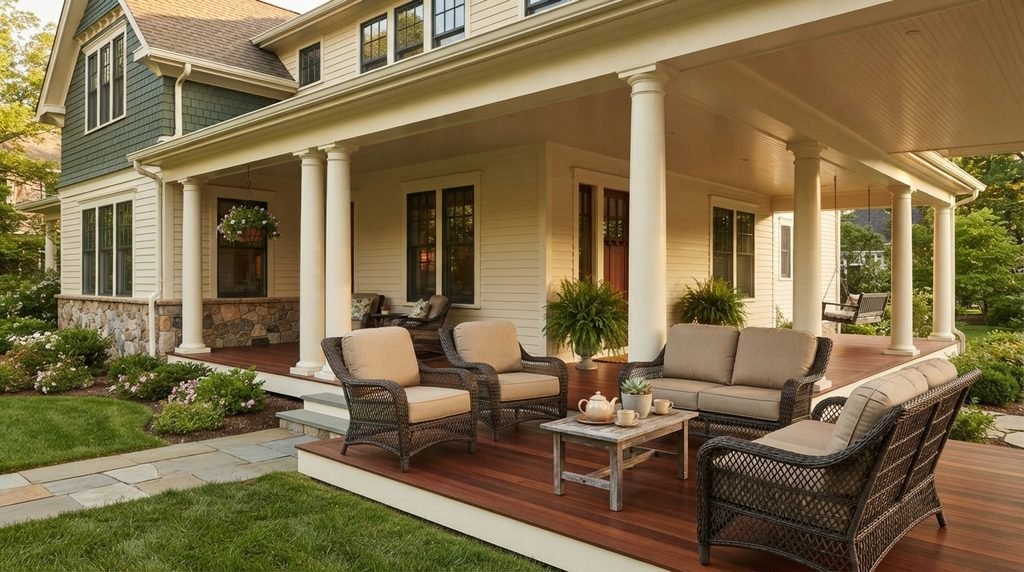
Have you ever seen a house with a covered outdoor area where people sit, drink tea, welcome guests, or simply enjoy the evening breeze? You may have been looking at a veranda.
The veranda meaning is fairly simple: it is a roofed, open or partly enclosed platform attached to the outside of a house or another building. It often sits at ground-floor level and may run along the front or side of the building. Cambridge describes a veranda as a raised, covered area on the front or side of a building, while Oxford defines it as a platform with an open front and a roof attached to the side of a house.
But there is more to this word than a simple architectural definition.
The spelling, pronunciation, regional use, and history of veranda can all cause confusion. Is it the same as a porch? Can a balcony be called a veranda? And why do some people write verandah?
This guide answers all of those questions in clear, everyday English.
Updated for 2026: Let’s explore the meaning, origin, pronunciation, examples, differences, and modern usage of veranda.
What Does “Veranda” Mean?
Veranda Definition
A veranda is a roofed outdoor platform or gallery connected to the exterior of a building. It is usually open on at least one side and is commonly found along the front or side of a house.
Think of it as an outdoor extension of the home: sheltered from direct sun and rain but still open enough to enjoy the outdoors.
For example:
We sat on the veranda and watched the sunset.
Here, veranda refers to the covered outdoor area attached to the house.
Oxford notes that in British English, a veranda is typically a platform with an open front and roof built onto the side of a house at ground-floor level. In North American English, porch is often the more common word for a similar structure.
Quick Answer
A veranda is a roofed, open or partly enclosed outdoor platform attached to a building, usually at ground level. It is commonly used as a shaded place to sit, relax, socialize, or enjoy the outdoors. The word can also be spelled “verandah.”
Where Did the Word “Veranda” Come From?
The history of veranda is surprisingly interesting.
English dictionaries generally connect the word with the Indian subcontinent and Portuguese. Oxford gives the origin as early 18th-century English, from Hindi varaṇḍā, ultimately connected with Portuguese varanda, meaning “railing.”
Merriam-Webster gives a more detailed picture. It says the word may have passed through an Indo-Portuguese form from Portuguese varanda, with related Romance forms such as Spanish baranda. It also notes connections with Hindi and Urdu baraṇḍā, meaning a roofed gallery.
The exact ultimate origin is not completely settled. That’s an important detail because dictionaries do not all give the same explanation.
English usage dates to the early 18th century. Etymonline records veranda and verandah in English around 1711 and describes the term as Anglo-Indian, associated with Hindi and Portuguese.
So the word has traveled quite a linguistic journey:
Portuguese / related European forms → Indian languages → Anglo-Indian English → modern English
The architectural feature itself became particularly useful in warm climates because a covered open area could provide shade, airflow, and a comfortable transition between indoors and outdoors.
Veranda or Verandah?
Both spellings are correct.
- Veranda — widely used in modern English, especially American and international English.
- Verandah — a traditional spelling that remains common in British, Australian, and some other varieties of English.
Cambridge lists verandah as an alternative spelling of veranda.
So if you write:
The house has a beautiful veranda.
or:
The house has a beautiful verandah.
both sentences are correct.
How Do You Pronounce Veranda?
The usual pronunciation is approximately:
vuh-RAN-duh
Cambridge gives the pronunciation as /vəˈræn.də/.
The stress normally falls on the middle syllable:
vuh-RAN-duh
How to Use “Veranda” Correctly in Everyday English
Unlike internet slang or a texting abbreviation, veranda is a standard English noun. You can use it in everyday conversation, writing, travel descriptions, real-estate listings, and literature.
Here are some natural examples:
- We had breakfast on the veranda.
- The hotel has a large veranda overlooking the garden.
- She was sitting on the front veranda.
- The children played near the veranda.
- They added chairs and plants to the veranda.
The word often creates an image of a relaxed outdoor space.
When Should You Use “Veranda”?
Use veranda when you’re talking about a covered outdoor platform attached to a building.
It works especially well when describing:
- houses
- hotels
- cottages
- restaurants
- colonial-style buildings
- tropical homes
- countryside properties
- outdoor sitting areas
For example:
The guesthouse has a wide veranda overlooking the ocean.
That sounds natural because the word identifies a specific architectural feature.
When Should You Avoid It?
You probably shouldn’t use veranda for every outdoor space.
A completely open patio, an upper-floor balcony, or a simple sidewalk awning may be something different.
For example, calling a fifth-floor balcony a veranda could confuse your reader because a traditional veranda is generally associated with a building’s lower level.
Context matters.
Is Veranda Formal or Informal?
Veranda is neither slang nor highly formal language. It is a normal dictionary word.
You can use it in:
- casual conversation
- school assignments
- professional writing
- property descriptions
- travel articles
- architectural discussions
- novels and stories
It is completely safe for work.
Real Conversation Examples Using “Veranda”
1. Between Friends
Maya: Where are you?
Sara: On the veranda. Come outside!
Maya: Give me two minutes.
Here, veranda simply identifies the covered outdoor area where Sara is sitting.
2. Family Conversation
Dad: Has Grandma had her tea?
Mom: Yes. She’s sitting on the veranda enjoying the breeze.
This use gives a warm, relaxed feeling. The veranda becomes a comfortable family space rather than just a structural feature.
3. At a Hotel
Guest: Does the room have a balcony?
Receptionist: It has a private veranda overlooking the garden.
The distinction matters here. A hotel may use veranda to describe a ground-level outdoor platform attached to the room.
4. In a Real-Estate Listing
Agent: This three-bedroom home has a spacious front veranda.
Buyer: Perfect. I was looking for somewhere to sit outside.
In property descriptions, veranda often suggests extra outdoor living space.
5. In a Story
Emma: I spent most summer evenings on the old veranda, listening to the rain.
This is a more literary use. The word helps create a visual setting and atmosphere.
6. In Everyday Conversation
Alex: Where should we have coffee?
Nina: Let’s sit on the veranda. It’s cooler out there.
This is one of the most natural everyday uses of the word.
Common Mistakes & Misunderstandings
Mistake 1: Thinking a Veranda Is Always a Balcony
A veranda and a balcony are not automatically the same thing.
A balcony is usually a platform projecting from an upper floor. A veranda is more commonly a roofed platform attached to the exterior of a building, often at ground level.
So:
Ground floor + roof + open outdoor area = often a veranda
Upper floor + projecting platform = usually a balcony
There can be architectural overlap, so context still matters.
Mistake 2: Assuming Veranda and Porch Are Always Identical
In everyday American English, porch can cover much of the same territory as veranda. Cambridge even lists veranda as a synonym in its American-English discussion of porch.
However, architectural usage can distinguish them.
A veranda often suggests a longer, roofed platform extending along the front or side of a building. A porch can be smaller and may specifically refer to the covered entrance area.
The boundary isn’t universal, though.
Mistake 3: Thinking “Verandah” Is Wrong
It isn’t.
Verandah is a legitimate alternative spelling. Cambridge specifically lists it alongside veranda.
If you see both spellings in books or websites, don’t assume one is a typo.
Generational Confusion
Older speakers may be more familiar with verandah, especially in regions where British English has influenced vocabulary.
Younger speakers may encounter veranda more often through American media, travel websites, home-design content, and real-estate listings.
The meaning remains essentially the same.
Regional Differences
The word can feel more natural in some varieties of English than others.
For example, Oxford notes that porch is usually preferred in North American English for this type of structure, while veranda is especially associated with British English.
Australian and New Zealand English also use veranda for a covered structure, and Oxford records another Australian/New Zealand sense: a roof covering part of the street in front of a shop, similar to an awning.
“Veranda” Across Different Platforms & Demographics
Unlike modern slang terms, veranda doesn’t change meaning dramatically between social platforms.
You might see it in:
TikTok
Travel and home-design videos may use captions such as:
“Morning coffee on the veranda ☕”
Here, the word helps create a relaxed lifestyle image.
Instagram users often use veranda when posting photos of:
- houses
- gardens
- resorts
- outdoor furniture
- vacation homes
- sunset views
Example:
“Slow evenings on the veranda 🌅”
On Reddit, veranda may appear in discussions about home design, architecture, gardening, property renovation, or regional vocabulary.
WhatsApp and Text Messages
Someone might write:
“I’m sitting on the veranda. Come join me.”
No special slang or abbreviation is involved.
Professional Writing
The word is perfectly acceptable in professional writing, especially when describing buildings or property.
For example:
The property includes a covered veranda overlooking the landscaped garden.
That sentence would fit naturally in a real-estate listing.
Veranda vs. Porch vs. Balcony vs. Terrace
These words overlap, but they aren’t always interchangeable.
| Term | Typical Meaning | Common Location |
|---|---|---|
| Veranda | Roofed outdoor platform attached to a building | Usually ground floor |
| Porch | Covered area near or beside a building entrance | Usually ground floor |
| Balcony | Platform projecting from an upper floor | Upper floor |
| Terrace | Open, relatively level outdoor area | Ground or upper level |
| Patio | Paved outdoor sitting area | Usually ground level |
| Portico | Covered entrance supported by columns | Building entrance |
The easiest way to remember the difference is to picture the structure.
A balcony often sticks out from an upper floor.
A patio is generally a ground-level outdoor area and does not need to be attached to the building.
A veranda is usually a roofed outdoor platform connected to the building.
A porch often sits around an entrance, although the term can describe larger covered areas too.
A terrace can be open and may be located at different levels.
Architecture loves exceptions, so don’t treat these as rigid legal definitions. Local usage can vary.
Related Slang, Abbreviations & Alternatives
Veranda isn’t slang, but several related words can appear in the same conversations.
| Related Term | Meaning |
|---|---|
| Porch | A covered outdoor area, often near a building entrance |
| Balcony | An elevated outdoor platform attached to an upper floor |
| Patio | A ground-level outdoor area used for sitting or dining |
| Terrace | A level outdoor space, often open to the sky |
| Portico | A covered entrance supported by columns |
| Deck | A raised outdoor platform, often made of wood or composite material |
| Gallery | A covered passage or long platform, depending on context |
| Lanai | A roofed outdoor living area, especially associated with Hawaii |
| Awning | A covering that projects from a building to provide shade or shelter |
| Gazebo | A freestanding roofed outdoor structure |
Veranda Synonyms
Depending on the building and region, possible alternatives include:
- porch
- covered patio
- portico
- gallery
- covered outdoor area
However, these aren’t perfect synonyms in every situation.
What Is the Opposite of a Veranda?
There isn’t a true dictionary antonym for veranda.
But if you’re contrasting spaces, you might describe something as:
- fully enclosed indoor space
- uncovered outdoor area
- interior room
- open ground-level yard
For example:
We moved from the enclosed room to the open veranda.
The contrast is about indoor versus outdoor space rather than opposite meanings.
FAQs:
What does veranda mean?
A veranda is a roofed outdoor platform or gallery attached to the exterior of a building, usually at ground level. It is often open on one or more sides and may have railings, screens, or columns. People commonly use verandas for sitting, relaxing, dining, socializing, or enjoying outdoor views while remaining protected from direct sun and rain.
Is a veranda the same as a porch?
A veranda and a porch can refer to similar structures, especially in everyday American English. However, a veranda often suggests a larger roofed platform extending along the front or side of a building, while a porch may be a smaller covered area around an entrance. Regional and architectural usage varies, so the words can overlap.
Is a veranda the same as a balcony?
Not usually. A balcony generally projects from an upper floor, while a traditional veranda is usually attached at ground-floor level and may extend along the front or side of a building. Both are outdoor spaces, but their position and construction usually distinguish them. If the outdoor platform is elevated from an upper story, balcony is normally the better word.
How do you pronounce veranda?
Veranda is commonly pronounced vuh-RAN-duh, with the main stress on the middle syllable. Cambridge represents the pronunciation as /vəˈræn.də/. The word can also be spelled verandah, but the pronunciation is essentially the same.
What is the origin of the word veranda?
The word entered English in the early 18th century and is generally connected with Hindi varaṇḍā and Portuguese varanda. Merriam-Webster notes that the exact history is complicated, with related words appearing across Portuguese, Spanish, Hindi, Urdu, and other languages.
Is “verandah” a correct spelling?
Yes. Verandah is a standard alternative spelling of veranda. Cambridge explicitly lists verandah as another form. You may encounter the spelling more often in British, Australian, or older texts, while veranda is very common internationally.
Is a veranda inside or outside?
A veranda is an outdoor or semi-outdoor space. It is attached to the outside of a building and usually has a roof but open sides. Some verandas may have screens, glass, railings, or partial walls, so they can feel partly enclosed while still functioning as an outdoor living area.
Can a veranda be on the second floor?
The traditional definition usually places a veranda at ground-floor level, but real-world architecture can be more varied. Some buildings use the word for larger covered galleries or outdoor platforms on higher levels. If the structure projects from an upper floor, however, balcony or terrace may be more precise depending on its design.
Conclusion:
The veranda meaning is straightforward: it is a roofed outdoor platform attached to a building, usually at ground level and often open on one or more sides.
The word has an interesting history, too. English usage developed through contact with the Indian subcontinent, with dictionaries connecting it to Hindi and Portuguese forms. The spelling verandah is also perfectly valid.
And when you’re comparing it with a porch, balcony, patio, or terrace, remember the basic picture: a veranda is typically a covered outdoor extension of a building. Once you picture it, the meaning becomes easy to remember.
Explore more English word meanings, architecture terms, and everyday vocabulary to build a stronger working vocabulary.

I’m Lina Roys, a passionate writer behind Storevian, where I make words, phrases, slang, and everyday expressions easy to understand. I create clear, engaging, and reader-friendly content to help people find the meanings they’re looking for, quickly and confidently.


