Imagine you’re booking your dream cruise vacation. You’ve picked the itinerary, reserved your cabin, and are filling out the travel forms when you see the phrase “disembarkation port.” If you’ve never encountered this travel term before, it can be surprisingly confusing.
Understanding the disembarkation port meaning is more important than many travelers realize. Whether you’re boarding a luxury cruise, completing a visa application, arranging airport transfers, or reading a ferry schedule, knowing exactly what this term means can help you avoid costly mistakes and unnecessary stress.
The good news? It’s actually a simple concept once someone explains it in plain English.
In this updated 2026 guide, you’ll learn what a disembarkation port is, how it differs from an embarkation port, where you’ll see the term used, and how to interpret it correctly on travel documents and cruise itineraries.
What Does “Disembarkation Port” Mean?
Quick Answer:
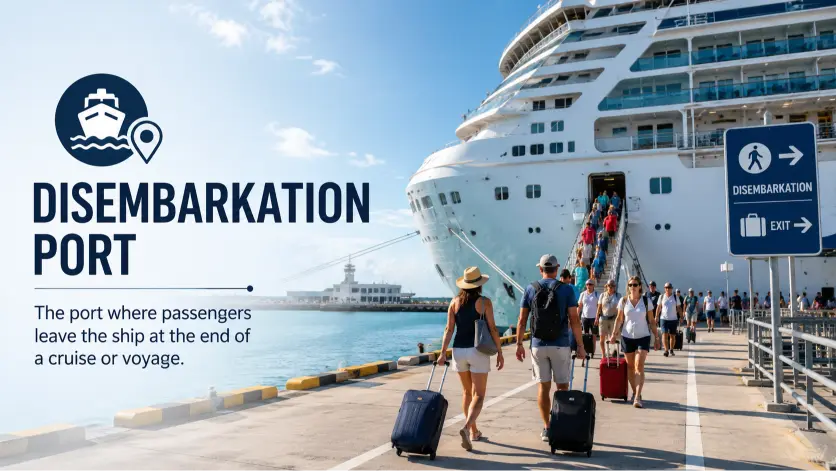
A disembarkation port is the place where passengers officially leave a ship, ferry, or cruise at the end of their journey. It marks the point where your voyage concludes and you exit the vessel permanently rather than during a temporary stop.
Simply put, disembarkation means getting off a ship or boat.
A disembarkation port is therefore the location where your trip officially ends.
For example:
- You board a cruise in Miami.
- You visit Nassau.
- You stop in Cozumel.
- You return to Miami and leave the ship.
Your disembarkation port is Miami because that’s where you permanently exit the cruise.
If instead the cruise ended in Barcelona after starting in Rome, then Barcelona would be your disembarkation port.
Breaking Down the Word
The word disembarkation comes from:
- dis- = off or away
- embark = to board a ship
- -ation = the act or process
So the literal meaning is:
the act of leaving a ship or vessel.
Although the word originally referred to ships, today it’s commonly used in:
- Cruise travel
- Ferry services
- Military transportation
- Immigration documents
- International travel forms
- Maritime logistics
Pronunciation
Disembarkation
Pronunciation:
dis-em-bar-KAY-shun
IPA:
/ˌdɪsɛmbɑːrˈkeɪʃən/
How the Meaning Has Evolved
Historically, people used “disembark” only for ships.
Today, travel professionals sometimes extend the term to describe leaving:
- ferries
- cruise ships
- naval vessels
- river cruises
- even aircraft in certain aviation contexts
However, in everyday English, most people simply say:
- get off the ship
- leave the cruise
- exit the ferry
Travel documents and official forms continue using disembarkation because it’s precise and internationally recognized.
Disembarkation Port vs. Port of Call
Many first-time cruisers confuse these two terms.
| Term | Meaning |
|---|---|
| Disembarkation Port | Where your trip officially ends and you leave the ship permanently. |
| Port of Call | A temporary stop where passengers may go ashore before returning to continue the journey. |
Example
Cruise itinerary:
- Miami
- Nassau
- Cozumel
- Grand Cayman
- Miami
In this itinerary:
- Nassau = Port of Call
- Cozumel = Port of Call
- Grand Cayman = Port of Call
- Miami = Disembarkation Port
Embarkation vs. Disembarkation
These two travel terms are opposites.
| Embarkation | Disembarkation |
|---|---|
| Boarding the ship | Leaving the ship |
| Beginning of the trip | End of the trip |
| Check-in | Final exit |
| Starts your cruise | Ends your cruise |
Think of it like this:
- Embark = Enter
- Disembark = Exit
That’s an easy memory trick many travelers use.
Where You’ll See This Term
The phrase appears more often than people expect.
Common places include:
- Cruise booking confirmations
- Cruise itineraries
- Visa applications
- Immigration declaration forms
- Customs paperwork
- Ferry tickets
- International travel documents
- Maritime passenger manifests
For example:
Port of Embarkation: Seattle
Port of Disembarkation: Vancouver
This tells immigration officials exactly where your voyage begins and ends.
How to Use “Disembarkation Port” Correctly in Texts & Travel
Unlike internet slang, disembarkation port is a formal travel term. You’ll mostly encounter it in official documents rather than casual conversations.
Correct Usage
“Our disembarkation port is Athens.”
“The visa application asks for the disembarkation port.”
“Please arrange transportation from the disembarkation port.”
“Passengers should prepare to leave the ship at the designated disembarkation port.”
When to Use It
Use the phrase when discussing:
- Cruise planning
- International travel
- Immigration forms
- Customs procedures
- Maritime transportation
- Ferry travel
- Travel insurance paperwork
When Not to Use It
In everyday conversation, the phrase can sound overly formal.
Instead of saying:
“I’ll arrive at the disembarkation port around 9.”
Most people naturally say:
“I’ll get off the cruise around 9.”
Or:
“The cruise ends in Seattle.”
Simple language often sounds more natural outside official travel contexts.
Platform-Specific Usage
Travel Booking Websites
You’ll commonly see fields labeled:
- Port of Embarkation
- Port of Disembarkation
- Final Port
- Cruise End Port
Cruise Line Apps
The term is frequently used in:
- baggage instructions
- departure schedules
- customs information
- final departure notices
Travel Forums
Experienced travelers often write:
“Our disembarkation port was Vancouver.”
“Don’t book an early flight on disembarkation day.”
Social Media
On Instagram, Facebook, TikTok, or X, travelers rarely use the full term.
Instead, captions usually say:
- “Last day of the cruise!”
- “Back in Miami.”
- “Cruise officially over.”
The technical term mainly appears in travel blogs, guidebooks, and official cruise information.
Formatting Tips
When writing the term:
- Use lowercase in normal sentences.
- Capitalize it only in forms or headings.
- Avoid abbreviating it, as there is no universally accepted shorthand.
- Pair it with the city or port name for clarity.
Correct:
- Disembarkation Port: Barcelona
- Our disembarkation port is Sydney.
Avoid:
- Dis Port
- D-Port
- DP (unless a specific document defines the abbreviation)
Real Conversation Examples Using “Disembarkation Port”
The easiest way to understand the disembarkation port meaning is by seeing it used in real-life situations. While the phrase is common in travel documents, it also comes up when people discuss cruises, ferries, and international trips.
Example 1: Between Friends Planning a Cruise
Emma: Which city does your cruise end in?
Liam: Our disembarkation port is Vancouver, even though we board in Seattle.
Emma: Nice! So you’re flying home from Canada?
Liam: Exactly.
What it means:
The disembarkation port is where Liam leaves the ship permanently. Since the cruise is one-way, the starting and ending ports are different.
Example 2: At the Cruise Terminal
Passenger: Where do we collect our luggage?
Crew Member: After you disembark at the final port, your luggage will be waiting in the terminal.
Passenger: Great, thanks!
What it means:
The crew member is referring to the official point where passengers leave the ship and retrieve their belongings.
Example 3: Filling Out a Visa Application
Traveler: The form asks for my port of disembarkation. What should I write?
Travel Agent: Enter Barcelona because that’s where you’ll leave the cruise.
Traveler: Even though we’re stopping in France first?
Travel Agent: Yes. Those are just ports of call.
What it means:
Temporary stops don’t count as the disembarkation port. Only the final location where the traveler exits the vessel matters.
Example 4: Family Vacation Planning
Dad: Should we book a hotel in Rome?
Mom: No, our disembarkation port is Athens.
Dad: Right! We’ll need a hotel there instead.
What it means:
Knowing the disembarkation port helps travelers arrange accommodations, airport transfers, and flights.
Example 5: Online Travel Forum
User 1: Can I catch a 9:00 a.m. flight on disembarkation day?
User 2: It depends on customs, luggage collection, and traffic. Most experienced cruisers recommend booking a later flight.
What it means:
Cruise passengers often discuss logistics related to the disembarkation port, especially transportation and departure times.
Common Mistakes & Misunderstandings
Although the term is straightforward, it’s easy to confuse with other travel terminology. Here are the most common mistakes people make.
Mistake 1: Confusing It with the Embarkation Port
Many first-time cruisers assume the embarkation and disembarkation ports are always the same.
That’s true for many round-trip cruises—but not all.
Example
Round-trip cruise:
- Starts: Miami
- Ends: Miami
Embarkation Port = Miami
Disembarkation Port = Miami
One-way cruise:
- Starts: Rome
- Ends: Athens
Embarkation Port = Rome
Disembarkation Port = Athens
Tip: Always check your itinerary before booking flights.
Mistake 2: Mixing It Up with a Port of Call
A port of call is simply a scheduled stop during your journey.
You may leave the ship to sightsee, but you’ll return before the ship sails again.
A disembarkation port, however, is where your cruise officially ends.
Quick Comparison
| Port of Call | Disembarkation Port |
|---|---|
| Temporary stop | Final stop |
| Return to the ship | Leave the ship permanently |
| Continue sailing | Journey ends |
Mistake 3: Assuming It Only Applies to Cruises
While cruises are the most common context, the term also appears in:
- Ferry travel
- Military transportation
- Maritime shipping
- Immigration paperwork
- Customs declarations
- International travel documents
So if you encounter “disembarkation port” on official forms, it isn’t limited to vacations.
Generational Differences
Gen Z
Most younger travelers simply say:
- “Where does the cruise end?”
- “Final stop.”
- “Last port.”
The formal term isn’t used much in casual conversation.
Millennials
Millennials are more likely to recognize the phrase from travel booking websites and cruise apps.
Older Travelers
Frequent cruisers and seasoned travelers often use “disembarkation port” naturally because they’ve seen it on countless itineraries and travel documents.
Regional Differences
The meaning stays consistent worldwide, but wording may vary.
United States
- Port of Disembarkation
- Final Cruise Port
United Kingdom
- Port of Disembarkation
- Arrival Port
Australia & New Zealand
Travel companies often simplify the language with phrases like:
- Cruise Ends Here
- Final Port
How to Clarify If Someone Doesn’t Understand
Instead of saying:
“Our disembarkation port is Barcelona.”
You can simply say:
“Barcelona is where our cruise ends.”
Or:
“That’s the city where we get off the ship.”
Using plain language avoids confusion, especially for people new to cruising.
“Disembarkation Port” Across Different Platforms & Demographics
Unlike internet slang, disembarkation port is a travel industry term. Even so, you’ll encounter it differently depending on where you’re looking.
Cruise Booking Websites
This is where you’ll see it most often.
Typical sections include:
- Embarkation Port
- Disembarkation Port
- Cruise Itinerary
- Boarding Information
- Departure Details
Understanding these labels helps you avoid booking return flights from the wrong city.
Travel Apps
Apps from cruise lines often use the phrase in:
- Daily schedules
- Check-out instructions
- Luggage pickup information
- Customs guidance
- Departure notifications
Visa & Immigration Forms
Government forms frequently ask for:
- Port of Entry
- Port of Departure
- Port of Embarkation
- Port of Disembarkation
Providing the correct information can help prevent delays during processing.
Travel Blogs
Travel bloggers often explain:
- What happens on disembarkation day
- How early passengers leave the ship
- Transportation from the cruise terminal
- Hotel recommendations near the disembarkation port
These guides are especially useful for first-time cruisers.
Social Media
On social platforms, the technical term appears less often.
Instead, you’ll see captions like:
- “Cruise complete!”
- “Back on land!”
- “Final stop.”
- “Home after seven amazing days!”
Travel creators usually use simpler language because it’s easier for a broad audience to understand.
Is It Formal or Informal?
Formal: ✅ Yes
Informal: ❌ Not usually
You’ll mainly encounter the phrase in:
- Cruise contracts
- Booking confirmations
- Government documents
- Travel insurance policies
- Immigration paperwork
- Official travel guides
In everyday speech, people generally replace it with simpler expressions like “where the cruise ends” or “the final stop.”
Is It Safe for Work?
Absolutely.
“Disembarkation port” is a neutral, professional travel term suitable for:
- Business travel
- Academic writing
- Government forms
- Cruise planning
- Tourism websites
- Travel agencies
There’s no slang or informal meaning associated with it.
Related Travel Terms & Alternatives
If you’re learning about the disembarkation port meaning, these related terms will help you better understand cruise and travel terminology.
| Term | Meaning |
|---|---|
| Embarkation Port | The port where you board a ship and begin your journey. |
| Port of Call | A scheduled stop where passengers may temporarily go ashore before continuing the voyage. |
| Final Destination | The last place you plan to travel to; may or may not be your disembarkation port. |
| Arrival Port | The port where a vessel arrives. Depending on context, this may also be the disembarkation port. |
| Departure Port | The location where the ship leaves at the beginning of the trip. |
| Cruise Terminal | The facility where passengers check in, board, or leave a cruise ship. |
| Customs Clearance | The inspection process for passengers and luggage after arriving at the disembarkation port. |
| Immigration Checkpoint | The location where travelers complete entry formalities after leaving the ship. |
| Round-Trip Cruise | A cruise that begins and ends at the same port. |
| One-Way Cruise | A cruise with different embarkation and disembarkation ports. |
Synonyms (Context-Dependent)
- Final port
- Cruise end port
- Arrival port
- End-of-voyage port
Related Opposite Term
- Embarkation port (where the journey begins)
These travel terms frequently appear together, so understanding them makes cruise itineraries and travel documents much easier to read.
FAQs:
What does a disembarkation port mean on a cruise?
A disembarkation port is the final port where passengers permanently leave the cruise ship. After arriving, you’ll collect your luggage, complete any necessary customs or immigration procedures, and continue your journey by heading home, to a hotel, or to another destination.
Is the disembarkation port always the same as the embarkation port?
No. It depends on the itinerary.
- Round-trip cruises usually begin and end at the same port.
- One-way cruises start in one city and finish in another.
For example, a cruise that departs from Seattle and ends in Vancouver has different embarkation and disembarkation ports.
What is the difference between a port of call and a disembarkation port?
A port of call is a temporary stop where passengers can explore before returning to the ship.
A disembarkation port is where your voyage officially ends and you leave the ship for the final time.
Can I leave the cruise before the disembarkation port?
Most cruise lines require passengers to remain on board until the scheduled disembarkation port. Leaving the ship early may only be allowed under special circumstances, such as medical emergencies or with prior approval from the cruise operator and local authorities.
Does “disembarkation” only apply to ships?
Traditionally, yes. The word refers to leaving a ship, ferry, or other watercraft.
However, in some official travel or military contexts, it can also describe passengers leaving other forms of transportation. In everyday English, it’s most closely associated with cruises and ferries
Conclusion:
Understanding the disembarkation port meaning is essential for anyone planning a cruise or completing international travel documents.
While the phrase may sound technical, it simply refers to the place where your journey officially ends and you leave the ship.
Knowing the difference between a disembarkation port, an embarkation port, and a port of call can help you avoid travel mistakes,
choose the right flights, and complete official forms with confidence.
Whether you’re a first-time cruiser or an experienced traveler, this small piece of travel vocabulary can make your trip much smoother.
Have another travel term you’re curious about? Drop it in the comments or explore more travel and language guides to become a smarter traveler!

I’m Lina Roys, a passionate writer behind Storevian, where I make words, phrases, slang, and everyday expressions easy to understand. I create clear, engaging, and reader-friendly content to help people find the meanings they’re looking for, quickly and confidently.


