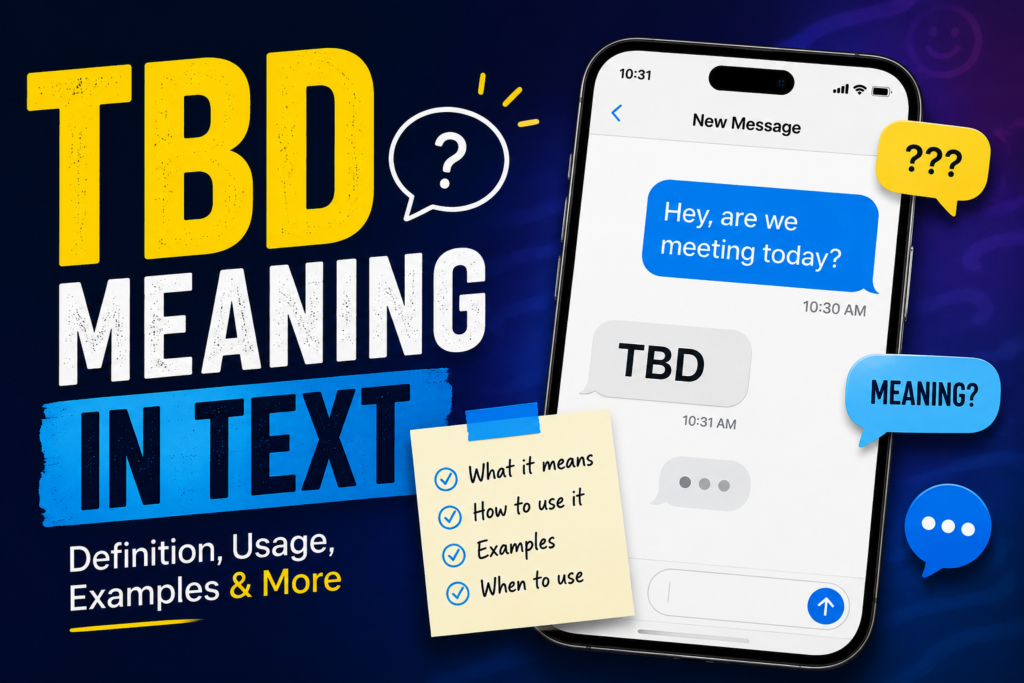
Have you ever received a message saying, “Dinner time is TBD,” or noticed “TBD” on an event invitation? If you weren’t sure what it meant, you’re definitely not alone.
TBD meaning in text is one of the most common abbreviations used in digital communication today. You’ll see it in text messages, emails, calendars, work chats, social media posts, and even school assignments. Although it’s only three letters long, it communicates an important idea—that a decision hasn’t been finalized yet.
Updated for 2026, this guide explains everything you need to know about **tbd meaning in text. You’ll learn its full form, where it came from, how people use it in everyday conversations, the difference between similar abbreviations like TBA, and plenty of real-world examples so you’ll never be confused again.
Whether you’re a student, professional, parent, or simply curious about modern internet abbreviations, this guide will help you understand TBD with confidence.
What Does “TBD” Mean in Text?
Quick Answer
TBD means “To Be Determined.” It tells the reader that a decision, detail, or piece of information has not been finalized yet and will be confirmed later.
The abbreviation TBD stands for To Be Determined.
People use it whenever something is still being decided. Instead of leaving a blank space or writing a long explanation, they simply type TBD.
For example:
- Meeting location: TBD
- Wedding venue: TBD
- Movie night time: TBD
- Project deadline: TBD
In every case, the missing information hasn’t been confirmed yet.
Pronunciation
People usually pronounce it one of two ways:
- “Tee Bee Dee” (letter by letter)
- “To Be Determined” (the full phrase)
Both pronunciations are completely acceptable.
Full Form
| Abbreviation | Full Form | Meaning |
|---|---|---|
| TBD | To Be Determined | Not decided yet |
Origin of TBD
Unlike many internet slang terms that started on platforms like TikTok or Discord, TBD has existed for decades.
The phrase “To Be Determined” was widely used in business, government documents, military planning, engineering projects, and event scheduling long before smartphones became popular.
As texting, email, and online collaboration became part of everyday life, people naturally shortened the phrase to TBD because it’s quicker to type while keeping the meaning perfectly clear.
Today, it’s one of the world’s most recognized abbreviations.
How the Meaning Has Evolved
Originally, TBD mostly appeared in official schedules and planning documents.
For example:
- Conference agenda
- Construction projects
- Government reports
- School timetables
Today, you’ll also see it in casual conversations such as:
“What time are we meeting?”
“TBD 😂”
or
“Vacation destination is still TBD.”
Its meaning hasn’t changed—it simply expanded into everyday digital communication.
When People Use TBD
You’ll commonly encounter TBD whenever details are still uncertain.
Examples include:
- 📅 Event dates
- 📍 Meeting locations
- ⏰ Appointment times
- 🎓 School schedules
- 💼 Work deadlines
- 🎉 Party planning
- ✈️ Travel itineraries
- 🎮 Gaming sessions
Instead of saying:
“We’re still deciding the exact time.”
People simply write:
Time: TBD
It’s shorter, cleaner, and universally understood.
How to Use “TBD” Correctly in Texts & Chat
Using TBD is surprisingly simple, but understanding the right context makes your communication much clearer.
The abbreviation works best whenever information is pending rather than unknown forever.
For example:
“Game night starts at TBD.”
“Location is TBD.”
“Final guest list: TBD.”
Each example tells the reader that an update will come later.
In Text Messages
Friends often use TBD while making plans.
Example
Alex:
Want to grab lunch Saturday?
Sam:
Sure! Time is TBD until I finish work.
Here, Sam already plans to meet but doesn’t know the exact time yet.
In WhatsApp Chats
Family groups frequently use TBD when organizing events.
Mom:
Sunday dinner location: TBD
Everyone understands the place hasn’t been chosen yet.
In Work Chats
Professionals regularly use TBD because it sounds concise and neutral.
Examples:
- Budget: TBD
- Presenter: TBD
- Launch date: TBD
- Final approval: TBD
It saves time while making it obvious that an update is coming later.
In Emails
Business emails often include TBD in schedules or project timelines.
Example:
Training Session

Date: July 28
Venue: TBD
Speaker: TBD
This is completely acceptable in professional communication.
On Social Media
You’ll occasionally see posts like:
“New merch dropping soon 👀 Date: TBD”
or
“Vacation vlog coming soon… destination TBD ✈️”
Creators use it to build anticipation without committing to specific details.
When NOT to Use TBD
Although TBD is versatile, there are situations where it’s not the best choice.
Avoid using it when:
- The answer is already known.
- The information will never be decided.
- Someone expects an immediate response.
- The missing detail is critical and should be explained instead.
For example:
❌ “Your interview result is TBD.”
A recruiter should instead provide a clear timeline or explanation.
Similarly, replying only with “TBD” to an urgent question may come across as vague or unhelpful. Whenever possible, add context, such as:
“The meeting time is TBD—we’ll confirm it by Friday afternoon.”
That small clarification makes your communication much more useful and professional.
Real Conversation Examples Using “TBD“
The easiest way to understand **TBD meaning in text is to see how people use it in everyday conversations. While the abbreviation always means “To Be Determined,” the context changes depending on who you’re talking to.
Between Friends
Emma: Want to watch the new movie this weekend?
Jake: Absolutely! The time is TBD until I know my work schedule.
What it means: Jake has already agreed to the plan, but the exact time hasn’t been decided yet.
Dating Conversation
Chris: Are we still going out Friday?
Taylor: Yes! Restaurant is TBD because I’m checking a few places.
What it means: The date is happening, but the location is still being chosen.
Family Group Chat
Mom: Family BBQ this Sunday!
Dad: Sounds good.
Mom: Park location is TBD. I’ll let everyone know tomorrow.
What it means: The event is confirmed, but one important detail is still pending.
Work Chat
Manager: Client presentation next week.
Employee: What time?
Manager: Time is TBD until the client confirms.
What it means: The meeting hasn’t been scheduled yet, but everyone should expect an update.
Gaming Chat
Player 1: Raid tonight?
Player 2: Yep! Start time is TBD until everyone gets online.
What it means: The gaming session will happen, but players are waiting for everyone’s availability.
School Project
Teacher: Final presentation date: TBD.
Student: Thanks! We’ll keep an eye out for the announcement.
What it means: The teacher hasn’t selected the presentation date yet.
Travel Planning
Friend 1: Which hotel are we booking?
Friend 2: TBD. I’m comparing prices first.
What it means: The decision hasn’t been made because more information is needed.
Emotional Meaning Behind TBD
Although TBD isn’t an emotional abbreviation like LOL or OMG, it still communicates something important.
Depending on the situation, it can suggest:
- Waiting for more information
- Flexibility
- Ongoing planning
- Uncertainty
- Organization
- Future confirmation
For this reason, it’s common in both casual and professional conversations.
Common Mistakes & Misunderstandings
Even though TBD is simple, people sometimes misunderstand or misuse it. Here are the most common mistakes.
1. Confusing TBD with TBA
This is by far the biggest mistake.
Many people think TBD and TBA mean exactly the same thing. They are similar, but not identical.
| Abbreviation | Meaning | When to Use |
|---|---|---|
| TBD | To Be Determined | The decision hasn’t been made yet. |
| TBA | To Be Announced | The decision has already been made but hasn’t been shared yet. |
Example
❌ Concert location: TBA (when the venue hasn’t been selected)
✅ Concert location: TBD
Another example:
The company already chose the keynote speaker but hasn’t revealed the name.
Correct:
Speaker: TBA
The organizers are still choosing the speaker.
Correct:
Speaker: TBD
2. Assuming TBD Means “Cancelled”
This misunderstanding happens quite often.
Imagine you receive this message:
Wedding venue: TBD
Some people think the wedding has been postponed or cancelled.
That’s incorrect.
TBD only means the information isn’t finalized. The event is usually still happening.
3. Using TBD for Permanent Unknowns
TBD should only describe something that will eventually be decided.
Incorrect:
My favorite movie is TBD.
Unless you’re genuinely still deciding, this sounds odd.
Better:
I haven’t decided my favorite movie yet.
4. Replying Only with “TBD”
Someone asks:
What time should I arrive?
Replying:
TBD
This isn’t very helpful.
A better response is:
Time is TBD. I’ll confirm by this evening.
Adding a timeframe makes the conversation much clearer.
Generational Differences
Different age groups tend to use TBD differently.
Gen Z
- Mostly in group chats
- Discord servers
- TikTok planning
- Gaming communities
- College events
Example:
Beach trip date: TBD 🌊
Millennials
Often use it for:
- Work projects
- Travel plans
- Parenting schedules
- Shared calendars
Gen X & Boomers
Older generations usually recognize TBD from:
- Business documents
- School schedules
- Printed programs
- Company meetings
Many actually knew the abbreviation long before texting became popular.
Cultural Differences
Since TBD is English-based, it appears most often in:
- United States
- Canada
- United Kingdom
- Australia
- New Zealand
However, because English is widely used online, you’ll also find TBD in international workplaces, universities, and gaming communities.
Even many non-native English speakers understand it thanks to social media and global communication.
How to Clarify If Someone Doesn’t Understand
If someone asks:
What’s TBD?
You can simply reply:
It means “To Be Determined.” We haven’t decided that part yet.
Or even more casually:
It just means we’ll figure it out later.
Keeping the explanation simple avoids confusion.
TBD Across Different Platforms & Demographics
One reason TBD has remained popular for decades is its flexibility. Unlike many internet slang terms that rise and fall with trends, TBD works almost everywhere—from business meetings to family group chats.
Here’s how people use it across today’s most common platforms.
SMS & Text Messages
In regular texting, TBD is usually about making plans.
Examples include:
- Dinner time: TBD
- Movie location: TBD
- Weekend plans: TBD
Because texts are short, the abbreviation saves time without losing clarity.
Families, friends, and community groups often use TBD while organizing events.
Common examples:
- Birthday venue: TBD
- Pickup time: TBD
- Guest list: TBD
Since WhatsApp is widely used for coordination, TBD fits naturally into conversations.
On Instagram, TBD appears in:
- Story updates
- Giveaway announcements
- Product launches
- Event countdowns
- Creator posts
Example:
New collection dropping soon.
Release date: TBD 👀
Creators often use it to build excitement before revealing details.
X (formerly Twitter)
Because character limits encourage brevity, TBD is common in posts such as:
Livestream time: TBD.
Patch notes: TBD.
Collaboration announcement: TBD.
The abbreviation communicates uncertainty without using extra words.
Discord
Gaming and online communities rely heavily on TBD.
You’ll often see:
- Tournament brackets: TBD
- Voice chat time: TBD
- Clan meeting: TBD
- Raid schedule: TBD
Discord users appreciate quick, universally understood abbreviations, making TBD a perfect fit.
Reddit users usually write TBD when discussing future updates.
For example:
- AMA date: TBD
- Release schedule: TBD
- Moderator announcement: TBD
It signals that more information will be shared once available.
Is TBD Formal or Informal?
One unique feature of TBD is that it works in both formal and informal communication.
Formal Settings
You can safely use it in:
- Business emails
- Project documents
- Meeting agendas
- School schedules
- Conference programs
Example:
Speaker: TBD
This is completely professional.
Informal Settings
It’s equally common in:
- Text messages
- Group chats
- Social media posts
- Gaming servers
- Family conversations
That versatility is one reason TBD has remained relevant for decades.
Is TBD Safe for Work?
Yes.
Unlike many internet abbreviations, TBD contains no offensive, sarcastic, or slang-related meaning.
It’s appropriate in:
- Schools
- Universities
- Offices
- Government documents
- Professional presentations
- Public announcements
You can confidently use it in almost any environment where information is still pending.
Related Slang, Abbreviations & Alternatives
While TBD (“To Be Determined”) is one of the most widely recognized planning abbreviations, it’s often used alongside similar acronyms. Knowing the difference helps you communicate more clearly.
| Term | Full Form | Meaning | When to Use |
|---|---|---|---|
| TBA | To Be Announced | A decision has been made but hasn’t been shared yet. | Event announcements, speaker names |
| TBC | To Be Confirmed | Waiting for final confirmation. | Meetings, appointments, travel |
| ETA | Estimated Time of Arrival | Expected arrival time. | Deliveries, travel, pickups |
| ASAP | As Soon As Possible | Do something quickly. | Work tasks, urgent requests |
| FYI | For Your Information | Sharing helpful information. | Emails, team chats |
| IMO | In My Opinion | Expressing a personal opinion. | Texts, forums, social media |
| IDK | I Don’t Know | You don’t know the answer. | Casual conversations |
| BRB | Be Right Back | Stepping away briefly. | Chats, gaming |
| N/A | Not Applicable | Doesn’t apply to the situation. | Forms, spreadsheets |
| WIP | Work In Progress | Not finished yet. | Projects, creative work |
Similar Terms
- TBA – Use when something has already been decided but hasn’t been revealed.
- TBC – Use when details are expected to be confirmed soon.
- Pending – A plain-English alternative to TBD.
- Undecided – More conversational than TBD.
- Awaiting Confirmation – Better for formal documents.
Opposite of TBD
FAQs:
What does TBD mean in text?
TBD stands for “To Be Determined.” It means a detail—such as a date, time, location, or decision—has not been finalized yet. It’s commonly used in text messages, emails, calendars, work documents, and social media.
Is TBD professional?
Yes. TBD is widely accepted in professional communication. You’ll frequently see it in meeting agendas, project timelines, conference schedules, business emails, and official documents whenever information is still pending.
Is TBD still commonly used?
Yes. Despite the rise of modern internet slang, TBD remains one of the most frequently used abbreviations in schools, businesses, government organizations, universities, messaging apps, and online communities because it’s simple, professional, and universally understood.
Conclusion:
Whether you’re organizing a meeting, planning a vacation, scheduling a game night, or sending a quick text, **TBD meaning in text is one of the most useful abbreviations you can know.
Remember, TBD stands for “To Be Determined.” It simply tells others that a decision or important detail hasn’t been finalized yet but it will be updated in the future. That’s why you’ll see it everywhere from business documents and calendars to
WhatsApp chats and Instagram posts.
Now that you understand TBD, you’ll know exactly what it means whenever it appears in a message—and you’ll be able to use it confidently in your own conversations.
What’s your favorite text abbreviation? Drop it in the comments below!

I’m Lina Roys, a passionate writer behind Storevian, where I make words, phrases, slang, and everyday expressions easy to understand. I create clear, engaging, and reader-friendly content to help people find the meanings they’re looking for, quickly and confidently.


