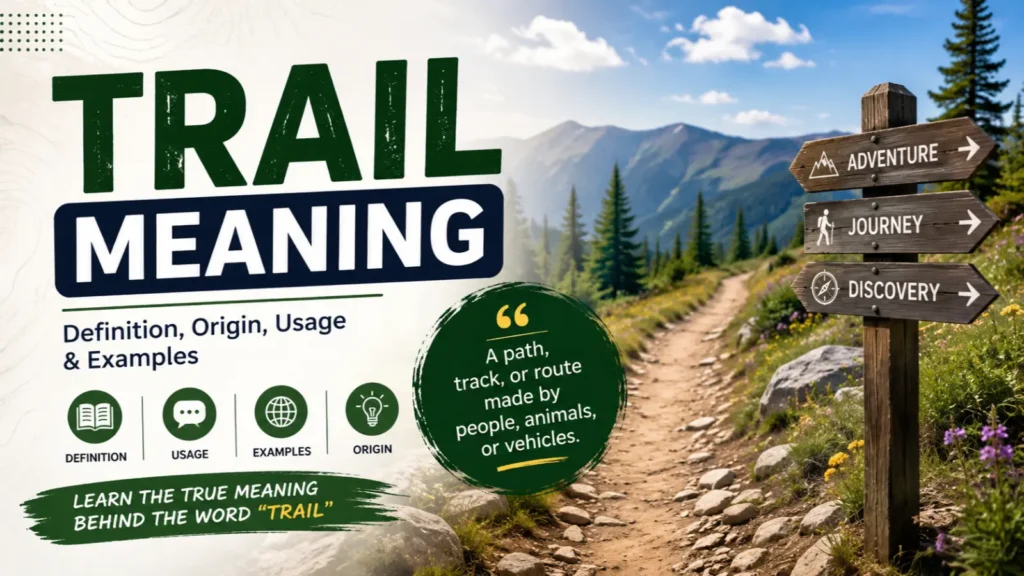
Imagine someone telling you, “Follow the trail,” or hearing a news reporter say that investigators are “following a financial trail.” At first glance, both sentences seem similar—but they’re actually referring to different kinds of trails.
Understanding the trail meaning helps you communicate more naturally because this simple word appears everywhere.
You might encounter it while hiking through a national park, reading a mystery novel, discussing cybersecurity, or even talking about someone’s social media activity.
The interesting part? Trail isn’t limited to outdoor adventures. It has grown into a versatile English word with several literal and figurative meanings used in everyday conversations, business, technology, sports, and entertainment.
In this guide, you’ll discover what trail really means, where it came from, how native speakers use it today, common examples, related expressions, and the mistakes many English learners make. Whether you’re a student, professional, or simply curious about English vocabulary, has everything you need.
What Does Trail Meaning Mean?
Quick Answer
Trail means a path, track, or line that shows where someone or something has gone. It may refer to a physical route through nature, a series of clues, or anything that follows behind another object.
Simply put, a trail helps people follow, discover, or trace something.
Dictionary Definition
As a noun, trail commonly means:
- A path through a forest or countryside
- Marks left by a person or animal
- A sequence of clues leading somewhere
- A route designed for walking, cycling, or horseback riding
As a verb, trail means:
- To follow someone or something
- To drag behind
- To be losing in a race or competition
Pronunciation
Trail
IPA (US): /treɪl/
Sounds like:
TRAYL
Rhymes with:
- sail
- fail
- pale
Origin of the Word Trail
The word trail has been part of English for hundreds of years.
Its roots come from the Old French word trailler, meaning to drag or pull along. Eventually, English speakers adopted the word to describe marks left behind by something being dragged across the ground.
Over time, the meaning expanded.
Today, “trail” can describe:
- hiking routes
- animal tracks
- smoke behind airplanes
- clues in investigations
- digital records
- website activity
- financial transactions
- career progression
This evolution makes trail one of those flexible English words whose meaning depends heavily on context.
Trail Meaning in Different Contexts
One reason people search for trail meaning is that it appears in many situations. Let’s explore the most common ones.
1. Trail in Nature
This is the meaning most people recognize.
A trail is a walking path through forests, mountains, deserts, or parks.
Example:
We spent the afternoon hiking along the mountain trail.
Common phrases:
- hiking trail
- forest trail
- bike trail
- nature trail
- mountain trail
2. Trail as Clues
Investigators often “follow a trail.”
Here, trail means evidence leading toward an answer.
Example:
Detectives followed a trail of fingerprints.
Other examples:
- paper trail
- money trail
- evidence trail
3. Digital Trail
Every online action leaves information behind.
This is known as a digital trail or digital footprint.
Examples include:
- browsing history
- search history
- login records
- online purchases
- location history
Companies and cybersecurity professionals frequently analyze these trails.
4. Trail in Sports
As a verb, trail means to be behind.
Example:
Our team trails by five points.
Here, nobody is walking on a path.
Instead, trail refers to the current score.
5. Trail in Movies and Storytelling
Authors often describe characters as following a trail.
Example:
The detective followed the trail to the abandoned warehouse.
This creates suspense and keeps readers interested.
Literal vs Figurative Meaning
Literal Trail Figurative Trail Forest trail Paper trail Hiking trail Digital trail Bike trail Financial trail Animal trail Trail of evidence Nature path Trail of memories Understanding this difference makes reading and listening much easier.
How to Use Trail Correctly in Texts & Everyday English
Although trail is a common word, choosing the right context is important.
Let’s look at where it fits naturally.
Casual Conversations
Native speakers often use trail when discussing:
- hiking
- vacations
- parks
- travel
- sports
- mysteries
Example:
Have you tried the new hiking trail?
Example:
We lost the trail after the heavy rain.
Example:
The kids followed the nature trail.
At School
Teachers may use trail in subjects like:
History
Explorers followed trading trails.
Science
Animals leave trails behind.
Geography
The Appalachian Trail is one of America’s longest hiking routes.
At Work
Professionals use figurative meanings.
Example:
We need a clear paper trail.
Example:
The audit trail shows every transaction.
Example:
Follow the email trail.
These expressions are especially common in finance, law, accounting, and IT.
Online & Technology
Modern English uses trail frequently in technology.
Examples include:
- digital trail
- browser trail
- data trail
- activity trail
- audit trail
Sentence:
Every click leaves a digital trail.
As a Verb
Trail can also describe following someone.
Example:
The police trailed the suspect.
Or losing in a game.
Example:
The Lakers trailed by ten points before halftime.
When NOT to Use Trail
Avoid replacing every “path” with “trail.”
Incorrect:
The sidewalk trail leads to school.
Better:
The sidewalk path leads to school.
Likewise, don’t confuse trail with:
- road
- highway
- street
- avenue
A trail usually suggests something less formal or naturally formed unless used figuratively.
Capitalization Tips
Generally write:
✅ trail
Capitalize only when it’s part of an official name.
Examples:
- Appalachian Trail
- Pacific Crest Trail
- Oregon Trail
Common Word Combinations
Native speakers frequently pair trail with these adjectives:
- scenic trail
- winding trail
- hiking trail
- narrow trail
- muddy trail
- popular trail
- hidden trail
- historic trail
- mountain trail
- wooded trail
Likewise, you’ll often see figurative combinations like:
- paper trail
- audit trail
- digital trail
- financial trail
- evidence trail
These collocations sound natural and can help you use trail more fluently in both spoken and written English.
Real Conversation Examples Using Trail
Understanding the trail meaning becomes much easier when you see how native English speakers use it in everyday situations. Below are realistic conversations from different settings, along with a quick explanation of what trail means in each context.
Example 1: Between Friends (Hiking Trip)
Emma: Which route are we taking tomorrow?
Jake: Let’s try the lake trail. I heard the views are amazing.
Emma: Perfect! I’ll bring my hiking boots.
Meaning: Here, trail refers to a marked path for hiking through nature.
Example 2: Family Conversation
Mom: Did you find the dog?
Son: Yes! I followed his muddy trail into the backyard.
Mom: Good thinking.
Meaning: In this example, trail means a series of footprints or marks left behind.
Example 3: Office Chat
Manager: Can you find the original invoice?
Accountant: Yes, there’s a complete paper trail in our records.
Manager: Great. That makes the audit much easier.
Meaning: A paper trail is a collection of documents that records transactions or decisions.
Example 4: Detective Story
Officer: We finally found a clue.
Detective: Excellent. Follow the trail and see where it leads.
Officer: I’ll report back as soon as I find something.
Meaning: Here, trail means a chain of clues leading toward a solution.
Example 5: Sports Commentary
Commentator: With only two minutes left, the home team trails by three points.
Meaning: As a verb, trail means to be behind in a competition.
Example 6: Technology Discussion
Alex: Should I delete my browsing history?
Sam: Remember, websites may still keep part of your digital trail.
Meaning: A digital trail refers to information left behind through online activity.
Example 7: Travel Planning
Lily: Is the waterfall difficult to reach?
Guide: Not really. The trail is well marked and suitable for beginners.
Meaning: Here, trail refers to an outdoor walking route.
Example 8: Gaming Chat
Player 1: Where’s the hidden treasure?
Player 2: Follow the glowing trail behind the castle.
Meaning: The word trail describes a route or visual guide leading to an objective.
Emotional Meaning Behind These Examples
Depending on the situation, trail can express different ideas.
| Context | Meaning Conveyed |
|---|---|
| Hiking | Direction and exploration |
| Investigation | Searching for answers |
| Business | Documentation and accountability |
| Sports | Falling behind |
| Technology | Digital activity and records |
| Gaming | Guidance and progression |
| Family | Tracking something or someone |
Notice that the core idea remains the same: a trail helps you follow, trace, or reach something.
Common Mistakes & Misunderstandings
Although trail is a straightforward word, learners often confuse it with similar terms or use it in the wrong context. Here are the most common mistakes.
Mistake 1: Confusing “Trail” with “Path”
Many people assume these words are always interchangeable.
Incorrect
We walked on a trail inside the shopping mall.
Better
We walked along the path inside the shopping mall.
Why?
A trail usually suggests a natural route or an informal track, while a path can exist almost anywhere, including cities, parks, and buildings.
Mistake 2: Mixing Up “Trail” and “Track”
These words overlap, but they’re not identical.
Trail
- Hiking
- Walking
- Nature
- Recreation
Track
- Footprints
- Railway track
- Running track
- Tire marks
Example:
✔ We hiked the forest trail.
✔ The tiger left fresh tracks.
Mistake 3: Forgetting That “Trail” Can Be a Verb
Some learners think trail is only a noun.
Actually, both are correct.
Noun
The mountain trail is beautiful.
Verb
Our team trails by two goals.
Mistake 4: Overusing “Trail”
Not every route is called a trail.
For example:
Highway trail
Airport trail
Office trail (unless referring to documents)
Choose words like:
- road
- street
- route
- avenue
- hallway
when appropriate.
Mistake 5: Misunderstanding Figurative Expressions
Expressions like paper trail or money trail don’t refer to physical paths.
Instead, they describe a sequence of evidence that helps someone understand events or transactions.
Generational Differences
Different age groups may use trail in different ways.
Gen Z
Usually encounters the word through:
- travel videos
- hiking influencers
- gaming
- digital privacy
- online discussions
Common phrases:
- digital trail
- breadcrumb trail
- hiking trail
Millennials
Often hear trail in:
- fitness apps
- camping
- outdoor travel
- workplace discussions
- cybersecurity
Older Generations
More familiar with:
- historical trails
- nature trails
- paper trails
- financial trails
While the contexts vary, the fundamental meaning stays the same.
Cultural & Regional Differences
The meaning of trail changes slightly depending on where English is spoken.
United States
Very common for:
- National Park trails
- hiking trails
- bike trails
Examples include famous long-distance routes across the country.
Canada
Frequently used for:
- snowmobile trails
- hiking trails
- forest trails
United Kingdom
People often say:
- footpath
- public footpath
- walking path
Although trail is still understood, it’s more commonly used for longer recreational routes.
Australia & New Zealand
Trail commonly refers to:
- bushwalking tracks
- cycling trails
- mountain trails
How to Clarify If Someone Doesn’t Understand
If someone looks confused, simply explain the context.
Instead of saying:
Follow the trail.
Try saying:
Follow the hiking path.
Or:
Follow the clues.
Choosing more specific wording makes communication clearer, especially for English learners.
Trail Meaning Across Different Platforms & Demographics
The internet has expanded how people use the word trail. While its basic meaning remains the same, different communities apply it in unique ways.
On TikTok
Travel creators often use:
- hidden trail
- secret trail
- scenic trail
- waterfall trail
These phrases usually accompany hiking videos, travel tips, and outdoor adventures.
On Instagram
You’ll commonly see captions like:
- Found my favorite hiking trail.
- Every trail leads somewhere beautiful.
- Trust the trail.
Travel photographers and nature enthusiasts frequently use the word to describe outdoor experiences.
On Reddit
Discussion topics include:
- backpacking trails
- national park recommendations
- trail conditions
- trail etiquette
- digital privacy and online trails
Users often exchange practical advice and personal experiences.
On Discord
Gaming communities use trail in a more figurative sense.
Examples:
- Follow the quest trail.
- The treasure trail starts here.
- Trail markers unlock the next mission.
In Business & Technology
Professionals regularly use expressions such as:
- audit trail
- paper trail
- transaction trail
- digital trail
- data trail
These phrases emphasize tracking information, ensuring accountability, and maintaining records.
Is “Trail” Formal or Informal?
The answer depends on the context.
Formal
- audit trail
- paper trail
- financial trail
- evidence trail
These are widely accepted in business, legal, and academic writing.
Informal
- hiking trail
- trail adventure
- follow the trail
These fit casual conversations, travel blogs, and social media posts.
Is “Trail” Safe for Work?
Yes.
The word trail is completely safe for work (SFW). It carries no offensive or inappropriate meaning and is appropriate in professional, educational, and everyday settings.
Has “Trail” Become Trendy?
While trail itself isn’t modern slang, interest in the word has grown because of:
- outdoor recreation
- hiking culture
- travel influencers
- environmental awareness
- digital privacy discussions
- cybersecurity topics
Its figurative uses—especially digital trail and audit trail—have become increasingly relevant in the digital age.
Related Words, Synonyms & Alternatives
If you’re exploring the trail meaning, these related terms can help expand your vocabulary. Some are close synonyms, while others are used in specific contexts.
| Word | Meaning | When to Use |
|---|---|---|
| Path | A general walkway or route | Everyday walking |
| Track | Marks or a defined course | Sports, animals, railways |
| Route | Planned direction from one place to another | Travel and navigation |
| Footpath | A path for pedestrians | Parks and urban areas |
| Walkway | Constructed pedestrian route | Cities and buildings |
| Course | A direction or planned route | Navigation, education, sports |
| Passage | A way through a place | Buildings, literature |
| Road | A paved route for vehicles | Transportation |
| Way | General direction or method | Everyday conversation |
| Route Map | Planned travel guide | Navigation and logistics |
Related Expressions
- Paper trail — A documented history of actions or transactions.
- Audit trail — A detailed record used for verification.
- Digital trail — Data left behind through online activity.
- Money trail — Financial records that help trace transactions.
- Trailblazer — A person who leads the way or introduces new ideas.
- Trailhead — The starting point of a hiking trail.
- Nature trail — A walking path through natural surroundings.
- Trail marker — A sign or symbol that guides travelers.
- Follow the trail — Continue tracing clues or a route.
- Off the beaten trail — Away from popular or well-known places.
Suggested Internal Link Opportunities
If your website covers English vocabulary, consider linking to related guides such as:
- Path Meaning
- Track Meaning
- Route Meaning
- Journey Meaning
- Trailblazer Meaning
These related articles can improve user experience and strengthen your site’s topical authority.
FAQs:
What does trail mean in simple words?
Trail means a path, route, or line left behind by someone or something. It can describe a hiking path through nature, footprints, clues in an investigation, or digital records created by online activity. The exact meaning depends on the context, but it generally involves following or tracing something.
Is trail a noun or a verb?
Both. As a noun, a trail is a path, track, or series of marks. As a verb, trail means to follow behind, drag along the ground, or be behind in a race or competition.
Examples:
- The forest trail was quiet. (noun)
- Our team trails by four points. (verb)
What is the difference between a trail and a path?
A path is a general route people use for walking and can be found almost anywhere, including parks, gardens, or cities. A trail usually refers to a natural or recreational route, such as one through a forest or mountain. It can also have figurative meanings, like a paper trail or digital trail.
What does digital trail mean?
A digital trail is the information you leave behind when using the internet or digital devices. This includes browsing history, search queries, app activity, location data, online purchases, and social media interactions. Organizations may use this data for analytics, security, or personalization.
What is a paper trail?
A paper trail is a collection of documents, emails, receipts, or records that show the history of an action or transaction. Businesses, accountants, lawyers, and government agencies often rely on paper trails for audits, investigations, and legal compliance.
What does trail mean in sports?
In sports, trail is commonly used as a verb. It means to be behind the opposing team or competitor in score, points, or time.
Example:
The visitors trailed by seven points before making a comeback.
What are common synonyms for trail?
Depending on the context, common synonyms include:
- Path
- Track
- Route
- Footpath
- Walkway
- Course
- Passage
- Way
- Trackway
- Routeway
Each synonym has a slightly different nuance, so choose the one that best fits the situation.
Is trail a formal or informal word?
The word trail works well in both formal and informal English. In casual conversations, it often refers to hiking or outdoor paths. In professional settings, terms like audit trail, paper trail, and digital trail are widely used in business, finance, law, and information technology.
Conclusion:
The trail meaning goes far beyond a simple path through the woods. While many people associate it with hiking, the word also plays an important role in technology, business, law, sports, and everyday conversations. Whether you’re following a forest trail, tracking a digital trail, or reviewing a paper trail, the central idea remains the same: a trail helps you follow, trace, or discover something.
Learning how trail is used in different contexts makes your English more natural and helps you better understand books, news articles, workplace conversations, and online content. It’s a versatile word that appears in both literal and figurative expressions, making it well worth adding to your active vocabulary.
The next time you hear someone mention a trail, you’ll know exactly what they mean—and why context matters.
What’s your favorite expression using the word “trail”? Share it in the comments, or explore more English vocabulary guides to keep expanding your language skills!

I’m Lina Roys, a passionate writer behind Storevian, where I make words, phrases, slang, and everyday expressions easy to understand. I create clear, engaging, and reader-friendly content to help people find the meanings they’re looking for, quickly and confidently.


