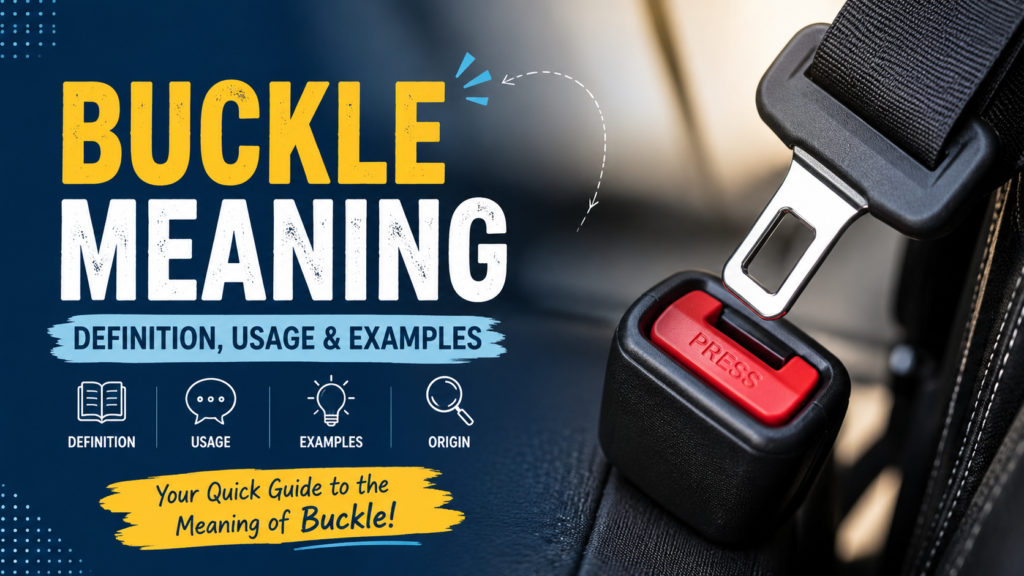
Have you ever been told to “buckle up” before a road trip or heard a sports commentator say a team “buckled under pressure”? Although the word is common in everyday English, many people don’t realize it has several different meanings depending on the situation. Understanding the buckle meaning can help you follow conversations, improve your vocabulary, and use the word confidently in both spoken and written English.
At its most basic, a buckle is a fastening device found on belts, shoes, backpacks, helmets, and many other everyday items. As a verb, however, buckle can mean to fasten something securely, bend under force, or even give in when facing stress or pressure. Because of these multiple meanings, the word appears in everything from fashion and engineering to sports, literature, and casual conversations.
Whether you’re an English learner, student, writer, or simply curious about word meanings, this guide covers everything you need to know. You’ll learn the definition, pronunciation, origin, common uses, real-life examples, idioms, and frequently asked questions—all updated for 2026 to reflect modern English usage.
What Does “Buckle” Mean?

Quick Answer:
Buckle meaning refers to a fastening device used to secure belts, straps, shoes, bags, and other items. As a verb, it means to fasten something with a buckle, bend under pressure, collapse, or give in to stress depending on the context.
The English word buckle serves as both a noun and a verb, making it a versatile part of everyday language.
Buckle as a Noun
When used as a noun, buckle describes a device that joins two ends of a strap or belt together. Most buckles are made from metal or durable plastic and are designed to keep something securely fastened.
Examples include:
- Belt buckles
- Shoe buckles
- Backpack buckles
- Helmet buckles
- Watch buckles
- Dog collar buckles
These fastening devices are practical and often decorative. In fashion, buckles can also serve as stylish accessories that enhance clothing and accessories.
Buckle as a Verb
As a verb, buckle has multiple meanings.
1. To Fasten Something
This is the most literal meaning.
Examples:
- Please buckle your seatbelt.
- She buckled her sandals before leaving.
- He buckled the backpack securely.
In these examples, buckle simply means to fasten using a buckle.
2. To Bend or Collapse
Buckle can also describe an object bending because of pressure or weight.
Examples:
- The bridge buckled after the earthquake.
- The road buckled during the summer heat.
- The shelf buckled beneath the heavy books.
Here, buckle means that the object loses its shape because of excessive force.
3. To Give In Under Pressure
This is a figurative meaning that appears frequently in news reports, sports, politics, and everyday conversations.
Examples:
- She refused to buckle under pressure.
- The company didn’t buckle despite economic challenges.
- The athlete never buckled during the championship.
In these cases, buckle means to lose confidence or surrender when facing difficult circumstances.
Origin and History of the Word
The word buckle has a fascinating history that stretches back hundreds of years.
It originated from the Old French word boucle, meaning loop or ring. This term was later adopted into Middle English, where it referred to a fastening device used on armor, belts, and clothing.
As societies evolved, so did the meaning of the word. Initially, buckle referred only to physical fasteners. Over time, English speakers began using it metaphorically to describe objects bending under force and people yielding under emotional or mental pressure.
Today, buckle is used across many industries, including:
- Fashion
- Automotive safety
- Construction
- Engineering
- Sports
- Psychology
- Journalism
This broad usage has made it one of the most flexible words in modern English.
Pronunciation
Buckle
IPA: /ˈbʌk.əl/
Simple pronunciation: BUH-kuhl
It contains two syllables:
Buck + le
The first syllable rhymes with words like:
- luck
- duck
- truck
The second syllable is pronounced softly as uhl.
Different Meanings of Buckle
Understanding the context is the key to interpreting the correct meaning.
| Meaning | Part of Speech | Example |
|---|---|---|
| Fastening device | Noun | The belt has a silver buckle. |
| Fasten securely | Verb | Buckle your helmet before riding. |
| Bend under pressure | Verb | The floor buckled under the heavy machinery. |
| Give in to stress | Verb | He refused to buckle under criticism. |
Because English relies heavily on context, readers and listeners naturally determine which meaning is intended based on the sentence.
Why Understanding Buckle Meaning Matters

Many English learners initially think buckle only refers to belts. In reality, it appears in many common expressions, safety instructions, news headlines, and professional writing.
You’ll encounter the word when:
- Driving a car
- Reading sports articles
- Watching news reports
- Studying engineering
- Shopping for clothing
- Learning English idioms
How to Use “Buckle” Correctly in Everyday English
Now that you know the basic buckle meaning, let’s look at how native English speakers actually use this word in daily conversations. The correct meaning depends entirely on the context.
1. Using “Buckle” to Mean Fasten
This is the most common and literal use of the word.
You use buckle when securing something with a fastening device.
Examples
- Buckle your seatbelt before driving.
- She buckled her boots tightly.
- Please buckle your helmet securely.
- He buckled the suitcase straps.
- The child couldn’t buckle his backpack.
This meaning is common in:
- Cars
- Airplanes
- Helmets
- Belts
- Shoes
- Backpacks
- Luggage
2. Using “Buckle” to Mean Bend or Collapse
In engineering, construction, and everyday conversation, buckle often describes something that bends because of too much force or pressure.
Examples
- The bridge buckled during the earthquake.
- The road buckled because of the intense heat.
- The chair buckled under his weight.
- The shelf buckled beneath dozens of books.
- The roof buckled after the storm.
Here, buckle doesn’t mean “break completely.” It means the structure bends, warps, or loses its original shape.
3. Using “Buckle Under Pressure”
This is one of the most popular figurative expressions.
When someone buckles under pressure, they cannot handle stress or difficult situations.
Examples
- The team never buckled under pressure.
- She refused to buckle despite criticism.
- Investors worried the market would buckle.
- He didn’t buckle during the interview.
- The company survived instead of buckling.
This phrase is especially common in:
- Sports
- Business
- Politics
- Education
- Personal development
4. The Expression “Buckle Up”
“Buckle up” literally means to fasten your seatbelt.
However, it’s also used as an informal expression meaning:
“Get ready because something exciting, difficult, or surprising is about to happen.”
Literal Examples
- Buckle up before the plane takes off.
- Everyone, buckle up!
Figurative Examples
- Buckle up—we have a busy week ahead.
- Buckle up, this story gets wild.
- Buckle up because the final episode is incredible.
You’ll often hear this phrase in:
- YouTube videos
- Podcasts
- TV shows
- Motivational speeches
- Social media captions
5. The Expression “Buckle Down”
Another common idiom is buckle down.
It means:
To begin working seriously or with greater focus.
Examples
- I need to buckle down and study.
- It’s time to buckle down before the exams.
- The team buckled down to finish the project.
- We all buckled down after lunch.
Unlike “buckle under pressure,” this expression has a positive meaning because it shows determination and hard work.
How Buckle Is Used on Different Platforms
Although buckle isn’t internet slang, it appears frequently in online communication.
SMS & Text Messages
Examples:
- Buckle up 😂
- Buckle up, today is going to be wild.
- Better buckle up.
Tone:
- Casual
- Friendly
- Excited
Examples
Friend:
Buckle up. I’ve got some huge news.
Sibling:
Buckle up—we’re leaving in five minutes.
Tone:
- Conversational
- Humorous
- Dramatic
Popular captions include:
- Buckle up for another adventure.
- Life is a ride—buckle up.
- Buckle up and enjoy the journey.
Travel creators especially love this phrase.
X (Twitter)
Examples:
- Markets may buckle under inflation.
- Buckle up. Election season is beginning.
- Buckle up, football fans.
Here the phrase often builds suspense.
Common uses include:
- Buckle up because this rabbit hole gets deep.
- The server buckled under heavy traffic.
- Buckle under pressure isn’t always a bad thing.
Discord & Gaming
Gamers often say:
- Buckle up, boss fight incoming.
- Don’t buckle now.
- The defense buckled in overtime.
These expressions encourage teammates to stay focused.
When NOT to Use Buckle
Although buckle is common, it’s not always the right word.
❌ Incorrect
The homework buckled me.
✅ Better
The homework overwhelmed me.
❌ Incorrect
Please buckle the door.
✅ Better
Please lock the door.
❌ Incorrect
The computer buckled on.
✅ Better
The computer turned on.
Formatting Tips
When writing buckle, remember:
Usually lowercase.
Capitalize only at the beginning of a sentence or in titles.
Common punctuation:
- Buckle up!
- Buckle your seatbelt.
- Don’t buckle under pressure.
Emoji Pairings
People often pair “buckle up” with emojis.
Popular combinations include:
🚗 Buckle up!
🎢 Buckle up!
😅 Buckle up…
🔥 Buckle up—it’s about to get interesting.
💺 Buckle up before takeoff.
Real Conversation Examples Using Buckle

Example 1 – Between Friends
Emma: Are you ready for the road trip?
Liam: Absolutely.
Emma: Buckle up! We’ve got six hours to drive.
Meaning: A literal reminder to fasten a seatbelt before traveling.
Example 2 – Dating
Alex: I have something important to tell you.
Taylor: Okay…
Alex: Buckle up.
Taylor: Now I’m nervous!
Meaning: Used playfully to prepare someone for surprising news.
Example 3 – Workplace Chat
Manager: This week’s project will be challenging.
Employee: We’re ready.
Manager: Great. Don’t buckle under pressure.
Meaning: Encouraging the team to stay confident during difficult tasks.
Example 4 – Family Conversation
Dad: Everyone buckled in?
Kids: Yep!
Dad: Let’s go!
Meaning: Refers to fastening seatbelts before driving.
Example 5 – Gaming
Final boss ahead.
Time to buckle down.Player 3: Let’s do this!
Meaning: “Buckle down” means to focus seriously on completing a difficult challenge.
Example 6 – Sports
Reporter: Were you nervous in overtime?
Captain: We stayed calm and never buckled under pressure.
Meaning: The team remained mentally strong despite the intense situation.
SEO Tip
Throughout this guide, we’ve naturally used the focus keyword buckle meaning along with related terms such as buckle definition, what does buckle mean, buckle in a sentence, and buckle under pressure to help answer the most common search queries comprehensively.
FAQs:
What is the basic buckle meaning?
A buckle is a fastening device used on belts, straps, shoes, helmets, backpacks, and many other items. As a verb, buckle means to fasten something securely or to bend, collapse, or give in under pressure.
Is buckle a noun or a verb?
Both.
As a noun, it refers to a fastening device.
As a verb, it means to fasten something or to bend and give way under force.
What does “buckle under pressure” mean?
It means someone cannot cope with stress or difficult situations and eventually gives in.
Example:
“The rookie buckled under the pressure of the championship game.”
What does “buckle up” mean?
Literally, it means fastening your seatbelt.
Figuratively, it means preparing yourself for something exciting, difficult, or unexpected.
What is the difference between buckle and fasten?
“Fasten” is a general verb meaning to secure something.
“Buckle” specifically refers to fastening with a buckle or clasp.
Every buckle fastens something, but not everything is fastened with a buckle.
Can buckle describe buildings and roads?
Yes.
Engineers use the word when structures bend or deform because of excessive force, heat, weight, or pressure.
Examples include roads, bridges, rails, walls, and steel beams.
Is buckle a formal English word?
Yes.
It is widely accepted in:
- Academic writing
- Engineering
- Journalism
- Business communication
- Everyday English
Conclusion:
The buckle meaning is much broader than simply describing the clasp on a belt. Depending on the context, it can refer to fastening something securely, bending under pressure, or even giving in during stressful situations.
Because the word appears in everything from safety instructions and engineering reports to sports commentary and everyday conversations, understanding its different meanings can greatly improve your English vocabulary and comprehension.
The next time you hear someone say “buckle up” or read that a bridge “buckled under pressure,” you’ll immediately recognize the intended meaning. Keep exploring new words, practice using buckle in your own sentences, and you’ll build confidence in both spoken and written English.

I’m Lina Roys, a passionate writer behind Storevian, where I make words, phrases, slang, and everyday expressions easy to understand. I create clear, engaging, and reader-friendly content to help people find the meanings they’re looking for, quickly and confidently.


