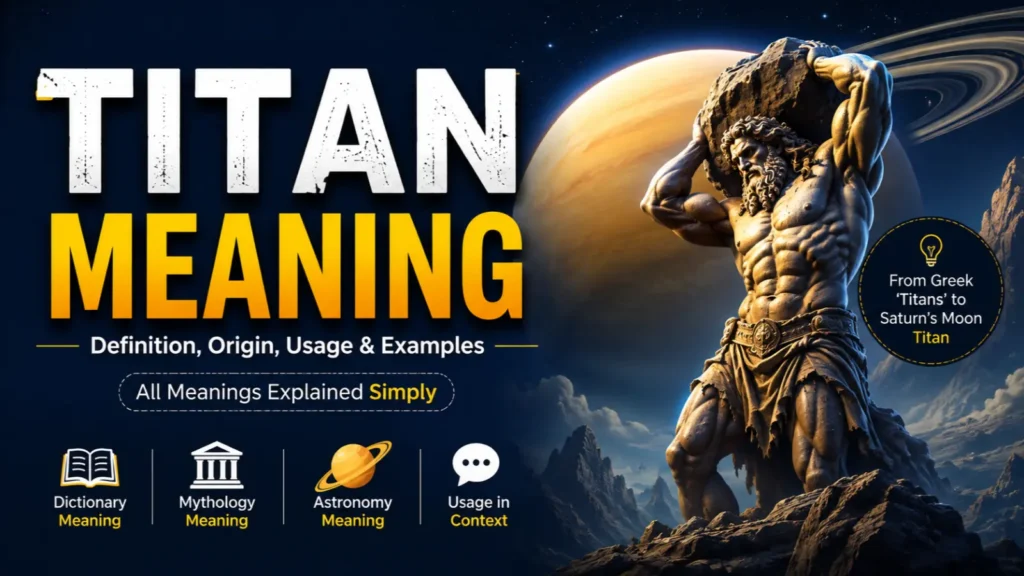
Have you ever heard someone described as a “titan” and wondered if they were talking about a giant creature, a powerful person, or something from ancient mythology?
The word titan meaning has evolved far beyond its mythological roots. Today, people use “titan” to describe someone who dominates a field, achieves incredible success, or has enormous influence. You might hear phrases like “a tech titan,” “a sports titan,” or “a titan of industry” when talking about people who changed the world.
Originally, Titans were powerful beings from Greek mythology who represented strength and authority. Over thousands of years, the word transformed from a name for mythical gods into a symbol of greatness and achievement.
In this complete guide, updated for 2026, you’ll discover what titan really means, where the word came from, how people use it today, and why this simple word carries such a powerful image.
Whether you found the term online, heard it in conversation, or want to understand its deeper symbolism, this guide explains everything you need to know.
What Does “Titan” Mean? (Definition + Origin)
Quick Answer
A titan is a person, thing, or being known for exceptional power, size, importance, or influence. The word originally described the powerful Titans of Greek mythology but now commonly refers to highly successful or dominant figures in areas like business, sports, science, and entertainment.
The simplest titan meaning is: a powerful, influential, or extraordinary person or thing.
When someone calls a person a “titan,” they usually mean that individual has reached an impressive level of success or has a major impact on others.
For example:
- “She is a titan of the fashion industry.”
- “He became a titan in technology.”
- “That company is a titan of global business.”
In each example, “titan” suggests strength, leadership, and importance.
Origin of the Word Titan
The word titan comes from ancient Greek mythology.
According to Greek myths, the Titans were a group of powerful divine beings who ruled the universe before the Olympian gods, including Zeus, Poseidon, and Hades.
The Titans were children of:
- Uranus (the sky)
- Gaia (the Earth)
Some famous Titans include:
- Cronus — leader of the Titans and father of Zeus
- Rhea — mother of several Olympian gods
- Atlas — the Titan famous for holding up the sky
- Prometheus — the Titan associated with giving fire to humanity
The Titans represented enormous strength and cosmic power. Because of this image, the word eventually became associated with anything huge, impressive, or dominant.
How the Meaning Changed Over Time
Originally:
Titan = powerful mythological being
Over time:
Titan = someone or something exceptionally important
Today, the word is used in many areas:
Business
A successful entrepreneur may be called a “business titan.”
Example:
“She became a titan of the technology world.”
Meaning:
She became one of the most powerful and influential people in technology.
Sports
An athlete with legendary achievements may be described as a titan.
Example:
“He was a titan of basketball.”
Meaning:
He was one of the greatest and most respected players.
Entertainment
A famous creator or performer may be called a titan.
Example:
“The director was a titan of cinema.”
Meaning:
The director had enormous influence on movies.
Pronunciation of Titan
The word titan is pronounced:
TY-tan
/ˈtaɪ.tən/
Breakdown:
- Ty → sounds like “tie”
- tan → sounds like “tuhn”
“The company founder became a titan in the industry.”
How to Use “Titan” Correctly in Texts & Writing
The word titan is not slang, but it is commonly used in modern communication, articles, social media, and conversations to describe greatness or dominance.
It carries a strong, positive feeling.
Correct Contexts for Using Titan
1. Describing Successful People
Use “titan” when someone has achieved exceptional success.
Examples:
- “She is a titan in the medical field.”
- “He became a titan of finance.”
The word suggests more than being successful — it implies being among the most influential.
2. Describing Powerful Organizations
Companies and institutions can also be called titans.
Examples:
- “The company is a titan of online retail.”
- “These brands are titans of the entertainment industry.”
Here, “titan” means a dominant or leading organization.
3. Describing Something Huge or Impressive
Titan can describe things beyond people.
Examples:
- “The spacecraft was a titan of engineering.”
- “The mountain stood like a titan above the valley.”
This creates an image of strength and greatness.
Titan in Casual Online Communication
Although “titan” is not a typical texting abbreviation, people use it online in captions, gaming communities, and discussions.
Examples:
Gaming:
“That player is a titan!”
Meaning:
The player is extremely skilled.
Social media:
“A titan of creativity 🔥”
Meaning:
Someone is exceptionally talented.
Sports discussion:
“A true titan of the game.”
Meaning:
A legendary competitor.
When NOT to Use Titan
Because “titan” is a powerful word, it may sound exaggerated in normal situations.
For example:
❌ “My friend is a titan because he finished his homework.”
This sounds overly dramatic.
Better:
✅ “My friend is a genius when it comes to studying.”
Use “titan” for achievements that are genuinely impressive.
Titan vs. Similar Words
| Word | Meaning | Difference |
|---|---|---|
| Titan | Extremely powerful or influential figure | Strongest sense of greatness |
| Giant | Very large or important | More general |
| Legend | Someone admired for achievements | Focuses on reputation |
| Leader | Someone who guides others | Focuses on authority |
| Expert | Someone highly skilled | Focuses on knowledge |
Real Conversation Examples Using “Titan”
Although titan meaning is rooted in mythology, modern speakers use it as a powerful compliment. It often appears in conversations about success, talent, leadership, and achievement.
Here are realistic examples showing how people use the word today.
Example 1: Between Friends (Talking About Success)
Friend 1: “Did you hear Sarah became the CEO of that international company?”
Friend 2: “Yeah, she’s a real titan in the business world now.”
Meaning:
The word “titan” shows admiration. The speaker means Sarah has reached a high level of success and influence.
Example 2: In a Sports Discussion
Fan 1: “Nobody can forget what he achieved during his career.”
Fan 2: “Absolutely. He’s a titan of the sport.”
Meaning:
Here, “titan” suggests the athlete is legendary, respected, and among the greatest in history.
Example 3: In a Gaming Group Chat
Player 1: “Did you see that final match?”
Player 2: “That player is a titan! The strategy was unbelievable.”
Meaning:
In gaming communities, “titan” is often used casually to describe someone extremely skilled or dominant.
Example 4: Family Conversation
Parent: “Your grandfather built that entire business from nothing.”
Child: “Wow, he was a titan of his generation.”
Meaning:
The word expresses respect for someone’s achievements and lasting impact.
Example 5: Social Media Caption
Instagram Caption:
“Celebrating a titan of creativity and innovation 🚀”
Meaning:
The person being praised is seen as exceptionally talented and influential.
Common Mistakes & Misunderstandings About “Titan”
Even though “titan” seems like a simple word, people sometimes misunderstand how and when to use it.
Mistake 1: Thinking Titan Only Means a Giant Creature
Many people first connect “titan” with huge fictional creatures or monsters.
While the word can suggest something enormous, its modern meaning is usually about:
- Influence
- Power
- Achievement
- Importance
Example:
❌ “He is a titan because he is physically tall.”
✅ “He is a titan because he transformed the technology industry.”
Mistake 2: Using Titan for Small Achievements
Because “titan” carries a powerful meaning, using it for ordinary accomplishments can sound exaggerated.
Example:
❌ “My brother is a titan because he won a small school competition.”
Better:
✅ “My brother is a champion because he won the competition.”
Save “titan” for people or things with major impact.
Mistake 3: Confusing Titans With Gods
In Greek mythology, Titans were powerful divine beings, but they were not the same as the Olympian gods.
The Titans came before famous gods like:
- Zeus
- Athena
- Apollo
- Poseidon
The Titans and Olympians were separate generations of mythological beings.
Generational Differences in Understanding Titan
Different age groups may interpret “titan” differently.
Older Generations
Older speakers may connect the word mainly with:
- Greek mythology
- Classical literature
- Traditional storytelling
Example:
“The Titans were ancient Greek gods.”
Millennials
Many millennials recognize “titan” through:
- Movies
- Books
- Video games
- Business language
Example:
“He’s a titan of the industry.”
Gen Z
Younger users often see “titan” as an internet compliment.
Examples:
- “Bro is a titan 🔥”
- “Absolute titan behavior”
- “Gaming titan”
The meaning becomes more casual and expressive.
“Titan” Across Different Platforms & Demographics
The word titan appears across many digital spaces, but the tone changes depending on the platform.
Titan on TikTok
On TikTok, users often use “titan” as a dramatic compliment.
Examples:
- “This creator is a titan.”
- “A titan among beginners.”
It usually means someone is unusually talented or impressive.
Titan on Instagram
Instagram users commonly use the word in captions about:
- Achievements
- Motivation
- Success stories
- Personal branding
Example:
“Celebrating a titan of innovation.”
The word helps create a feeling of greatness and inspiration.
Titan on Discord and Gaming Communities
Gaming communities use “titan” to describe:
- Powerful players
- Strong characters
- Dominant strategies
- Legendary achievements
Example:
“That boss fight was brutal, but our team played like titans.”
Titan in Professional Communication
In business writing, “titan” is acceptable but should be used carefully.
Good examples:
✅ “A titan of the financial industry”
✅ “A technology titan”
Avoid casual exaggeration in formal reports.
Example:
❌ “John is a titan because he completed the project.”
Better:
✅ “John demonstrated exceptional leadership during the project.”
Related Slang, Words & Alternatives to Titan
Understanding similar words helps you choose the right expression.
| Term | Meaning | Example |
|---|---|---|
| Giant | Someone or something very important | “A giant in science” |
| Legend | A highly respected person | “A sports legend” |
| Powerhouse | Someone extremely capable | “A creative powerhouse” |
| Icon | A widely admired figure | “A fashion icon” |
| Mastermind | A brilliant planner or creator | “A business mastermind” |
| Heavyweight | A major person in a field | “A political heavyweight” |
| Superstar | A highly successful person | “A music superstar” |
| Champion | A winner or supporter | “A champion of change” |
| Genius | Someone exceptionally intelligent | “A scientific genius” |
| Trailblazer | Someone who creates new paths | “A technology trailblazer” |
Synonyms and Antonyms of Titan
Synonyms
Words with similar meanings:
- Giant
- Colossus
- Powerhouse
- Leader
- Legend
- Master
- Influencer
- Authority
- Pioneer
Antonyms
Words with opposite meanings:
- Beginner
- Amateur
- Weakling
- Nobody
- Follower
- Minor figure
FAQs:
What does titan mean in simple words?
A titan means someone or something extremely powerful, successful, or important. The word originally described powerful beings in Greek mythology but is now commonly used to describe influential people, companies, and achievements.
Is titan a positive word?
Yes, titan is almost always positive. Calling someone a titan means you respect their success, strength, influence, or accomplishments. It is usually used as a compliment for people who have made a significant impact.
What is the titan meaning in Greek mythology?
In Greek mythology, Titans were a group of powerful ancient beings who ruled before the Olympian gods. They were associated with enormous strength and cosmic power. Famous Titans include Cronus, Atlas, and Prometheus.
What does “business titan” mean?
A business titan is a person who has achieved extraordinary success and influence in the business world. Entrepreneurs, executives, and founders who transform industries are often described this way.
Can titan be used for a woman?
Yes. Titan is gender-neutral and can describe anyone with exceptional influence or achievement.
Examples:
- “She is a titan of science.”
- “She became a titan in the fashion industry.”
Is titan a name?
Yes, Titan is sometimes used as a personal name. Parents may choose it because it symbolizes strength, power, courage, and greatness.
Conclusion:
The titan meaning goes far beyond ancient mythology. While the word began as a description of powerful Greek beings, today it represents greatness, influence, and extraordinary achievement.
When someone is called a titan, it means they stand out from the crowd. They are not simply successful they have made a noticeable impact.
From business leaders to athletes, creators, and innovators, a titan represents someone who reaches remarkable heights.
Want to learn more powerful words and modern meanings? Explore more vocabulary guides and discover how language shapes the way we communicate.
What word should we explain next? Share your favorite term in the comments!

I’m Lina Roys, a passionate writer behind Storevian, where I make words, phrases, slang, and everyday expressions easy to understand. I create clear, engaging, and reader-friendly content to help people find the meanings they’re looking for, quickly and confidently.


