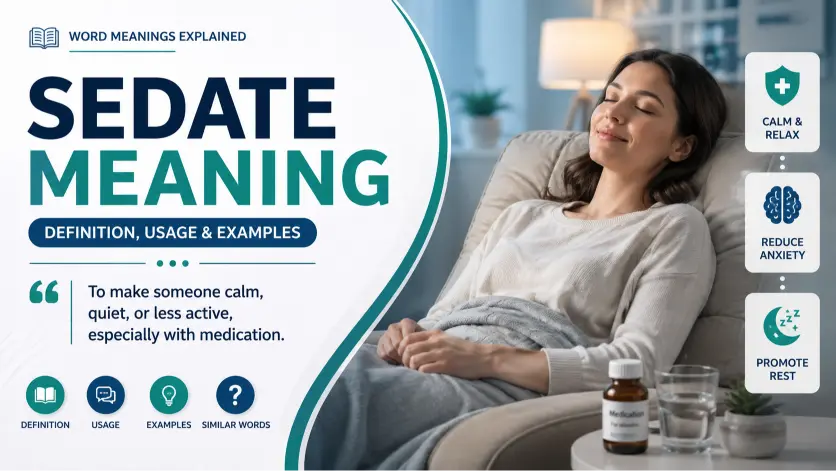
Have you ever read a book describing someone as “sedate” or heard a doctor mention that a patient would be “sedated” before surgery? Although these uses sound similar, they don’t always mean exactly the same thing. Understanding the sedate meaning can help you avoid confusion in everyday conversations, academic writing, and medical discussions.
The word sedate appears in novels, newspapers, workplaces, classrooms, and healthcare settings. Depending on the situation, it can describe a person’s calm personality or the effect of medication that makes someone relaxed or sleepy.
Updated for 2026, this guide explains the meaning of sedate, its origin, pronunciation, common uses, real-life examples, and the difference between its everyday and medical meanings. By the end, you’ll know exactly when—and when not—to use this versatile English word.
What Does Sedate Mean?
Quick Answer
Sedate means calm, composed, quiet, and not easily excited. In medicine, it means to make someone relaxed or sleepy by using sedative medication before or during a medical procedure.
The meaning of sedate changes slightly depending on the context.
Everyday Meaning
In everyday English, sedate describes someone or something that is calm, serious, dignified, or restrained.
For example:
- She has a sedate personality.
- The meeting remained sedate despite the disagreement.
- Their neighborhood is quiet and sedate.
Medical Meaning
In healthcare, sedate is used as a verb.
It means giving medication that helps a person relax, become sleepy, or remain unconscious during a medical procedure.
Examples include:
- The dentist will sedate the patient before surgery.
- The doctor lightly sedated him during the examination.
This medical meaning is where words like sedation and sedative come from.
Word Forms
| Word | Part of Speech | Meaning |
|---|---|---|
| Sedate | Adjective | Calm and composed |
| Sedate | Verb | To calm someone with medication |
| Sedation | Noun | The process of calming medically |
| Sedative | Noun/Adjective | Medicine that causes relaxation or sleep |
| Sedately | Adverb | In a calm or dignified manner |
Origin of the Word
The word sedate comes from the Latin word sedatus, meaning calm or settled. It entered English in the 17th century and was originally used to describe people who behaved with dignity, seriousness, and self-control.
As medical science advanced, doctors adopted the verb sedate to describe the process of calming patients with medication before procedures. Today, both meanings remain common, but context makes the intended meaning clear.
How the Meaning Has Changed
Originally, sedate referred almost exclusively to someone’s personality or behavior.
Over time, medicine gave the word an additional technical meaning.
Today:
- Writers often use it to describe calm people, events, or places.
- Healthcare professionals use it when discussing anesthesia and patient care.
Understanding the surrounding sentence helps determine which meaning is intended.
How to Use Sedate Correctly in Texts & Everyday English
The sedate meaning changes depending on whether you’re describing a person’s behavior or discussing medical treatment.
1. Describing a Person
Use sedate when someone is calm, mature, and composed.
Examples:
- Despite the excitement, she remained sedate.
- The professor spoke in a sedate tone.
- His grandfather has a sedate personality.
This usage often carries a respectful tone.
2. Describing an Event
You can describe events, places, or activities as sedate if they are peaceful rather than energetic.
Examples:
- The wedding was elegant and sedate.
- They enjoyed a sedate evening at home.
- The conference maintained a sedate atmosphere.
3. Medical Context
Doctors use sedate as an action.
Examples:
- The surgeon decided to sedate the patient.
- Children are sometimes sedated during complex procedures.
- The veterinarian sedated the injured animal.
Here, the word refers specifically to medication.
Formal vs. Informal Usage
| Situation | Appropriate? |
|---|---|
| Academic writing | ✅ Yes |
| News articles | ✅ Yes |
| Medical discussions | ✅ Yes |
| Business writing | ✅ Yes |
| Casual conversation | ✅ Yes |
| Internet slang | ❌ Rarely |
Unlike many trendy expressions, sedate is a standard English vocabulary word rather than internet slang.
Should You Use It in Text Messages?
You can, but it’s uncommon.
Instead of saying:
“I’m feeling sedate today.”
Many people simply say:
- I’m relaxed.
- I’m calm.
- I’m taking it easy.
- I’m feeling peaceful.
However, sedate may appear in conversations among native English speakers who have a strong vocabulary or in literary writing.
Capitalization & Formatting Tips
- Write sedate in lowercase unless it begins a sentence.
- No special punctuation is required.
- It pairs naturally with descriptive words such as:
- calm
- quiet
- composed
- dignified
- peaceful
Example:
The audience remained remarkably sedate throughout the presentation.
When Not to Use “Sedate”
Avoid using sedate when you simply mean:
- excited
- energetic
- enthusiastic
- loud
- chaotic
For example:
❌ The party was sedate and full of wild dancing.
This sentence is contradictory because sedate suggests the opposite of energetic behavior.
Instead, choose words like lively, vibrant, or energetic when describing exciting situations.
Real Conversation Examples Using Sedate
Understanding the sedate meaning becomes much easier when you see it used in real conversations. Below are several everyday scenarios showing both the adjective (calm, composed) and verb (to calm with medication) forms.
Example 1: Between Friends
Emma: That party wasn’t what I expected.
Liam: Yeah, it was much more sedate than last year’s.
Emma: Honestly, I enjoyed the quieter atmosphere.
What it conveys: Here, sedate means calm, relaxed, and less energetic than expected.
Example 2: Family Conversation
Mom: Grandma always stays so calm during family gatherings.
Dad: She’s naturally very sedate.
Mom: I wish I had that kind of patience!
What it conveys: The word describes someone’s composed and dignified personality.
Example 3: Workplace Chat
Manager: The presentation went smoothly.
Employee: I tried to keep my tone sedate and professional.
Manager: It definitely helped everyone stay focused.
What it conveys: Sedate suggests a measured, serious, and professional approach.
Example 4: At the Hospital
Patient: Will I be awake during the procedure?
Doctor: We’ll lightly sedate you so you’re comfortable.
Patient: That makes me feel much better.
What it conveys: Here, sedate is a medical verb meaning to administer medication that helps someone relax or sleep.
Example 5: Book Club Discussion
Sarah: The novel starts slowly.
Alex: True, but I like its sedate pace.
Sarah: It gives you time to appreciate the characters.
What it conveys: Sedate describes something calm, steady, and unhurried.
Example 6: Online Gaming Chat
Everyone’s arguing in voice chat again.
: Let’s keep things more sedate and focus on the match.
Good idea.
What it conveys: The speaker encourages a calmer, more respectful conversation.
Example 7: Teacher and Student
Teacher: Your speech was very clear.
Student: I was worried it sounded too sedate.
Teacher: Calm delivery often sounds more confident than shouting.
What it conveys: A sedate speaking style can project confidence and professionalism.
Common Mistakes & Misunderstandings
Although sedate is a straightforward word, people often misuse it because it has both everyday and medical meanings.
Here are the most common mistakes to avoid.
1. Thinking “Sedate” Always Means Sleepy
This is probably the biggest misunderstanding.
Many learners assume sedate always refers to medication.
That’s only true in medical contexts.
Incorrect
She has a sedate personality, so she must always be sleepy.
Correct
She has a sedate personality, meaning she’s calm and composed.
Remember: In everyday English, sedate usually describes behavior—not drowsiness.
2. Using It to Mean “Boring”
A calm event isn’t necessarily boring.
Many elegant weddings, museums, libraries, and concerts are sedate without being dull.
Incorrect
The concert was sedate because everyone hated it.
Better
The concert had a sedate atmosphere with soft classical music.
3. Confusing “Sedate” with “Sedentary”
These two words sound similar but have different meanings.
| Word | Meaning |
|---|---|
| Sedate | Calm, composed, or medically relaxed |
| Sedentary | Spending most of the time sitting with little physical activity |
Example:
- She has a sedate personality.
- He has a sedentary lifestyle.
4. Using It for Highly Energetic Situations
Avoid describing exciting moments as sedate.
Incorrect
- A sedate football final
- A sedate rock concert
- A sedate dance competition
Unless you’re intentionally contrasting expectations, sedate doesn’t fit energetic situations.
5. Forgetting the Context
Because sedate has two meanings, always look at nearby words.
Consider these examples:
The nurse sedated the patient.
Medical meaning.
The audience remained sedate.
Behavioral meaning.
Context tells you everything.
Generational Differences
Different generations may interpret sedate differently.
Gen Z
Most Gen Z speakers rarely use sedate in casual conversations.
Instead, they might say:
- chill
- relaxed
- low-key
- mellow
- peaceful
Millennials
Millennials usually recognize the word from books, workplaces, or news articles.
They may use it occasionally in writing but less often in casual texting.
Gen X & Baby Boomers
Older generations tend to use sedate more naturally, especially when describing people, neighborhoods, or social events.
For example:
It was a very sedate dinner party.
Cultural & Regional Differences
The sedate meaning remains consistent across English-speaking countries, including:
- United States
- United Kingdom
- Canada
- Australia
- New Zealand
However, frequency differs.
British English
The adjective sedate appears more often in newspapers, novels, and formal descriptions.
American English
People are more likely to choose alternatives such as:
- calm
- quiet
- relaxed
- reserved
The medical meaning is equally common worldwide.
How to Clarify the Meaning
If someone misunderstands the word, you can quickly explain which meaning you intend.
For example:
“I mean calm—not medically sedated.”
or
“I’m talking about the medical procedure.”
Adding a little context avoids confusion immediately.
Sedate Across Different Platforms & Demographics
Unlike internet slang such as IMO, TBH, or FR, sedate is a traditional English word.
Still, you’ll encounter it across different platforms.
In Books
Novelists frequently use sedate to describe:
- personalities
- conversations
- neighborhoods
- clothing
- lifestyles
Example:
The village maintained its sedate charm.
On News Websites
Journalists often describe:
- political debates
- ceremonies
- financial markets
- public gatherings
Example:
Trading remained relatively sedate throughout the afternoon.
On Reddit
You’ll occasionally see users write things like:
“The discussion stayed surprisingly sedate.”
Here it simply means civil and respectful.
On X (Twitter)
The word appears mostly in discussions about:
- politics
- economics
- sports analysis
- books
It’s much less common than casual alternatives like “calm” or “chill.”
On Instagram
Lifestyle creators may describe:
- hotels
- cafés
- vacations
- luxury interiors
Example:
A beautifully sedate weekend retreat.
On TikTok
TikTok creators rarely use sedate in captions.
Instead, they prefer words like:
- chill
- cozy
- peaceful
- aesthetic
- low-key
However, educational creators and English teachers often explain the sedate meaning in vocabulary videos.
On Discord
Gamers seldom use sedate, but moderators might.
For example:
Let’s keep the chat sedate and respectful.
Is “Sedate” Formal or Informal?
It works well in both settings.
| Context | Suitable? |
|---|---|
| Academic essays | ✅ Yes |
| Books | ✅ Yes |
| Newspapers | ✅ Yes |
| Business communication | ✅ Yes |
| Casual conversations | ✅ Yes |
| Medical discussions | ✅ Yes |
| Text messages | ✅ Occasionally |
| Internet memes | ❌ Rare |
Is It Safe for Work?
Absolutely.
Sedate is a completely appropriate word in:
- schools
- offices
- hospitals
- universities
- interviews
- presentations
It has no offensive or slang meaning.
Related Words, Synonyms & Alternatives
If you’re learning the sedate meaning, these related words can expand your vocabulary.
| Word | Meaning | When to Use It |
|---|---|---|
| Calm | Free from stress or excitement | Everyday conversations |
| Composed | Emotionally controlled | Professional situations |
| Tranquil | Peaceful and quiet | Nature, places, moods |
| Reserved | Quiet and not overly expressive | Personalities |
| Dignified | Showing respect and self-control | Formal writing |
| Relaxed | Comfortable and at ease | Casual speech |
| Mellow | Gentle and easygoing | Informal conversations |
| Peaceful | Without conflict or noise | Places and events |
| Sedative | Medicine that induces relaxation or sleep | Medical contexts |
| Serene | Calm and untroubled | Literature and descriptive writing |
Synonyms
Depending on the context, you can replace sedate with:
- calm
- composed
- tranquil
- peaceful
- restrained
- dignified
- quiet
- poised
- collected
- relaxed
Antonyms
The opposite of sedate includes:
- energetic
- lively
- animated
- noisy
- chaotic
- restless
- excited
- wild
- vibrant
- boisterous
Learn More About Related Terms
If you’re building your English vocabulary, these topics are also worth exploring:
- Calm meaning
- Reserved meaning
- Composed meaning
- Tranquil meaning
- Sedative meaning
These make excellent internal links for a language-learning website and help readers discover related vocabulary naturally.
Frequently Asked Questions About Sedate Meaning
FAQs:
H3: What does sedate mean in simple words?
Sedate means calm, quiet, and not easily excited. It often describes a person’s behavior, voice, or atmosphere. In medical settings, sedate means giving someone medication to help them relax or sleep before or during a procedure. The intended meaning depends on the context.
H3: Is sedate a positive or negative word?
In most situations, sedate has a positive or neutral meaning. It suggests maturity, self-control, and calmness. However, in some contexts, it can imply that something is too serious or lacks excitement. Whether it’s positive or negative depends on the speaker’s tone and the situation.
H3: What’s the difference between sedate and calm?
Both words describe a peaceful state, but sedate often carries a sense of dignity, restraint, or seriousness. Calm is broader and can describe emotions, weather, or situations. For example, a calm beach is peaceful, while a sedate dinner party is quiet and refined.
H3: Can sedate be used in medical situations?
Yes. In medicine, sedate is commonly used as a verb. Doctors may sedate a patient before surgery, dental work, or other procedures to reduce anxiety, discomfort, or movement. This meaning is different from using sedate to describe a calm personality or atmosphere.
Choose the synonym that best fits the context, as each has a slightly different nuance.
H3: Is sedate commonly used in everyday conversation?
It’s used, but not as often as words like calm, relaxed, or quiet. You’ll encounter sedate more frequently in books, newspapers, academic writing, professional communication, and medical discussions than in casual text messages or social media posts.
Conclusion:
Understanding the sedate meaning is easier once you recognize its two primary uses. In everyday English, sedate describes someone or something that is calm, composed, dignified, or restrained. In medicine, it refers to using medication to help a person relax or sleep before a procedure.
Although sedate isn’t as common in casual conversations as words like calm or relaxed, it’s still an important vocabulary word you’ll see in literature, news articles, workplaces, and healthcare settings. Knowing the context will help you interpret—and use—the word correctly every time.
The next time you come across sedate, you’ll know whether it describes a peaceful personality, a quiet atmosphere, or a medical procedure. Expanding your vocabulary with words like this makes both your reading and communication more precise.
👉 What’s your favorite English word with multiple meanings? Share it in the comments below!

I’m Lina Roys, a passionate writer behind Storevian, where I make words, phrases, slang, and everyday expressions easy to understand. I create clear, engaging, and reader-friendly content to help people find the meanings they’re looking for, quickly and confidently.


