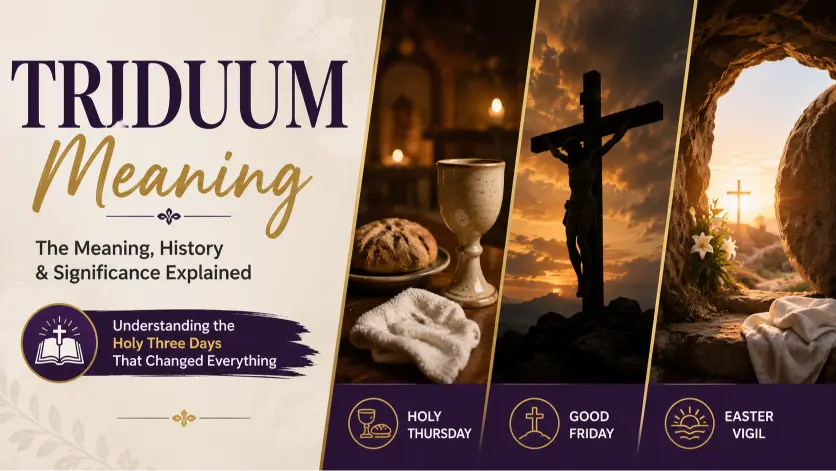
Have you ever heard someone mention the Holy Triduum during Easter and wondered what they were talking about? You’re not alone. Many people encounter the word triduum in church services, religious books, or online discussions but aren’t sure what it actually means.
The triduum meaning is surprisingly simple, yet its importance runs deep. While the word literally means “three days,” it carries profound significance in Christianity, especially during Easter.
Whether you’re studying religion, preparing for Holy Week, or simply expanding your vocabulary, understanding this term gives valuable insight into one of Christianity’s most sacred observances.
In this guide, you’ll discover the definition of triduum, where the word comes from, why it matters in Christian traditions, how it’s used today, and examples that make the concept easy to understand.
Updated for 2026, this guide combines historical background, practical explanations, and modern usage to answer everything you need to know.
What Does “Triduum” Mean?
Quick Answer:
Triduum means “three days.” In Christianity, it most often refers to the Holy Triduum, the three sacred days commemorating Jesus Christ’s Passion, Crucifixion, Death, Burial, and Resurrection.
Unlike many religious terms that have multiple meanings, triduum has remained remarkably consistent throughout history. Although the word can technically describe any three-day period devoted to prayer or religious observance, it almost always refers to the Easter Triduum.
Simple Definition
A triduum is:
- A religious observance lasting three consecutive days.
- Most commonly the period from Holy Thursday evening through Easter Sunday evening.
- The climax of the Christian liturgical year.
Many churches consider these three days not as separate celebrations but as one continuous liturgy spread across three days.
The Origin of the Word “Triduum”
The word comes directly from Latin.
- Tri = three
- Dies = day
Combined, triduum literally means “three-day period.”
The term has been used in Christian worship for centuries and became closely associated with Easter because those three days represent the central events of Christian belief.
Today, you’ll hear it in:
- Catholic churches
- Anglican churches
- Lutheran churches
- Orthodox Christian discussions
- Religious education
- Theology books
- Academic articles about Christianity
Pronunciation Guide
Most English speakers pronounce it as:
TRID-oo-um
IPA:
/ˈtrɪd.uː.əm/
Break it down:
Tri → “trid”
du → “doo”
um → “uhm”
Putting it together:
TRID-oo-um
Why Is the Holy Triduum So Important?
The Holy Triduum commemorates the most significant events in Christianity.
begins on the evening of Holy Thursday with the remembrance of the Last Supper.
continues through Good Friday, honoring Jesus Christ’s crucifixion.
reaches its joyful conclusion on Easter Sunday, celebrating the Resurrection.
Rather than being three unrelated holidays, Christians view these events as one connected story of sacrifice, redemption, and hope.
The Three Days at a Glance
| Day | Main Event | Meaning |
|---|---|---|
| Holy Thursday | Last Supper | Jesus institutes the Eucharist and washes the disciples’ feet. |
| Good Friday | Crucifixion | Christians remember Jesus’ suffering and death. |
| Easter Vigil & Easter Sunday | Resurrection | Celebration of Jesus rising from the dead. |
How to Use “Triduum” Correctly in Texts & Conversations
Although triduum isn’t internet slang or a texting abbreviation, it’s a useful vocabulary word in conversations about religion, history, education, and culture.
Here’s how people commonly use it.
Casual Conversation
You might hear:
“Our church is preparing for the Holy Triduum.”
“I’m attending all the Triduum services this year.”
“The Easter Triduum begins on Thursday evening.”
These uses sound natural because the speaker is referring to the religious observance rather than simply saying “three days.”
In Religious Discussions
The word frequently appears in:
- Church bulletins
- Sermons
- Bible study groups
- Theology classes
- Christian podcasts
- Religious books
Example:
“The Triduum is the most sacred period of the liturgical calendar.”
On Social Media
Around Easter, Christians often post messages such as:
- “Praying throughout the Holy Triduum.”
- “Wishing everyone a blessed Triduum.”
- “Reflecting on the meaning of the Triduum this Easter.”
These posts are common on:
- X (formerly Twitter)
- Church websites
- Parish newsletters
When NOT to Use the Word
Because triduum is a religious and somewhat formal term, it usually doesn’t belong in everyday conversations unless you’re discussing Christianity or church traditions.
Avoid using it:
- In casual workplace conversations unrelated to religion
- As a substitute for any random three-day event
- When your audience may not understand the term without explanation
For example:
❌ “I’m taking a triduum vacation.”
Instead say:
✅ “I’m taking a three-day vacation.”
Formatting Tips
The word is usually written:
- Triduum (capitalized) when referring specifically to the Holy Triduum
- triduum (lowercase) when referring to a generic three-day devotional period
Examples:
Holy Triduum
Easter Triduum
A prayer triduum before the feast day
Is It Formal or Informal?
| Situation | Appropriate? |
|---|---|
| Church bulletin | ✅ Yes |
| Religious article | ✅ Yes |
| Theology class | ✅ Yes |
| Academic writing | ✅ Yes |
| Texting about Easter | ✅ Yes |
| Everyday casual slang | ❌ Usually No |
The term is considered formal, respectful, and religious rather than modern slang or internet shorthand.
Real Conversation Examples Using “Triduum”
Understanding a definition is helpful, but seeing triduum used in real conversations makes it much easier to remember. Below are realistic examples from different situations.
Example 1: Between Friends
Emma: Are you coming to church this Thursday?
Lucas: Yes! I’m planning to attend all the Holy Triduum services this year.
Emma: That’s great. Easter feels much more meaningful when you experience the whole Triduum.
What it conveys:
Here, Triduum refers to the complete three-day Easter celebration, showing commitment and spiritual preparation.
Example 2: Family Conversation
Mom: Don’t forget the Good Friday service tomorrow.
Daughter: I won’t. Since we’re observing the Triduum, I want to attend every service.
Mom: It’ll be a wonderful way to prepare for Easter.
What it conveys:
The speaker uses Triduum to describe participating in all three sacred days rather than attending only Easter Sunday.
Example 3: Church Group Chat
Leader: Reminder: The Holy Thursday Mass begins at 7:00 PM.
Member: Thanks! Looking forward to celebrating the Triduum together.
Leader: See everyone there.
What it conveys:
The word creates a sense of community and shared worship among church members.
Example 4: Classroom Discussion
Teacher: Does anyone know what the word triduum means?
Student: It literally means “three days.”
Teacher: Exactly. Christians usually use it to refer to the three days before Easter.
What it conveys:
This example focuses on the literal meaning while introducing its religious context.
Example 5: Social Media Post
“Wishing everyone a peaceful and blessed Holy Triduum. May these sacred days prepare our hearts for Easter.”
What it conveys:
The term is used respectfully and reflects the spiritual importance of the Easter season.
Common Mistakes & Misunderstandings
Although triduum has a straightforward definition, it’s often misunderstood—especially by people unfamiliar with Christian traditions.
Here are the most common mistakes.
1. Thinking Triduum Means Only Good Friday
Many people assume the word refers only to Jesus’ crucifixion.
That’s incorrect.
The Holy Triduum includes:
- Holy Thursday evening
- Good Friday
- Holy Saturday
- Easter Vigil and Easter Sunday
Good Friday is only one part of the Triduum.
2. Assuming It’s Exclusively Catholic
Another common misconception is that only Catholics observe the Triduum.
In reality, many Christian denominations celebrate it, including:
- Roman Catholic
- Anglican
- Lutheran
- Episcopal
- Some Methodist churches
- Eastern Christian traditions (with different liturgical practices)
While customs vary, the three-day remembrance is recognized across much of Christianity.
3. Using It for Any Three-Day Event
Because the Latin word literally means “three days,” some people use triduum for vacations, festivals, or conferences.
In modern English, that’s usually incorrect.
Outside religious contexts, it’s clearer to simply say:
- three-day trip
- three-day event
- weekend retreat
Generational Differences
Older Generations
Older Christians—especially those who regularly attend church—are generally familiar with the term Holy Triduum.
Millennials
Many Millennials recognize the word if they participate in Easter services but may not use it in everyday conversation.
Gen Z
Among Gen Z, triduum isn’t part of everyday vocabulary unless they’re active in church communities or religious education.
Instead, younger users are more likely to refer simply to:
- Easter weekend
- Holy Week
- Good Friday services
Cultural Differences
The meaning remains consistent worldwide, but traditions differ.
Europe
Countries like Italy, Spain, and Poland often celebrate the Triduum with large public processions and centuries-old customs.
North America
Churches usually focus on liturgical services, prayer, Scripture readings, and community worship.
Latin America
Holy Week celebrations often include dramatic reenactments, processions, and cultural festivals that highlight the significance of the Triduum.
Asia and Africa
Christian communities observe the Triduum through local traditions while maintaining the same core religious meaning.
How to Clarify If Someone Doesn’t Understand
If someone asks, “What’s a Triduum?”
A simple explanation works best:
“It’s the three holiest days before Easter when Christians remember Jesus’ Last Supper, death, and resurrection.”
This concise definition is easy for people of all backgrounds to understand.
Triduum Across Different Platforms & Demographics
Unlike internet slang, triduum is primarily used in religious, educational, and community settings. Its popularity depends more on faith traditions than on age.
How Gen Z Uses It
Young Christians may use the word when:
- Posting Easter reflections on Instagram
- Sharing church event photos
- Creating faith-based TikTok content
- Participating in youth ministry discussions
Outside these circles, many Gen Z users are unfamiliar with the term.
How Millennials Use It
Millennials often encounter Triduum through:
- Church bulletins
- Parenting children in faith communities
- Bible study groups
- Easter event planning
They tend to use the term correctly, especially during Holy Week.
Older Generations
Older Christians are generally the most familiar with the term because of lifelong participation in church traditions.
For many, attending every Triduum service is an annual practice.
Usage on Different Platforms
Churches frequently post:
- Holy Thursday schedules
- Good Friday reflections
- Easter Vigil reminders
- Triduum prayer resources
Common content includes:
- Church decorations
- Scripture verses
- Holy Week reflections
- Inspirational Easter graphics
X (formerly Twitter)
Short posts often include:
- Easter greetings
- Prayer requests
- Bible verses
- Holy Week reminders
YouTube
Many churches livestream:
- Holy Thursday Mass
- Good Friday services
- Easter Vigil celebrations
- Educational videos explaining the Triduum
Religious communities discuss topics such as:
- Why the Triduum matters
- Liturgical traditions
- Differences between denominations
- First-time experiences attending Easter services
Is It Formal or Informal?
| Setting | Appropriate? |
|---|---|
| Church announcements | ✅ Yes |
| Religious books | ✅ Yes |
| Academic writing | ✅ Yes |
| Theology discussions | ✅ Yes |
| Everyday casual texting | ⚠️ Sometimes |
| Business emails | ❌ No |
The term is respectful and formal. While it’s perfectly acceptable in personal messages about Easter, it isn’t used as everyday slang.
Related Terms, Religious Words & Alternatives
If you’re learning the triduum meaning, these related terms can help you better understand Holy Week and Christian worship.
| Term | Meaning |
|---|---|
| Holy Week | The week leading up to Easter, beginning with Palm Sunday. |
| Good Friday | The day Christians remember Jesus’ crucifixion. |
| Holy Thursday (Maundy Thursday) | Commemorates the Last Supper of Jesus with His disciples. |
| Holy Saturday | The day between Jesus’ crucifixion and resurrection. |
| Easter Vigil | The evening service celebrating Christ’s resurrection. |
| Paschal Mystery | Jesus’ passion, death, resurrection, and ascension. |
| Lent | A 40-day season of prayer, fasting, and repentance before Easter. |
| Resurrection | Jesus rising from the dead on Easter Sunday. |
| Passion of Christ | The suffering and crucifixion of Jesus. |
| Liturgical Year | The annual cycle of Christian seasons and celebrations. |
FAQs:
What does triduum mean in Christianity?
The triduum meaning in Christianity refers to the three most sacred days of the Christian liturgical year. Known as the Holy Triduum, it begins on the evening of Holy Thursday and concludes on the evening of Easter Sunday. During this time, Christians remember Jesus Christ’s Last Supper, crucifixion, burial, and resurrection.
Is the Holy Triduum the same as Holy Week?
No. Although they’re closely connected, they are not the same.
Holy Week begins with Palm Sunday and includes several important days leading up to Easter. The Holy Triduum is the final three-day period of Holy Week and is considered its spiritual climax.
Why is it called a triduum?
The word comes from the Latin triduum, meaning “three days.”
It combines the ideas of:
- Tri = three
- Dies = days
The name reflects the continuous three-day celebration commemorating the Passion, Death, and Resurrection of Jesus Christ.
How do you pronounce triduum?
The most common English pronunciation is:
TRID-oo-um
IPA: /ˈtrɪd.uː.əm/
Saying it slowly as TRID – oo – um helps many first-time learners pronounce it correctly.
Do all Christians celebrate the Holy Triduum?
Many Christian denominations observe the Holy Triduum, though traditions vary.
These include:
- Roman Catholic
- Anglican
- Lutheran
- Episcopal
- Some Methodist churches
- Eastern Christian traditions
Each denomination may have different liturgies and customs, but all focus on remembering the final events of Jesus’ earthly ministry.
Can “triduum” refer to something other than Easter?
Yes.
While the Holy Triduum is by far the most common usage, the word can also describe any three-day period of prayer or religious devotion. For example, some churches hold prayer tridua before feast days or special celebrations. However, without additional context, most people assume Triduum refers to Easter.
Is triduum a common English word?
Not really.
Outside religious communities, triduum isn’t used frequently in everyday English. Most people encounter it in church services, religious education, theological writings, or discussions about Holy Week.
Is the Holy Triduum considered one celebration?
Yes.
Although it spans three calendar days, the Church views the Holy Triduum as one continuous liturgical celebration. Each service flows into the next, culminating in the Easter Vigil and Easter Sunday celebration of the Resurrection.
Conclusion:
The **triduum meaning is simple on the surface, it literally means “three days.” Yet within Christianity, it represents far more than a period of time. The Holy Triduum commemorates the central events of the Christian faith: Jesus’ Last Supper, His sacrifice on the cross, and His resurrection.
Whether you’re reading the Bible, attending Easter services, studying Christian history, or simply expanding your vocabulary, understanding triduum gives you deeper insight into one of Christianity’s most meaningful traditions.
If you found this guide helpful, explore more of our meaning articles to build your vocabulary and better understand religious, historical, and everyday terms.
And if you have a favorite word or phrase you’d like us to explain next, let us know in the comments!

I’m Lina Roys, a passionate writer behind Storevian, where I make words, phrases, slang, and everyday expressions easy to understand. I create clear, engaging, and reader-friendly content to help people find the meanings they’re looking for, quickly and confidently.


