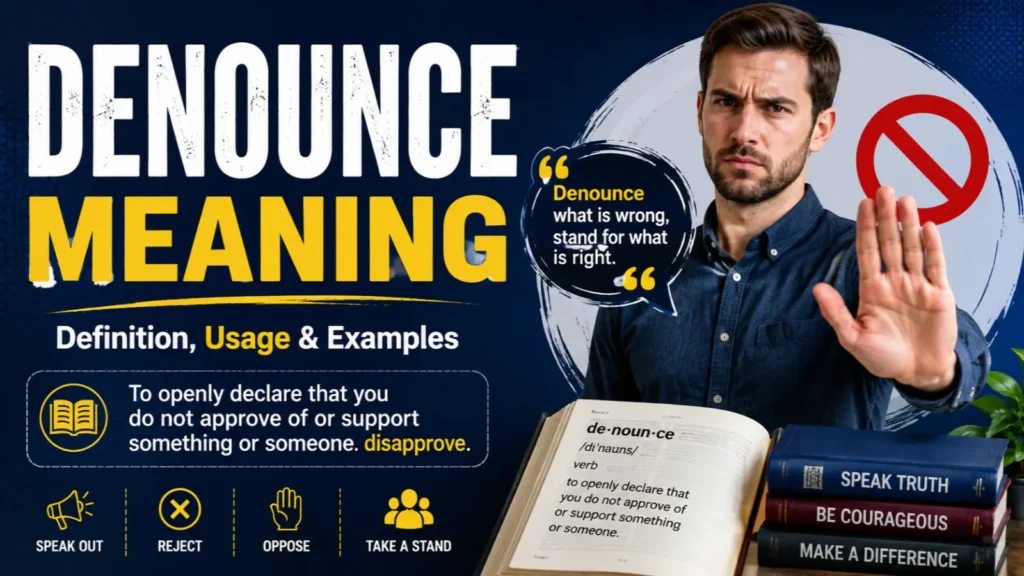
Have you ever heard someone say, “The company denounced the unfair policy,” or “The leader denounced violence”? If you understood the general feeling but weren’t completely sure what denounce meaning was, you’re not alone.
The word denounce appears frequently in news reports, social debates, politics, literature, and formal conversations. Unlike simple words like “dislike” or “criticize,” it carries a stronger message — it shows that someone is openly rejecting or condemning something.
Understanding this word can help you read articles more confidently, improve your vocabulary, and communicate your opinions more clearly.
In this updated 2026 guide, you’ll learn what denounce means, where it came from, how to use it correctly, real-life examples, common mistakes, and similar words you can use instead.
Whether you’re a student, writer, professional, or simply curious about English vocabulary, this complete explanation will make the meaning simple.
What Does “Denounce” Mean?
Quick Answer
Denounce means to publicly criticize, condemn, or strongly express disapproval of a person, action, idea, or situation. It is commonly used when someone openly declares that something is wrong, harmful, or unacceptable.
The word denounce describes a strong form of criticism.
If someone quietly dislikes something, they might say they “disagree” or “object.” But if they make a public statement against it, they may denounce it.
For example:
- A government may denounce an act of violence.
- A company may denounce unethical practices.
- A person may denounce discrimination.
The key idea is public rejection.
Denounce Definition
According to standard English usage, denounce means:
“To publicly declare that someone or something is wrong, harmful, or unacceptable.”
It can refer to:
- Actions
- Behaviors
- Policies
- Organizations
- People
- Ideas
The word usually appears in serious situations where strong disagreement is involved.
Origin and Etymology of Denounce
The word denounce comes from the Latin word denuntiare, meaning “to announce officially” or “to declare.”
It entered English through Old French during the Middle Ages.
Originally, the word was connected with making an official announcement. Over time, its meaning shifted toward announcing something negative — especially exposing wrongdoing or publicly condemning something.
Today, it is mostly used for criticism, rejection, and public opposition.
How to Pronounce Denounce
Denounce is pronounced:
di-NOUNS
Phonetic spelling:
/dɪˈnaʊns/
Break it down:
- “de” → dih
- “nounce” → nouns
Example:
“Many people denounce corruption.”
How the Meaning Has Changed Over Time
The meaning of denounce has become more closely connected with public criticism.
Older usage:
- Officially announce
- Report something formally
Modern usage:
- Condemn publicly
- Speak strongly against
- Reject openly
Today, when people hear “denounce,” they usually expect a serious statement.
For example:
“The organization denounced the attack.”
This does not simply mean they disliked it. It means they publicly declared their opposition.
How to Use “Denounce” Correctly in Texts & Communication
The word denounce is powerful. You usually don’t use it for small disagreements like “I don’t like this movie” or “I disagree with your opinion.”
Instead, denounce fits situations where someone strongly rejects something they believe is harmful, unfair, immoral, or unacceptable.
Think of it as a louder, more serious version of words like criticize or disagree with.
Correct Context and Tone
Denounce is generally used in:
1. Formal situations
You’ll often see it in:
- News articles
- Government statements
- Business announcements
- Legal discussions
- Public speeches
Example:
“The organization denounced the illegal activities.”
This sounds formal and serious.
2. Social discussions
People also use denounce when discussing social issues.
Examples:
- “Many activists denounced discrimination.”
- “Users online denounced the harmful trend.”
Here, the word shows strong public disagreement.
3. Emotional situations
The word often appears when people feel strongly about an issue.
Example:
“The community denounced the unfair treatment of workers.”
The speaker is not just unhappy — they are openly rejecting the behavior.
How to Use “Denounce” in Text Messages and Chats
Although denounce is not typical casual texting slang, people may use it online when discussing serious topics.
Examples:
Friend group chat:
“Everyone is denouncing that new update. It ruined the app.”
Meaning:
People are publicly complaining and showing strong disagreement.
Social media comment:
“I completely denounce this behavior.”
Meaning:
“I strongly reject and criticize this behavior.”
Platform-Specific Usage
SMS and WhatsApp
In personal chats, “denounce” can sound formal.
Most people would say:
- “I hate this.”
- “I disagree with this.”
- “That’s wrong.”
Instead of:
- “I denounce this.”
However, it can work when discussing serious topics.
Example:
“We should all denounce bullying.”
Instagram and TikTok
On social platforms, denounce often appears in:
- Activism posts
- Awareness campaigns
- Public statements
- Comment discussions
Example:
“Creators are denouncing online harassment.”
It creates a stronger, more serious tone.
Twitter/X
The word is very common on Twitter/X because users frequently discuss:
- Politics
- Social issues
- Public controversies
- News events
Example:
“Thousands of users denounced the decision.”
Discord and Reddit
In gaming and online communities, users may use denounce during debates.
Example:
“The community denounced the developer’s decision.”
This means many members publicly criticized the choice.
When Should You NOT Use “Denounce”?
Because the word is strong, avoid using it for everyday complaints.
❌ Incorrect:
“I denounce my friend for being late.”
This sounds dramatic.
Better:
“I’m annoyed that my friend was late.”
❌ Incorrect:
“I denounce this restaurant because the food was cold.”
Too extreme.
Better:
“I complained about the restaurant.”
Good Situations for “Denounce”
✅ A politician rejects corruption
✅ A company rejects unethical behavior
✅ A community opposes violence
✅ A person publicly criticizes injustice
Formatting Tips: Capitalization, Punctuation & Style
Since denounce is a normal English verb, there are no special capitalization rules.
Correct:
“The mayor denounced corruption.”
Incorrect:
“The Mayor Denounced Corruption.”
(Unless it starts a sentence or is part of a title.)
Common Word Pairings
Certain words frequently appear with denounce:
| Phrase | Meaning |
|---|---|
| denounce violence | publicly reject violent actions |
| denounce corruption | criticize dishonest practices |
| denounce injustice | oppose unfair treatment |
| denounce a decision | strongly disagree with a choice |
| denounce an action | say an action is wrong |
These combinations are common in news writing and formal English.
Real Conversation Examples Using “Denounce”
Example 1: Between Friends
Context: Discussing a bad online trend
Alex: Did you see that dangerous challenge going viral?
Mia: Yeah, many people are denouncing it because it encourages unsafe behavior.
Meaning:
Mia means people are publicly criticizing and rejecting the trend.
Example 2: Workplace Chat
Context: Company discussion
Manager: We need to address the rumors spreading online.
Employee: The company should denounce false information clearly.
Meaning:
The employee wants the company to publicly reject the rumors.
Example 3: Family Conversation
Context: Discussing unfair behavior
Parent: Everyone deserves respect.
Child: I agree. We should denounce bullying whenever we see it.
Meaning:
The child means people should openly oppose bullying.
Example 4: Social Media Comment
Context: Online discussion
User 1: That decision hurt many customers.
User 2: Thousands of people are denouncing the company’s choice.
Meaning:
Many people are publicly criticizing the company.
Example 5: Gaming Community
Context: Game update controversy
Player 1: The new update removed important features.
Player 2: The community is denouncing the changes.
Meaning:
Players are strongly expressing their dissatisfaction.
Common Mistakes & Misunderstandings
Even though denounce seems simple, many people misuse it.
Mistake 1: Using It for Small Complaints
A common mistake is using denounce when you only mean “dislike.”
Example:
❌ “I denounce this pizza because it was too salty.”
This sounds like a public protest.
Better:
✅ “I didn’t enjoy the pizza.”
Mistake 2: Confusing Denounce With Announce
These words look similar but have completely different meanings.
Announce:
To share information.
Example:
“The company announced a new product.”
Denounce:
To criticize publicly.
Example:
“The company denounced unfair business practices.”
A single letter changes the meaning completely.
Mistake 3: Thinking It Always Means Attack
While denounce is negative, it does not always mean personally attacking someone.
Example:
“The organization denounced violence.”
They are rejecting an action, not necessarily attacking a person.
Generational Understanding of “Denounce”
Different generations may understand and use this word differently.
Older Generations
Older speakers often encounter denounce through:
- Newspapers
- Political speeches
- Formal writing
They may associate it with official statements.
Millennials
Millennials often see it in:
- Online articles
- Social media discussions
- Workplace communication
They may use it when discussing public issues.
Gen Z
Gen Z usually prefers simpler alternatives in casual conversations:
- “Call out”
- “Reject”
- “Speak against”
- “Cancel”
However, they may still use denounce in serious posts or discussions.
Example:
“Everyone is denouncing this behavior.”
This sounds more formal than everyday slang.
“Denounce” Across Different Platforms & Demographics
TikTok
On TikTok, the word appears mostly in:
- Social justice discussions
- News commentary
- Creator responses
Example:
“Creators denounce harmful trends.”
Instagram users often use it in captions related to:
- Awareness campaigns
- Charity causes
- Community issues
Example:
“We denounce hate in all forms.”
Reddit communities frequently use denounce during debates.
Examples:
- Gaming controversies
- Company decisions
- Social discussions
Is “Denounce” Formal or Informal?
Denounce is mostly formal.
It works well in:
✅ Articles
✅ Essays
✅ Speeches
✅ Professional statements
It may sound too serious in:
❌ Casual texting
❌ Friendly jokes
❌ Everyday complaints
Related Slang, Words & Alternatives
| Word | Meaning | Tone |
|---|---|---|
| Condemn | Strongly criticize something wrong | Formal |
| Criticize | Point out problems | Neutral |
| Reject | Refuse to accept something | Neutral |
| Oppose | Be against something | Neutral |
| Call out | Publicly criticize | Casual |
| Protest | Show disagreement publicly | Strong |
| Disapprove | Have a negative opinion | Mild |
| Rebuke | Strongly criticize someone | Formal |
| Expose | Reveal wrongdoing | Direct |
| Challenge | Question or oppose something | Neutral |
Synonyms of Denounce
Common alternatives include:
- Condemn
- Criticize
- Attack
- Reject
- Oppose
- Blame
- Disapprove
- Rebuke
Antonyms of Denounce
Opposite meanings include:
- Support
- Approve
- Praise
- Defend
- Accept
- Encourage
FAQs:
What does denounce mean in simple words?
Denounce means to publicly say that something is wrong, harmful, or unacceptable. It is a stronger way of saying “criticize” or “reject.” People often use it when discussing serious issues such as crime, unfair treatment, corruption, violence, or unethical behavior.
Example:
“The community denounced the unfair policy.”
This means the community openly criticized and rejected the policy.
Is denounce a positive or negative word?
Denounce is usually a negative word because it expresses strong disagreement or criticism.
However, the reason behind the denouncement can be positive.
For example:
“People denounced violence.”
The word “denounced” is negative because it shows rejection, but opposing violence is generally viewed positively.
What is another word for denounce?
Common synonyms for denounce include:
- Condemn
- Criticize
- Reject
- Oppose
- Rebuke
- Attack
- Call out
- Disapprove
The best replacement depends on the situation.
For example:
- Formal: condemn
- Casual: call out
- Neutral: criticize
What is the difference between denounce and condemn?
The words are very similar, and they can often be used interchangeably.
However:
Denounce usually emphasizes a public statement of criticism.
Example:
“The organization denounced the unfair treatment.”
Condemn often focuses more on expressing strong moral disapproval.
Example:
“The leader condemned the violent attack.”
Both words show strong rejection, but denounce often highlights the act of speaking out publicly.
Can denounce be used for a person?
Yes, but it depends on the context.
You can denounce a person’s actions, beliefs, or behavior.
Example:
“The group denounced the politician’s actions.”
Using it directly against a person can sound very serious.
Example:
“They denounced him.”
This means they publicly criticized or rejected him.
Conclusion: Understanding the True Meaning of Denounce
The word denounce is more than just another synonym for “dislike.” It represents a strong, often public rejection of something considered wrong, harmful, or unacceptable.
Whether you see it in news articles, social media debates, workplace statements, or everyday discussions, understanding denounce meaning helps you recognize the strength behind someone’s words.
Remember the simple idea:
Denounce = publicly criticize or strongly reject.
Now that you know how to use it correctly, you can understand formal conversations and written content with much more confidence.
Have another confusing English word or modern phrase you want explained? Explore more vocabulary guides and keep building your word power.

I’m Lina Roys, a passionate writer behind Storevian, where I make words, phrases, slang, and everyday expressions easy to understand. I create clear, engaging, and reader-friendly content to help people find the meanings they’re looking for, quickly and confidently.


