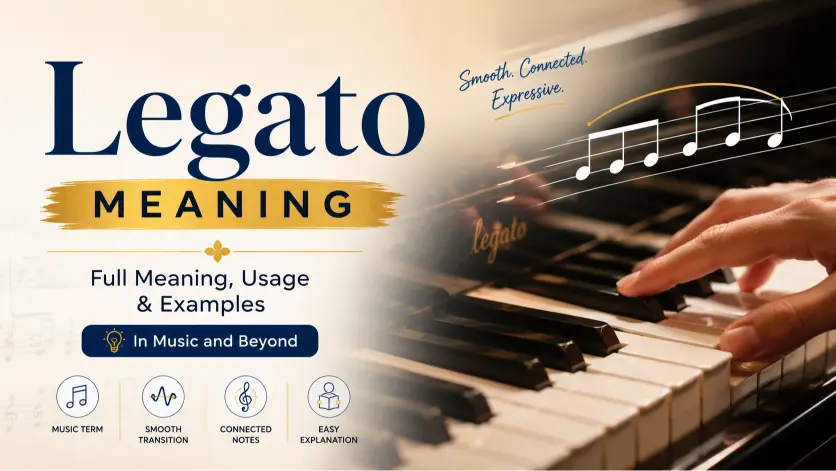
Have you ever listened to a beautiful piano piece or a violin solo that seemed to flow effortlessly from one note to the next? That smooth, connected sound is known as legato. Whether you’re learning music, reading sheet music, or simply curious about musical terminology, understanding the legato meaning can make listening and performing music much more enjoyable.
Updated for 2026, this guide explains everything you need to know—from the definition and pronunciation to real-world examples and comparisons with other musical techniques. You’ll also discover where the word comes from, how musicians use it across different genres, and why it remains one of the most essential terms in music.
If you’ve ever wondered why some melodies feel soft and flowing while others sound short and punchy, you’re about to find out.
What Does Legato Mean?
Quick Answer
Legato means playing or singing notes smoothly so each note connects naturally to the next without obvious gaps. It creates a flowing, continuous musical phrase.
Simply put, legato tells musicians not to separate individual notes. Instead, they should make every note blend into the following one, creating a seamless musical line.
Imagine speaking an entire sentence without awkward pauses between words. That’s exactly how legato works in music.
Definition
The legato meaning is “smoothly connected.” When performers see a legato marking in sheet music, they know the notes should be played or sung in one continuous motion.
Rather than emphasizing each note individually, legato focuses on the melody as one flowing idea.
Origin of the Word
The word legato comes from the Italian verb legare, which means “to tie” or “to bind together.”
Italian has influenced musical terminology for hundreds of years because many of the earliest composers and music theorists came from Italy during the Renaissance and Baroque periods.
Today, musicians around the world still use Italian musical terms such as:
- Legato
- Staccato
- Allegro
- Adagio
- Forte
- Piano
These terms remain universal regardless of the language spoken by performers.
Pronunciation
Legato is pronounced:
luh-GAH-toh
IPA: /ləˈɡɑːtoʊ/
The stress falls on the second syllable:
le-GA-to
How the Meaning Has Evolved
Originally, legato described a specific way of performing written music.
Today, musicians also use the word more generally to describe:
- Smooth guitar solos
- Flowing vocal performances
- Connected piano playing
- Emotional violin melodies
- Seamless orchestral passages
Even outside music, people occasionally describe speech or writing as “legato” when it flows naturally and smoothly.
Where You’ll Commonly See Legato
You’ll encounter legato in:
- Piano lessons
- Guitar tutorials
- Choir rehearsals
- Orchestra scores
- Band arrangements
- Music theory books
- Singing classes
It’s one of the very first musical terms beginners learn.
Why Legato Matters
Legato changes the emotional feel of music.
Instead of sounding choppy, the melody becomes:
- Smooth
- Expressive
- Relaxed
- Emotional
- Elegant
- Continuous
Many famous classical pieces rely heavily on legato phrasing to create beauty and emotion.
Modern pop ballads also use legato vocals to make songs sound warm and heartfelt.
How to Use Legato Correctly in Music
Unlike internet slang or text abbreviations, legato is a performance instruction rather than a conversational word.
Here’s how musicians use it correctly.
On Sheet Music
A curved slur line placed over several notes often indicates legato phrasing.
Musicians understand that these notes should be connected smoothly rather than played separately.
On Guitar
Guitarists create legato using techniques such as:
- Hammer-ons
- Pull-offs
- Slides
These methods reduce picking and create a fluid, singing sound.
Many rock and metal guitar solos rely heavily on legato technique.
In Singing
Vocalists use legato by:
- Maintaining steady airflow
- Connecting vowel sounds
- Avoiding sudden breaks
- Keeping phrases smooth
This creates expressive, emotional performances often heard in opera, musical theatre, and pop ballads.
In Orchestra
String players achieve legato by moving the bow smoothly without abrupt direction changes.
Wind players connect notes through continuous breath support.
The result is rich, lyrical phrasing.
When to Use Legato
Legato is ideal for:
- Romantic melodies
- Emotional passages
- Slow songs
- Ballads
- Classical music
- Film scores
- Worship music
- Jazz standards
Whenever a composer wants music to sound flowing and expressive, legato is usually the preferred articulation.
When Not to Use Legato
Legato isn’t suitable when music calls for:
- Sharp accents
- Short detached notes
- March rhythms
- Percussive styles
- Crisp articulation
In these cases, composers often choose staccato instead.
Legato vs. Staccato
| Feature | Legato | Staccato |
|---|---|---|
| Note connection | Smooth | Detached |
| Sound | Flowing | Short |
| Emotion | Gentle | Energetic |
| Playing style | Connected | Separated |
| Musical feel | Singing | Punchy |
Real Conversation Examples Using Legato
The easiest way to understand the legato meaning is to see how musicians use the term in real situations. Below are several dialogue-style examples from different musical settings.
Example 1: Between Piano Teacher and Student
Teacher: “You’re lifting your fingers too quickly. Try playing this phrase legato.”
Student: “So I should connect every note?”
Teacher: “Exactly. Imagine the melody is flowing like a river.”
What it conveys:
The teacher wants the student to create a smooth, connected sound instead of playing each note separately.
Example 2: During Choir Practice
Choir Director: “Keep the chorus legato. Don’t breathe between every word.”
Singer: “Should we treat the sentence as one long phrase?”
Choir Director: “Yes—that makes it sound much more expressive.”
What it conveys:
Legato singing keeps the musical line continuous and emotionally engaging.
Example 3: Guitar Lesson
Instructor: “This solo sounds stiff because you’re picking every note.”
Student: “Should I use more hammer-ons and pull-offs?”
Instructor: “Exactly. That’s how you create a legato guitar style.”
What it conveys:
On guitar, legato often relies on techniques that reduce picking and produce a smoother sound.
Example 4: Orchestra Rehearsal
Conductor: “Violins, make the opening phrase more legato.”
Violinist: “We’ll use longer bow strokes.”
Conductor: “Perfect. The melody should feel seamless.”
What it conveys:
String players use smooth bowing to connect notes and create lyrical phrasing.
Example 5: Recording Studio
Producer: “Can you sing the second verse more legato?”
Vocalist: “I’ll smooth out the transitions.”
Producer: “That will make the performance feel warmer.”
What it conveys:
Producers often ask singers for a legato delivery when they want a softer, more emotional performance.
Common Mistakes & Misunderstandings
Although legato is a basic musical term, beginners often misunderstand how it should be applied.
1. Thinking Legato Means “Play Slowly”
One of the biggest misconceptions is that legato automatically means slow music.
That’s not true.
A piece can be:
- Fast and legato
- Slow and legato
- Medium tempo and legato
Legato describes how notes connect, not how fast they are played.
2. Confusing Legato with Slurs
Many new musicians believe every slur marking means exactly the same thing as legato.
While slurs often indicate legato phrasing, their meaning can vary depending on the instrument and musical context. Always consider the composer’s notation and performance practice.
3. Holding Every Note Too Long
Another common mistake is sustaining notes so long that they overlap unnaturally.
Good legato isn’t about making every note longer it’s about making transitions between notes smooth and controlled.
Beginner Tip
Ask yourself:
“Can I hear obvious gaps between the notes?”
If the answer is yes, your playing probably isn’t fully legato yet.
Legato Across Different Genres & Demographics
Unlike internet slang, legato isn’t tied to a particular age group. However, different musicians and music communities use it in different ways.
Classical Musicians
Classical performers use legato constantly.
Whether it’s a Mozart sonata or a Chopin nocturne, smooth phrasing is essential for expressing the composer’s intentions.
Jazz Musicians
Jazz players often alternate between legato and more detached articulations.
A saxophonist, for example, may play one phrase legato to create a relaxed feel before switching to shorter notes for rhythmic contrast.
Pop and Contemporary Vocalists
Many pop singers use legato to create:
- Emotional ballads
- Smooth vocal runs
- Gentle verse melodies
- Expressive choruses
Artists frequently blend legato phrasing with modern vocal techniques to produce a polished sound.
Rock and Metal Guitarists
Legato is especially popular among lead guitarists.
Techniques such as:
- Hammer-ons
- Pull-offs
- Slides
- Tapping
allow players to perform fast, fluid solos with minimal picking.
Film and Video Game Composers
Soundtracks often rely on legato strings, brass, and vocals to evoke emotion.
A sweeping orchestral score in a film or game frequently uses legato passages to create warmth, suspense, or grandeur.
Is Legato Formal or Informal?
Legato is a formal musical term recognised worldwide.
You’ll encounter it in:
- Music examinations
- Conservatory programmes
- Orchestra rehearsals
- University music courses
- Professional recordings
Because it’s part of standard musical vocabulary, it remains consistent across countries and musical traditions.
Where You Might Encounter the Term
You may see legato in:
- Sheet music
- Piano lesson books
- Guitar method guides
- Choir scores
- Orchestra parts
- Music theory textbooks
- Online tutorials
- Instrument masterclasses
Learning the term early will make reading and performing music much easier.
Why Understanding Legato Matters
Mastering the legato meaning helps you do more than recognise a musical instruction.
It enables you to:
- Interpret sheet music accurately.
- Perform melodies with greater expression.
- Understand feedback from teachers and conductors.
- Appreciate why different performances of the same piece can sound so different.
Whether you’re a beginner learning your first instrument or an experienced musician refining your technique, legato is a foundational concept that will improve both your playing and your listening.
Related Musical Terms & Alternatives
Understanding the legato meaning becomes easier when you compare it with other common musical terms. These articulations and tempo markings are often seen together in sheet music.
| Musical Term | Meaning | How It Relates to Legato |
|---|---|---|
| Staccato | Notes are played short and detached. | The opposite of legato. |
| Slur | A curved line connecting notes. | Often indicates legato phrasing. |
| Tenuto | Hold each note for its full value. | Can be combined with legato for expressive playing. |
| Marcato | Play notes with strong emphasis. | Produces a more accented sound than legato. |
| Accent (>) | Stress a particular note. | Adds emphasis even within a legato phrase. |
| Portato | Gently separated notes. | A middle ground between legato and staccato. |
| Glissando | Slide continuously between notes. | Creates a different type of smooth connection. |
| Allegro | Fast tempo. | Describes speed, not articulation. |
| Adagio | Slow tempo. | Often paired with legato melodies. |
| Cantabile | Play or sing in a singing style. | Frequently achieved through legato phrasing. |
FAQs:
What does legato mean in music?
Legato means performing notes smoothly and continuously so that each note flows naturally into the next. It creates a connected, expressive melody without obvious pauses.
How do you pronounce legato?
Legato is pronounced luh-GAH-toh (IPA: /ləˈɡɑːtoʊ/). The emphasis falls on the second syllable.
What is the opposite of legato?
The opposite of legato is staccato. While legato connects notes smoothly, staccato separates them with short, detached articulation.
Is legato only used in classical music?
No. Although common in classical music, legato is also widely used in jazz, pop, rock, gospel, film scores, musical theatre, and contemporary instrumental music.
How do pianists play legato?
Pianists play legato by coordinating finger movements so that one key is released only as the next key is pressed. This creates a seamless transition between notes.
How do guitarists play legato?
Guitarists achieve legato using techniques such as hammer-ons, pull-offs, and slides. These methods reduce picking and produce a smooth, flowing sound.
Why is legato important?
Legato adds expression, warmth, and musicality. It helps melodies sound natural and connected, making performances more engaging and emotionally expressive.
Conclusion:
The legato meaning is simple yet fundamental: play or sing notes so they connect smoothly, creating one flowing musical phrase. Derived from the Italian word meaning “tied together,” legato remains one of the most important articulation techniques in music.
Whether you’re learning piano, guitar, violin, voice, or simply exploring music theory, understanding legato will improve both your performance and your appreciation of music. From classical masterpieces to modern pop ballads, this technique shapes countless memorable melodies.
Now that you know the legato meaning, listen to your favourite songs and see if you can recognise smooth, connected phrasing. The more you notice it, the more you’ll appreciate the artistry behind every performance.
Enjoyed this guide? Share it with fellow musicians, bookmark it for future reference, and explore more music terminology to strengthen your musical knowledge.

I’m Lina Roys, a passionate writer behind Storevian, where I make words, phrases, slang, and everyday expressions easy to understand. I create clear, engaging, and reader-friendly content to help people find the meanings they’re looking for, quickly and confidently.


