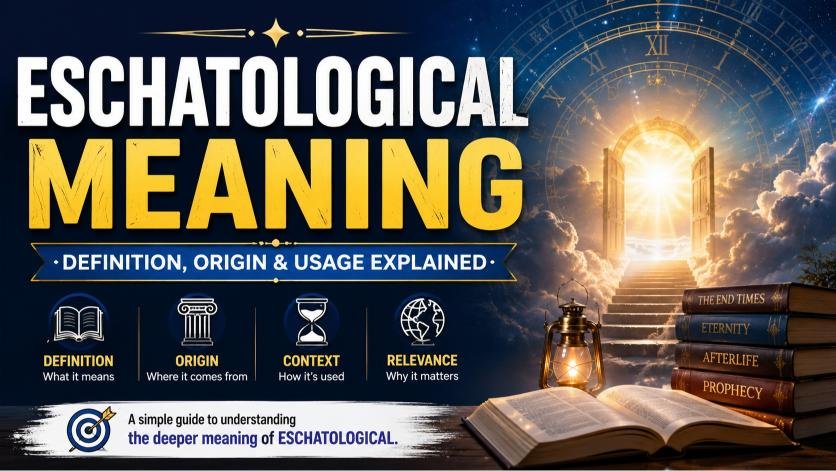
Have you ever come across a word that sounds incredibly complex but has a surprisingly simple idea behind it? Eschatological meaning is one of those terms. You might see it in religious discussions, philosophy books, academic articles, or even online debates about the future of humanity.
Simply put, eschatological meaning relates to ideas about the “last things” — the final events of human existence, the end of the world, death, judgment, and what may happen after life ends.
The word appears frequently in theology, especially when people discuss prophecies, heaven, resurrection, or the ultimate destiny of humanity. However, it is not limited to religion. Philosophers and cultural thinkers also use eschatological concepts when discussing humanity’s future.
Updated for 2026, this guide breaks down everything you need to know about the term: its definition, origin, examples, religious connections, everyday usage, and how it differs from similar words like “apocalyptic.”
Whether you are a student, a curious reader, or someone who simply encountered this word online, this article will make eschatological meaning easy to understand.
What Does “Eschatological Meaning” Mean?
Quick Answer
Eschatological meaning refers to ideas, beliefs, or studies connected to the final events of existence, including the end of the world, death, judgment, the afterlife, and humanity’s ultimate future.
The term eschatological describes anything related to eschatology, which is the study of “the last things.” It examines questions humans have asked for centuries:
- What happens at the end of the world?
- Is there life after death?
- Will humanity face a final judgment?
- Does history have an ultimate purpose?
At its core, eschatology focuses on endings — but not always in a negative way. Many traditions view the “end” as a transformation, renewal, or beginning of a new state of existence.
Origin of the Word “Eschatological”
The word comes from Ancient Greek roots:
- Eschatos (ἔσχατος) = last, final, or farthest
- Logos (λόγος) = study, discussion, or reasoning
Together, the concept means “the study of final things.”
The term became especially important in religious studies because many belief systems contain teachings about humanity’s final destiny.
How the Meaning Has Evolved Over Time
Originally, eschatology was strongly connected with religious teachings about the end of history. Ancient civilizations often developed ideas about:
- Cosmic endings
- Divine judgment
- Renewal of the world
- The fate of souls
Over time, scholars expanded the meaning beyond religion. Today, people may discuss:
- Environmental eschatology (the future fate of Earth)
- Technological eschatology (AI, humanity’s future)
- Philosophical eschatology (the meaning of existence)
For example, a researcher discussing whether artificial intelligence could transform human civilization might explore an “eschatological” question about humanity’s future.
Pronunciation Guide
Eschatological is pronounced:
es-kuh-tuh-LOJ-i-kul
The emphasis is usually placed on the third syllable: LOJ.
Many people mispronounce it because the spelling looks intimidating, but once broken into parts, it becomes easier:
Es-cha-to-log-i-cal
How to Use “Eschatological Meaning” Correctly in Texts & Writing
Unlike internet slang or casual abbreviations, eschatological meaning is mainly used in academic, religious, and intellectual conversations. It rarely appears in everyday texting.
Understanding the context matters because using the term casually can sometimes sound overly formal.
Correct Contexts for Using Eschatological
You can use “eschatological” when discussing:
Religion
Example:
“Many religious scholars study eschatological beliefs about the end times.”
Here, the word refers to religious teachings about future events.
Philosophy
Example:
“The philosopher’s work contains eschatological themes about human destiny.”
In this context, it refers to deeper questions about existence and the future.
Literature
Example:
“The novel uses eschatological imagery to explore humanity’s fear of destruction.”
Writers often use end-of-world themes to create meaning.
When NOT to Use Eschatological
Avoid using it when a simpler word works better.
For example:
❌ “My phone dying is an eschatological problem.”
This sounds incorrect because a dead battery is not related to ultimate endings.
Better:
✅ “My phone dying is a frustrating problem.”
Formal vs. Informal Usage
| Context | Suitable? |
|---|---|
| Theology class | ✅ Yes |
| Academic writing | ✅ Yes |
| Religious discussion | ✅ Yes |
| Casual texting | ❌ Rare |
| Social media slang | ❌ Usually not |
Real Conversation Examples Using “Eschatological Meaning”
Although eschatological meaning is not a common texting phrase, people use the concept in discussions about religion, philosophy, books, movies, and world events.
Here are realistic examples:
Example 1: Between Students Discussing Religion
Student A: “Why does this theology book keep talking about the end of history?”
Student B: “Because it focuses on eschatological meaning and how different religions view humanity’s final destiny.”
What it conveys:
The term shows that the discussion is about deeper spiritual ideas, not simply a prediction of disaster.
Example 2: In a Philosophy Class
Professor: “This philosopher’s work asks what happens after humanity reaches its final stage.”
Student: “So would you say it has an eschatological meaning?”
What it conveys:
Here, eschatological refers to questions about humanity’s ultimate purpose and future.
Example 3: In an Online Discussion
User 1: “This movie feels like it is about more than just an apocalypse.”
User 2: “Exactly. It has an eschatological meaning because it explores human survival, judgment, and renewal.”
What it conveys:
The speaker uses the term to explain deeper themes behind an end-of-world story.
Example 4: Family Conversation About Beliefs
Person A: “Different cultures have different ideas about what happens after death.”
Person B: “Yes, many of those ideas have eschatological meanings connected to the afterlife.”
What it conveys:
The word connects personal beliefs with broader religious concepts.
Example 5: Work or Research Discussion
Researcher: “The article examines climate change from a historical perspective.”
Colleague: “Does it include any eschatological themes?”
What it conveys:
The question asks whether the research discusses humanity’s possible future or ultimate outcome.
Common Mistakes & Misunderstandings About “Eschatological Meaning”
Because eschatological meaning is a specialized term, people often misunderstand or misuse it.
Here are the most common mistakes:
1. Thinking It Only Means “The End of the World”
Many people assume eschatology only refers to destruction or disasters.
That is only part of the picture.
Eschatology also includes ideas about:
- Renewal
- Resurrection
- Spiritual transformation
- The afterlife
- Humanity’s final purpose
For many religions, the “end” is not simply an ending — it is a transition into something new.
2. Confusing “Eschatological” With “Apocalyptic”
These words are related but not identical.
| Term | Meaning |
|---|---|
| Eschatological | Related to final events, ultimate destiny, or the last things |
| Apocalyptic | Related to revelations, visions, disasters, or dramatic end-time events |
An apocalypse can be eschatological, but not every eschatological idea is apocalyptic.
For example:
- A discussion about heaven after death → eschatological
- A story about a catastrophic world-ending event → often apocalyptic
3. Using It for Any Future Event
Another common mistake is using “eschatological” as a fancy word for “future.”
Example:
❌ “My vacation plans are eschatological.”
This is incorrect.
The word refers specifically to ultimate or final matters, not ordinary future events.
Correct:
✅ “The book presents an eschatological view of humanity’s future.”
Generational Understanding Differences
Different age groups may interpret eschatological topics differently.
Older Generations
Older readers may connect the term mainly with:
- Religious teachings
- Biblical prophecy
- Traditional beliefs about the afterlife
Millennials
Many millennials encounter eschatological ideas through:
- Movies
- Books
- Philosophy discussions
- Environmental concerns
Gen Z
Younger audiences often see these themes through:
- Climate discussions
- AI debates
- Social media conversations
- Dystopian entertainment
The vocabulary may change, but the core question remains the same:
What happens to humanity in the end?
“Eschatological Meaning” Across Different Platforms & Demographics
Unlike popular internet slang, eschatological meaning is mostly found in educational and intellectual spaces.
However, discussions about eschatological ideas appear everywhere online.
TikTok and Short-Form Content
On TikTok, users may not frequently type “eschatological,” but they often discuss related topics:
- End-of-the-world theories
- Religious predictions
- Future technology
- Humanity’s survival
Creators may simplify complex eschatological ideas into short videos.
Reddit Communities
Reddit discussions often use eschatological concepts in communities focused on:
- Religion
- Philosophy
- History
- Science fiction
Users may debate questions like:
- Will humanity survive forever?
- Does civilization have a final stage?
- What happens after death?
Instagram and Social Media Captions
The word itself is uncommon in captions, but creators may use related phrases:
- “end times”
- “humanity’s future”
- “the final chapter”
- “the destiny of mankind”
Academic Platforms
This is where the term appears most often.
Researchers and students use it in:
- Theology papers
- Philosophy essays
- Religious studies
- Historical analysis
Religious Perspectives on Eschatological Meaning
Different traditions have developed their own eschatological beliefs.
Christian Eschatology
In Christianity, eschatological ideas often focus on:
- The second coming of Jesus Christ
- Resurrection of the dead
- Final judgment
- Eternal life
Many Christian scholars study biblical passages about the ultimate fulfillment of God’s plan.
Jewish Eschatology
Jewish eschatological beliefs often discuss concepts such as:
- The coming of the Messiah
- The future restoration of the world
- Divine justice
Different Jewish traditions interpret these ideas in different ways.
Islamic Eschatology
Islamic eschatology includes beliefs about:
- The Day of Judgment
- Resurrection
- Paradise and Hell
- The final accountability of humanity
These teachings emphasize moral responsibility and the consequences of human actions.
Related Terms, Slang & Alternatives
| Related Term | Meaning |
|---|---|
| Eschatology | The study of final events and ultimate destiny |
| Apocalypse | A revelation or dramatic end-time event |
| End times | A phrase describing the final period of history |
| Afterlife | Existence after physical death |
| Prophecy | A prediction or message about future events |
| Judgment Day | A final evaluation of human actions |
| Resurrection | Rising from death or returning to life |
| Millennialism | Belief about a future thousand-year period |
| Theology | Study of religious beliefs |
| Cosmology | Study of the universe and its origins |
FAQs:
What is the simple meaning of eschatological?
Eschatological means related to the study or belief of final things, such as the end of the world, death, judgment, the afterlife, and humanity’s ultimate future. It comes from the Greek word “eschatos,” meaning “last” or “final.”
What does eschatological mean in the Bible?
In the Bible, eschatological meaning refers to teachings about future spiritual events, including the return of Christ, resurrection, final judgment, and the fulfillment of God’s promises. These ideas appear throughout biblical texts discussing the destiny of humanity.
Is eschatology only a religious concept?
No. While eschatology is strongly associated with religion, philosophers, historians, and cultural researchers also use it to discuss humanity’s future, civilization’s possible endings, and questions about existence.
What is the difference between eschatological and apocalyptic?
Eschatological is a broader term involving final events and ultimate destiny. Apocalyptic usually refers to dramatic revelations, destruction, or catastrophic end-time scenarios. Apocalyptic ideas can be part of eschatology, but they are not identical.
How do you use eschatological in a sentence?
You can say: “The author explores eschatological themes by examining ideas about death, eternity, and humanity’s future.” The word is most appropriate in academic, religious, or philosophical discussions.
Conclusion:
The eschatological meaning of a concept goes beyond simply talking about endings. It explores some of humanity’s biggest questions: Where are we going? What happens after life? Does history have a final purpose?
From ancient religious teachings to modern discussions about technology and civilization, eschatological ideas continue to shape how people think about the future.
Understanding this word helps you better read theology, philosophy, literature, and even modern conversations about humanity’s destiny.
Want to understand more complex terms without the confusion? Explore more meaning guides and expand your vocabulary one word at a time.
Share your thoughts: What do you think humanity’s ultimate future looks like?

I’m Lina Roys, a passionate writer behind Storevian, where I make words, phrases, slang, and everyday expressions easy to understand. I create clear, engaging, and reader-friendly content to help people find the meanings they’re looking for, quickly and confidently.


