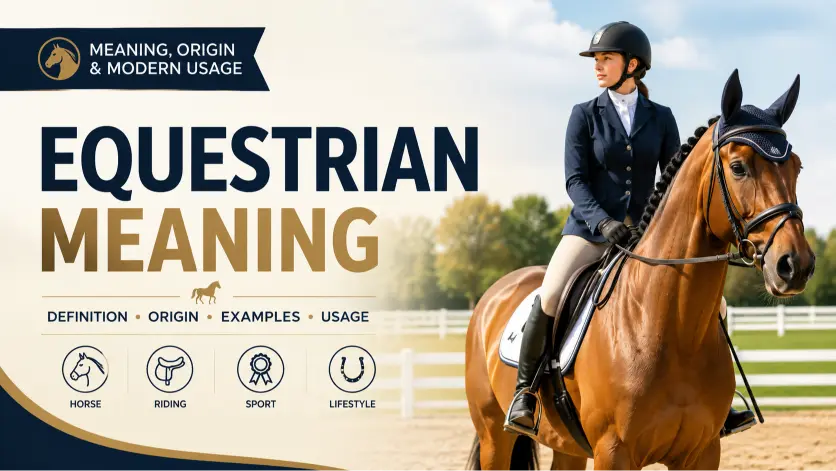
Have you ever seen someone confidently riding a horse and wondered, “What exactly do you call someone who does that?” The answer is often equestrian.
The word equestrian meaning goes beyond simply being a person who rides horses. It connects to a world of horse sports, training, competitions, animal care, and a lifestyle built around the bond between humans and horses.
From Olympic events like dressage and show jumping to casual horseback riding on countryside trails, equestrian culture has existed for centuries and continues to attract millions of horse lovers worldwide.
Updated for 2026, this complete guide explains what equestrian means, where the word comes from, how people use it, and why it matters in modern conversations.
Whether you are learning English, researching horse sports, or simply curious after seeing the word online, you’ll find everything you need to understand equestrian meaning clearly.
What Does “Equestrian” Mean?
Quick Answer Box
Equestrian meaning: Equestrian refers to anything related to horses, horseback riding, or people involved with horse activities. An equestrian may be a horse rider, trainer, competitor, or horse enthusiast who participates in equine-related activities.
The word equestrian describes a connection between humans and horses.
It can refer to:
- A person who rides horses
- A professional horse trainer
- Someone involved in horse competitions
- Horse-related sports and activities
- A lifestyle involving horse care and riding
For example:
- “She is an experienced equestrian who competes internationally.”
- “The equestrian event attracted thousands of visitors.”
In simple terms, an equestrian is someone who has a relationship with horses through riding, training, competition, or care.
The Origin of the Word “Equestrian”
The history of equestrian goes back to ancient Rome.
The term comes from the Latin word eques, meaning:
- horseman
- rider
- mounted soldier
The Latin root equus means “horse,” which is also the source of words like:
- equine
- equestrian
- equitation
In ancient societies, horses were symbols of power, transportation, and military strength. Skilled horse riders often held important social positions.
Over time, the word evolved from describing mounted warriors into a broader term connected with horse riding, sports, and horse culture.
How Has the Meaning Changed Over Time?
Originally, “equestrian” mainly described people who rode horses, especially soldiers or members of elite riding groups.
Today, the meaning is much wider.
Modern usage includes:
1. Competitive Riders
People who participate in organized horse sports.
Examples:
- Olympic riders
- show jumping competitors
- dressage athletes
2. Horse Professionals
People who work with horses professionally.
Examples:
- trainers
- instructors
- stable managers
3. Horse Enthusiasts
People who simply love horses and spend time riding or caring for them.
So, while every equestrian may interact with horses, not every equestrian is a professional athlete.
How to Pronounce Equestrian
The correct pronunciation is:
Equestrian → ih-KWES-tree-uhn
Breaking it down:
- e- = “ih”
- ques = “kwes”
- tri-an = “tree-uhn”
Many people mistakenly pronounce it as “ee-kwes-trian,” but the common English pronunciation starts with a short “ih” sound.
How to Use “Equestrian” Correctly in Texts & Conversation
The word equestrian is not slang. It is a formal term commonly used in sports, education, media, and professional discussions.
However, people use it casually when talking about horses.
Common Usage Examples
Talking About a Person
✅ Correct:
“My sister is an equestrian who competes in horse shows.”
Meaning: She rides or participates in horse activities.
Talking About Sports
✅ Correct:
“The equestrian events at the Olympics are exciting.”
Meaning: Horse-related competitions.
Talking About Lifestyle
✅ Correct:
“She has an equestrian lifestyle and spends most weekends at the stable.”
Meaning: Horses are an important part of her daily life.
Equestrian Meaning in Different Contexts
1. In Sports
In sports, equestrian refers to competitive horse riding.
Major equestrian sports include:
| Sport | Meaning |
|---|---|
| Dressage | A competition showing a horse’s training and movement skills |
| Show Jumping | Riders guide horses over obstacles |
| Eventing | A combination of dressage, jumping, and cross-country riding |
| Endurance Riding | Long-distance horse riding competition |
| Polo | A team sport played on horseback |
Equestrian sports require teamwork between the horse and rider. The rider’s skill matters, but so does the horse’s training, trust, and performance.
2. In Everyday Language
Someone might say:
“I’m interested in equestrian activities.”
This usually means they enjoy:
- horseback riding
- horse care
- riding lessons
- horse competitions
It does not necessarily mean they own a horse or compete professionally.
3. In Fashion and Culture
The word also appears in fashion.
“Equestrian style” often refers to clothing inspired by horse riding culture.
Common features include:
- riding boots
- fitted jackets
- leather accessories
- tailored clothing
Brands and designers often use equestrian themes because horses are associated with elegance, tradition, and luxury.
Real Conversation Examples Using “Equestrian”
Understanding a word becomes easier when you see how people actually use it. Here are realistic examples of equestrian meaning in everyday conversations.
Example 1: Between Friends
Friend 1: “What do you usually do on weekends?”
Friend 2: “I’m an equestrian, so I spend most Saturdays riding horses at a local stable.”
Meaning:
Here, equestrian describes someone whose hobby or lifestyle involves horse riding.
Example 2: In a School Conversation
Student 1: “Which sports do you play?”
Student 2: “I compete in equestrian sports. I’ve been training in dressage for three years.”
Meaning:
The word refers to organized horse competitions rather than ordinary riding.
Example 3: In a Dating Conversation
Person 1: “Your photos always have horses in them. Are you a professional rider?”
Person 2: “Not professionally, but I’m an equestrian and love spending time with horses.”
Meaning:
The person enjoys horse-related activities but may not compete professionally.
Example 4: In a Family Conversation
Parent: “Why does Emma spend so much time at the farm?”
Sibling: “She’s becoming an equestrian. She’s learning horse care and riding skills.”
Meaning:
Equestrian describes someone developing skills related to horses.
Example 5: Gaming or Online Community Chat
User 1: “I’m designing a fantasy character who rides horses.”
User 2: “Make them an equestrian warrior with advanced riding skills.”
Meaning:
The term can also appear in fictional or creative contexts involving skilled horse riders.
Common Mistakes & Misunderstandings About “Equestrian”
Even though equestrian meaning seems simple, people often misunderstand how the word works.
Here are the most common mistakes.
Mistake 1: Thinking Equestrian Only Means “Horse Rider”
Many people believe an equestrian is simply anyone sitting on a horse.
That is not completely wrong, but it is incomplete.
An equestrian can be:
- a rider
- a trainer
- a competitor
- a horse caretaker
- someone deeply involved in horse culture
The word describes a broader connection with horses.
Mistake 2: Confusing Equestrian With Equine
These words sound similar but have different meanings.
| Word | Meaning | Example |
|---|---|---|
| Equestrian | Related to riders or horse activities | “She is an equestrian athlete.” |
| Equine | Related to horses themselves | “The equine species includes horses.” |
A simple way to remember:
Equestrian = person/activity
Equine = horse/animal
Mistake 3: Using It in the Wrong Situation
Calling someone an equestrian when they casually rode a horse once may sound exaggerated.
For example:
❌ “I rode a horse during vacation, so I’m an equestrian.”
Better:
✅ “I went horseback riding during vacation.”
Usually, equestrian suggests a regular interest, skill, or involvement with horses.
Generational and Cultural Differences
The word equestrian is understood differently depending on age and culture.
Gen Z Usage
Younger generations often use “equestrian” online when discussing:
- horse hobbies
- riding communities
- aesthetic trends
- equestrian fashion
On platforms like TikTok and Instagram, the word often appears with content about:
- stable life
- horse training videos
- riding outfits
- competition clips
Millennials
Millennials may recognize equestrian mainly through:
- sports competitions
- childhood riding lessons
- luxury lifestyle references
- countryside culture
Older Generations
Older audiences may connect the word with:
- traditional horse riding
- military history
- formal riding clubs
- classic countryside lifestyles
Is “Equestrian” Formal or Informal?
Equestrian is considered a formal word.
It is commonly used in:
✅ Sports journalism
✅ Academic writing
✅ Horse organizations
✅ Competitions
✅ Professional settings
Examples:
- “She qualified for the national equestrian championship.”
- “The university offers equestrian training programs.”
However, it can also appear in casual conversations among horse lovers.
Equestrian Across Different Platforms
On Instagram, equestrian content often includes:
- horse photography
- riding videos
- competition highlights
- stable routines
Common hashtags include:
- #equestrian
- #equestrianlife
- #horselover
TikTok
TikTok has helped younger audiences discover equestrian culture through:
- riding tutorials
- funny horse moments
- competition clips
- “day in my life” stable videos
The word is often connected with lifestyle content.
Horse communities use “equestrian” when discussing:
- training advice
- riding equipment
- competitions
- horse care
Discord
Gaming and hobby communities may use the term for:
- horse simulation games
- fantasy characters
- riding communities
Related Slang, Terms & Alternatives
Here are related words that help you understand the horse world better.
| Term | Meaning |
|---|---|
| Horse rider | A person who rides horses |
| Horseback riding | The activity of riding a horse |
| Equine | Anything related to horses |
| Horse enthusiast | Someone who loves horses |
| Rider | A person controlling a horse |
| Dressage | A structured horse training competition |
| Show jumping | Horse jumping competition |
| Jockey | A professional racehorse rider |
| Stable hand | Someone who cares for horses |
| Horseman/Horsewoman | A skilled person who works with horses |
Synonyms and Similar Expressions
Depending on the context, alternatives include:
- horse rider
- rider
- horse lover
- horse enthusiast
- horseback rider
- mounted rider
However, equestrian sounds more professional and covers a wider range of horse-related activities.
Antonyms: Words With Opposite Meaning
There is no exact opposite of “equestrian,” but opposite ideas could include:
- non-rider
- person unfamiliar with horses
- someone without interest in horse activities
FAQs:
What does equestrian mean in simple words?
Equestrian means someone or something connected to horses, horseback riding, or horse-related activities. An equestrian can be a rider, trainer, competitor, or horse enthusiast. The word is commonly used in sports, horse communities, and professional riding environments.
Is an equestrian a professional horse rider?
Not always.
An equestrian can be a professional rider, but the term also includes hobby riders, trainers, and people involved in horse care. Someone does not need to compete professionally to be considered an equestrian.
What is an equestrian sport?
An equestrian sport is a competition involving horses and riders.
Popular examples include:
- dressage
- show jumping
- eventing
- endurance riding
- polo
These sports test teamwork, communication, and skill between horse and rider.
What does equestrian lifestyle mean?
An equestrian lifestyle refers to a way of living centered around horses.
It may include:
- riding regularly
- caring for horses
- visiting stables
- participating in competitions
- wearing horse-inspired fashion
Is equestrian the same as horseback riding?
Not exactly.
Horseback riding is the activity of riding a horse, while equestrian is a broader term that includes riding, training, competitions, and horse-related culture.
Conclusion:
The equestrian meaning goes far beyond simply riding a horse. It represents a connection between people and horses through sports, training, care, and passion.
Whether someone competes in Olympic events, enjoys weekend trail rides, or spends time caring for horses, the term “equestrian” describes their involvement in the horse world.
As horse culture continues growing online, understanding words like equestrian helps you communicate clearly and appreciate this unique community.
Love learning meanings behind interesting words? Explore more terms, share your favorite horse-related expression, and keep expanding your vocabulary!

I’m Lina Roys, a passionate writer behind Storevian, where I make words, phrases, slang, and everyday expressions easy to understand. I create clear, engaging, and reader-friendly content to help people find the meanings they’re looking for, quickly and confidently.


