Have you ever felt like everything is happening at once — nonstop messages, endless deadlines, problems coming from every direction? You might say you feel besieged.
The phrase besieged meaning goes beyond just being attacked. While the word originally described armies surrounding a city or fortress, modern English often uses it to describe emotional pressure, stress, and situations where someone feels overwhelmed.
For example, a person dealing with constant work demands may say, “I feel besieged by emails.” They are not literally under attack, but they feel surrounded by problems.
This word appears frequently in books, news reports, history discussions, and everyday conversations. Understanding it helps you recognize both its literal military meaning and its powerful figurative use.
In this updated 2026 guide, you’ll learn what besieged meaning really is, where the word came from, how to use it correctly, real examples, common mistakes, and similar words that can improve your vocabulary.
What Does “Besieged” Mean?
Quick Answer
Besieged means surrounded, attacked, or overwhelmed by something. It originally referred to a place surrounded by an enemy army, but today it is commonly used to describe people who feel pressured or troubled by many problems at once.
The word besieged is the past tense and past participle form of besiege.
To besiege means:
- To surround a place with an army
- To attack continuously
- To pressure or trouble someone repeatedly
In simple words, when something is besieged, it is being surrounded by a force that creates difficulty or pressure.
Literal Meaning of Besieged
The original meaning comes from warfare.
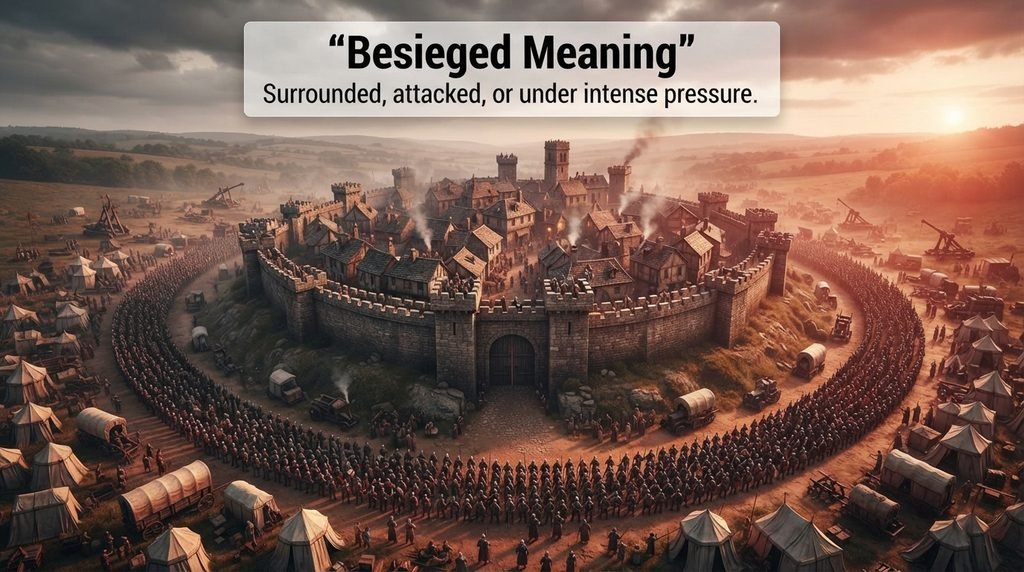
In ancient times, an army would surround a city, castle, or fortress and block supplies or escape routes. This military strategy was called a siege.
For example:
“The castle was besieged for months before the defenders surrendered.”
This means enemies surrounded the castle and continuously attacked it.
Historical examples of sieges appear throughout world history, including battles involving cities, kingdoms, and fortified areas.
Figurative Meaning of Besieged
Today, besieged is often used in a non-military way.
Instead of enemies with weapons, the “attack” may come from:
- Stress
- Responsibilities
- Questions
- Problems
- Negative emotions
- Heavy workloads
Examples:
“The manager was besieged with complaints after the service failure.”
Here, the manager was not physically attacked. Many complaints came at once, creating pressure.
Another example:
“She felt besieged by anxiety before the big exam.”
This means anxiety surrounded her emotionally.
Origin and Etymology of Besieged
The word besiege comes from the Old French word assegier, meaning “to besiege or sit before.”
It is connected to the idea of an army “sitting” outside a place and waiting while surrounding it.
The concept became common in English during medieval times when castles and fortified cities were frequently attacked.
Over time, the word expanded from a battlefield term into a metaphor for everyday struggles.
Pronunciation Guide
Besieged is pronounced:
bih-SEEJD
Phonetic spelling:
/bɪˈsiːdʒd/
Break it down:
- be → “bih”
- sieged → “seejd”
Example:
“After the announcement, the company was besieged with questions.”
How to Use “Besieged” Correctly in Texts & Writing
The word besieged is more common in formal writing, news, storytelling, and serious conversations than casual texting.
It carries a strong emotional feeling, so it is usually used when the pressure feels intense.
Common Sentence Patterns
1. Besieged by + Problem
This is the most common structure.
Examples:
- “The city was besieged by enemy forces.”
- “The teacher was besieged by requests from students.”
- “The company was besieged by negative reviews.”
The phrase “besieged by” means something is surrounding or overwhelming someone.
2. Besieged with + Requests or Questions
This structure often describes receiving too much attention.
Examples:
- “The celebrity was besieged with interview requests.”
- “The customer support team was besieged with complaints.”
Tone and Context
“Besieged” sounds:
✅ Serious
✅ Dramatic
✅ Formal
✅ Descriptive
It works well in:
- News articles
- Essays
- Novels
- Speeches
- Professional writing
It may sound too dramatic for simple situations.
For example:
❌ “I was besieged because my phone battery died.”
This sounds exaggerated.
Better:
✅ “I was frustrated because my phone battery died.”
Using Besieged in Digital Communication
Although besieged is not typical internet slang, people sometimes use it online to describe feeling overwhelmed.
Examples:
- “I’m being besieged by notifications today.”
- “My inbox is besieged with emails.”
- “Students are feeling besieged by assignments.”
On platforms like:
- Instagram captions
- Reddit discussions
- X (Twitter)
people usually use it humorously or dramatically.
Example:
“Monday mornings have me completely besieged 😂”
The writer means they feel overwhelmed, not physically attacked.
Real Conversation Examples Using “Besieged”
Understanding a word becomes much easier when you see how people actually use it. Here are realistic examples showing different situations where besieged meaning changes slightly depending on context.
Example 1: Between Friends (Daily Stress)
Friend A: “How’s your new job going?”
Friend B: “Honestly, I feel besieged by meetings and deadlines.”
Meaning:
The person feels overwhelmed because too many responsibilities are coming at the same time.
Example 2: In a Group Chat (Funny Use)
Friend A: “Why haven’t you replied all day?”
Friend B: “Sorry! I was besieged by messages after posting that photo.”
Meaning:
The person received many messages at once and jokingly describes them as an “attack.”
Example 3: Work Conversation
Employee: “The customer service team is completely besieged with complaints today.”
Meaning:
The team is receiving an unusually high number of complaints and feels under pressure.
Example 4: Family Situation
Parent: “I’ve been besieged by questions since my kids started school.”
Meaning:
The parent feels surrounded by many questions and requests.
Example 5: Gaming Community
Player: “Our base was besieged by enemy players for three hours.”
Meaning:
This example uses the original military-style meaning. The base was surrounded and attacked.
Common Mistakes & Misunderstandings About “Besieged”
Even though besieged is a useful word, many people misunderstand its intensity or use it incorrectly.
Mistake 1: Using It for Small Problems
Because “besieged” suggests being surrounded or attacked, it is stronger than normal words like “busy” or “annoyed.”
Incorrect:
“I was besieged because I had one homework task.”
Better:
“I was overwhelmed because I had many assignments.”
Use “besieged” when the pressure feels constant or comes from many directions.
Mistake 2: Confusing “Besieged” With “Beside”
The words look similar but have completely different meanings.
Besieged:
- Surrounded
- Attacked
- Overwhelmed
Beside:
- Next to something
Example:
❌ “The city was beside by enemies.”
✅ “The city was besieged by enemies.”
Mistake 3: Thinking It Always Means Physical Attack
Many people only associate “besieged” with armies and battles.
However, modern English frequently uses it emotionally.
Examples:
Physical:
“The fortress was besieged by soldiers.”
Emotional:
“She was besieged by doubts.”
Both are correct.
Generational and Cultural Differences
Language changes depending on age groups and online communities.
How Older Generations Use “Besieged”
Older speakers often use the word in traditional ways:
- Military history
- News reporting
- Formal writing
Example:
“The city was besieged during the war.”
How Younger Generations Use “Besieged”
Younger speakers often use it metaphorically and sometimes humorously.
Examples:
“My phone has been besieged by notifications.”
“I’m being besieged by exams this week.”
Gen Z may choose dramatic words like “besieged” for exaggeration, similar to saying:
- “I’m drowning in work.”
- “I’m getting attacked by emails.”
- “Everything is coming at me.”
“Besieged” Across Different Platforms & Demographics
On WhatsApp, people usually use “besieged” in personal conversations.
Example:
“Sorry for the late reply. I was besieged with family events.”
It creates a dramatic but understandable explanation.
Instagram users may use it in captions when describing busy lifestyles.
Example:
“Besieged by deadlines but still chasing dreams ✨”
The word adds a storytelling effect.
TikTok Comments
On TikTok, the word is less common but may appear in:
- Book discussions
- Historical videos
- Emotional storytelling content
Example:
“The character was besieged by guilt.”
Reddit communities often use “besieged” when discussing:
- Personal struggles
- Politics
- Gaming
- Workplace issues
Example:
“Small businesses are besieged by rising costs.”
Professional Communication
“Besieged” can work in professional writing, but use it carefully.
Good:
“The support team has been besieged with customer requests.”
Less suitable:
“I am besieged because my meeting schedule is full.”
Professional alternatives:
- Overloaded
- Managing a high volume
- Facing increased demand
Related Words, Synonyms & Alternatives
| Word | Meaning | Example |
|---|---|---|
| Overwhelmed | Having too much to handle | “I feel overwhelmed by tasks.” |
| Surrounded | Being enclosed by something | “The house was surrounded by trees.” |
| Attacked | Being targeted aggressively | “The company was attacked online.” |
| Bombarded | Receiving many things quickly | “My inbox was bombarded with emails.” |
| Pressured | Feeling stress or demand | “She felt pressured to decide.” |
| Troubled | Experiencing difficulties | “He was troubled by doubts.” |
| Swamped | Extremely busy | “I’m swamped with work.” |
| Flooded | Receiving too much of something | “The website was flooded with visitors.” |
| Beset | Troubled by problems | “He was beset by challenges.” |
| Burdened | Carrying heavy responsibility | “She felt burdened by expectations.” |
Related Vocabulary You Can Explore
- Siege meaning — the original concept behind besieged
- Overwhelmed meaning — a common emotional alternative
- Bombarded meaning — useful for describing too many messages or requests
- Beset meaning — a close synonym often used in literature
FAQs:
What does besieged mean in simple words?
Besieged means surrounded or overwhelmed by something difficult. It can describe a city surrounded by enemies or a person dealing with many problems, requests, or emotions at the same time.
Is besieged the same as overwhelmed?
Not exactly. Both words describe pressure, but besieged creates a stronger image of being surrounded from every direction. “Overwhelmed” is more common in everyday speech, while “besieged” sounds more dramatic and descriptive.
Can besieged describe emotions?
Yes. Modern English often uses besieged for emotions and mental pressure.
Examples:
- “He was besieged by fear.”
- “She felt besieged by stress.”
It means negative feelings seemed to surround or control the person.
What is the opposite of besieged?
Opposite words include:
- Free
- Protected
- Safe
- Relaxed
- Untroubled
- Peaceful
Example:
“After finishing the project, she no longer felt besieged by deadlines.”
Is besieged a formal word?
Yes, besieged is considered a moderately formal word. It appears often in journalism, literature, history, and professional writing, but it can also be used casually for dramatic effect.
Conclusion:
The besieged meaning is all about being surrounded — whether by enemies, responsibilities, emotions, or challenges. The word started as a military term but evolved into a powerful way to describe modern struggles.
When someone says they feel “besieged,” they usually mean life feels like pressure is coming from every direction. It adds more intensity than simply saying “busy” or “stressed.”
Now that you understand besieged meaning, you can recognize it in books, conversations, news articles, and online discussions with confidence.
Have a word that keeps confusing you? Share it, and keep expanding your vocabulary one powerful word at a time.

I’m Lina Roys, a passionate writer behind Storevian, where I make words, phrases, slang, and everyday expressions easy to understand. I create clear, engaging, and reader-friendly content to help people find the meanings they’re looking for, quickly and confidently.


