Have you ever heard someone say, “That’s my baby mama,” in a movie, rap song, TikTok video, or even a casual conversation and wondered what they actually meant?
You’re not alone. The baby mama meaning is one of the most searched slang terms online because people hear it everywhere, from Instagram comments and podcasts to reality TV and text messages. While the phrase seems simple, its meaning can change depending on who’s saying it and the relationship between the people involved.
Originally popularized in African American Vernacular English (AAVE), the expression has become part of mainstream English and is now recognized around the world. However, it’s also one of those slang terms that can sound perfectly normal in one conversation and surprisingly offensive in another.
Whether you’re learning English, trying to understand internet slang, or simply curious about modern relationship terminology, this guide explains everything you need to know.
You’ll discover where the phrase came from, how people use it today, when you should avoid saying it, and plenty of real-world examples to help you understand the context.
Updated for 2026: This guide reflects how the phrase is currently used across social media, texting, and everyday conversations.
What Does Baby Mama Mean?
Quick Answer
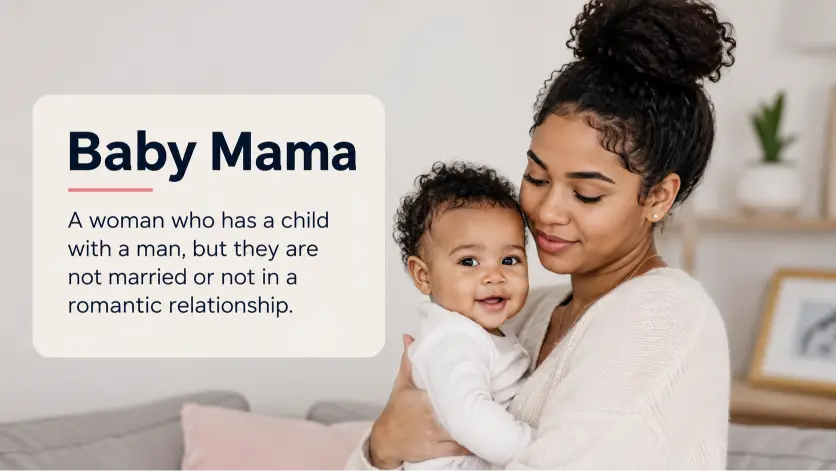
Baby mama is an informal slang term for the mother of someone’s child, especially when the parents are not married or are no longer in a romantic relationship. Depending on the speaker and context, it can be used neutrally, affectionately, humorously, or as an insult.
At its core, the phrase simply describes a family relationship.
For example:
- “She’s my baby mama.”
- “My baby mama is picking up our son after school.”
In these examples, the speaker is referring to the mother of their child. The phrase doesn’t automatically reveal whether the parents are dating, separated, divorced, or simply co-parenting.
That’s why context matters so much.
Some couples who are happily raising children together jokingly use the term with each other. Others dislike it because they feel it reduces a parent to a slang label rather than acknowledging their role as a mother.
Simple Definition
A baby mama is:
- The mother of someone’s child.
- Usually someone who isn’t married to the child’s father.
- A slang expression rather than a formal title.
Think of it as the female counterpart to baby daddy, another common slang phrase.
Pronunciation
Baby mama
Pronounced: BAY-bee MAH-muh
Phonetic spelling:
/ˈbeɪ.bi ˈmɑː.mə/
The pronunciation is straightforward, with equal emphasis on both words.
Where Did the Term “Baby Mama” Come From?
The phrase baby mama originated in African American Vernacular English (AAVE), a recognized variety of English with its own grammar, vocabulary, and cultural history.
Linguists trace the widespread use of the term back to communities in the United States during the late twentieth century. While similar expressions existed earlier in spoken language, “baby mama” became much more visible through hip-hop culture during the 1990s and early 2000s.
As rap music, television, and internet culture expanded globally, millions of people began using the phrase in everyday conversation.
Today, you’ll hear it in:
- Text messages
- TikTok videos
- Instagram captions
- Reality television
- Podcasts
- Hip-hop lyrics
- Comedy sketches
- Online memes
Because of this popularity, many younger English speakers recognize the term even if they don’t know its cultural origins.
How the Meaning Has Evolved
When the phrase first gained popularity, it mainly referred to an unmarried woman who had a child with someone.
Today, the meaning has become much broader.
Depending on the situation, people may use it to describe:
- A co-parent
- An ex-partner with whom they share children
- A current girlfriend who has their child
- The mother of their children regardless of marital status
Some people even jokingly call their wife their “baby mama” after having children together.
For example:
“Can’t wait for date night with my baby mama ❤️”
In this case, there’s no negative meaning at all. It’s simply playful affection.
On the other hand, during arguments or gossip, the same phrase may sound dismissive or disrespectful.
For example:
“His baby mama keeps calling.”
Here, the wording may imply emotional distance or conflict.
This is why understanding tone is just as important as understanding the dictionary definition.
How to Use Baby Mama Correctly in Texts & Chat
The phrase is most appropriate in casual conversations where everyone understands the tone and relationship.
Appropriate situations
You might hear it used among:
- Friends
- Family members
- Romantic partners
- Social media users
- Podcasts
- Comedy shows
- Informal texting
Examples:
Friend:
“Your baby mama coming to the birthday party?”
Reply:
“Yeah, we’re co-parenting really well now.”
Text Message
Alex: “Who’s picking up Emma?”
Chris: “Her baby mama is on the way.”
Casual Conversation
“We may not be together anymore, but my baby mama and I work as a team for our daughter.”
This usage focuses on co-parenting rather than the romantic relationship.
When You Shouldn’t Use It
Even though it’s common slang, baby mama isn’t appropriate in every situation.
Avoid using it in:
- Business emails
- School essays
- Legal documents
- Court records
- Medical paperwork
- Job interviews
- Professional meetings
Instead, use more respectful alternatives like:
- the child’s mother
- co-parent
- mother of his child
- mother of her child
- parent
For example:
❌ “His baby mama attended the meeting.”
✅ “The child’s mother attended the meeting.”
The second version sounds more professional and respectful.
Real Conversation Examples Using Baby Mama
One of the easiest ways to understand the baby mama meaning is to see how people naturally use it in everyday conversations. The same phrase can sound friendly, humorous, respectful, or even rude depending on the tone.
Here are several realistic examples from different situations.
Between Friends
Jake: “You coming to the cookout this weekend?”
Marcus: “Yeah, my baby mama’s bringing the kids around noon.”
Jake: “Nice! It’ll be good seeing everyone.”
Meaning:
Here, baby mama is simply a casual way to refer to the mother of Marcus’s children. There’s no negative emotion attached to it.
In a Text Message
Emma: “Who’s watching Noah tonight?”
Chris: “His baby mama has him this weekend.”
Emma: “Perfect, thanks!”
Meaning:
The phrase communicates a co-parenting arrangement. It’s short, casual, and common in text conversations.
Between Co-Parents
David: “Thanks for helping with the school supplies.”
Sarah: “Of course. We both want the best for him.”
David: “You’re an awesome baby mama.”
Meaning:
In this situation, the phrase is used as a compliment. Some parents use it affectionately when they have a healthy co-parenting relationship.
Dating Conversation
Friend: “Does he have any kids?”
Ashley: “Yeah, he has one daughter and gets along well with his baby mama.”
Friend: “That’s actually a good sign.”
Meaning:
The phrase simply identifies the mother of his child without giving extra relationship details.
Group Chat
Mike: “Who’s bringing the birthday cake?”
Aaron: “My baby mama already ordered one.”
Mike: “Nice—you just saved us!”
Meaning:
The expression is completely casual and fits naturally in an informal group conversation.
Gaming Voice Chat
1: “BRB.”
2: “Everything okay?”
1: “Yeah, my baby mama needs help getting the kids ready.”
2: “No worries.”
Meaning:
Friends often use everyday family slang even while gaming. The tone here is conversational rather than dramatic.
Social Media Caption
“Happy Mother’s Day to my amazing baby mama. Thanks for always putting our son first. ❤️”
Meaning:
Many people use the phrase positively on social media to acknowledge the mother of their children.
Negative Example
“My baby mama is always causing problems.”
Meaning:
The words themselves aren’t offensive, but the negative context makes the expression sound critical or resentful.
Common Mistakes & Misunderstandings
Although the phrase is widely understood, many people misuse it or misunderstand what it actually means.
Let’s clear up the biggest misconceptions.
Mistake 1: Thinking It Always Means an Ex-Girlfriend
This is probably the most common misunderstanding.
Many people assume a baby mama must be someone’s ex-partner.
That’s not always true.
Some people use the phrase for:
- their current girlfriend
- their fiancée
- their wife (playfully)
- a long-term partner
- an ex-partner
The relationship status isn’t defined by the phrase itself.
Mistake 2: Assuming It’s Always Disrespectful
Some people believe calling someone a baby mama is automatically insulting.
In reality, it depends entirely on the speaker.
For example:
❤️ “Happy birthday to my beautiful baby mama.”
This sounds affectionate.
Compare that with:
😒 “Here comes my baby mama again.”
This sounds dismissive.
The same words can carry completely different meanings depending on tone.
Mistake 3: Using It in Formal Writing
Because it’s common in conversation, some English learners accidentally use it in professional situations.
Avoid writing things like:
❌ “The employee’s baby mama attended the meeting.”
Instead, write:
✅ “The mother of his child attended the meeting.”
Professional communication should avoid slang whenever possible.
Generational Differences
Different generations often interpret the phrase differently.
Gen Z
- Usually sees it as normal slang.
- Common on TikTok and Instagram.
- Often used humorously.
Millennials
- Generally understand it well.
- Frequently use it in texting and everyday conversation.
- May use it casually among friends.
Gen X and Baby Boomers
Older generations are more likely to view the phrase as:
- informal
- disrespectful
- grammatically incorrect
- inappropriate for formal conversation
This doesn’t mean they’re wrong—it simply reflects different language norms.
Cultural Differences
In the United States, the phrase is widely recognized.
Outside the U.S., however, reactions vary.
United Kingdom
People understand the term through American media but are more likely to say:
- my ex
- my partner
- my child’s mother
Canada
The expression is familiar, especially among younger speakers.
Australia
It appears in pop culture but isn’t used as frequently as in the U.S.
Non-Native English Speakers
Many English learners first encounter baby mama in:
- Netflix shows
- TikTok videos
- rap music
- YouTube
- Instagram Reels
Because of this, they sometimes assume it’s the standard or official term—which it isn’t.
How to Clarify if Someone Doesn’t Understand
If someone asks:
“What’s a baby mama?”
A simple explanation works best:
“It’s an informal way of saying the mother of someone’s child.”
If they ask whether it’s rude, you can explain:
“Some people use it affectionately, while others find it disrespectful. It depends on the relationship and context.”
That answer avoids confusion and reflects how the phrase is actually used today.
Baby Mama Across Different Platforms & Demographics
Language changes depending on where people communicate. The baby mama meaning stays mostly the same, but the tone, frequency, and intent vary across platforms and age groups.
TikTok
TikTok users often use the phrase in:
- relationship stories
- parenting videos
- comedy skits
- trending audio
- memes
Example:
“POV: Your baby mama is your biggest supporter.”
The tone is usually humorous or wholesome.
On Instagram, you’ll often see it in:
- Mother’s Day posts
- birthday captions
- family photos
- parenting reels
Example:
“Shoutout to my amazing baby mama for everything she does.”
The phrase is commonly used as a term of appreciation.
X (Formerly Twitter)
On X, users frequently use the phrase in:
- jokes
- trending discussions
- celebrity news
- relationship commentary
Because posts are short, slang terms like baby mama fit naturally.
Reddit conversations tend to use the phrase more literally.
You’ll often find discussions about:
- co-parenting
- custody
- family relationships
- dating advice
- financial responsibilities
In advice communities, users often ask questions like:
“My baby mama wants to move to another state. What should I do?”
Here, the phrase is descriptive rather than emotional.
Discord
Discord users mostly use it jokingly while chatting with friends.
Example:
“Hold on, my baby mama’s calling.”
Even when someone isn’t a parent, the phrase may be used humorously among close friends.
In Text Messages
Texts usually keep the phrase simple and direct.
Examples:
- “Baby mama picked him up.”
- “Talked to my baby mama.”
- “My baby mama already handled it.”
The casual tone makes it common in everyday texting.
How Different Generations Use It
| Generation | Typical Usage | Tone |
|---|---|---|
| Gen Z | Very common | Casual, humorous |
| Millennials | Common | Friendly, conversational |
| Gen X | Occasional | Context-dependent |
| Baby Boomers | Less common | Often considered informal |
Is It Safe for Work?
Generally, no.
Although it isn’t profanity, it’s still slang.
In workplaces, schools, legal settings, and professional writing, it’s better to use:
- child’s mother
- co-parent
- mother of his child
- mother of her child
- parent
These alternatives sound more respectful and appropriate.
Why the Phrase Became So Popular
Several factors helped spread the expression worldwide:
- Hip-hop music
- Reality TV
- Celebrity interviews
- Viral internet memes
- Social media platforms
- Streaming shows
- Online relationship discussions
Today, many people recognize the term even if they don’t personally use it.
Related Slang, Abbreviations & Alternatives
If you’re learning internet slang, understanding similar expressions can help you recognize them in conversations.
| Term | Meaning |
|---|---|
| Baby Daddy | The father of someone’s child. |
| Co-parent | Two parents raising a child together without necessarily being in a relationship. |
| Ex | A former romantic partner. |
| Partner | A person’s romantic companion, married or unmarried. |
| BM | A text abbreviation sometimes used for “Baby Mama.” Context matters because BM can also mean other things. |
| BD | Short for “Baby Daddy.” |
| Situationship | A romantic connection without an official relationship label. |
| Bae | A slang nickname for a romantic partner or someone you love. |
| Wifey | Informal term for a wife or someone considered wife material. |
| Ride or Die | Someone who stays loyal through good and bad times. |
Synonyms
- child’s mother
- mother of his child
- co-parent
- mother of their child
Casual Alternatives
- my ex
- my partner
- my son’s mom
- my daughter’s mom
Not Quite the Same
Although people sometimes use them interchangeably, these terms aren’t identical:
- Baby mama focuses on parenthood.
- Ex-girlfriend focuses on a past relationship.
- Co-parent focuses on raising children together.
- Partner focuses on the current relationship.
Understanding these differences helps you choose the most accurate expression for each situation.
FAQs:
Is baby mama a bad word?
No. Baby mama is not profanity or a swear word. However, it is informal slang. Some people use it affectionately, while others feel it sounds disrespectful or dismissive. If you’re unsure how someone feels about the term, it’s safer to use a more neutral phrase like “the child’s mother” or “co-parent.”
Can a married couple use the term baby mama?
Yes. Although the phrase originally became popular for unmarried parents, some married couples jokingly call each other baby mama and baby daddy after having children. In these cases, it’s usually playful and affectionate rather than literal.
What’s the difference between baby mama and baby mother?
Both refer to the mother of someone’s child, but there’s a difference in tone.
- Baby mama is informal slang and commonly heard in conversations, music, and social media.
- Baby mother is less slang-heavy and may sound more neutral, though many people still prefer phrases like “the child’s mother” in formal situations.
Is baby mama only used in the United States?
No. While the term originated in the United States and is strongly associated with American English, it has spread worldwide through music, movies, TV shows, TikTok, Instagram, YouTube, and other social media platforms.
People in countries like Canada, the UK, Australia, and many non-English-speaking regions recognize the phrase, even if they don’t use it as frequently.
Can women say baby mama?
Absolutely.
A woman might say:
“I’m his baby mama.”
Or she might refer to another woman as someone’s baby mama.
The phrase isn’t limited to men—it simply describes a family relationship.
Is baby mama appropriate in school or at work?
Usually not.
Because it’s slang, it may sound too casual in professional, academic, or legal settings.
Instead, consider using:
- the child’s mother
- mother of his child
- mother of her child
- co-parent
- parent
These alternatives are more respectful and suitable for formal communication.
Why do some people find baby mama offensive?
The concern isn’t the definition—it’s the tone.
Some people feel the phrase reduces a woman to her role as the mother of someone’s child and overlooks her identity. Others associate it with negative stereotypes because of how it’s sometimes portrayed in media.
At the same time, many families use the term affectionately with no negative intent. The key is understanding your audience and respecting individual preferences.
Is baby mama the same as a co-parent?
Not always.
A co-parent is anyone who shares parenting responsibilities for a child, whether they’re together, divorced, married, or never had a romantic relationship.
A baby mama specifically refers to the mother of someone’s child. While many baby mamas are also co-parents, the two terms aren’t exact synonyms.
Conclusion:
Understanding the baby mama meaning is about more than knowing a simple definition—it’s about recognizing the context behind the words. At its core, the phrase refers to the mother of someone’s child, most commonly in informal conversations.
Like many internet slang terms, baby mama can carry different meanings depending on the speaker, relationship, and situation. Friends may use it jokingly, co-parents may use it respectfully, while others may avoid it altogether because they prefer more neutral language. Paying attention to tone and audience is the best way to decide whether it’s appropriate.
Whether you came here after hearing the phrase in a text message, TikTok video, podcast, movie, or everyday conversation, you now know its meaning, origin, proper usage, and the situations where it’s best to choose a more formal alternative.
What’s your favorite internet slang term? Drop it in the comments below, and explore more modern text abbreviations to stay up to date with today’s digital language.

I’m Lina Roys, a passionate writer behind Storevian, where I make words, phrases, slang, and everyday expressions easy to understand. I create clear, engaging, and reader-friendly content to help people find the meanings they’re looking for, quickly and confidently.


