Have you ever read a headline like “The actress was feted at the awards ceremony” and wondered what fete actually means? You’re not alone. Although the word isn’t used in everyday conversation as often as words like party or celebrate, it regularly appears in newspapers, books, speeches, and formal writing.
Understanding the fete meaning can help you interpret news stories, improve your vocabulary, and communicate more naturally in professional or academic settings.
It’s also one of those words that sounds sophisticated but is surprisingly easy to understand once you know its origin.
In this guide, you’ll learn exactly what fete means, where it came from, how to pronounce it correctly, when to use it, and how it differs from similar words like celebrate, festival, and party. You’ll also see practical examples that make the meaning stick.
What Does “Fete” Mean?
Quick Answer
Fete means to honor, celebrate, or entertain someone with a special event. As a noun, it also means a festival or community celebration.
The word has two main uses in English.
1. Fete as a Verb
When used as a verb, fete means to honor someone with praise, a banquet, ceremony, or celebration.
Examples:
- The Nobel Prize winner was feted by universities across Europe.
- The city plans to fete its Olympic athletes.
- Fans gathered to fete the championship team.
In these examples, the person isn’t simply attending a party—they’re the guest of honor.
2. Fete as a Noun
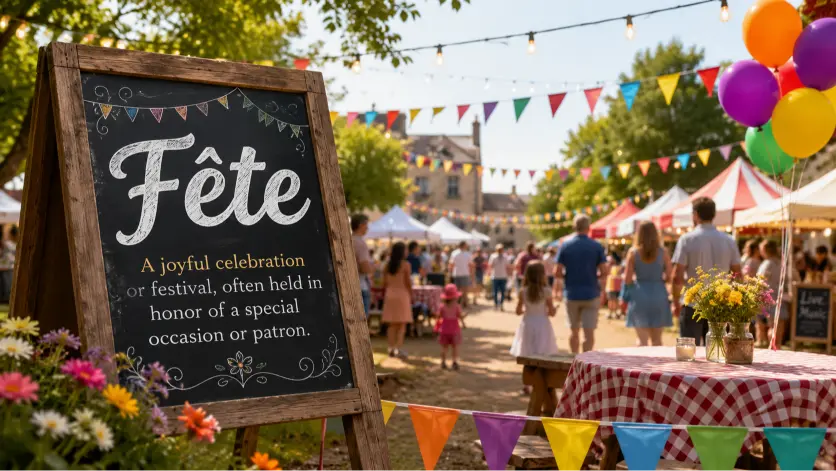
As a noun, fete refers to a festival, fair, or community celebration.
Examples include:
- a school fete
- a church fete
- a summer fete
- a charity fete
- a village fete
In British English especially, a fete often includes games, food stalls, raffles, music, and fundraising activities.
Origin of the Word Fete
The word comes from the French fête, meaning festival, holiday, or celebration.
Its roots stretch even further back to the Latin word festum, meaning feast or festival.
Over time, English adopted the spelling fete (sometimes written as fête with the accent), while keeping nearly the same meaning.
Timeline
- Latin: festum (festival)
- Old French: feste
- Modern French: fête
- English: fete
Although English usually drops the accent mark, both fete and fête are considered correct.
How Has the Meaning Changed?
Originally, the word mainly described religious festivals and public celebrations.
Today it has expanded to include:
- honoring important people
- celebrating achievements
- official ceremonies
- charity events
- community festivals
- school fairs
- cultural celebrations
News organizations frequently use feted when reporting on award ceremonies, political receptions, sporting victories, or entertainment events.
Example:
“The director was feted after winning the international film award.”
Pronunciation Guide
Fete
Pronunciation:
/feɪt/
It sounds exactly like:
fate
Rhymes with:
- late
- gate
- date
- weight
Many English learners mistakenly pronounce the final “e.” Don’t—the word has only one syllable.
✅ Correct: FATE
❌ Incorrect: fee-tee
When Is “Fête” Written with an Accent?
Both spellings are accepted.
Fete → Common in English dictionaries and newspapers.
Fête → More common when preserving the original French spelling or in formal publications.
Both have the same meaning.
How to Use “Fete” Correctly in Texts & Everyday English
Although fete isn’t internet slang or a text abbreviation, it’s still useful to know because it appears frequently in articles, speeches, books, and formal conversations.
Casual Conversation
People usually say:
- celebrate
- throw a party
- honor
- congratulate
Instead of:
Let’s fete Sarah tonight.
Most native speakers would naturally say:
Let’s celebrate Sarah tonight.
Formal Writing
This is where fete shines.
Examples:
- The university will fete its distinguished alumni.
- The charity feted hundreds of volunteers.
- Local officials feted emergency workers.
- The actor was feted during the film festival.
Professional Settings
Appropriate:✔ award ceremonies
company recognition events
retirement celebrations
official speeches
Example:
“The organization will fete employees celebrating 25 years of service.”
Social Media Usage
Although uncommon in casual posts, you’ll occasionally see it in captions like:
Proud to be feted tonight for our community work.
or
Feeling honored to be feted at this year’s awards.
Platform-Specific Usage
| Platform | Common? | Example |
|---|---|---|
| SMS | Rare | “Congrats!” is more common |
| Rare | Usually replaced by “celebrate” | |
| Sometimes | Award captions | |
| Occasionally | Community event posts | |
| Common | Professional recognition | |
| News Websites | Very Common | “CEO feted at ceremony” |
| Newspapers | Very Common | Headlines and reports |
| Academic Writing | Moderate | Formal descriptions |
When NOT to Use Fete
Avoid using fete in:
- everyday texting
- casual chats with friends
- gaming conversations
- memes
- informal workplace messages
Instead, use:
- celebrate
- party
- congratulate
- honor
These sound more natural in casual English.
Tone of the Word
Fete usually carries a tone that is:
- respectful
- celebratory
- formal
- prestigious
- appreciative
It suggests that someone is receiving recognition rather than simply attending a celebration.
Emoji Pairings (Social Media)
If you’re posting about being feted, these emojis fit naturally:
🏆 🎉 👏 🎖️ 🌟 🎊 ❤️
Example:
Honored to be feted tonight! 🏆🎉👏
Real Conversation Examples Using Fete
Seeing fete in context is the easiest way to remember it. Below are realistic dialogue examples from different situations. Notice that the word is generally used in formal or semi-formal contexts rather than everyday texting.
Example 1: Between Friends
Emma: Did you hear? Olivia was feted at the university awards night.
Liam: That’s amazing! She definitely deserved the recognition.
Meaning: Here, feted means Olivia was publicly honored for her achievements, not just invited to a party.
Example 2: Workplace Chat
Manager: We’ll fete our Employee of the Year during Friday’s luncheon.
Employee: That’s a wonderful way to recognize everyone’s hard work.
Meaning: The company plans to celebrate and honor an employee during a formal event.
Example 3: Family Conversation
Dad: Grandma is turning 90 this weekend.
Mom: Let’s fete her with a family dinner and invite everyone.
Meaning: The family wants to make Grandma the guest of honor and celebrate her milestone birthday.
Example 4: News Interview
Reporter: The Olympic champions were feted after returning home.
Athlete: It was overwhelming to receive so much love from our supporters.
Meaning: The athletes received public recognition and celebration for their success.
Example 5: Community Event
Volunteer: Are you coming to the village fete on Saturday?
Neighbor: Absolutely! I heard there will be food stalls, games, and live music.
Meaning: Here, fete is used as a noun, referring to a community fair or festival.
Example 6: Social Media Caption
Feeling incredibly honored to be feted for our charity work tonight. Thank you to everyone who made this possible! 🎉🏆
Meaning: The writer is expressing gratitude for being publicly recognized.
Common Mistakes & Misunderstandings
Although fete is a straightforward word, many learners confuse it with similar-looking or similar-sounding words. Here are the most common mistakes.
1. Thinking Fete Means Any Party
❌ Incorrect:
We had pizza and watched movies—it was a fete.
Unless the gathering is a festival, community event, or formal celebration, “party” is usually the better choice.
✔ Better:
We had a small party at home.
2. Confusing Fete with Fate
Because fete and fate sound exactly alike, many people mix them up.
Word Meaning Fete To celebrate or honor; a festival Fate Destiny or something predetermined Example:
✔ The mayor feted the volunteers.
✔ It was fate that they met.
3. Using Fete in Casual Text Messages
Most native English speakers don’t text:
Let’s fete tonight!
Instead, they’ll naturally say:
- Let’s celebrate!
- Let’s party!
- Let’s hang out!
- Let’s grab dinner!
4. Assuming It Always Means “Festival”
Remember, fete has two meanings.
As a noun:
A summer fete.
As a verb:
They feted the scientist.
The surrounding sentence tells you which meaning is intended.
5. Forgetting the Formal Tone
Words like celebrate or party fit casual conversations.
Fete sounds more polished and is commonly used in:
- newspapers
- award ceremonies
- speeches
- official announcements
- historical writing
Generational Differences
Gen Z
Gen Z rarely uses fete in everyday speech. Instead, you’ll hear:
- iconic
- slay
- big win
- celebrated
- GOAT
- legend
They may still encounter feted while reading news articles or watching award shows.
Millennials
Millennials are more likely to recognize the word from newspapers, books, and professional workplaces, but they still don’t use it often in casual conversation.
Older Generations
Older adults, especially frequent newspaper readers, are generally more familiar with the word because it appears regularly in journalism and literature.
Regional Differences
British English 🇬🇧
The noun fete is very common.
Examples:
- school fete
- church fete
- village fete
- charity fete
These events often include:
- bake sales
- raffles
- games
- live entertainment
- fundraising
American English 🇺🇸
Americans are more likely to say:
- fair
- festival
- fundraiser
- carnival
The verb feted, however, appears frequently in American newspapers.
Example:
The actor was feted after winning an Academy Award.
How to Clarify the Meaning
If someone isn’t familiar with the word, simply explain:
“Fete means to honor or celebrate someone, or it can mean a community festival.”
That short explanation is usually enough.
Fete Across Different Platforms & Demographics
Unlike internet slang, fete is a standard English vocabulary word. Its popularity varies depending on where you’re reading or communicating.
Common.
Professional recognition posts often use feted because it sounds respectful and polished.
Example:
Our CEO was feted at the annual leadership awards.
News Websites
Very common.
Journalists frequently choose feted instead of repeatedly writing “celebrated” or “honored.”
Typical headlines include:
- Nobel winner feted in London
- Volunteers feted for community service
- Champions feted after historic victory
Occasionally used.
You’ll mostly find it in captions about:
- award ceremonies
- graduations
- charity events
- professional achievements
More common among community organizations promoting events like:
- village fetes
- church fetes
- fundraising fetes
- school fetes
TikTok
Rare.
TikTok creators generally prefer simpler words like:
- celebrated
- honored
- iconic
- won
- huge achievement
Discord
Almost never used.
Gamers would usually say:
- GG
- Congrats
- Huge W
- Well deserved
Occasionally appears in discussions about:
- literature
- history
- British culture
- language learning
- world news
Is Fete Formal or Informal?
Situation Appropriate? Academic writing ✅ Yes Newspapers ✅ Yes Award ceremonies ✅ Yes Business speeches ✅ Yes School newsletters ✅ Yes Text messages ❌ Rare Gaming chats ❌ No Casual memes ❌ No
Is It Safe for Work?
Yes.
Fete is completely professional and appropriate for:
- emails
- presentations
- press releases
- speeches
- reports
- academic papers
Unlike slang terms, it carries no offensive or inappropriate meaning.
Why Does It Still Matter?
Even if you never say fete aloud, understanding it helps you:
- read news confidently
- improve academic vocabulary
- understand award announcements
- recognize British English expressions
- expand your professional writing skills
It’s one of those words that quietly appears everywhere once you know what it means.
Related Words, Synonyms & Alternatives
Here are some words related to fete, along with how they’re commonly used.
Word Meaning When to Use Celebrate Mark a happy event Everyday conversations Honor Show respect or recognition Formal and professional contexts Commemorate Remember an important event or person Historical or memorial events Festival Large public celebration Community and cultural events Fair Public event with stalls and entertainment American English equivalent of some fetes Carnival Celebration with rides and games Entertainment-focused events Reception Formal gathering to welcome or honor someone Business or official events Tribute Act of showing admiration or gratitude Speeches, ceremonies, memorials Banquet Formal meal celebrating someone or something Awards and recognition dinners Ceremony Official event marking an occasion Graduations, awards, inaugurations Related Learning Opportunities
If your website covers vocabulary and modern English, consider linking readers to articles such as:
- Celebrate vs. Commemorate: What’s the Difference?
- Festival Meaning Explained
- Honor Meaning in English
- Fair vs. Carnival vs. Fete
- Common French Words Used in English
These internal links help readers explore related topics while strengthening your site’s topical authority.
FAQs:
What does fete mean in English?
Fete means to honor, celebrate, or entertain someone with a special event or public recognition. As a noun, it also refers to a festival, fair, or community celebration. The word is commonly found in newspapers, books, and formal English.
Is fete a French word?
Yes. Fete comes from the French word fête, which means festival or celebration. English adopted the word centuries ago, and both fete and fête are accepted spellings, although fete is more common in English publications.
How do you pronounce fete?
Fete is pronounced:
/feɪt/
It sounds exactly like “fate.” It’s a one-syllable word that rhymes with late, gate, and date.
What is the difference between fete and celebrate?
While both words involve celebrating, celebrate is broader and suitable for everyday conversations. Fete usually implies honoring someone through a formal event, ceremony, banquet, or public recognition. It has a more elegant and official tone.
Is fete commonly used today?
Yes, but mostly in formal contexts. You’ll often see feted in:
- newspaper headlines
- award ceremonies
- government announcements
- university news
- professional publications
In casual speech, people usually say celebrate, honor, or throw a party instead.
What is a village fete?
A village fete is a traditional British community event that typically includes games, food stalls, live music, raffles, crafts, and fundraising activities. These events bring local residents together and are often organized by schools, churches, or community groups.
Can fete be used as both a noun and a verb?
Yes.
As a noun:
We visited the annual school fete.
As a verb:
The city feted its Olympic champions.
The meaning depends on how the word is used in the sentence.
Is fete formal or informal?
Fete is generally considered formal or semi-formal. It’s appropriate for professional writing, journalism, speeches, and ceremonial contexts. In casual conversations or text messages, simpler words like celebrate or party sound more natural.
Conclusion:
Understanding the fete meaning is a simple way to strengthen your English vocabulary and better understand formal writing. Whether you’re reading a news article, attending a community event, or writing professionally, you’ll now recognize exactly how the word is used.
Remember, fete has two primary meanings. As a verb, it means to honor or celebrate someone. As a noun, it refers to a festival, fair, or community celebration, especially in British English.
The next time you read that an athlete, actor, or community leader was feted, you’ll know they weren’t just attending a party they were being publicly recognized and celebrated.
Want to keep improving your vocabulary? Explore more word meanings and everyday English expressions to become a more confident reader and communicator.

I’m Lina Roys, a passionate writer behind Storevian, where I make words, phrases, slang, and everyday expressions easy to understand. I create clear, engaging, and reader-friendly content to help people find the meanings they’re looking for, quickly and confidently.


