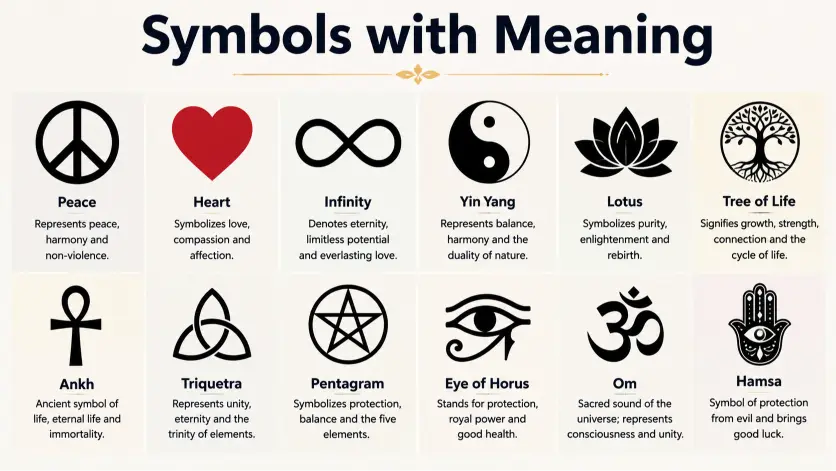
Imagine sending a text without using a single word. Instead, you reply with a ❤️, 👍, or ✓, and the other person instantly understands your message. That’s the power of symbols with meaning. They communicate ideas, emotions, and intentions in seconds, often more effectively than words themselves.
From ancient cave paintings to today’s social media posts, symbols have always been part of human communication. Whether you’re browsing the internet, reading road signs, studying mathematics, or chatting on WhatsApp, symbols appear everywhere. Some represent emotions, while others stand for safety, religion, technology, or even entire cultures.
Updated for 2026, this comprehensive guide explains the most common symbols, where they came from, how their meanings have evolved, and how to use them correctly in everyday conversations and online communication. You’ll also discover why certain symbols mean different things depending on the platform, culture, or generation.
If you’ve ever wondered why a simple icon can say so much, you’re in the right place.
What Does “Symbols with Meaning” Mean?
A symbol with meaning is any visual sign, mark, or character that represents an idea, object, emotion, action, or belief beyond its literal appearance.
Unlike ordinary drawings, symbols communicate a message that people recognize and understand without needing lengthy explanations.
Quick Answer:
Symbols with meaning are visual representations that communicate ideas, emotions, beliefs, instructions, or concepts without relying on words.
For example:
- ❤️ represents love.
- ☮ represents peace.
- ✓ represents approval or correctness.
- ⚠ warns of danger.
- ∞ symbolizes something without an end.
Because symbols are easy to recognize, they help people communicate across different languages and cultures.
The Origin of Symbols
Humans have used symbols for thousands of years.
Early civilizations carved symbols into stone to record important events and religious beliefs. Ancient Egyptians used hieroglyphics, while many early cultures relied on symbolic artwork to communicate long before modern alphabets existed.
As societies evolved, symbols became part of mathematics, science, religion, transportation, and eventually digital communication.
Today, symbols appear in:
- Text messages
- Social media
- Computer programming
- Road signs
- Company logos
- Maps
- Religious traditions
- Education
- Warning labels
Modern technology has made symbols even more important because people often prefer visual communication over long blocks of text.
Why Symbols Matter More Than Ever
The internet has transformed how people communicate.
Instead of writing:
“I completely agree with you.”
Many people simply type:
✓
or
👍
Likewise, instead of saying:
“I’m sending love.”
People send:
❤️
Visual communication saves time while adding personality and emotion.
That’s why symbols have become an essential part of texting, gaming, online communities, and professional interfaces.
Some benefits include:
- Faster communication
- Universal recognition
- Emotional expression
- Easy international understanding
- Better visual learning
- Stronger branding and marketing
Types of Symbols and Their Meanings
Symbols appear in nearly every aspect of daily life. While thousands exist, most fall into a few major categories.
1. Emotional Symbols
These express feelings quickly.
| Symbol | Meaning |
|---|---|
| ❤️ | Love |
| 💔 | Heartbreak |
| 😊 | Happiness |
| 😢 | Sadness |
| ⭐ | Admiration |
These are common on Instagram, WhatsApp, Snapchat, and Messenger.
2. Mathematical Symbols
Students encounter these every day.
| Symbol | Meaning |
|---|---|
| + | Addition |
| − | Subtraction |
| × | Multiplication |
| ÷ | Division |
| = | Equal |
| ≠ | Not equal |
| ∞ | Infinity |
Many mathematical symbols have become part of everyday speech, especially “infinity.”
3. Safety Symbols
Safety symbols communicate important warnings instantly.
Examples include:
⚠ Warning
☢ Radioactive
☣ Biohazard
🚫 Prohibited
🔥 Fire hazard
These symbols reduce accidents because people recognize them regardless of language.
4. Religious Symbols
Many religions use symbols to express beliefs and identity.
Examples include:
✝ Christianity
☪ Islam
☸ Buddhism
✡ Judaism
☯ Taoism
Each carries deep historical and spiritual significance beyond its visual appearance.
5. Internet & Technology Symbols
Digital life depends heavily on symbols.
Examples include:
@ Email address
Hashtag
& And
% Percentage
- Wildcard or emphasis
_ Underscore
<> HTML tags
These symbols are essential for online communication, programming, and social media.
How to Use “Symbols with Meaning” Correctly
Knowing what a symbol means is only half the story. Understanding when and where to use it is equally important.
In Text Messages
Symbols help make conversations quicker and more expressive.
Example:
Friend: Are you coming tonight?
You: ✓ ❤️
Instead of writing a full sentence, you’ve confirmed your attendance and shown enthusiasm.
On Social Media
Platforms like Instagram, TikTok, Facebook, and X rely heavily on symbols to increase engagement.
People often use:
❤️ to support creators
🔥 for impressive content
👏 to congratulate someone
✨ to highlight exciting news
📍 to indicate locations
Used naturally, symbols make captions more visually appealing without overwhelming readers.
In Professional Communication
Not every symbol belongs in a work email.
Appropriate:
✓ Completed
→ Next steps
• Bullet points
Avoid using excessive decorative symbols or playful icons in formal reports unless your workplace culture encourages them.
Professional writing should prioritize clarity over creativity.
Formatting Tips
To keep symbols effective:
- Don’t overuse them.
- Match the symbol to the message.
- Consider your audience.
- Remember that some symbols have different meanings across cultures.
- When in doubt, pair a symbol with a few words for clarity.
For example:
✔ Project Approved
is clearer than simply sending:
✔
without context.
Real Conversation Examples Using Symbols with Meaning
Symbols become much easier to understand when you see them in real conversations. Here are examples from different situations and what each symbol conveys.
Between Friends
Alex: I finally passed my driving test!
Sam: ⭐👏 Congratulations! You earned it.
Meaning:
The ⭐ (star) highlights achievement, while 👏 (clapping hands) shows praise and excitement.
Dating Conversation
Emma: I had a great time tonight.
Liam: ❤️😊 Me too. Let’s do it again soon.
Meaning:
The ❤️ expresses affection, and 😊 adds warmth and sincerity without sounding overly formal.
Family Group Chat
Mom: Dinner is ready!
Dad: 👍 Coming.
Meaning:
A simple 👍 confirms the message quickly. It’s one of the most common symbols used in family chats.
Workplace Chat
Manager: Has the presentation been finalized?
Employee: ✓ Everything is ready for tomorrow.
Meaning:
The ✓ (check mark) communicates completion and confidence in a professional setting.
Gaming Chat
Player 1: We won the tournament!
Player 2: 🔥🔥 GG!
Meaning:
The 🔥 (fire) symbol suggests something impressive or exciting, while “GG” means “Good Game.”
Social Media Comment
Creator: Just launched my first business!
Follower: 🚀 Wishing you massive success!
Meaning:
The 🚀 (rocket) symbolizes rapid growth, ambition, and exciting new beginnings.
School Group Chat
Student: I finally finished my assignment.
Friend: 💯 Nice work!
Meaning:
The 💯 (100) represents doing something exceptionally well or giving maximum effort.
Why Symbols Work So Well
Unlike long sentences, symbols:
- Grab attention instantly.
- Add emotional tone.
- Reduce misunderstandings.
- Save time while texting.
- Make conversations feel more natural.
That’s why people often combine words and symbols rather than replacing text completely.
Common Mistakes & Misunderstandings
Although symbols seem universal, they don’t always mean the same thing to everyone. Misunderstandings are common, especially between different age groups and cultures.
1. Assuming Every Symbol Has One Meaning
Many symbols have multiple interpretations.
For example:
🙏 can mean:
- Thank you
- Please
- Prayer
- Gratitude
- High five (according to some users)
Context matters much more than the symbol itself.
2. Using Too Many Symbols
Adding too many symbols can make your message confusing.
Example:
❌
🔥✨❤️⭐🎉💯🚀😊
This looks cluttered.
A better version:
Congratulations! 🎉⭐
Simple messages are usually easier to understand.
3. Using Casual Symbols at Work
Some symbols belong in friendly conversations but not professional emails.
Instead of writing:
“🔥 Great presentation!”
A workplace message might be:
“Excellent presentation. ✓ Well done.”
Professional communication should remain clear and respectful.
Generational Differences
Gen Z
Gen Z often gives symbols new meanings.
Examples include:
💀 = “That’s hilarious.”
🤡 = Someone embarrassed themselves.
🫠 = Feeling overwhelmed.
✨ = Something exciting or aesthetically pleasing.
Millennials
Millennials usually use symbols more literally.
❤️ means love.
😂 means something is funny.
👍 means agreement.
Their interpretations are often more straightforward than Gen Z’s evolving slang.
Older Generations
Older adults may interpret symbols differently.
For example:
👍 may simply mean “Okay.”
Younger users sometimes see a lone 👍 as brief or emotionally distant, depending on the conversation.
Neither interpretation is wrong—it depends on the relationship and context.
Cultural Differences
Some symbols have very different meanings around the world.
For example:
👍 Thumbs Up
In many countries:
- Approval
- Agreement
- Good job
In some cultures:
- Can be considered rude or offensive.
👌 OK Hand
Traditionally:
- Everything is fine.
However, online communities have occasionally used it in different contexts, so it’s wise to consider your audience.
Colors Matter Too
Even symbols with identical shapes can carry different meanings depending on color.
For example:
❤️ Love
💛 Friendship
💚 Nature or health
🖤 Elegance, grief, or dark humor
💜 Support or admiration
What If Someone Doesn’t Understand a Symbol?
The easiest solution is to explain it politely.
Example:
“I meant ❤️ as a way of saying I appreciate you.”
Most misunderstandings disappear once context is provided.
WhatsApp conversations are usually personal.
Popular symbols include:
❤️ Love
👍 Confirmation
😂 Laughter
🙏 Thanks
🎉 Celebration
People often combine symbols with short text messages.
Instagram focuses on visual storytelling.
You’ll frequently see:
✨ Aesthetic posts
🔥 Amazing content
📍 Location tags
📸 Photography
💖 Appreciation
Creators also use symbols to make captions easier to scan.
TikTok
TikTok trends change quickly, and symbols often take on playful or exaggerated meanings.
Common examples include:
💀 = Extremely funny
😭 = Laughing so hard you’re crying
🚩 = Warning sign in relationships
✨ = Main-character energy
TikTok users often invent new symbolic meanings faster than other platforms.
Discord
Gaming and online communities use symbols extensively.
Examples:
🎮 Gaming
⚔ Competition
🔥 Skill
👀 Something interesting
✅ Confirmed
Discord users also rely on custom server emojis to create shared meanings within their communities.
Reddit generally favors text over decorative symbols.
However, you’ll still see:
⬆ Upvote
⬇ Downvote
🏆 Awards
⭐ Recognition
Symbols are used sparingly but remain important for navigating discussions.
X (formerly Twitter)
Because posts are short, symbols help communicate quickly.
Popular choices include:
🚨 Breaking news
📢 Announcement
💬 Discussion
📈 Growth
📉 Decline
Hashtags (#) also remain one of the platform’s defining symbols.
Are Symbols Formal or Informal?
Most symbols are informal and work best in:
- Text messages
- Social media
- Group chats
- Gaming
- Casual conversations
Formal communication should generally use only practical symbols, such as:
- ✓ Check marks
- → Arrows
- • Bullet points
Avoid excessive decorative symbols in resumes, legal documents, or business reports unless they serve a clear purpose.
Related Symbols, Meanings & Alternatives
The table below highlights some of the most common symbols people use in digital communication.
| Symbol | Meaning | Common Use | Alternative |
|---|---|---|---|
| ❤️ | Love | Relationships, appreciation | 💖 🤍 |
| 👍 | Agreement | Text messages, work chats | ✓ |
| 🔥 | Amazing, trending | Social media, gaming | ⭐ |
| 💯 | Perfect, excellent | Praise | 👏 |
| 🚀 | Growth, success | Business, startups | 📈 |
| ✨ | Exciting, aesthetic | Instagram, TikTok | 🌟 |
| 🎉 | Celebration | Birthdays, achievements | 🥳 |
| ⚠ | Warning | Safety, announcements | 🚨 |
| ∞ | Endless | Mathematics, motivation | ♾ |
| ☮ | Peace | Social causes | 🕊 |
Similar Symbols
If you’re exploring symbols with meaning, you may also enjoy learning about:
- Emoji meanings
- Texting abbreviations
- Internet slang
- Keyboard symbols
- Punctuation marks
- Mathematical symbols
- Zodiac symbols
- Religious symbols
- Unicode characters
- ASCII symbols
These topics help you better understand how people communicate online and offline.
FAQs:
What are symbols with meaning?
Symbols with meaning are visual signs, characters, or icons that represent ideas, emotions, beliefs, objects, or actions. They allow people to communicate quickly without relying entirely on words. You’ll find them in texting, social media, mathematics, road signs, religion, branding, and everyday communication.
Are symbols and emojis the same thing?
No. While they’re related, they’re not identical.
Symbols include characters like ✓, ∞, @, #, &, and ★, which often have fixed meanings. Emojis are colorful digital images such as 😊, ❤️, or 😂 that mainly express emotions, objects, or activities. Many people use both together to make messages clearer and more engaging.
Which symbols are used most in texting?
Some of the most popular texting symbols include:
- ❤️ = Love or appreciation
- 👍 = Agreement or approval
- 😂 = Laughter
- 🔥 = Something impressive or trending
- 💯 = Excellent or completely true
- ✨ = Exciting or aesthetically pleasing
- 🚀 = Success or rapid growth
The exact meaning often depends on the conversation and relationship between the people chatting.
FAQs:
Can symbols have different meanings in different cultures?
Yes. A symbol that carries a positive meaning in one country may have a different interpretation elsewhere.
For example, the 👍 (thumbs up) is widely understood as “good job” or “okay” in many places, but it can be considered rude in some cultures. Always consider your audience, especially when communicating internationally.
Why do people prefer using symbols instead of words?
Symbols are quick, visually engaging, and easy to recognize. They help people express emotions, reactions, and ideas in just a single character or icon. On fast-moving platforms like WhatsApp, Instagram, TikTok, and Discord, symbols make conversations feel more natural and save time.
What is the oldest known symbol?
Humans have used symbols for thousands of years. Ancient cave paintings, Egyptian hieroglyphs, and early religious signs are among the oldest known symbolic communication systems. These early symbols laid the foundation for many of the visual signs we still use today.
Are symbols suitable for professional communication?
Some are. Practical symbols such as ✓, →, and bullet points (•) are common in reports, presentations, and emails because they improve readability. Decorative or highly informal symbols, however, are usually better suited to casual conversations and social media.
Conclusion:
Whether you’re sending a quick text, posting on social media, solving a math problem, or reading a road sign, symbols with meaning play an essential role in modern communication. They simplify complex ideas, express emotions instantly, and help people connect across different languages and cultures.
As digital communication continues to evolve, the meanings of many symbols evolve with it. A symbol that once had a single definition may now carry multiple interpretations depending on the platform, audience, or context. Understanding these differences helps you communicate more clearly and avoid misunderstandings.
The next time you use a ❤️, ✓, 🔥, or ∞, you’ll know there’s much more behind that small character than meets the eye.
What’s your favorite symbol and what does it mean to you? Share it in the comments below!

I’m Lina Roys, a passionate writer behind Storevian, where I make words, phrases, slang, and everyday expressions easy to understand. I create clear, engaging, and reader-friendly content to help people find the meanings they’re looking for, quickly and confidently.


