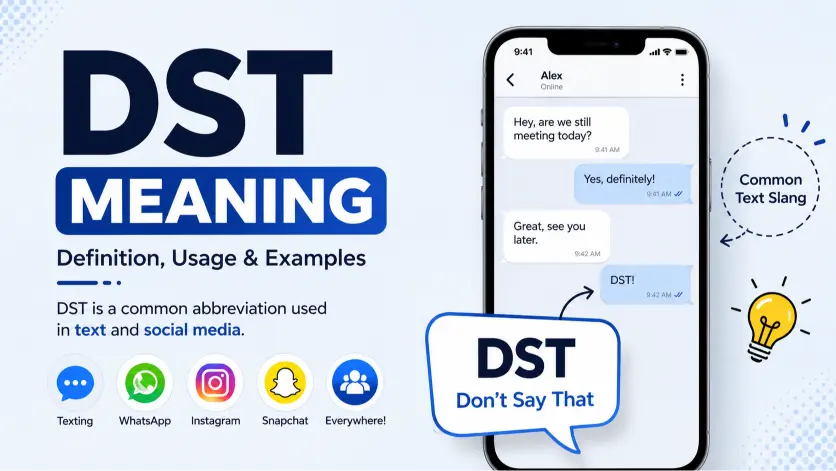
Have you ever noticed your phone clock suddenly changing by one hour and wondered, “Why did that happen?” That little time shift is connected to DST meaning, an abbreviation most commonly used for Daylight Saving Time.
Whether you are checking a meeting time, scheduling a video call, or chatting with someone in another country, DST can create confusion if you do not know what it means. A simple three-letter abbreviation can affect travel plans, work schedules, and even your daily routine.
Updated for 2026, this guide explains everything about DST — from its full form and history to real-life examples, online usage, and common misunderstandings.
You will learn how DST works, why some countries follow it, why others avoid it, and how this abbreviation appears in digital conversations. By the end, you will never have to guess what DST means again.
What Does DST Mean?
Quick Answer
DST meaning is most commonly “Daylight Saving Time.” It refers to the practice of moving clocks forward by one hour during part of the year, usually in spring and summer, to create more daylight during evening hours.
DST is a time adjustment system designed around the idea that people can use natural daylight more efficiently.
For example, instead of having sunrise at 5 a.m. when many people are still asleep, clocks are shifted forward so sunset happens later in the evening.
The main purpose is to provide more usable daylight after work or school hours.
What Is the Full Form of DST?
The full form of DST is:
DST = Daylight Saving Time
It is also sometimes called:
- Daylight Savings Time (common informal spelling)
- Summer Time (used in many countries)
- Clock Change
Although “Daylight Saving Time” is the official phrase, many people casually add an “s” and say “Daylight Savings Time.”
Origin and History of DST
The idea of changing clocks is older than many people realize.
The concept became widely recognized in the early 20th century when countries looked for ways to save energy and make better use of daylight.
During World War I, several nations introduced clock changes to reduce energy consumption. Since then, different countries have adopted, removed, and modified DST rules depending on their needs.
Today, DST remains a debated topic.
Some people appreciate longer summer evenings, while others argue that changing clocks twice a year creates unnecessary confusion.
How DST Meaning Has Evolved
Originally, DST was mainly discussed in government policies, farming, and energy planning.
Today, it appears everywhere:
- Smartphone settings
- Calendar apps
- International meetings
- Flight schedules
- Workplace communication
- Online gaming events
A person might write:
“The meeting time changed because of DST.”
Here, DST is not slang. It is a practical abbreviation used in everyday digital communication.
How Do You Pronounce DST?
DST is usually pronounced letter by letter:
“D-S-T”
People normally do not pronounce it as a single word.
Example:
“DST starts this weekend.”
Pronunciation:
“D-S-T starts this weekend.”
How to Use “DST” Correctly in Texts & Chat
Although DST meaning is not usually internet slang, it appears frequently in digital conversations because people constantly discuss schedules, meetings, travel, and time zones online.
Unlike casual abbreviations such as “LOL” or “BRB,” DST is a practical acronym used to make conversations shorter and clearer.
You will often see it in:
- Work emails
- Calendar invitations
- Group chats
- Travel discussions
- Online meetings
- Gaming schedules
Correct Context and Tone
DST is mostly used in a neutral or informative tone.
It is not emotional, funny, or sarcastic. Instead, it provides information about time changes.
Examples:
✅ “Our meeting is one hour earlier because of DST.”
✅ “Remember that DST begins this Sunday.”
✅ “The flight arrival time changed due to DST.”
In these examples, DST simply explains why a time difference exists.
DST Usage in Different Platforms
SMS and Text Messages
In normal texting, people use DST when discussing plans affected by time changes.
Example:
“Don’t forget DST starts tonight. Set your clocks forward.”
The abbreviation saves space while keeping the message understandable.
WhatsApp Chats
WhatsApp users often mention DST when communicating internationally.
Example:
“Can we move the call to 8 PM after DST?”
This is especially common when friends, family members, or coworkers live in different countries.
Instagram DMs
Instagram users may use DST when discussing:
- Travel plans
- Events
- Live streams
- International content schedules
Example:
“The concert starts at 7 PM EST after DST adjustment.”
Twitter/X Posts
On Twitter/X, DST appears in posts about:
- News updates
- Sports schedules
- Online events
- TV premieres
Example:
“The match starts at 9 PM after the DST change.”
Discord Communities
Gaming and online communities frequently mention DST because players often coordinate events across different time zones.
Example:
“Raid starts at 6 PM UTC after DST changes.”
When to Use DST vs. When Not To Use It
Good Situations to Use DST:
✔ Scheduling international meetings
✔ Explaining time differences
✔ Discussing travel plans
✔ Talking about calendar changes
✔ Sharing event timings
Situations Where You Should Avoid DST
DST may confuse people who are unfamiliar with the abbreviation.
Avoid using only “DST” when:
- Talking to someone who does not know the term
- Writing for a general audience
- Explaining a time change for customers
Instead of:
“The appointment changed because of DST.”
You can write:
“The appointment changed because of Daylight Saving Time.”
Clear communication matters more than saving three letters.
Formatting Tips: Capitalization, Punctuation & Emojis
Because DST is an acronym, it should normally be written in capital letters:
✅ DST
❌ dst
❌ Dst
Examples:
- “DST begins tomorrow.”
- “Check your clock after DST.”
You can combine it with emojis in casual conversations:
“DST starts this weekend ⏰”
or:
“Lost an hour of sleep because of DST 😴”
The emoji adds emotion, but the abbreviation itself stays professional.
Real Conversation Examples Using DST
Example 1: Between Friends
Friend 1:
“Why is your call time different today?”
Friend 2:
“My country changed clocks because of DST.”
Meaning:
Here, DST explains a one-hour time difference. The speaker is giving a practical reason for schedule confusion.
Example 2: Workplace Chat
Manager:
“Please check tomorrow’s meeting time.”
Employee:
“Got it. Is this because of DST?”
Meaning:
In professional communication, DST helps explain calendar changes without writing the full phrase repeatedly.
Example 3: International Group Chat
Person A:
“The event starts at 7 PM my time.”
Person B:
“Is that after DST?”
Meaning:
The person wants to confirm whether the time already includes the daylight adjustment.
Example 4: Gaming Community
Player 1:
“Tournament starts Sunday.”
Player 2:
“Does the schedule account for DST?”
Meaning:
Gamers often need accurate timing because members may join from different countries.
Example 5: Family Conversation
Parent:
“Remember the clocks change tonight.”
Child:
“Oh, because of DST?”
Meaning:
The abbreviation is used casually to refer to the seasonal clock adjustment.
Common Mistakes & Misunderstandings
Even though DST seems simple, many people misunderstand it.
Here are the most common mistakes:
Mistake 1: Thinking DST Means “Saving Daylight”
A common misunderstanding is believing DST creates more daylight.
It does not.
The amount of daylight stays the same. DST only changes the clock time so daylight appears later in the evening.
Example:
Before DST:
- Sunrise: 6 AM
- Sunset: 6 PM
After DST:
- Sunrise: 7 AM
- Sunset: 7 PM
The sun does not change — only the clock does.
Mistake 2: Assuming Every Country Uses DST
Not every country follows DST.
Some countries avoid it because:
- Their daylight hours do not change much
- They see little benefit
- They prefer consistent time schedules
This is why international communication can become confusing.
Mistake 3: Confusing DST With Time Zones
DST is not a separate time zone.
Instead, it temporarily changes the clock within an existing time zone.
For example:
A region may normally follow:
- Standard Time
During certain months, it switches to:
- Daylight Saving Time
Generational Misunderstandings Around DST
Different generations may view DST differently.
Older Generations
Many older adults grew up adjusting physical clocks manually.
They may remember:
- Changing wall clocks
- Adjusting watches
- Updating appliances
Younger Generations
Gen Z and younger users mostly experience DST through:
- Smartphones
- Smart watches
- Automatic calendar updates
Many younger people simply notice their phone changed overnight.
Cultural and Regional Differences
DST rules vary worldwide.
Some places:
- Move clocks forward in spring
- Move clocks back in autumn
- Never change clocks
This creates confusion when people communicate internationally.
A person in one country may say:
“The meeting is at 5 PM.”
Another person may see it differently because their country changed clocks on a different date.
How to Clarify DST Confusion
If someone does not understand DST, avoid only saying:
“It changed because of DST.”
Instead explain:
“Our clocks moved forward by one hour because of Daylight Saving Time.”
Clear explanations prevent scheduling mistakes.
DST Across Different Platforms & Demographics
How Gen Z Uses DST
Gen Z usually encounters DST through:
- Smartphone notifications
- Online events
- Gaming schedules
- Streaming times
They are less likely to manually change clocks because devices update automatically.
How Millennials Use DST
Millennials often connect DST with:
- Remote work schedules
- International meetings
- Travel planning
- Digital calendars
For this group, DST is often a workplace communication term.
How Older Generations Use DST
Older users may associate DST with traditional clock adjustments and seasonal routines.
They may still manually adjust:
- Kitchen clocks
- Car clocks
- Watches
Is DST Formal or Informal?
DST is considered a formal abbreviation.
It is acceptable in:
✅ Workplace communication
✅ News articles
✅ Academic writing
✅ Travel information
However, when writing for a general audience, spelling out “Daylight Saving Time” once is usually better.
Example:
“Daylight Saving Time (DST) begins on Sunday.”
After that, DST is clear.
How to Use “DST” Correctly in Texts & Chat
Although DST meaning is not usually internet slang, it appears frequently in digital conversations because people constantly discuss schedules, meetings, travel, and time zones online.
Unlike casual abbreviations such as “LOL” or “BRB,” DST is a practical acronym used to make conversations shorter and clearer.
You will often see it in:
- Work emails
- Calendar invitations
- Group chats
- Travel discussions
- Online meetings
- Gaming schedules
Correct Context and Tone
DST is mostly used in a neutral or informative tone.
It is not emotional, funny, or sarcastic. Instead, it provides information about time changes.
Examples:
✅ “Our meeting is one hour earlier because of DST.”
✅ “Remember that DST begins this Sunday.”
✅ “The flight arrival time changed due to DST.”
In these examples, DST simply explains why a time difference exists.
DST Usage in Different Platforms
SMS and Text Messages
In normal texting, people use DST when discussing plans affected by time changes.
Example:
“Don’t forget DST starts tonight. Set your clocks forward.”
The abbreviation saves space while keeping the message understandable.
WhatsApp Chats
WhatsApp users often mention DST when communicating internationally.
Example:
“Can we move the call to 8 PM after DST?”
This is especially common when friends, family members, or coworkers live in different countries.
Instagram DMs
Instagram users may use DST when discussing:
- Travel plans
- Events
- Live streams
- International content schedules
Example:
“The concert starts at 7 PM EST after DST adjustment.”
Twitter/X Posts
On Twitter/X, DST appears in posts about:
- News updates
- Sports schedules
- Online events
- TV premieres
Example:
“The match starts at 9 PM after the DST change.”
Discord Communities
Gaming and online communities frequently mention DST because players often coordinate events across different time zones.
Example:
“Raid starts at 6 PM UTC after DST changes.”
When to Use DST vs. When Not To Use It
Good Situations to Use DST:
✔ Scheduling international meetings
✔ Explaining time differences
✔ Discussing travel plans
✔ Talking about calendar changes
✔ Sharing event timings
Situations Where You Should Avoid DST
DST may confuse people who are unfamiliar with the abbreviation.
Avoid using only “DST” when:
- Talking to someone who does not know the term
- Writing for a general audience
- Explaining a time change for customers
Instead of:
“The appointment changed because of DST.”
You can write:
“The appointment changed because of Daylight Saving Time.”
Clear communication matters more than saving three letters.
Formatting Tips: Capitalization, Punctuation & Emojis
Because DST is an acronym, it should normally be written in capital letters:
✅ DST
❌ dst
❌ Dst
Examples:
- “DST begins tomorrow.”
- “Check your clock after DST.”
You can combine it with emojis in casual conversations:
“DST starts this weekend ⏰”
or:
“Lost an hour of sleep because of DST 😴”
The emoji adds emotion, but the abbreviation itself stays professional.
Real Conversation Examples Using DST
Example 1: Between Friends
Friend 1:
“Why is your call time different today?”
Friend 2:
“My country changed clocks because of DST.”
Meaning:
Here, DST explains a one-hour time difference. The speaker is giving a practical reason for schedule confusion.
Example 2: Workplace Chat
Manager:
“Please check tomorrow’s meeting time.”
Employee:
“Got it. Is this because of DST?”
Meaning:
In professional communication, DST helps explain calendar changes without writing the full phrase repeatedly.
Example 3: International Group Chat
Person A:
“The event starts at 7 PM my time.”
Person B:
“Is that after DST?”
Meaning:
The person wants to confirm whether the time already includes the daylight adjustment.
Example 4: Gaming Community
Player 1:
“Tournament starts Sunday.”
Player 2:
“Does the schedule account for DST?”
Meaning:
Gamers often need accurate timing because members may join from different countries.
Example 5: Family Conversation
Parent:
“Remember the clocks change tonight.”
Child:
“Oh, because of DST?”
Meaning:
The abbreviation is used casually to refer to the seasonal clock adjustment.
Common Mistakes & Misunderstandings
Even though DST seems simple, many people misunderstand it.
Here are the most common mistakes:
Mistake 1: Thinking DST Means “Saving Daylight”
A common misunderstanding is believing DST creates more daylight.
It does not.
The amount of daylight stays the same. DST only changes the clock time so daylight appears later in the evening.
Example:
Before DST:
- Sunrise: 6 AM
- Sunset: 6 PM
After DST:
- Sunrise: 7 AM
- Sunset: 7 PM
The sun does not change — only the clock does.
Mistake 2: Assuming Every Country Uses DST
Not every country follows DST.
Some countries avoid it because:
- Their daylight hours do not change much
- They see little benefit
- They prefer consistent time schedules
This is why international communication can become confusing.
Mistake 3: Confusing DST With Time Zones
DST is not a separate time zone.
Instead, it temporarily changes the clock within an existing time zone.
For example:
A region may normally follow:
- Standard Time
During certain months, it switches to:
- Daylight Saving Time
Older Generations
Many older adults grew up adjusting physical clocks manually.
They may remember:
- Changing wall clocks
- Adjusting watches
- Updating appliances
Younger Generations
Gen Z and younger users mostly experience DST through:
- Smartphones
- Smart watches
- Automatic calendar updates
Many younger people simply notice their phone changed overnight.
Cultural and Regional Differences
DST rules vary worldwide.
Some places:
- Move clocks forward in spring
- Move clocks back in autumn
- Never change clocks
This creates confusion when people communicate internationally.
A person in one country may say:
“The meeting is at 5 PM.”
Another person may see it differently because their country changed clocks on a different date.
How to Clarify DST Confusion
If someone does not understand DST, avoid only saying:
“It changed because of DST.”
Instead explain:
“Our clocks moved forward by one hour because of Daylight Saving Time.”
Clear explanations prevent scheduling mistakes.
DST Across Different Platforms & Demographics
How Gen Z Uses DST
Gen Z usually encounters DST through:
- Smartphone notifications
- Online events
- Gaming schedules
- Streaming times
They are less likely to manually change clocks because devices update automatically.
How Millennials Use DST
Millennials often connect DST with:
- Remote work schedules
- International meetings
- Travel planning
- Digital calendars
For this group, DST is often a workplace communication term.
How Older Generations Use DST
Older users may associate DST with traditional clock adjustments and seasonal routines.
They may still manually adjust:
- Kitchen clocks
- Car clocks
- Watches
Is DST Formal or Informal?
DST is considered a formal abbreviation.
It is acceptable in:
✅ Workplace communication
✅ News articles
✅ Academic writing
✅ Travel information
However, when writing for a general audience, spelling out “Daylight Saving Time” once is usually better.
Example:
“Daylight Saving Time (DST) begins on Sunday.”
After that, DST is clear.
Related Terms, Abbreviations & Alternatives
DST is connected with several other time-related terms. Understanding these related words makes online conversations and scheduling much easier.
| Term | Meaning | How It Relates to DST |
|---|---|---|
| Daylight Saving Time | A system of moving clocks forward during part of the year | The full form of DST |
| Standard Time | The normal time used outside DST periods | The time before or after DST adjustments |
| Time Zone | A region that follows the same standard clock time | DST temporarily changes the time within some zones |
| UTC | Coordinated Universal Time used worldwide | Often used to compare times internationally |
| GMT | Greenwich Mean Time reference point | Commonly used when discussing global time differences |
| Summer Time | Another name for DST in many countries | Frequently used in Europe and other regions |
| Clock Change | A casual phrase for adjusting clocks | Refers to the DST transition |
| Time Shift | A change in scheduled time | Often used when explaining DST effects |
| Time Conversion | Changing one location’s time into another | Important when DST affects international calls |
| Jet Lag | Sleep disruption caused by travel across time zones | Sometimes compared with DST adjustment effects |
Synonyms and Opposite Concepts
Similar Terms
- Daylight Saving
- Summer Time
- Seasonal Time Adjustment
- Clock Adjustment
- Time Change
Opposite Ideas
- Permanent Standard Time
- Fixed Time System
- No Clock Change
FAQs:
What does DST mean?
DST meaning usually refers to Daylight Saving Time. It is a system where clocks are moved forward by one hour during certain months, usually in spring and summer, to provide more evening daylight.
The abbreviation is commonly used in calendars, travel information, workplace communication, and international scheduling.
Why does DST exist?
DST exists to make better use of daylight during warmer months. By moving clocks forward, people have more sunlight available after typical work or school hours.
Supporters believe it helps with outdoor activities and energy use, while critics argue that changing clocks can disrupt sleep patterns and daily routines.
Does DST affect my phone?
Most modern smartphones automatically update for DST if the correct location and time settings are enabled.
However, problems can happen if:
- Your device location is incorrect
- Automatic time settings are disabled
- Your calendar uses outdated information
Checking your phone’s time settings can prevent confusion.
Is DST the same in every country?
No. DST rules are different around the world.
Some countries:
- Start DST in different months
- End DST on different dates
- Do not use DST at all
This is why international meetings sometimes require extra attention.
What does DST mean in texting?
In texting, DST meaning is usually still “Daylight Saving Time.”
It is not typically a slang abbreviation like “LOL” or “BRB.” Instead, people use it as a practical shortcut when discussing schedules, travel, or time changes.
Is DST good or bad?
Opinions about DST are divided.
People who support it like:
- Longer evening daylight
- More time for outdoor activities
- Seasonal routine changes
People who dislike it often mention:
- Sleep disruption
- Confusing clock changes
- Scheduling problems
The debate continues in many regions.
Conclusion:
DST meaning is most commonly connected to Daylight Saving Time, a simple abbreviation that affects millions of people every year.
Whether you see it in a calendar invite, a work message, or an international chat, understanding DST helps you avoid missed meetings and scheduling mistakes.
Although it is only three letters, DST represents a system that influences travel, communication, technology, and everyday routines.
Want to understand more digital terms and abbreviations? Explore more guides on modern slang, texting shortcuts, and online communication language.
Drop your favorite abbreviation or confusing internet term in the comments below!

I’m Lina Roys, a passionate writer behind Storevian, where I make words, phrases, slang, and everyday expressions easy to understand. I create clear, engaging, and reader-friendly content to help people find the meanings they’re looking for, quickly and confidently.


