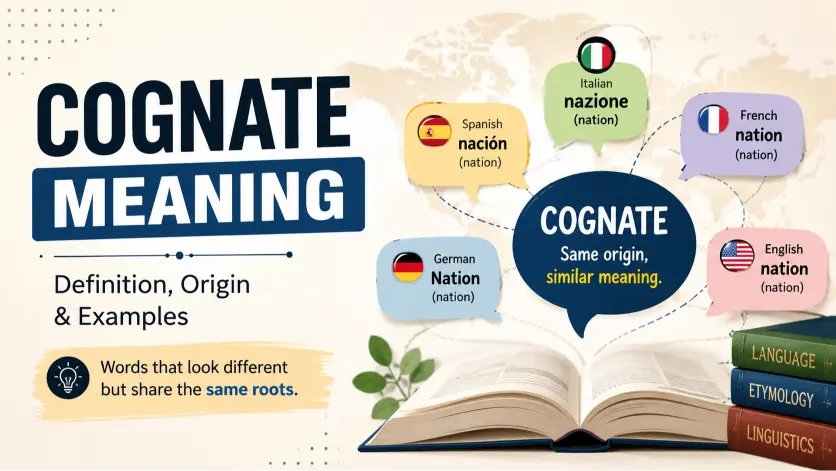
Have you ever started learning a new language and noticed words that look surprisingly familiar? Maybe you saw the Spanish word animal, the French word restaurant, or the Italian word università and instantly guessed what they meant. That’s not just luck—it’s the power of **cognate meaning.
Understanding cognate meaning can dramatically speed up language learning, improve reading comprehension, and help you recognize thousands of words without memorizing each one individually. Whether you’re studying Spanish, French, German, Italian, Portuguese, or another language, cognates provide valuable clues that make learning easier and more enjoyable.
In this guide, you’ll discover what cognates are, where they come from, how they differ from false cognates, and how to use them effectively while learning a language. You’ll also see plenty of real-world examples and practical tips to avoid common mistakes.
If you’ve ever wondered why certain words seem almost identical across different languages, you’re about to find out.
What Does Cognate Meaning Mean?
Quick Answer
A cognate is a word that shares the same historical origin as a word in another language. These words often have similar spelling, pronunciation, and meaning because they evolved from a common ancestral language.
Simply put, cognates are linguistic relatives.
For example:
| English | Spanish | Relationship |
|---|---|---|
| Family | Familia | True Cognate |
| Animal | Animal | True Cognate |
| Hospital | Hospital | True Cognate |
| Color | Color | True Cognate |
| Natural | Natural | True Cognate |
Definition in Simple Words
A cognate is a word in one language that is directly related to a similar word in another language through a shared historical ancestor.
Unlike random similarities, cognates have a documented linguistic connection that experts can trace back through centuries of language evolution.
Pronunciation
Cognate
/KOG-nayt/
Sounds like: KOG-nate
Origin of the Word “Cognate”
The word cognate comes from the Latin word cognatus, meaning:
- related by birth
- kindred
- belonging to the same family
The English term first appeared in scholarly linguistic discussions during the 17th century and became especially important as linguists began comparing Indo-European languages.
Today, it remains one of the most useful concepts in historical linguistics and second-language education.
How the Meaning Has Evolved
Originally, linguists used the term strictly to describe words descending from the same ancestral root.
Modern language teachers use the term more practically.
Instead of focusing only on historical language evolution, they teach students to recognize cognates as vocabulary shortcuts that make learning faster.
For example:
English speakers learning Spanish immediately recognize words like:
- Hospital
- Doctor
- Animal
- Hotel
- Radio
Because these words resemble English, students gain confidence while expanding their vocabulary.
How to Use Cognate Meaning Correctly
Although cognate meaning isn’t an internet slang term or text abbreviation, you’ll often encounter it in educational discussions, language-learning communities, dictionaries, and translation work.
Here’s how to use the term naturally.
In Language Learning
✅ Correct
“Spanish has many cognates with English.”
“Learning cognates helped me remember new vocabulary.”
In a Classroom
Teachers frequently introduce cognates when teaching reading comprehension.
Example:
“Look for cognates before reaching for a dictionary.”
This strategy encourages students to identify familiar words independently.
In Translation
Professional translators discuss cognates when evaluating whether two words genuinely share the same origin or merely resemble each other.
Example:
“Although these words look similar, they aren’t true cognates.”
In Academic Writing
Linguists often use the term when comparing language families.
Example:
“English and German contain numerous cognate words inherited from Proto-Germanic.”
Platform-Specific Usage
SMS & Text Messages
Rarely used unless discussing language learning.
Example:
“I found another cognate while studying Spanish today!”
Common among students and study groups.
Example:
“That word is a cognate—you already know its meaning.”
Often appears in educational language-learning posts and vocabulary reels.
Caption example:
“Learn 20 Spanish cognates in under five minutes!”
Popular in communities focused on linguistics, etymology, and language learning.
Users often debate whether specific word pairs are true cognates or false friends.
Discord
Language-learning servers frequently share lists of useful cognates to help beginners build vocabulary quickly.
X (formerly Twitter)
Teachers and language enthusiasts sometimes post “Word of the Day” content highlighting interesting cognates and their origins.
When NOT to Use the Term
Avoid using cognate when talking about:
- unrelated words that merely look alike
- brand names
- internet slang
- abbreviations
- acronyms
Not every similar-looking word is a cognate.
Always verify the historical origin before calling two words cognates.
Formatting Tips
When writing educational content:
- Capitalization isn’t required unless it’s the first word in a sentence.
- Italicize foreign-language examples for readability.
- Pair cognates with translations when teaching beginners.
- Tables work especially well for comparing cognate pairs.
Example:
| English | French |
|---|---|
| Nation | Nation |
| Important | Important |
| Culture | Culture |
| Music | Musique |
Using side-by-side comparisons makes cognates much easier to recognize and remember.
Real Conversation Examples Using Cognate Meaning
One of the best ways to understand cognate meaning is to see it in realistic conversations. While people don’t usually say “cognate meaning” in everyday chats, they often discuss cognates when learning a language, translating text, or studying linguistics.
Example 1: Between Friends (Learning Spanish)
Emma: I figured out that hospital in Spanish means the same thing as in English.
Jake: That’s because it’s a cognate. They both come from the same Latin root.
Emma: So I already know more Spanish than I thought!
Jake: Exactly. Cognates give you a huge vocabulary boost.
What it conveys:
Emma discovers that cognates help learners recognize familiar words, making language learning feel less overwhelming.
Example 2: In a Classroom
Teacher: Can anyone identify a cognate in today’s reading passage?
Student: Is familia a cognate of family?
Teacher: Yes! They share the same Latin origin and nearly the same meaning.
Student: That makes remembering new words much easier.
What it conveys:
Teachers use cognates to improve vocabulary, reading comprehension, and student confidence.
Example 3: During Translation Work
Translator: This looks like an English word, but be careful.
Editor: Is it a false cognate?
Translator: Exactly. Similar spelling doesn’t always mean similar meaning.
Editor: Good catch—we almost translated it incorrectly.
What it conveys:
Professional translators verify historical origins instead of relying only on spelling.
Example 4: In an Online Study Group
User 1: Is animal in English and Spanish considered a cognate?
User 2: Yes. They both come from the Latin word animalis.
User 1: That’s one less vocabulary word to memorize!
What it conveys:
Study groups frequently discuss cognates because they simplify language learning.
Example 5: University Linguistics Class
Professor: English and German contain hundreds of cognates inherited from Proto-Germanic.
Student: So that’s why words like hand and Hand look almost identical?
Professor: Exactly. Shared ancestry explains many similarities.
What it conveys:
Linguistics students study cognates to understand how languages evolved over time.
Common Mistakes & Misunderstandings
Although cognate meaning is a simple concept, many learners make avoidable mistakes. Knowing these common misunderstandings can save you from confusion.
1. Assuming Every Similar-Looking Word Is a Cognate
This is the most common mistake.
Words that look alike aren’t always historically related.
Example
| English | German | Meaning |
|---|---|---|
| Gift | Gift | Poison |
Many beginners assume both words refer to a present or gift, but the German word means something entirely different.
These are known as false cognates or false friends.
2. Confusing Cognates with Loanwords
A loanword is borrowed directly from another language.
A cognate develops naturally from a shared ancestral language.
For example:
- Restaurant (English)
- Restaurant (French)
English borrowed this word from French, making it a loanword. While borrowed words and cognates may look alike, they’re not always classified the same way in historical linguistics.
3. Ignoring Pronunciation
Many cognates have different pronunciations.
Example:
| English | Spanish |
|---|---|
| Family | Familia |
Although the spelling is similar, pronunciation differs.
Learning pronunciation is just as important as recognizing spelling patterns.
Generational Misunderstandings
Older generations often learned vocabulary through memorization.
Today’s language learners use cognates as shortcuts to build vocabulary much faster.
Apps like Duolingo and Babbel have made this learning strategy increasingly popular.
Cultural Differences
Languages belonging to the same language family share more cognates.
Examples include:
- English
- Spanish
- French
- Italian
- Portuguese
- Romanian
By contrast, English shares fewer natural cognates with languages such as:
- Chinese
- Japanese
- Korean
- Arabic
Although borrowed words exist, true cognates are less common across unrelated language families.
How to Explain Cognates Simply
If someone asks what a cognate is, you can say:
A cognate is a word in two different languages that shares the same historical origin and often has a similar spelling and meaning.
Simple examples usually explain the concept better than technical definitions.
Cognate Meaning Across Different Platforms & Demographics
Unlike internet slang, cognate meaning is primarily used in educational and language-learning contexts. However, its popularity has grown as online language education has expanded.
Gen Z
Gen Z learners often discover cognates through:
- Duolingo lessons
- TikTok language creators
- YouTube tutorials
- Instagram educational reels
They appreciate cognates because they make learning feel faster and more rewarding.
Millennials
Millennials commonly encounter cognates when:
- learning a second language
- preparing for international travel
- using translation tools
- reading multilingual websites
Many also use cognates while helping children with schoolwork.
Older Adults
Older learners usually come across the term in:
- college courses
- dictionaries
- language textbooks
- genealogy and historical research
Where You’ll See It Online
| Platform | Typical Usage |
|---|---|
| YouTube | Language lessons and pronunciation guides |
| Discussions about true vs. false cognates | |
| Language Blogs | Vocabulary-building articles |
| Duolingo Forums | Learning tips and word comparisons |
| University Websites | Linguistics and etymology resources |
Is It Formal or Informal?
Cognate is considered an academic and educational term.
It is perfectly appropriate in:
- schools
- universities
- research papers
- dictionaries
- translation agencies
- educational websites
Unlike slang expressions, it isn’t typically used in casual conversation unless people are discussing languages.
Is It Safe for Work?
Yes.
The term is entirely professional and suitable for:
- classrooms
- workplaces
- academic publications
- language-learning materials
- business communication involving translation
Why It’s Becoming More Popular
Interest in cognates has increased because of:
- language-learning apps
- AI translation tools
- global remote work
- international travel
- multilingual education
- online language communities
As more people learn second and third languages, understanding cognates has become an essential vocabulary-building skill.
Related Terms, Slang & Alternatives
Learning related linguistic terms will deepen your understanding of cognate meaning.
| Related Term | Brief Definition |
|---|---|
| False Cognate | Similar-looking words with different meanings. |
| False Friend | A misleading word that resembles one in another language. |
| Loanword | A word borrowed from another language. |
| Etymology | The study of a word’s history and origin. |
| Root Word | The base form from which other words develop. |
| Language Family | A group of related languages descended from a common ancestor. |
| Proto-Language | The reconstructed ancestral language of a language family. |
| Lexicon | The vocabulary of a language. |
| Semantic Change | The evolution of a word’s meaning over time. |
| Historical Linguistics | The study of language development and change. |
FAQs:
What does cognate meaning mean?
Cognate meaning refers to words in different languages that share a common historical origin. These words often have similar spelling, pronunciation, and meaning because they evolved from the same ancestral language. For example, the English word family and the Spanish word familia are cognates, both tracing back to the Latin word familia.
Why are cognates important in language learning?
Cognates help learners recognize familiar vocabulary without memorizing every word individually. They improve reading comprehension, boost confidence, and accelerate vocabulary acquisition. Recognizing cognates also helps learners understand texts more quickly and communicate with greater ease in a new language.
Are all similar-looking words cognates?
No. Similar spelling alone doesn’t make two words cognates. Linguists determine whether words are cognates by tracing their historical development and etymology. Some words only appear similar by coincidence or because one language borrowed the word from another.
Conclusion:
Learning the cognate meaning is one of the easiest ways to expand your vocabulary and understand how languages are connected. Cognates reveal fascinating links between words, making it easier to recognize unfamiliar terms and build confidence when learning a new language.
Whether you’re studying Spanish, French, German, Italian, Portuguese, or another language, identifying cognates can save time, improve reading comprehension, and reduce the need for constant dictionary lookups. Just remember that not every similar looking word is a true cognate always watch out for false friends.
The next time you encounter a familiar looking word in another language, take a closer look. It might be a cognate waiting to unlock its meaning. Keep exploring, stay curious, and you’ll discover that language learning becomes much more enjoyable when you recognize the connections between words.