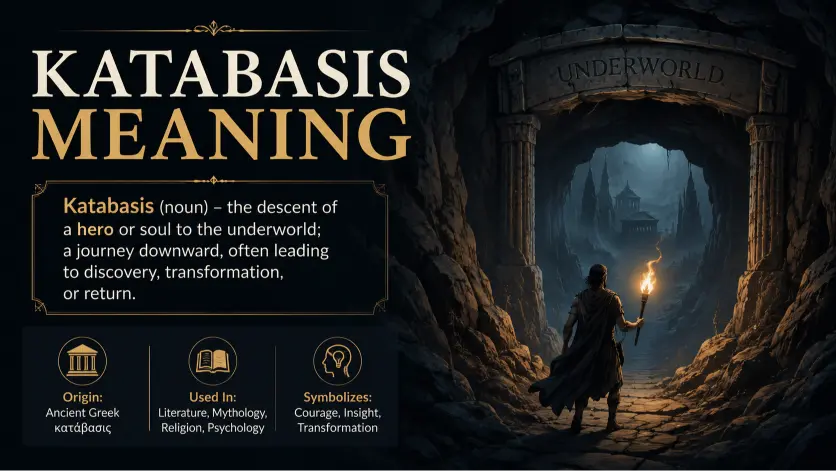
Imagine a hero willingly stepping into the darkness—not to escape life, but to discover something greater. That powerful journey is at the heart of the Katabasis Meaning. Although the word isn’t used in everyday conversation, it appears frequently in mythology, literature, psychology, philosophy, and even modern films and video games.
If you’ve encountered the term while reading a classic novel, studying Greek mythology, or exploring storytelling techniques, you’re probably wondering what it actually means—and why so many scholars consider it one of the oldest narrative patterns in history.
Updated for 2026, this guide explains everything you need to know about Katabasis Meaning, including its Greek origins, symbolic importance, pronunciation, literary examples, and how the concept continues to influence modern storytelling.
By the end of this article, you’ll understand not only the dictionary definition but also why katabasis remains one of the most fascinating ideas in literature and human psychology.
What Does Katabasis Mean?
Quick Answer:
Katabasis is an Ancient Greek term meaning “descent” or “going down.” In literature and mythology, it usually refers to a hero’s journey into the underworld or through a period of darkness, hardship, or self-discovery before returning transformed.
At its simplest, the Katabasis Meaning is a descent. However, the word carries far more significance than simply moving downward. It often describes a journey into the unknown—whether that’s the underworld, the subconscious mind, or a difficult chapter in someone’s life.
Unlike an ordinary trip, a katabasis changes the traveller forever. They leave as one person and return with greater wisdom, strength, or understanding.
Origin of the Word
The word katabasis (pronounced kuh-TAB-uh-sis) comes from the Ancient Greek word κατάβασις (katábasis).
It is formed from:
- kata = down
- bainein = to go or walk
Together, they literally mean “going down” or “descent.”
In Ancient Greece, the term could describe a physical journey downhill. Over time, writers and philosophers gave it a deeper symbolic meaning, using it to represent emotional, spiritual, and psychological descent.
Katabasis in Greek Mythology
Greek mythology is filled with famous examples of katabasis. Heroes often travelled into the land of the dead to complete impossible missions, seek knowledge, or rescue loved ones.
Some well-known examples include:
- Orpheus descending into the Underworld to bring back Eurydice.
- Heracles (Hercules) entering Hades as one of his Twelve Labours.
- Odysseus visiting the world of the dead in The Odyssey to seek guidance.
- Aeneas travelling through the Underworld in The Aeneid before founding Rome.
These stories established katabasis as one of the oldest storytelling patterns in Western literature.
How the Meaning Has Evolved
Although the original meaning focused on a literal descent, modern usage is much broader.
Today, katabasis can describe:
- overcoming depression or grief
- facing personal fears
- recovering after failure
- spiritual transformation
- psychological healing
- a hero’s darkest moment before success
Because of this wider meaning, you’ll often hear the term in discussions about literature, psychology, philosophy, religion, and film analysis.
Pronunciation Guide
Katabasis
Pronunciation: kuh-TAB-uh-sis
Phonetic: /kəˈtæbəsɪs/
Breaking it into syllables:
kuh • TAB • uh • sis
The emphasis falls on TAB.
How to Use Katabasis Correctly in Texts, Writing & Conversation
Unlike internet slang or text abbreviations, katabasis isn’t commonly used in everyday chats. Instead, it’s most often found in academic writing, literary discussions, philosophy, psychology, and conversations about storytelling.
Understanding the right context makes using the word feel natural rather than forced.
When to Use Katabasis
Use katabasis when describing:
- a hero’s journey into danger
- emotional struggles that lead to growth
- a symbolic descent before transformation
- mythological stories involving the Underworld
- literary themes of death and rebirth
- psychological healing after hardship
For example:
“The novel follows a classic katabasis, where the main character loses everything before rebuilding a better life.”
Here, katabasis doesn’t mean a literal trip underground. Instead, it describes a symbolic journey through suffering.
Platform-Specific Usage
Although the term appears online, its usage varies depending on the platform.
| Platform | How Katabasis Is Commonly Used |
|---|---|
| Discussions about mythology, philosophy, psychology, and literature. | |
| Discord | Book clubs, fantasy communities, and writing servers analysing character arcs. |
| X (Twitter) | Literary commentary, mythology threads, or discussions about films and novels. |
| Captions analysing books, poetry, or symbolic artwork. | |
| WhatsApp & SMS | Rarely used unless discussing literature or education. |
Formal vs Informal Usage
Appropriate for:
- essays
- academic writing
- book reviews
- literary criticism
- mythology discussions
- storytelling analysis
- philosophy articles
Less suitable for:
- casual texting
- workplace chats unrelated to literature
- customer emails
- everyday conversation with people unfamiliar with the term
For instance, saying:
“I’m having a katabasis today.”
may confuse most listeners unless they’re familiar with the concept. A clearer alternative would be:
“I’m going through a difficult phase that’s helping me grow.”
Writing Tips
When writing katabasis:
- Always spell it in lowercase unless it starts a sentence.
- Italicise it only when discussing the original Greek term in academic contexts.
- There’s no special punctuation required.
- It doesn’t usually pair with emojis because it’s a scholarly term rather than internet slang.
When NOT to Use Katabasis
Avoid using the word if you simply mean:
- travelling downstairs
- taking a short trip
- feeling mildly sad
- everyday disappointment
Katabasis implies deep transformation, not an ordinary setback.
For example:
❌ “I experienced katabasis because my phone battery died.”
✔ “After losing his career, the protagonist begins a symbolic katabasis that ultimately reshapes his identity.”
The second example reflects the depth and transformational nature that defines the Katabasis Meaning.
Real Conversation Examples Using Katabasis
Although katabasis is primarily a literary and academic term, it can naturally appear in discussions about books, films, psychology, and storytelling. Here are several real-world examples showing how the word is used in context.
Example 1: Between Friends (Discussing a Novel)
Emma: Have you finished the novel yet?
Liam: Yes. The middle chapters felt like the hero’s katabasis.
Emma: Exactly. He had to lose everything before he could truly change.
What it conveys:
Here, katabasis refers to the protagonist’s emotional and symbolic descent before personal growth.
Example 2: In a Literature Class
Teacher: Why does Odysseus travel to the Underworld?
Student: It’s a classic example of katabasis because he descends to gain wisdom before continuing his journey.
Teacher: Correct. That experience transforms him into a wiser leader.
What it conveys:
The term highlights a mythological descent that leads to knowledge and transformation.
Example 3: Book Club Discussion
Sarah: The main character keeps making terrible decisions.
Mark: That’s intentional. It’s her katabasis before the redemption arc.
Sarah: That makes much more sense now.
What it conveys:
The word describes the darkest stage of a character’s journey before recovery.
Example 4: Film Discussion
Alex: Why does Batman disappear for so long?
Jordan: Many critics see that part of the story as his katabasis—his lowest point before returning stronger.
Alex: I never thought about it that way.
What it conveys:
Modern films often use the same storytelling pattern found in ancient myths.
Example 5: Writers’ Workshop
My protagonist faces one problem after another.
That’s fine, but make sure the katabasis leads to meaningful growth.
Good point. I’ll strengthen the ending.
What it conveys:
In storytelling, a descent should always serve the character’s development rather than exist only for drama.
Common Mistakes & Misunderstandings
Because katabasis is an uncommon word, many people misunderstand or misuse it. Here are the most common mistakes.
1. Thinking Katabasis Means Any Downward Movement
The biggest misconception is believing the word simply means “going down.”
While its literal Greek meaning is “descent,” modern usage usually refers to a symbolic, spiritual, emotional, or mythological journey rather than a physical one.
❌ Incorrect:
We experienced a katabasis while hiking downhill.
✔ Correct:
The novel portrays the hero’s katabasis through grief, isolation, and eventual redemption.
2. Confusing Katabasis with Depression
Some readers assume katabasis is another word for depression.
Not quite.
Depression may be part of someone’s katabasis, but the term describes an entire transformative journey—not merely an emotional state.
A katabasis often includes:
- struggle
- self-discovery
- learning
- renewal
- eventual return with greater wisdom
3. Using It Outside the Right Context
Because the word sounds dramatic, people sometimes use it for minor inconveniences.
❌ “My Wi-Fi stopped working. Total katabasis.”
This exaggerates the meaning.
Katabasis is better reserved for:
- major life changes
- profound emotional experiences
- mythological narratives
- literary analysis
- significant character development
Generational Differences
Gen Z
Most Gen Z users rarely use katabasis in everyday conversation. Those who do usually encounter it through:
- BookTok
- mythology videos
- fantasy novels
- video game discussions
- creative writing communities
Millennials
Millennials are more likely to recognise the term from:
- university literature courses
- psychology discussions
- philosophy books
- storytelling podcasts
Older Generations
Older readers may know the word from studying:
- Ancient Greek literature
- classical history
- religious texts
- literary criticism
However, it remains a niche academic term across all age groups.
Cultural Differences
While katabasis originated in Ancient Greece, the concept appears in stories from many cultures.
Examples include:
- journeys into the afterlife
- spiritual pilgrimages
- symbolic death and rebirth
- heroic quests through darkness
Although different cultures use different names, the underlying narrative pattern is remarkably similar.
How to Clarify the Meaning
If someone isn’t familiar with the word, avoid giving only the literal translation.
Instead, explain it simply:
“Katabasis is a journey through hardship that changes someone for the better.”
This captures both the historical and symbolic meanings without requiring knowledge of Greek mythology.
Katabasis Across Different Platforms & Demographics
Despite being thousands of years old, the idea of katabasis continues to thrive in modern media and online communities.
Gen Z
Gen Z often encounters the concept indirectly through:
- fantasy books
- anime
- BookTok recommendations
- mythology explainers
- character analysis videos
Rather than saying “katabasis,” creators often describe it as:
- the character’s darkest moment
- the emotional breakdown arc
- the redemption journey
- the transformation phase
Millennials
Millennials are more likely to use the actual term when discussing:
- classic literature
- films
- psychology
- Joseph Campbell’s Hero’s Journey
- creative writing
Writers & Storytellers
Among authors and screenwriters, katabasis is a recognised narrative device.
A strong story often follows this sequence:
- Ordinary life
- Conflict
- Katabasis (descent)
- Transformation
- Return
- Resolution
This structure appears in countless novels, films, and television series.
Social Media Usage
TikTok
BookTok creators frequently discuss characters experiencing emotional “rock bottom” moments, even if they don’t explicitly use the term katabasis.
The word occasionally appears in:
- literary quotes
- mythology pages
- philosophy accounts
- poetry captions
- book reviews
Communities focused on mythology, literature, and storytelling regularly use katabasis when analysing character arcs and classic narratives.
Discord
Writing groups and fantasy communities often reference the term while giving feedback on plot structure and character development.
Is Katabasis Formal or Informal?
Formal: ✅ Yes
Academic: ✅ Very common
Professional: ✅ Appropriate in literary, educational, and scholarly contexts
Casual texting: ❌ Rare
Business communication: ❌ Usually inappropriate unless discussing literature or storytelling
Because of its specialised meaning, katabasis is best reserved for contexts where readers are likely to understand the reference.
Related Slang, Literary Terms & Alternatives
Although katabasis is a unique literary term, several related words and concepts help explain similar ideas. Understanding these can deepen your appreciation of mythology, storytelling, and character development.
| Term | Meaning | When It’s Used |
|---|---|---|
| Anabasis | An upward journey or return after a descent | The opposite of katabasis; often represents recovery or triumph. |
| Hero’s Journey | A classic storytelling framework where a hero faces trials and returns transformed | Used in literature, films, and mythology. |
| Descent into the Underworld | A literal or symbolic journey to the realm of the dead | Common in Greek, Roman, and other mythologies. |
| Catharsis | Emotional release or purification after intense experiences | Often follows a character’s katabasis. |
| Transformation Arc | A character’s personal growth throughout a story | Frequently includes a katabasis stage. |
| Redemption Arc | A storyline where a flawed character earns forgiveness or improves | A katabasis often leads to redemption. |
| Existential Crisis | A period of questioning life’s purpose or identity | Can act as a modern psychological katabasis. |
| Dark Night of the Soul | A profound period of suffering before spiritual renewal | Common in religious, philosophical, and psychological discussions. |
| Tragic Hero | A protagonist whose flaws lead to suffering and eventual insight | Many tragic heroes experience a katabasis. |
| Mythological Quest | A journey filled with supernatural challenges and personal growth | Katabasis is a recurring element in many mythological quests. |
Synonyms (Depending on Context)
While there is no perfect one-word synonym for katabasis, these terms may fit certain contexts:
- Descent
- Downward journey
- Spiritual descent
- Psychological journey
- Underworld journey
- Rite of passage
- Transformational journey
- Personal struggle
- Inner journey
- Crisis leading to growth
Antonyms
The primary antonym is:
- Anabasis – an ascent or return, often symbolising victory, recovery, or enlightenment.
Other related opposites include:
- Ascent
- Rise
- Elevation
- Resurrection (in symbolic contexts)
- Renewal
Learn More About Related Terms
To build your understanding of literary and mythological concepts, consider reading articles on:
- Anabasis Meaning
- Hero’s Journey Explained
- Catharsis Meaning
- Archetype Meaning
- Greek Mythology Terms
These topics naturally complement katabasis and help explain how stories are structured across cultures and time periods.
FAQs:
What does katabasis literally mean?
Katabasis literally means “descent” or “going down.” The word comes from Ancient Greek and originally referred to a downward journey. Today, it most often describes a symbolic descent into hardship, the underworld, or a challenging emotional experience that leads to transformation.
Is katabasis only found in Greek mythology?
No. While the concept originated in Ancient Greek culture, katabasis now appears in literature, psychology, philosophy, religious studies, and modern storytelling. Many books, films, and video games feature characters who undergo a katabasis before emerging wiser or stronger.
What is the opposite of katabasis?
The opposite of katabasis is anabasis, an Ancient Greek term meaning “ascent” or “going up.” In storytelling, anabasis often represents the hero’s return after completing a difficult journey, symbolising recovery, victory, or enlightenment.
How do you pronounce katabasis?
The most common English pronunciation is:
kuh-TAB-uh-sis
Phonetic spelling: /kəˈtæbəsɪs/
The stress falls on the second syllable: TAB.
Why is katabasis important in literature?
Katabasis represents one of the oldest and most influential storytelling patterns. It allows characters to confront fear, loss, or death before returning transformed. This narrative structure creates emotional depth and makes a character’s growth feel meaningful and believable.
Can katabasis describe real life?
Yes. Although traditionally used in literature, many people use katabasis metaphorically to describe periods of personal hardship, grief, burnout, or self-discovery. In this sense, it represents a difficult phase that ultimately leads to resilience, wisdom, or positive change.
Conclusion:
The **Katabasis Meaning goes far beyond its literal definition of “descent.” It represents one of humanity’s oldest storytelling patterns—a journey through darkness that leads to growth, wisdom, and transformation.
From Ancient Greek mythology to modern novels, films, and psychology, katabasis continues to resonate because it reflects a universal human experience. Whether a hero ventures into the underworld or someone overcomes personal challenges, the essence of katabasis remains the same: meaningful change often begins in life’s most difficult moments.
Now that you understand the Katabasis Meaning, you’ll be able to recognise this powerful concept in books, movies, myths, and even real-life stories of resilience.
What’s your favourite example of a character who experiences a katabasis? Share your thoughts in the comments below!

I’m Lina Roys, a passionate writer behind Storevian, where I make words, phrases, slang, and everyday expressions easy to understand. I create clear, engaging, and reader-friendly content to help people find the meanings they’re looking for, quickly and confidently.


