Have you ever read the phrase “warm the cockles of your heart” and wondered what on earth “cockles” are doing anywhere near a heart?
You are not alone. The word cockles can look confusing because it has both a literal meaning and a well-known figurative use. In everyday English, a cockle is a small, rounded shellfish. But in expressions such as “it warmed the cockles of my heart,” the word refers to the deepest, most emotional part of someone’s feelings.
So, what is the cockles meaning exactly?
This guide breaks it down in plain English. You’ll learn the definition, pronunciation, origin, common phrases, sentence examples, related words, and the difference between the literal shellfish meaning and the figurative “cockles of the heart” meaning.
Updated for 2026: This guide also explains why the expression still appears in modern English, even though “cockles” is not a word you are likely to see in casual texting or internet slang.
What Does Cockles
Simple definition of cockles
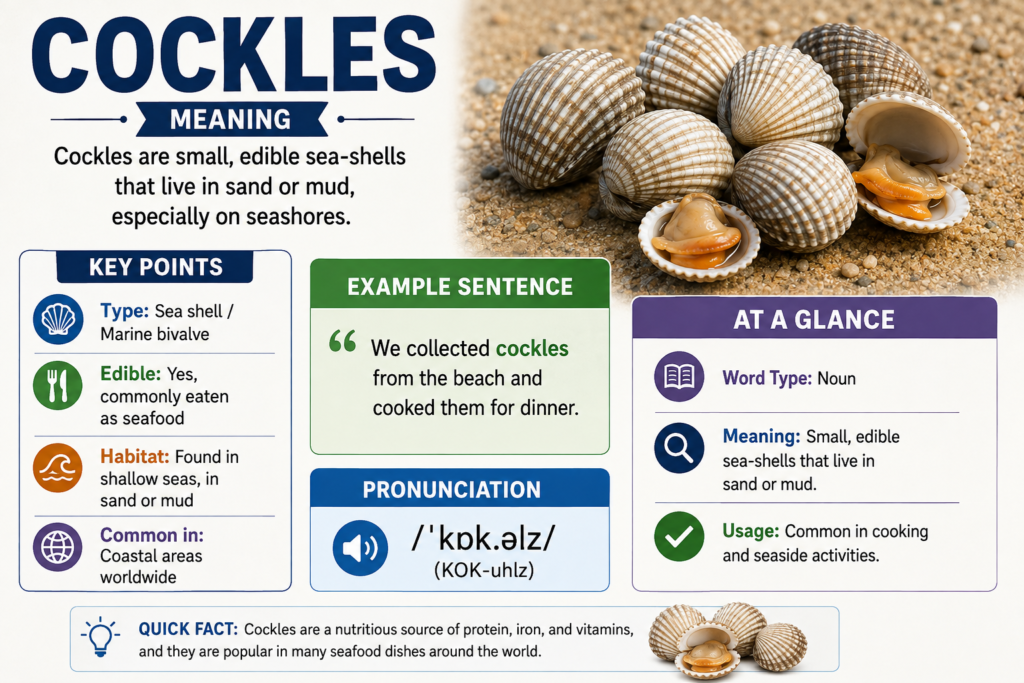
Cockles are small, rounded shellfish with shells, commonly found along European coasts. They are edible and are often collected from sandy or muddy coastal areas.
The singular form is cockle.
- One: a cockle
- More than one: cockles
- Related term: cockle shell
For example:
We collected cockles from the beach at low tide.
Here, “cockles” has its literal meaning: small shellfish.
Cockles pronunciation
The word cockle is pronounced roughly:
KOK-uhl
Cambridge gives the British pronunciation as /ˈkɒk.əl/ and the American pronunciation as /ˈkɑː.kəl/.
The plural cockles is pronounced approximately:
KOK-uhlz
It is not pronounced like “coke-ulls.”
Where did the word “cockle” come from?
The history of the word is surprisingly old.
The shellfish sense of cockle dates to the early 14th century. The word came into English through Old French coquille, referring to a shell or shellfish, and ultimately traces back through Latin conchylium to Greek words associated with shellfish and shells.
That makes “cockle” much older than modern internet vocabulary. It is not a newly invented slang term.
There is also another historical English word cockle, referring to a weed that grew among crops. That is a separate word with a different history, so it should not be confused with the shellfish.
Quick Answer
Cockles are small edible shellfish. In the phrase “warm the cockles of your heart,” however, cockles refers figuratively to the deepest part of your feelings, so the expression means to make you feel happy, touched, comforted, or pleased.
How to Use “Cockles” Correctly in Texts & Chat
Unlike abbreviations such as “LOL” or “BTW,” cockles is not normally internet slang.
You might see it in:
- Books
- News articles
- British English
- Food writing
- Coastal or marine discussions
- Historical writing
- Idioms and expressions
- Humorous social media posts
Literal use
Use cockle when you are talking about the shellfish itself.
Example:
The restaurant serves fresh cockles with garlic and herbs.
Here, the meaning is completely literal.
Figurative use
The more interesting usage appears in the phrase:
“warm the cockles of your heart.”
It means that something gives you a strong feeling of happiness, affection, comfort, or emotional warmth.
Example:
Seeing the children help the elderly man really warmed the cockles of my heart.
The speaker does not mean that actual shellfish became warm.
Thankfully.
They mean the experience made them feel deeply touched.
Is it casual or formal?
“Cockles” itself is neither strongly formal nor informal. Context determines the tone.
The expression “warm the cockles of your heart” can sound slightly old-fashioned, literary, British, humorous, or deliberately playful.
That makes it different from modern phrases such as:
- That made my day.
- That was so wholesome.
- My heart is full.
- Aww, that’s sweet.
- That really touched me.
Should you use it in professional communication?
You can, but choose the context carefully.
A sentence like:
Your team’s kindness warmed the cockles of my heart.
is grammatically fine, but it may sound playful or old-fashioned in a corporate email.
For a professional message, something simpler may work better:
Your team’s kindness really meant a lot to me.
What about WhatsApp, Instagram, or X?
You can absolutely use the phrase in social media conversations, especially when you want a humorous or slightly dramatic tone.
For example:
My dog waited by the door until I came home. Warmed the cockles of my heart.
The phrase works because the old-fashioned wording creates a funny contrast with modern social media language.
Real Conversation Examples Using “Cockles”
Example 1: Between friends
Friend 1:
“I saw an old man giving his umbrella to a kid in the rain.”
Friend 2:
“Aww. That warms the cockles of my heart.”
What it conveys:
The speaker feels emotionally touched by an act of kindness.
Example 2: Family conversation
Mom:
“Your little brother saved the last piece of cake for you.”
You:
“Okay, that warms the cockles of my heart.”
What it conveys:
The speaker feels affectionate and grateful.
Example 3: Dating
Alex:
“I remembered your favorite coffee order.”
Sam:
“Stop. You’re warming the cockles of my heart
What it conveys:
The speaker feels loved or emotionally appreciated, with a playful tone.
Example 4: Work chat
Manager:
“The whole team stayed late to help finish the project.”
Employee:
“Honestly, that warms the cockles of my heart.”
What it conveys:
The phrase expresses genuine appreciation, although it has a slightly humorous or old-fashioned flavor.
Example 5: Social media
Post:
“A little girl gave her lunch to a stray dog.”
Comment:
“Absolutely warming the cockles of my heart.
What it conveys:
The commenter feels emotionally moved by something wholesome.
Example 6: Literal shellfish meaning
Friend:
“What did you order?”
You:
“Cockles with lemon and herbs.”
What it conveys:
Here, “cockles” simply refers to edible shellfish.
Common Mistakes & Misunderstandings
Mistake 1: Thinking cockles are slang
The cockles meaning is not primarily slang.
It is a standard dictionary word. The idiom involving the word has been used for centuries, while modern social media has simply given people new places to use it.
Mistake 2: Assuming “cockles” always means shellfish
This is where context matters.
Compare:
We gathered cockles on the beach.
and:
Your message warmed the cockles of my heart.
The first sentence is literal.
The second is idiomatic.
Mistake 3: Taking “cockles of the heart” literally
The phrase does not mean there are shellfish inside a human heart.
It is figurative language describing deep emotional feelings.
The phrase “cockles of the heart” has been recorded since the 1660s. Its exact origin is uncertain. One explanation connects the expression with the resemblance between a cockle shell and the shape of the heart; another possibility connects it with Latin corculum, a diminutive form related to “heart.”
A generational misunderstanding
Older readers may recognize “warm the cockles of my heart” immediately, while younger readers may find it unusual.
A Gen Z reader might simply say:
That was so wholesome.
Someone using a more traditional expression might say:
That warmed the cockles of my heart.
Same basic emotional reaction. Very different vocabulary.
Regional differences
The shellfish meaning is especially familiar in British and European contexts because cockles are common along parts of European coastlines. Cambridge specifically describes them as small, rounded sea creatures common in Europe.
The idiom, however, can be understood by English speakers more broadly.
“Cockles” Across Different Platforms & Demographics
Gen Z
Gen Z is more likely to encounter cockles in memes, humorous captions, books, or ironic uses than as everyday slang.
For example:
This rescue video just warmed the cockles of my heart
The humor comes partly from using a traditional phrase in a modern setting.
Millennials
Millennials may recognize the phrase through books, television, British expressions, or general exposure to English idioms.
It can feel warm and sincere, but also slightly cheeky.
Older generations
Older English speakers may be more familiar with traditional expressions such as:
It warmed the cockles of my heart.
The phrase is not necessarily considered old-fashioned to everyone, but it has a distinctly traditional flavor.
TikTok
On TikTok, “cockles” is more likely to appear as part of a joke, caption, reaction, or commentary than as a standalone slang term.
You might see:
This made my day. Truly warmed the cockles of my heart.
The expression works especially well with sentimental posts.
Discord and gaming
Gamers might use it humorously:
Bro saved the whole squad. Warmed the cockles of my heart
Again, this is an idiomatic use, not a special gaming definition.
Is “cockles” safe for work?
Yes. The ordinary word cockle is a standard term for shellfish.
However, because the word begins with “cock,” some readers may make immature jokes about it. That does not change the actual dictionary meaning.
In the phrase “cockles of my heart,” the word has nothing to do with the unrelated slang sense of “cock.”
Related Slang, Abbreviations & Alternatives
| Term | Meaning | Typical tone |
|---|---|---|
| Cockle | A small shellfish | Neutral |
| Cockles | Plural of cockle | Neutral |
| Cockles of the heart | Deepest emotional feelings | Literary/idiomatic |
| Warm the cockles of your heart | Make you feel deeply happy or touched | Traditional/playful |
| Warm my heart | Make me feel happy or emotional | Everyday |
| Touch my heart | Create a strong emotional reaction | Common |
| Made my day | Made me very happy | Casual |
| Wholesome | Emotionally positive or heartwarming | Modern/casual |
| Heartwarming | Causing happiness or affection | Neutral |
| Aww | Reaction to something cute or sweet | Informal |
Modern alternatives
If you want to replace “warm the cockles of my heart,” you could say:
- That warmed my heart.
- That really touched me.
- That made my day.
- That was so wholesome.
- My heart is full.
- That was incredibly sweet.
- That made me smile.
Is there an antonym?
There is no exact one-word antonym for “warm the cockles of your heart.”
Depending on the context, you could use:
- Broke my heart
- Upset me
- Hurt my feelings
- Made me sad
- Chilled my heart
These express the opposite emotional direction rather than being exact linguistic opposites.
FAQs:
What does “cockles” mean in simple English?
Cockles are small shellfish with rounded, ridged shells. The word is also used figuratively in the expression “warm the cockles of your heart,” which means something makes you feel deeply happy, comforted, or emotionally touched. The exact meaning therefore depends on whether the word is being used literally or as part of an idiom.
What does “warm the cockles of your heart” mean?
“Warm the cockles of your heart” means to make you feel happy, affectionate, comforted, or deeply touched. For example, watching someone perform a generous act might “warm the cockles of your heart.” It is an established English idiom and can sound slightly traditional, humorous, or literary in modern conversation.
Are cockles a type of clam?
Cockles are bivalve mollusks and are commonly described as shellfish. They are related to clams but are not simply another name for every type of clam. The term “cockle” refers to particular shellfish, especially small, rounded species with distinctive shells.
Is “cockles” an English slang word?
No. Cockles is not primarily slang. It is the plural of “cockle,” a standard English word for a type of shellfish. Its appearance in “warm the cockles of your heart” is an idiomatic use. Modern social media sometimes uses the phrase humorously, but that does not make the word itself slang.
How do you pronounce “cockles”?
“Cockles” is pronounced approximately KOK-uhlz. The singular word “cockle” is listed by Cambridge as /ˈkɒk.əl/ in British English and /ˈkɑː.kəl/ in American English. The second syllable is light and unstressed.
What does “cockles of my heart” mean?
“Cockles of my heart” refers figuratively to the deepest part of someone’s emotions or feelings. Therefore, saying “that warmed the cockles of my heart” means “that made me feel deeply happy or touched.” The expression dates back centuries and is not normally intended as a literal reference to anatomy.
Is “warm the cockles of my heart” old-fashioned?
It can sound somewhat old-fashioned or traditional, especially compared with modern expressions such as “that warmed my heart” or “that was so wholesome.” However, people still understand and use it, particularly for humor, sentimental writing, British-style expressions, and playful social media captions.
Conclusion:
The simplest cockles meaning is small shellfish, but the word becomes much more interesting in the phrase “warm the cockles of your heart.” In that expression, it describes a deep feeling of happiness, affection, comfort, or emotional warmth.
The word itself has a long history, dating back to the early 14th century, while the figurative “cockles of the heart” expression is recorded from the 17th century. Its exact figurative origin remains uncertain, which makes the phrase even more fascinating.
So next time someone says, “That warmed the cockles of my heart,” you won’t be left wondering about mysterious seafood anatomy. You’ll know they simply mean: “That made me feel really good inside.”
Enjoy discovering more unusual English words and expressions? Explore more slang and meaning guides, and share your favorite unusual phrase in the comments!

Hi, I’m Harry Mark, the Writer and Creator of storevian.com, where words get unpacked, decoded, and actually make sense.
I started this space with one goal: to simplify meanings in a world where language changes faster than ever. From trending slang to everyday terms that people quietly Google, I break things down in a way that’s clear, direct, and easy to understand.
No complicated definitions. No academic overload. Just real meanings for real conversations.


1 thought on “Cockles Meaning: Full Meaning, Usage & Examples [2026 Guide]”