Have you ever come across the term annealing while reading about manufacturing, engineering, physics, or even computer science and wondered what it actually means? You’re not alone. Although the word sounds technical, the concept behind it is surprisingly easy to understand.
Annealing meaning refers to a controlled heating and cooling process that changes the physical properties of a material. It’s one of the most important techniques used in industries ranging from metalworking and glass production to semiconductor manufacturing and artificial intelligence.
Whether you’re a student preparing for an exam, an engineer looking for a refresher, or simply curious after encountering the term online, this guide explains everything in plain English.
Updated for 2026, this article covers the definition, origin, pronunciation, practical applications, real-world examples, and common misconceptions so you can understand annealing with confidence.
What Does “Annealing” Mean?
Quick Answer
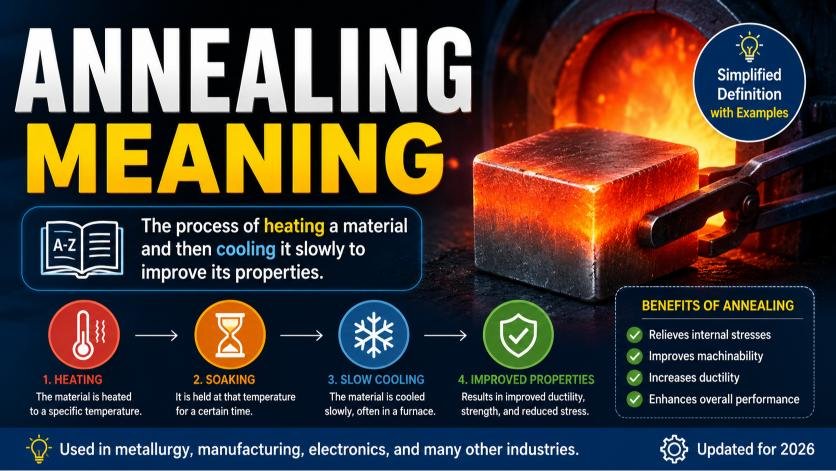
Annealing is a heat-treatment process in which a material is heated to a specific temperature and then cooled slowly to reduce internal stress, improve flexibility, increase toughness, and make it easier to shape or machine.
Simply put, annealing changes a material’s internal structure so it performs better during manufacturing or everyday use.
Unlike rapid cooling methods that make materials harder, annealing focuses on making them softer, more stable, and less likely to crack.
Definition
The annealing meaning in materials science is the controlled heating and slow cooling of a material to alter its microscopic structure.
The process typically aims to:
- Reduce internal stresses
- Increase ductility
- Improve toughness
- Restore flexibility
- Enhance machinability
- Improve electrical conductivity (for some metals)
Different materials require different temperatures and cooling rates, but the overall objective remains the same: improve the material’s performance.
Origin of the Word
The word anneal comes from the Old English word onǣlan, meaning to set on fire, kindle, or burn.
Over centuries, blacksmiths and metalworkers adopted the term to describe the practice of heating metal before allowing it to cool slowly.
As metallurgy advanced, the process became scientifically understood, and today annealing is a standardized industrial heat-treatment technique used worldwide.
Pronunciation
Annealing
Pronounced: uh-NEEL-ing
IPA: /əˈniːlɪŋ/
Breaking it down:
- uh
- NEEL
- ing
The emphasis is placed on the second syllable:
uh-NEEL-ing
What Happens During Annealing?
Although the exact procedure varies depending on the material, the process generally includes three stages:
1. Heating
The material is heated to a predetermined temperature based on its composition.
2. Soaking
It remains at that temperature long enough for the internal crystal structure to change uniformly.
3. Slow Cooling
Instead of cooling rapidly, the material cools gradually, often inside a furnace. Slow cooling allows the internal structure to stabilize and relieves stress.
Why Is Annealing Important?
Annealing offers several important benefits:
- Makes metal easier to bend and shape.
- Prevents cracking during manufacturing.
- Restores ductility after cold working.
- Improves durability.
- Reduces brittleness.
- Enhances electrical properties in certain metals.
- Extends the lifespan of manufactured components.
These advantages make annealing essential in industries such as automotive manufacturing, aerospace engineering, electronics, construction, jewelry making, and glass production.
Definition
The annealing meaning in materials science is the controlled heating and slow cooling of a material to alter its microscopic structure.
The process typically aims to:
- Reduce internal stresses
- Increase ductility
- Improve toughness
- Restore flexibility
- Enhance machinability
- Improve electrical conductivity (for some metals)
Different materials require different temperatures and cooling rates, but the overall objective remains the same: improve the material’s performance.
Origin of the Word
The word anneal comes from the Old English word onǣlan, meaning to set on fire, kindle, or burn.
Over centuries, blacksmiths and metalworkers adopted the term to describe the practice of heating metal before allowing it to cool slowly.
As metallurgy advanced, the process became scientifically understood, and today annealing is a standardized industrial heat-treatment technique used worldwide.
Pronunciation
Annealing
Pronounced: uh-NEEL-ing
IPA: /əˈniːlɪŋ/
Breaking it down:
- uh
- NEEL
- ing
The emphasis is placed on the second syllable:
uh-NEEL-ing
What Happens During Annealing?
Although the exact procedure varies depending on the material, the process generally includes three stages:
1. Heating
The material is heated to a predetermined temperature based on its composition.
2. Soaking
It remains at that temperature long enough for the internal crystal structure to change uniformly.
3. Slow Cooling
Instead of cooling rapidly, the material cools gradually, often inside a furnace. Slow cooling allows the internal structure to stabilize and relieves stress.
Why Is Annealing Important?
Annealing offers several important benefits:
- Makes metal easier to bend and shape.
- Prevents cracking during manufacturing.
- Restores ductility after cold working.
- Improves durability.
- Reduces brittleness.
- Enhances electrical properties in certain metals.
- Extends the lifespan of manufactured components.
These advantages make annealing essential in industries such as automotive manufacturing, aerospace engineering, electronics, construction, jewelry making, and glass production.
How to Use “Annealing” Correctly in Technical Writing & Everyday Conversation
Unlike internet slang or chat abbreviations, annealing is a technical term. You’ll most often see it in engineering, manufacturing, metallurgy, materials science, glassmaking, semiconductor production, and computer science. Using it correctly depends on the context.
When to Use the Term
Use annealing when referring to a process that heats a material and cools it slowly to improve its properties.
Common Contexts
| Field | Example Usage |
|---|---|
| Metallurgy | “The steel underwent annealing before machining.” |
| Manufacturing | “Annealing reduced stress in the metal sheet.” |
| Glassmaking | “The glass was annealed to prevent cracking.” |
| Electronics | “Silicon wafers require annealing after implantation.” |
| Computer Science | “The optimization algorithm uses simulated annealing.” |
Everyday Explanation
If you’re explaining the concept to someone without a technical background, keep it simple.
Instead of saying:
“The metal experienced recrystallization during annealing.”
Say:
“The metal was heated and cooled slowly so it became softer and easier to work with.”
Simple language makes the concept much easier to understand.
Professional vs. Casual Usage
Appropriate in Professional Settings
Annealing is perfectly suitable in:
- Engineering reports
- Manufacturing manuals
- Scientific research
- Classroom discussions
- Technical presentations
- Industrial documentation
Less Common in Casual Conversation
Most people don’t use the word in everyday conversations unless they’re discussing:
- DIY metalworking
- Blacksmithing
- Jewelry making
- Engineering projects
- Science classes
Formatting Tips
- Write annealing in lowercase unless it begins a sentence.
- Don’t capitalize it unnecessarily.
- Avoid quotation marks unless you’re defining the term.
- Pair it with descriptive words such as:
- Heat treatment
- Thermal process
- Controlled heating
- Slow cooling
- Stress relief
- Material processing
Real-Life Examples Using “Annealing”
The following examples show how the term is naturally used in different situations.
Example 1: Engineering Workshop
Engineer:
“The aluminum parts need annealing before we bend them.”
Technician:
“That should prevent cracks during forming.”
Meaning:
Annealing makes the material more flexible so it can be shaped safely.
Example 2: Manufacturing Plant
Supervisor:
“Have all the steel rods completed the annealing process?”
Worker:
“Yes, they’re cooling inside the furnace now.”
Meaning:
The conversation refers to the final slow-cooling stage of heat treatment.
Example 3: Classroom Discussion
Student:
“Why do manufacturers anneal metal?”
Teacher:
“Because it removes internal stress and improves ductility.”
Meaning:
The teacher explains the primary purpose of annealing in simple scientific terms.
Example 4: Jewelry Making
Jeweler:
“The silver wire became too stiff.”
Assistant:
“Let’s anneal it before shaping the ring.”
Meaning:
Annealing restores softness, making the metal easier to bend into intricate designs.
Example 5: Computer Science
Developer:
“We’re using simulated annealing to find the optimal solution.”
Colleague:
“That helps avoid getting stuck in local optima.”
Meaning:
Here, annealing doesn’t involve heat. Instead, it refers to an optimization algorithm inspired by the physical annealing process.
Example 6: Glass Manufacturing
Operator:
“Don’t remove the glass from the kiln yet.”
Supervisor:
“It still needs to finish annealing.”
Meaning:
Slow cooling prevents internal stresses that could cause the glass to crack later.
Common Mistakes & Misunderstandings
Even though annealing is a well-defined scientific term, it’s often misunderstood. Here are the most common mistakes.
Mistake 1: Thinking Annealing Makes Metal Harder
This is one of the biggest misconceptions.
Incorrect:
Annealing hardens steel.
Correct:
Annealing usually softens metal, improves ductility, and reduces internal stress. Processes like quenching and tempering are more commonly associated with increasing hardness.
Mistake 2: Confusing Annealing with Heat Treatment in General
Many people assume every heat-treatment process is annealing.
In reality, heat treatment includes several different processes, such as:
- Annealing
- Quenching
- Tempering
- Normalizing
- Case hardening
- Solution treatment
Annealing is just one type of heat treatment, each with its own purpose and cooling method.
Mistake 3: Assuming It’s Only Used for Metals
Another common misunderstanding is that annealing applies only to steel or iron.
In fact, annealing is widely used for:
- Glass
- Copper
- Aluminum
- Brass
- Gold
- Silver
- Silicon wafers
- Plastics (certain polymers)
- Ceramic materials
Different materials require different temperatures and procedures, but the principle remains the same.
Mistake 4: Believing Cooling Speed Doesn’t Matter
Some beginners think heating alone completes the process.
Actually, the slow cooling stage is what distinguishes annealing from many other heat-treatment methods. Cooling too quickly can leave stresses inside the material and reduce the intended benefits.
Mistake 5: Confusing Physical Annealing with Simulated Annealing
The word annealing also appears in computer science.
- Physical annealing changes the properties of real materials through heat and controlled cooling.
- Simulated annealing is an optimization algorithm inspired by this physical process. It doesn’t involve heating actual materials.
Understanding the context helps avoid confusion.
In technical writing, using annealing accurately demonstrates a clear understanding of materials science, while in everyday explanations, describing it as a process of “heating and slowly cooling to improve a material” makes the concept accessible to a broader audience.
Annealing” Across Different Industries & Applications
Although annealing began as a metallurgical process, its principles are now used in several fields. Understanding these applications helps you appreciate why the term is so important.
Annealing in Metallurgy
This is the most common use of annealing. Metals such as steel, copper, aluminum, brass, and silver are heated and then cooled slowly to:
- Reduce internal stress
- Increase ductility
- Improve machinability
- Restore flexibility after cold working
- Prevent cracking during fabrication
Industries like automotive, aerospace, construction, and manufacturing rely heavily on this process.
Annealing in Glass Manufacturing
Freshly formed glass contains internal stresses that can cause it to shatter unexpectedly.
Annealing allows the glass to cool gradually, relieving these stresses and producing stronger, more durable products such as:
- Windows
- Bottles
- Laboratory equipment
- Smartphone screens
- Decorative glassware
Annealing in Semiconductor Manufacturing
In electronics, silicon wafers undergo annealing after processes like ion implantation.
Benefits include:
- Repairing crystal defects
- Improving electrical conductivity
- Activating dopants
- Enhancing chip performance
This step is essential in producing reliable computer processors and electronic devices.
Annealing in Jewelry Making
Jewelry makers frequently anneal precious metals like:
- Gold
- Silver
- Platinum
- Copper
Heating and slow cooling restore softness, making the metal easier to bend, engrave, or shape without cracking.
Simulated Annealing in Computer Science
The term simulated annealing comes directly from the physical heat-treatment process.
Instead of heating metal, this optimization algorithm searches for the best possible solution by occasionally accepting less optimal choices early in the process to avoid getting trapped in local optima.
It is commonly used in:
- Artificial intelligence
- Machine learning
- Route optimization
- Scheduling problems
- Engineering design
- Data science
Is Annealing a Formal or Informal Term?
Annealing is a formal technical term.
You’ll commonly find it in:
- Engineering textbooks
- Scientific journals
- Manufacturing manuals
- Research papers
- University courses
- Industrial training materials
It is not slang and is rarely used in casual conversation unless discussing science, engineering, or manufacturing.
Related Terms & Alternatives
Understanding related terminology can help you distinguish annealing from other material-processing techniques.
| Term | Meaning |
|---|---|
| Heat Treatment | General process of heating and cooling materials to alter their properties. |
| Quenching | Rapid cooling to increase hardness. |
| Tempering | Reheating hardened steel to improve toughness. |
| Normalizing | Heating and air-cooling steel to refine its grain structure. |
| Recrystallization | Formation of new, stress-free crystal grains during annealing. |
| Ductility | A material’s ability to stretch without breaking. |
| Hardening | Increasing a material’s hardness through heat treatment. |
| Stress Relief | Reducing internal stresses without significantly changing the material’s structure. |
| Cold Working | Shaping metal below its recrystallization temperature, often followed by annealing. |
| Simulated Annealing | An optimization algorithm inspired by the physical annealing process. |
FAQs:
What does annealing mean in simple words?
Annealing means heating a material to a specific temperature and then cooling it slowly to make it softer, stronger, or easier to shape. The process also removes internal stresses that develop during manufacturing.
Why is annealing important?
Annealing improves a material’s performance by reducing brittleness, increasing ductility, improving machinability, and preventing cracks. It helps manufacturers produce more reliable and durable products.
Is annealing only used for metals?
No. While metals are the most common materials to undergo annealing, the process is also used for glass, semiconductors, ceramics, certain plastics, and even inspires optimization algorithms in computer science.
What’s the difference between annealing and quenching?
Annealing involves slow cooling to soften a material and relieve stress, whereas quenching uses rapid cooling to increase hardness. They are different heat-treatment processes with different goals.
What is simulated annealing?
Simulated annealing is a mathematical optimization algorithm modeled after the physical annealing process. It helps solve complex problems by searching for near-optimal solutions while avoiding poor local results.
Does annealing make metal stronger?
Not usually. Annealing primarily makes metal more ductile, less brittle, and easier to work with. While it can improve overall performance and durability, its main purpose is not to increase hardness.
Conclusion:
Understanding annealing meaning is essential for anyone studying engineering, materials science, manufacturing, or modern technology. At its core, annealing is a controlled heat-treatment process that improves a material’s structure through heating and slow cooling.
From steel beams and glass bottles to computer chips and AI algorithms, annealing plays a vital role in countless industries. Its ability to reduce stress, improve flexibility, and enhance material performance makes it one of the most widely used manufacturing techniques.
Now that you know what annealing means, you’ll be able to recognize the term confidently in textbooks, technical articles, industrial settings, and discussions about materials or computing.
Enjoyed this guide? Bookmark it for future reference and share it with classmates or colleagues who want a simple explanation of annealing.

I’m Lina Roys, a passionate writer behind Storevian, where I make words, phrases, slang, and everyday expressions easy to understand. I create clear, engaging, and reader-friendly content to help people find the meanings they’re looking for, quickly and confidently.


