Have you ever come across the word harlequin in a novel, movie, fashion magazine, or even a medical article and wondered what it actually means? You’re not alone. While many people associate the term with colorful costumes and classic theater, harlequin meaning goes far beyond a single definition.
Depending on the context, harlequin may refer to a famous comic character, a distinctive diamond-shaped pattern, a playful personality, or even specific medical conditions and animal species. That’s why understanding the context is just as important as knowing the dictionary definition.
In this comprehensive guide, you’ll discover where the word came from, how its meaning has evolved over centuries, and how it’s used today in literature, entertainment, fashion, design, and everyday conversations. By the end, you’ll confidently recognize and use the word whenever you encounter it.
What Does “Harlequin” Mean?
Quick Answer
Harlequin is a noun that originally referred to a clever, mischievous comic servant from traditional Italian theater. Today, it may also describe colorful diamond-patterned designs, playful personalities, fictional characters, or other specialized meanings depending on the subject.
At its core, harlequin meaning is connected with creativity, humor, colorful appearance, and cleverness.
Unlike many English words with only one definition, harlequin has developed several meanings over hundreds of years.
The most common interpretations include:
- A comic theatrical character
- A person who behaves playfully or mischievously
- A colorful diamond-pattern pattern
- A literary or fictional character
- Certain animal color varieties
- Specialized medical terminology
The intended meaning almost always depends on the context.
Dictionary Definition
Harlequin (noun)
- A comic servant character from traditional Italian theater.
- A person wearing a multicolored diamond-patterned costume.
- Anything marked with colorful diamond-shaped patterns.
- A playful or entertaining individual.
Pronunciation
Harlequin
Pronounced: HAR-luh-kwin
IPA: /ˈhɑːrləkwɪn/
What Does Harlequin Symbolize?
Throughout history, the harlequin has represented many ideas, including:
- Intelligence
- Humor
- Adaptability
- Trickery
- Creativity
- Freedom
- Optimism
- Entertainment
Artists often use the harlequin figure to symbolize life’s unpredictable nature—switching between comedy and seriousness with ease.
Origin of the Word Harlequin
Understanding harlequin meaning becomes much easier once you know its fascinating history.
The English word harlequin comes from the Italian name Arlecchino, one of the best-known characters in Commedia dell’Arte, an improvisational form of theater that became popular in Italy during the 16th century.
Arlecchino wasn’t a king, knight, or nobleman.
Instead, he was a quick-thinking servant who constantly found clever ways to escape trouble while making audiences laugh.
His costume eventually became famous around the world.
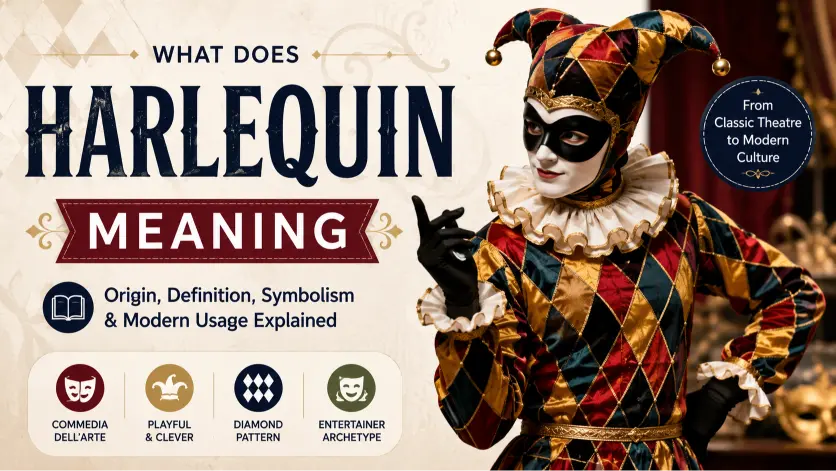
Instead of plain clothing, he wore colorful patches sewn together into the iconic diamond pattern we still recognize today.
As Italian theater spread throughout Europe, the character’s name gradually changed:
- Italian: Arlecchino
- French: Arlequin
- English: Harlequin
Eventually, the word entered English dictionaries and became part of everyday vocabulary.
The History Behind the Character
The original Harlequin wasn’t simply a clown.
He combined several qualities that made him unforgettable:
- Extremely agile
- Clever problem solver
- Funny without trying too hard
- Loyal but mischievous
- Often outsmarted richer characters
Because audiences loved him, Harlequin soon became one of the most recognizable theatrical figures in Europe.
Later, British pantomime adopted the character and gave him an even larger role in comedy performances.
How Harlequin Meaning Has Changed Over Time
Language constantly evolves, and harlequin is no exception.
1500s–1600s
The word referred almost exclusively to the comic stage character.
1700s–1800s
It expanded into literature, paintings, and European theater.
1900s
Designers began using harlequin to describe colorful diamond-shaped patterns in clothing, wallpaper, and textiles.
Today
Today, harlequin meaning has several common uses:
In Theater
The classic comic performer.
In Fashion
A colorful diamond-patterned design.
In Literature
A symbolic or playful fictional character.
In Interior Design
Decor inspired by bold geometric diamonds.
In Everyday Language
Someone humorous, lively, or entertaining.
In Specialized Fields
The word also appears in medicine, biology, and animal breeding, where it has very specific meanings unrelated to theater.
Why Is the Diamond Pattern Called Harlequin?
One of the most recognizable features of the Harlequin character was his patched clothing.
Over time, costume makers transformed those patches into neat, colorful diamonds.
Eventually, people began referring to any similar pattern simply as a harlequin pattern.
Today you’ll find it in:
- Fashion
- Upholstery
- Wallpapers
- Socks
- Home décor
- Quilts
- Graphic design
The pattern remains popular because it instantly creates a playful and energetic appearance.
Examples of Harlequin in Sentences
Here are a few examples showing how the word changes with context:
Theater
The actor played the role of the Harlequin during the performance.
Fashion
She wore a beautiful harlequin sweater with bright diamond patterns.
Art
The painting featured a lonely harlequin standing beneath the moon.
Design
The living room used a subtle harlequin wallpaper for added elegance.
General Description
His playful personality reminded everyone of a classic harlequin.
Why Is Harlequin Still Popular?
Despite being hundreds of years old, the Harlequin remains relevant because it combines timeless qualities:
- Humor
- Cleverness
- Creativity
- Visual appeal
- Rich cultural history
Whether you encounter the word in Shakespeare-inspired theater, modern novels, fashion collections, or interior design magazines, its historical roots continue to influence how it’s understood today.
How to Use Harlequin Correctly
Unlike internet slang or text abbreviations, harlequin is a standard English noun with several meanings. The correct interpretation depends entirely on the context. While the word most commonly refers to the famous theatrical character, it can also describe patterns, personalities, artistic themes, and specialized subjects.
Understanding the setting will help you use the word naturally and avoid confusion.
When to Use “Harlequin”
You can use harlequin when talking about:
1. Theater and Performing Arts
This is the word’s original meaning.
Examples
- The Harlequin always found a clever way out of trouble.
- The play featured a modern version of the classic Harlequin.
- Children laughed whenever the Harlequin appeared on stage.
Tone: Historical, artistic, theatrical
2. Fashion
Fashion designers often use harlequin to describe colorful diamond-shaped patterns.
Examples
- She wore a harlequin jacket with bold red and blue diamonds.
- The designer introduced a modern harlequin print for the winter collection.
- Harlequin socks have become popular again.
Tone: Stylish, descriptive
3. Interior Design
The word is also common in home décor.
Examples
- The dining room features harlequin wallpaper.
- We chose harlequin tiles for the entryway.
- The cushions have a subtle harlequin pattern.
4. Literature and Art
Authors frequently use the Harlequin character as a symbol of humor, mystery, tragedy, or hidden emotions.
Examples
- The novel compares the hero to a lonely harlequin.
- The artist painted a melancholic harlequin.
- Picasso created several famous paintings featuring harlequins during his early career.
5. Everyday Descriptions
Sometimes people use harlequin figuratively to describe someone playful, humorous, or colorful.
Examples
- He’s the harlequin of our friend group.
- Her colorful personality reminds me of a harlequin.
Although this figurative use is less common, it’s still understood by many English speakers.
When NOT to Use Harlequin
Avoid using the word when:
- You simply mean clown (they are not exactly the same).
- You want to describe someone acting foolish.
- You’re writing formal business communication.
- The audience may not recognize the cultural reference.
For example:
❌ The CEO acted like a harlequin during the meeting.
Unless you’re intentionally making a literary comparison, this sounds unusual.
A better alternative would be:
✔ The CEO acted unprofessionally.
Platform-Specific Usage
Although harlequin isn’t internet slang, it still appears across different online platforms.
| Platform | Common Usage |
|---|---|
| Rare; mostly when discussing books or costumes | |
| Fashion captions, cosplay, artwork | |
| TikTok | Makeup tutorials, costume trends, theater edits |
| Literature, comics, history discussions | |
| Discord | Gaming skins, fantasy roleplay |
| X (Twitter) | Art, theater, cultural commentary |
Capitalization Rules
Use Harlequin (capital H):
- Referring to the theatrical character.
- A named fictional character.
- Part of a proper title.
Examples:
- Harlequin appears in the final act.
- Harlequin costumes are iconic.
Use harlequin (lowercase):
- Referring to patterns.
- Describing colors.
- General descriptions.
Examples:
- harlequin wallpaper
- harlequin print
- harlequin design
Emoji Pairings
People discussing Harlequin costumes or aesthetics sometimes pair the word with emojis such as:
🎭 Performing arts
🃏 Joker or trickster themes
🎨 Artistic creations
✨ Colorful fashion
🎪 Circus-inspired looks
These aren’t official but fit the playful spirit associated with the word.
Real Conversation Examples Using “Harlequin”
Below are realistic examples showing how harlequin meaning changes depending on the situation.
Between Friends
Emma: Have you seen Jake’s Halloween costume?
Noah: Yeah! He dressed as a Harlequin this year.
Emma: The diamond costume looked amazing.
What it conveys
Here, Harlequin refers to the traditional theatrical costume with colorful diamond patterns.
Shopping for Clothes
Customer: What kind of sweater is this?
Salesperson: It’s a harlequin pattern. Those colorful diamonds are making a comeback.
Meaning
The word describes the clothing design rather than the theatrical character.
Art Class
Teacher: Why do so many painters include harlequins?
Student: Maybe because they represent both joy and sadness.
Meaning
Artists often use the Harlequin as a symbolic figure expressing complex emotions.
Family Conversation
Dad: Your room looks incredibly colorful.
Daughter: I wanted a harlequin theme with bright wallpaper.
Meaning
The word refers to the decorative diamond pattern.
Book Club
Reader 1: I loved the mysterious harlequin character.
Reader 2: He seemed funny on the outside but lonely inside.
Meaning
The character symbolizes hidden emotions beneath a cheerful appearance.
Common Mistakes & Misunderstandings
Because harlequin meaning has evolved over centuries, many people confuse it with similar words or assume it always has the same definition.
Here are the most common mistakes.
Mistake #1: Thinking Harlequin Means “Clown”
Although both entertain audiences, they’re different.
| Harlequin | Clown |
|---|---|
| Originated in Italian theater | Circus tradition |
| Clever servant | Comic performer |
| Diamond costume | Various costumes |
| Symbolic literary figure | Entertainment character |
Many dictionaries define Harlequin as a comic theatrical character—not a circus clown.
Mistake #2: Assuming It Only Means the Costume
The famous costume made the character popular, but harlequin can also refer to:
- Literary figures
- Decorative patterns
- Symbolic personalities
- Artistic themes
- Medical terminology
- Animal color varieties
The costume is only one piece of the larger story.
Mistake #3: Ignoring Context
Someone might say:
The room has a beautiful harlequin design.
This obviously doesn’t mean a comic actor is standing inside the room.
Instead, they’re describing the diamond-shaped pattern.
Context is everything.
Generational Differences
Gen Z
Usually encounters the word through:
- Cosplay
- TikTok
- Fashion
- Anime discussions
- Character aesthetics
Millennials
Often recognize it from:
- Literature
- Theater
- Graphic novels
- Interior design
- Classic cartoons
Older Generations
May associate Harlequin with:
- Traditional stage performances
- British pantomime
- Classical paintings
- Historical literature
Cultural Differences
Europe
The theatrical meaning remains widely recognized because of the long history of Commedia dell’Arte.
North America
Many people first encounter the word through:
- Fashion
- Home décor
- Books
- Art
- Costume parties
Other English-Speaking Regions
The meaning usually depends on education, media exposure, or cultural interests rather than everyday conversation.
Harlequin Across Different Modern Contexts
Today, the word appears in many surprising places.
Fashion
Designers continue using harlequin-inspired diamond prints in:
- Sweaters
- Dresses
- Socks
- Jackets
- Runway collections
Theater
The original Harlequin character still appears in:
- Classical productions
- Children’s theater
- Street performances
- Historical reenactments
Fine Art
Artists frequently paint Harlequin figures to explore themes such as:
- Joy
- Loneliness
- Performance
- Identity
- Hidden emotions
Literature
Novelists often use Harlequin characters as metaphors for people who hide sadness behind humor.
Medicine
The word also appears in medical terms such as Harlequin syndrome and Harlequin ichthyosis. These are specialized conditions with entirely different meanings from the theatrical character and should not be confused with the general definition.
Pop Culture
Modern audiences may also encounter Harlequin-inspired characters in:
- Comics
- Fantasy novels
- Video games
- Animated series
- Cosplay communities
These adaptations often borrow the original character’s colorful appearance, agility, wit, and playful personality while giving them contemporary twists.
Related Terms, Synonyms & Alternatives
Although harlequin meaning is unique, several words share similar ideas depending on the context. Some relate to theater, while others describe colorful patterns, playful personalities, or comic performers.
| Term | Meaning | When to Use |
|---|---|---|
| Arlecchino | The original Italian name of Harlequin | When discussing Commedia dell’Arte |
| Clown | A comic entertainer, usually associated with circuses | General comedy and performances |
| Jester | A medieval court entertainer | Historical or royal contexts |
| Fool | A humorous or wise comic character in literature | Shakespearean works and storytelling |
| Mime | A performer who tells stories through movement | Silent performances |
| Pierrot | A melancholic clown from French theater | Art, literature, and theater |
| Masquerade | A costume event or disguise | Festivals and costume parties |
| Diamond Pattern | A geometric decorative design | Fashion and interior design |
| Motley | A mix of different colors or styles | Clothing, décor, or figurative descriptions |
| Trickster | A clever, mischievous character | Folklore, mythology, and fiction |
Related Concepts Worth Exploring
If you’re building a glossary or “Meaning” category on your website, consider linking to related topics such as:
- Learn more about Jester Meaning
- Learn more about Motley Meaning
- Learn more about Clown Meaning
- Learn more about Masquerade Meaning
- Learn more about Commedia dell’Arte
- Learn more about Pierrot Meaning
- Learn more about Carnival Meaning
- Learn more about Mime Meaning
These pages naturally complement harlequin meaning and strengthen your site’s topical authority.
FAQs:
What does harlequin literally mean?
The literal meaning of harlequin is a comic servant character from the traditional Italian theatrical form known as Commedia dell’Arte. Over time, the term expanded to include colorful diamond-patterned designs, playful personalities, artistic symbols, and several specialized uses in medicine and biology.
Why is the Harlequin character famous?
Harlequin became famous because of his quick wit, agility, humorous tricks, and colorful costume. Unlike noble characters, he often relied on intelligence and creativity to solve problems, making him one of the most memorable figures in European theater.
Is harlequin a positive or negative word?
In most situations, harlequin has a positive or neutral meaning. It often suggests creativity, humor, liveliness, and colorful expression. However, in literature or art, a harlequin can also symbolize hidden sadness or emotional complexity beneath an outwardly cheerful appearance.
Why is the harlequin costume made of diamonds?
The iconic diamond pattern evolved from the patched clothing worn by the original Harlequin character. As theatrical costumes became more elaborate, the patches were transformed into neat, colorful diamonds that are now recognized worldwide as the classic harlequin design.
Is harlequin still used today?
Yes. The word remains common in theater, literature, fashion, interior design, art, and popular culture. It also appears in specialized terms such as Harlequin syndrome and Harlequin ichthyosis, though those medical meanings are separate from the theatrical origin.
Is Harlequin the same as a clown?
No. While both characters entertain audiences, they come from different traditions. Harlequin originated in Italian theater and is known for cleverness and agility, whereas a clown is more commonly associated with circuses and physical comedy.
Conclusion:
The harlequin meaning is much richer than many people realize. What began as a clever comic servant in 16th-century Italian theater has grown into a word used across literature, fashion, art, design, and even specialized scientific fields.
Whether you’re reading a classic novel, admiring a diamond patterned sweater, or watching a theatrical performance, understanding the different meanings of harlequin helps you appreciate the cultural history behind the word.
Now that you know its origin, symbolism, pronunciation, and modern uses, you’ll be able to recognize harlequin in almost any context with confidence.
What’s your favorite historical or unusual English word? Drop it in the comments below and explore more fascinating word meanings!