Have you ever read a book where a character was described as having unkempt hair, or heard someone say a yard looked “unkempt” and wondered exactly what that meant?
You’re not alone. The unkempt meaning is one of those English words people recognize but don’t always fully understand. It appears everywhere from novels and news articles to everyday conversations yet many English learners confuse it with words like messy, dirty, or scruffy. While those words are related, unkempt has its own unique meaning and tone.
Understanding this word can instantly improve your vocabulary and help you describe people, places, and objects more naturally. Whether you’re a student, English learner, writer, or simply curious, knowing when and when not to use unkempt will make your communication more precise.
You’ll learn the exact definition, where the word came from, how native English speakers use it today, common mistakes to avoid, and plenty of real-world examples.
What Does Unkempt Mean?
Quick Answer
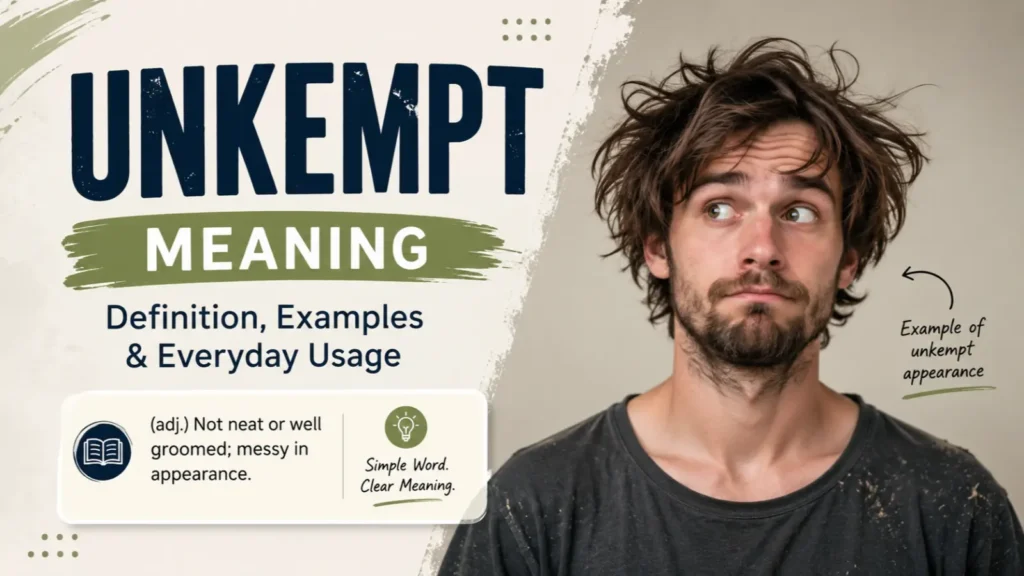
Unkempt is an adjective that describes someone or something that looks untidy, messy, or poorly maintained because it hasn’t been properly cared for. It most commonly refers to hair, clothing, beards, gardens, rooms, or other things that appear neglected.
Simple Definition
The word unkempt describes a lack of neatness or grooming.
Unlike words such as dirty or filthy, unkempt doesn’t necessarily mean something is covered in dirt. Instead, it suggests that proper care or maintenance has been neglected.
For example:
- uncombed hair
- wrinkled clothes
- an overgrown lawn
- an untidy beard
- a neglected garden
All of these could reasonably be described as unkempt.
Dictionary-Style Definition
Unkempt (adjective)
Meaning:
- Untidy in appearance.
- Not properly groomed or maintained.
- Looking neglected or disordered.
Pronunciation
American English
un-KEMPT
IPA
/ʌnˈkɛmpt/
The stress falls on the second syllable.
How to Pronounce It
Break it into two parts:
un + kempt
Say it like:
uhn-KEMPT
Rhymes loosely with:
- exempt
- preempt
Origin of the Word
One of the most interesting things about unkempt is that most people have never heard the word kempt even though it actually exists.
The adjective kempt comes from the Old English verb kemban, meaning to comb hair.
Originally:
- kempt meant well-combed or neatly groomed.
- unkempt literally meant “not combed.”
Over time, English speakers gradually stopped using kempt in everyday conversation, while unkempt remained common.
Today, most people recognize unkempt, even if they’ve never encountered kempt.
How the Meaning Has Evolved
Centuries ago, the word mainly described hair that hadn’t been combed.
Today, its meaning has broadened considerably.
Modern English uses unkempt for:
Personal appearance
- Hair
- Beard
- Clothing
- Facial hair
Example:
His unkempt beard made him look much older.
Places
Gardens, parks, lawns, and buildings can all be described as unkempt.
Example:
The abandoned house had an unkempt yard full of weeds.
Animals
Sometimes the word refers to fur or feathers.
Example:
The stray dog had unkempt fur.
Fictional descriptions
Authors frequently use unkempt to help readers picture a character.
Example:
The detective entered wearing an unkempt coat and carrying a stack of papers.
Is “Unkempt” Always Negative?
Not always.
Usually, it simply describes appearance.
Sometimes it suggests:
- carelessness
- exhaustion
- poverty
- stress
- being too busy to groom oneself
For example:
After working twelve-hour shifts all week, she looked slightly unkempt.
This sentence doesn’t insult the person it simply explains their appearance.
However, saying someone is always unkempt may imply poor personal hygiene or neglect, making the tone more critical.
Common Things Described as Unkempt
Thing Example Hair Unkempt hair hung over his eyes. Beard He had an unkempt beard after vacation. Clothes His unkempt clothes looked wrinkled. Garden The unkempt garden was full of weeds. Lawn Their lawn became unkempt during winter. Room The room appeared unkempt after the party. Office Papers made the office look unkempt. Dog The rescued dog had unkempt fur.
How to Use Unkempt Correctly in Texts & Everyday Conversation
Knowing the definition is one thing. Using unkempt naturally is another.
Fortunately, this adjective is fairly straightforward once you understand the situations where native speakers typically use it.
The General Rule
Use unkempt when describing someone or something that appears untidy because it hasn’t been properly maintained or cared for.
It often suggests neglect rather than a one-time mess.
For example:
✅ Her hair looked unkempt after a long camping trip.
✅ The old library had an unkempt garden.
✅ His beard became unkempt during the holidays.
These examples sound natural because they describe ongoing appearance rather than a brief accident.
When “Unkempt” Fits Perfectly
Use it when talking about:
- Hair that hasn’t been brushed
- Overgrown gardens
- Wrinkled clothing
- Untidy beards
- Neglected buildings
- Poorly maintained lawns
- Disorganized appearances
Example:
The professor arrived with slightly unkempt hair after cycling to work.
When NOT to Use “Unkempt”
Avoid using unkempt for temporary clutter or situations where another adjective fits better.
For example:
❌ The spilled coffee made the table unkempt.
Better:
✅ The table was messy.
Likewise:
❌ My homework is unkempt.
Better:
✅ My homework is disorganized.
Tone and Context
Unkempt is generally:
- Descriptive
- Mildly negative
- Neutral in formal writing
- Appropriate in journalism
- Common in literature
- Suitable in everyday English
It isn’t slang, and it isn’t offensive by itself. However, because it comments on appearance, it’s best used thoughtfully when describing people.
Formal vs. Informal Use
One advantage of unkempt is that it works in both formal and informal contexts.
Formal
The property appeared unkempt due to years of neglect.
Casual
I woke up with totally unkempt hair.
Academic
The novel portrays the protagonist as physically unkempt to reflect emotional distress.
All three uses sound natural because the word carries a standard, widely understood meaning.
Platform-Specific Usage
Although unkempt is not internet slang, it appears across many forms of digital communication.
Platform Typical Usage SMS “Sorry I look unkempt today 😂” Talking about appearance after work or travel Captioning “messy hair” photos with humor X (Twitter) Describing celebrities, fashion, or daily life Discussions about grooming, cleaning, or home improvement Discord Casual conversations, often joking about staying indoors
Emoji Pairings
People sometimes pair unkempt with emojis to soften the tone or add humor:
- 😂
- 🤦
- 😅
- 💇
- 🌿
- 🧔
Example:
My hair is completely unkempt today 😂
Capitalization Tips
Since unkempt is a regular adjective:
✅ unkempt
❌ UNKEMPT (unless for emphasis)
❌ UnKeMpT
Only capitalize it when it begins a sentence.
Real Conversation Examples Using Unkempt
The easiest way to understand unkempt meaning is to see how native English speakers use the word in everyday situations. Below are realistic dialogue examples from different settings.
Example 1: Between Friends
Emma: “Sorry I’m late. I barely had time to brush my hair.”
Sophia: “Don’t worry! It looks a little unkempt, but you still look great.”
What it conveys
Here, unkempt means her hair looks untidy because she rushed out of the house. It’s a gentle observation rather than an insult.
Example 2: Family Conversation
Mom: “Your room has become pretty unkempt this week.”
Teen: “I’ll clean it after my homework, I promise.”
What it conveys
The room isn’t necessarily dirty it simply looks neglected and disorganized after several days without cleaning.
Example 3: Workplace Chat
Alex: “Long week?”
Jordan: “You can probably tell from my unkempt beard!”
What it conveys
Jordan jokes that work has kept him too busy to shave. The word suggests a lack of grooming rather than poor hygiene.
Example 4: Dating Scenario
Chris: “I almost canceled because my hair was so unkempt.”
Taylor: “Honestly, it made you look kind of charming.”
What it conveys
Here, unkempt has a slightly positive twist. Instead of sounding unattractive, it suggests a relaxed, natural look.
Example 5: Gaming Voice Chat
Player 1: “You’ve been online all weekend.”
Player 2: “Yeah… I probably look pretty unkempt right now.”
What it conveys
The speaker humorously admits they haven’t spent much time grooming because they’ve been gaming.
Example 6: Book Description
The traveler entered the village wearing an unkempt coat, muddy boots, and a tired expression.
What it conveys
Writers often use unkempt to paint a vivid picture of a character’s appearance without saying they’re dirty.
Example 7: Garden Conversation
Neighbor: “Your roses are beautiful.”
Homeowner: “Thanks! The backyard is still pretty unkempt, though.”
What it conveys
The speaker means the yard needs trimming, mowing, or general maintenance.
Example Sentences
Here are more examples showing how versatile the word is.
- She tied back her unkempt hair before the meeting.
- His unkempt beard made him look older.
- The abandoned house had an unkempt lawn.
- After finals week, my apartment looked unkempt.
- The rescued puppy had unkempt fur.
- Despite his unkempt appearance, he was extremely professional.
- The park became unkempt after months without maintenance.
- The actor purposely appeared unkempt for the movie role.
- Her notebook looked unkempt, but every page was organized.
- Their vacation cabin looked charming despite its slightly unkempt exterior.
Common Mistakes & Misunderstandings
Although unkempt is a common English adjective, many people misuse it or misunderstand its meaning.
Let’s clear up the biggest mistakes.
Mistake #1: Thinking Unkempt Means Dirty
Many learners assume unkempt and dirty mean exactly the same thing.
They don’t.
Dirty
- Covered with dirt
- Needs washing
Unkempt
- Untidy
- Poorly groomed
- Neglected in appearance
Someone can have perfectly clean hair that’s still unkempt because they haven’t brushed it.
Likewise, a freshly washed garden can still look unkempt if weeds have grown everywhere.
Mistake #2: Using It for Temporary Messes
Sometimes people say:
❌ “My desk is unkempt because I spilled coffee.”
That’s not quite right.
Better choices include:
- messy
- cluttered
- untidy
Unkempt usually suggests a condition that has developed over time due to neglect rather than a one-time accident.
Mistake #3: Assuming It’s Always an Insult
The word often sounds negative, but context matters.
Compare these:
“He looked unkempt after hiking for three days.”
This simply describes his appearance.
Now compare:
“He’s always unkempt.”
This implies someone regularly neglects their appearance.
The second sentence feels much more critical.
Mistake #4: Confusing It with “Scruffy”
These words overlap, but they aren’t identical.
| Word | Typical Meaning |
|---|---|
| Unkempt | Untidy because of neglect |
| Scruffy | Rough, worn, shabby, or untidy |
| Messy | Disorganized in general |
| Dirty | Covered in dirt or stains |
| Disheveled | Very untidy, often after activity |
Mistake #5: Overusing It
Not everything untidy is unkempt.
For example:
An unkempt email
An unkempt spreadsheet
An unkempt phone
Those sound unnatural.
Instead say:
- disorganized
- cluttered
- poorly formatted
Generational Differences
Different generations may interpret unkempt a little differently.
Gen Z
Often uses simpler words like:
- messy
- chaotic
- looking rough
- bedhead
They still understand unkempt, but it’s less common in everyday speech.
Millennials
Millennials are familiar with the word through school, books, news, and workplace communication.
It’s commonly used in both speech and writing.
Gen X and Baby Boomers
Older generations use unkempt more frequently, especially when describing:
- gardens
- clothing
- neighborhoods
- homes
- professional appearance
Cultural Differences
Although unkempt is widely understood in English-speaking countries, its usage can vary slightly.
United States
Frequently used for:
- hair
- beards
- lawns
- clothing
United Kingdom
British English often uses unkempt in journalism and literature.
You’ll also hear words like:
- scruffy
- untidy
depending on the situation.
Australia
Australians understand unkempt, although casual speech often favors words like:
- messy
- scruffy
English Learners
Many English learners initially confuse:
- unkempt
- messy
- dirty
- disheveled
Learning the distinction makes your English sound much more natural.
What If Someone Doesn’t Understand?
If someone asks:
“What does unkempt mean?”
You can simply explain:
“It means something looks untidy because it hasn’t been taken care of.”
Or even shorter:
“It means messy or not well groomed.”
Both explanations are accurate and easy to understand.
Unkempt Across Different Platforms & Demographics
Unlike abbreviations or internet slang, unkempt is a standard English adjective. However, it still appears across social media, messaging apps, books, news articles, and online discussions.
The way people use it can vary depending on the platform and audience.
Gen Z Usage
Gen Z generally prefers shorter, trendier words in everyday conversations, such as:
- messy
- chaotic
- crusty
- looking rough
- bedhead
That said, unkempt still appears in:
- school assignments
- book reviews
- TikTok captions
- aesthetic posts
- fashion discussions
Example:
“Ignore my unkempt hair… it’s been one of those mornings 😂”
Millennial Usage
Millennials are more likely to use unkempt naturally in conversation and writing.
Common situations include:
- discussing home maintenance
- parenting
- workplace conversations
- personal grooming
- lifestyle blogs
Example:
“Our backyard has become so unkempt after all the rain.”
Older Generations
Gen X and Baby Boomers often use unkempt in a broader sense.
They may describe:
- neighborhoods
- public parks
- gardens
- clothing
- professional appearance
Example:
“The property looked unkempt after sitting vacant for years.”
Usage on TikTok
While TikTok favors trendy slang, unkempt appears in videos about:
- glow-ups
- hair transformations
- cleaning motivation
- home organization
- before-and-after makeovers
Example caption:
“POV: You finally brushed your unkempt hair after finals week.”
Usage on Instagram
Instagram users often use unkempt in captions that embrace authenticity or humor.
Examples include:
- “Messy bun? More like unkempt chic.”
- “Vacation mode = permanently unkempt hair.”
- “No filters. Just an unkempt Sunday.”
Usage on X (formerly Twitter)
On X, unkempt commonly appears in discussions about:
- celebrities
- fashion
- politics
- sports
- public spaces
Users may describe someone’s appearance, a neglected building, or even an overgrown park.
Usage on Reddit
Reddit communities frequently use unkempt in practical discussions, such as:
- grooming advice
- lawn care
- interior design
- pet care
- self-improvement
Example topics:
- “How do I fix an unkempt lawn?”
- “Why does my beard always look unkempt?”
- “How can I make my apartment look less unkempt?”
Is “Unkempt” Formal or Informal?
One reason the word remains popular is its flexibility.
Formal Writing
Suitable for:
- journalism
- academic papers
- reports
- literature
- professional reviews
Example:
The inspection noted that the property’s exterior appeared unkempt.
Informal Conversations
Equally natural in everyday speech.
Example:
I woke up looking completely unkempt today.
Is It Safe for Work?
Yes.
Unkempt is considered:
- Professional
- Polite
- Standard English
- Appropriate in schools and workplaces
However, when describing a person’s appearance, it’s wise to use the word tactfully to avoid sounding judgmental.
Has “Unkempt” Ever Gone Viral?
Unlike internet slang, unkempt hasn’t become a viral buzzword.
Instead, it maintains steady popularity because it’s commonly used in:
- novels
- news reports
- property listings
- beauty articles
- fashion magazines
- educational content
Its longevity comes from being a precise, descriptive word rather than a passing trend.
Why the Word Still Matters Today
Even in an era of fast-changing slang, unkempt remains valuable because it conveys a specific idea that words like messy or dirty don’t fully capture.
Whether you’re describing a hairstyle, a garden, a room, or a fictional character, using unkempt can make your writing sound more vivid, accurate, and polished.
Related Words, Synonyms & Alternatives
Expanding your vocabulary is one of the best ways to master the unkempt meaning. While unkempt is a precise adjective, several related words may fit better depending on the situation.
Related Words Table
| Word | Meaning | When to Use It |
|---|---|---|
| Messy | Disorganized or untidy | Everyday conversations |
| Untidy | Not neat or orderly | General appearance or spaces |
| Disheveled | Extremely untidy, especially after activity | Hair, clothing, or someone’s appearance |
| Scruffy | Untidy and slightly shabby | Casual appearance or clothing |
| Shabby | Worn-out or in poor condition | Clothes, furniture, buildings |
| Neglected | Not properly cared for | Gardens, homes, public spaces |
| Well-groomed | Neat and carefully maintained | Opposite of unkempt |
| Immaculate | Perfectly clean and tidy | Formal descriptions |
| Polished | Smart, refined, and professional | Business or professional settings |
| Neat | Clean and organized | Everyday speech |
Synonyms of Unkempt
Depending on context, these words can replace unkempt:
- Untidy
- Messy
- Disheveled
- Scruffy
- Neglected
- Shaggy
- Tousled (often for hair)
- Uncombed
- Sloppy (stronger and more critical)
- Disorderly (usually for places)
Example
Instead of:
He had unkempt hair.
You could also say:
- He had messy hair.
- He had disheveled hair.
- He had scruffy hair.
Each carries a slightly different tone.
Antonyms (Opposites)
The opposite of unkempt depends on what you’re describing.
Common antonyms include:
- Neat
- Tidy
- Well-groomed
- Well-kept
- Polished
- Orderly
- Immaculate
- Trim
- Presentable
- Groomed
Example:
Instead of looking unkempt, she appeared well-groomed and confident.
Related Vocabulary Worth Learning
If you’re building your English vocabulary, these words pair naturally with unkempt.
Grooming Terms
- Groomed
- Well-kept
- Trimmed
- Styled
- Clean-cut
Home & Garden Terms
- Overgrown
- Weedy
- Neglected
- Maintained
- Landscaped
Appearance Words
- Casual
- Elegant
- Smart
- Presentable
- Professional
Learn More About Related Terms
These topics make excellent companion articles and internal links:
- Messy vs. Untidy: What’s the Difference?
- Disheveled Meaning Explained
- Well-Groomed Meaning
- Scruffy Meaning
- Neglected Meaning
- Sloppy Meaning
- Orderly Meaning
- Immaculate Meaning
FAQs:
What does unkempt mean?
Unkempt means untidy, messy, or not properly maintained. It usually describes a person’s appearance such as hair, clothing, or a beard but it can also refer to places like gardens, rooms, or buildings that look neglected rather than simply dirty.
Is unkempt a negative word?
Not always. Unkempt is mainly descriptive. It points out that something looks untidy or poorly maintained. Depending on the context, it may sound mildly critical, but it isn’t considered an offensive or insulting word.
What’s the difference between messy and unkempt?
Messy refers to anything that is disorganized or untidy, often temporarily. Unkempt usually suggests a lack of regular care or grooming over time. For example, a desk can be messy after one busy day, while an overgrown garden is more accurately described as unkempt.
Can a person be described as unkempt?
Yes. People are often described as unkempt when their hair, beard, or clothing appears untidy or poorly groomed. The word focuses on appearance rather than cleanliness or personality.
Can you describe a place as unkempt?
Absolutely. Gardens, lawns, parks, buildings, rooms, and even neighborhoods can be called unkempt if they appear neglected or not properly maintained.
Is unkempt the same as dirty?
No. Something can be unkempt without being dirty. For example, freshly washed hair that hasn’t been brushed may look unkempt. The word emphasizes untidiness and neglect rather than dirt or stains.
Is unkempt a formal word?
Yes. Unkempt is a standard English adjective suitable for both formal and informal communication. You’ll often see it in books, newspapers, academic writing, property listings, and everyday conversations.
What are the best synonyms for unkempt?
Some of the closest synonyms include:
- Untidy
- Messy
- Disheveled
- Scruffy
- Neglected
- Disorderly
The best choice depends on the context and the level of formality you want.
How do you pronounce unkempt?
Unkempt is pronounced:
un-KEMPT
IPA: /ʌnˈkɛmpt/
The stress falls on the second syllable.
Can unkempt describe animals?
Yes. Native English speakers often use unkempt to describe an animal with tangled or poorly maintained fur or feathers, especially if it appears neglected.
Conclusion
The **unkempt meaning is simple once you understand its core idea: something looks untidy because it hasn’t been properly cared for or maintained. Whether you’re describing messy hair, an overgrown garden, a wrinkled outfit, or a neglected building, unkempt is a precise and widely accepted English adjective.
Although it’s sometimes confused with words like messy, dirty, or scruffy, unkempt carries its own unique meaning. It focuses on appearance and grooming rather than cleanliness, making it especially useful in both everyday conversations and professional writing.
The next time you come across unkempt in a novel, news article, or conversation, you’ll know exactly what it means and how to use it naturally yourself.
What’s your favorite English word that’s often misunderstood? Share it in the comments below, and explore more meaning guides to keep expanding your vocabulary!