Have you ever heard someone say, “I’m not being negative—I’m just being realistic”? Chances are, they were being called a pessimist. Whether it’s expecting rainy weather on a sunny day or assuming an interview won’t go well before it even begins, pessimism shows up in everyday life more often than many people realize.
Understanding pessimism meaning can help you communicate more clearly, improve your vocabulary, and recognise different attitudes in conversations, books, movies, and even social media. While pessimism is often viewed as the opposite of optimism, it’s more nuanced than simply “thinking negatively.”
In this guide, you’ll learn exactly what pessimism means, where the word comes from, how it’s used in psychology and daily life, its pronunciation, practical examples, common misconceptions, and how it compares with optimism. By the end, you’ll have a complete understanding of the term and know when and how to use it correctly.
What Does “Pessimism” Mean?
Quick Answer
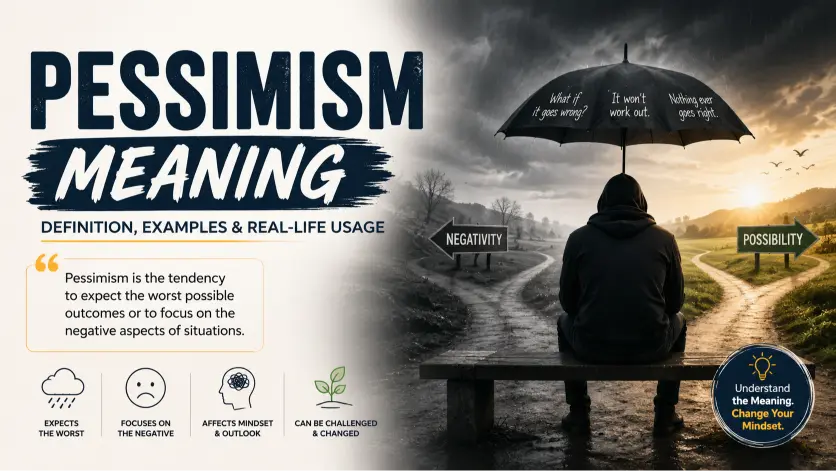
Pessimism means having a tendency to expect negative outcomes or believe that situations are more likely to turn out badly than well. It describes a mindset that focuses on potential problems, risks, or disappointments instead of positive possibilities.
Simply put, a person with a pessimistic outlook usually prepares for the worst rather than hoping for the best.
For example:
- “I probably won’t pass the exam.”
- “The holiday will probably be ruined by bad weather.”
- “There’s no point applying—they won’t hire me.”
These statements reflect a pessimistic way of thinking because they assume negative outcomes before the results are known.
Dictionary Definition
Pessimism (noun)
Definition:
A tendency to expect the worst possible outcome or to view situations from a negative perspective.
Simple Definition
Pessimism is the habit of believing that bad things are more likely to happen than good ones.
Pronunciation
Pessimism
IPA: /ˈpes.ɪ.mɪ.zəm/
Pronounced as:
PESS-ih-miz-um
Pronunciation Tip:
Stress the first syllable: PESS.
Origin and Etymology
The word pessimism comes from the Latin word pessimus, meaning “worst.”
It entered the English language during the 18th and 19th centuries, particularly in philosophy. Early philosophers used the term to describe the belief that suffering outweighs happiness and that the world is fundamentally imperfect.
Over time, the meaning expanded beyond philosophy. Today, it commonly refers to a person’s general outlook on life, their expectations about future events, or their attitude toward challenges.
Modern psychology also studies pessimism to understand how thinking patterns affect emotions, decision-making, stress, and resilience.
Is Pessimism Always Negative?
Not necessarily.
Although pessimism often has a negative reputation, it can sometimes encourage people to prepare more carefully for potential problems.
For instance:
- Double-checking important work before submitting it.
- Saving extra money for emergencies.
- Planning backup options before travelling.
- Identifying possible risks during business projects.
This balanced approach is sometimes called defensive pessimism, where anticipating challenges helps improve preparation rather than causing unnecessary worry.
However, excessive pessimism may reduce confidence, increase stress, or discourage people from pursuing worthwhile opportunities.
Different Types of Pessimism
Not all pessimism looks the same. Here are a few common forms:
1. Everyday Pessimism
A general tendency to expect disappointing outcomes in daily situations.
Example:
“The restaurant will probably be too crowded.”
2. Defensive Pessimism
Preparing for the worst to improve performance and reduce surprises.
Example:
“I’ll prepare answers for difficult interview questions just in case.”
3. Philosophical Pessimism
A philosophical belief that suffering is an unavoidable part of human existence and often outweighs happiness.
4. Situational Pessimism
Temporary negative thinking triggered by a specific event, such as failing an exam or losing a job.
Example:
“After missing the promotion, I don’t think my next application will succeed.”
Why Do People Become Pessimistic?
Several factors can contribute to a pessimistic outlook, including:
- Past disappointments
- Stress or anxiety
- Negative life experiences
- Family environment
- Personality traits
- Low self-confidence
- Constant exposure to negative news
- Fear of failure
Many people experience temporary pessimism during difficult periods, while others naturally have a more cautious personality.
Why Understanding Pessimism Matters
Learning the pessimism meaning helps you:
- Use the word accurately in speaking and writing.
- Understand psychological concepts more easily.
- Recognise different communication styles.
- Improve your English vocabulary.
- Interpret books, films, and news articles with greater clarity.
It also helps distinguish between being realistically cautious and automatically expecting the worst—an important difference in both personal and professional communication.
Understanding Pessimism in Everyday Life
Pessimism isn’t just a dictionary word—it’s something you can observe in everyday conversations, decisions, and attitudes. Most people experience pessimistic thoughts from time to time, especially during stressful or uncertain situations. The key difference is whether those thoughts are temporary or become a consistent way of viewing the world.
Someone with a pessimistic outlook often focuses on what could go wrong instead of what could go right. They may expect disappointment, prepare for failure, or doubt positive outcomes even when there’s good reason to be hopeful.
Signs of a Pessimistic Mindset
A pessimistic person may:
- Expect the worst before knowing the outcome.
- Focus more on problems than solutions.
- Assume success is unlikely.
- Worry about future events excessively.
- Find it difficult to celebrate achievements because they anticipate the next challenge.
For example:
- “I’m sure the holiday will get cancelled.”
- “There’s no point applying—I won’t get the job.”
- “This project is probably going to fail.”
These thoughts don’t necessarily mean someone is always negative, but they reflect a pessimistic way of thinking.
Pessimism in Psychology
In psychology, pessimism refers to a pattern of expecting negative outcomes. Researchers often study how optimism and pessimism influence mental health, decision-making, motivation, and resilience.
It’s important to understand that pessimism is not the same as depression. A person can be pessimistic without having a mental health condition, and someone with depression may experience symptoms that go far beyond negative expectations.
Psychologists also recognise a concept called defensive pessimism, where people deliberately imagine possible problems so they can prepare better. In some situations, this strategy can reduce anxiety and improve performance.
For example, a student might think:
“The exam could be difficult, so I’ll revise every chapter.”
Instead of causing failure, this cautious thinking motivates better preparation.
Everyday Situations Where Pessimism Appears
At School
A student says:
“I’m definitely going to fail the maths test.”
Even though they’ve studied, they expect the worst.
At Work
Before a presentation, an employee says:
“The client probably won’t like my ideas.”
This reflects uncertainty mixed with negative expectations.
In Sports
A football fan comments:
“Our team always loses important matches.”
Past experiences influence their expectations about future games.
In Relationships
Someone waiting for a text replies:
“They haven’t answered because they’re upset with me.”
Without evidence, they assume the most negative explanation.
During Travel
A traveller thinks:
“Our flight will probably be delayed.”
Sometimes this expectation is realistic, but constant assumptions like this can become a habit.
How to Use “Pessimism” Correctly
Understanding pessimism meaning is one thing; using the word naturally is another. Here’s how to use it correctly in different contexts.
In Everyday Conversation
“Pessimism” is commonly used to describe a person’s outlook or attitude.
Examples:
- “His pessimism makes it difficult to enjoy good news.”
- “Don’t let pessimism stop you from trying.”
- “Her pessimism disappeared after things started improving.”
These sentences sound natural in both spoken and written English.
In Academic Writing
The word frequently appears in psychology, philosophy, literature, and sociology.
Examples:
- “Researchers examined the relationship between pessimism and stress.”
- “The novel explores themes of pessimism and hope.”
- “Pessimism influenced the philosopher’s worldview.”
Academic writing often discusses pessimism as a concept rather than a personality trait.
In the Workplace
While the word is acceptable in professional settings, use it carefully. Calling a colleague “pessimistic” may sound personal or critical.
Instead, consider phrases such as:
- “Let’s discuss the potential risks.”
- “I appreciate the cautious perspective.”
- “We should balance optimism with realistic planning.”
These alternatives encourage constructive discussion without labelling someone.
On Social Media
You’ll often see the word used in captions, comments, and motivational posts.
Examples:
- “Trying to replace pessimism with gratitude.”
- “Monday pessimism is hitting hard!”
- “Less pessimism, more possibilities.”
These uses are informal and often paired with inspirational messages.
Can You Use “Pessimism” in Text Messages?
Yes. While people usually say someone is “pessimistic” rather than using the noun “pessimism” in casual texting, both are correct.
Example:
Friend 1: “I don’t think they’ll pick our team.”
Friend 2: “That’s just your pessimism talking!”
Formal vs Informal Usage
| Context | Appropriate? | Example |
|---|---|---|
| Everyday conversation | ✅ Yes | “His pessimism is understandable.” |
| School assignments | ✅ Yes | “The essay analyses pessimism.” |
| Business reports | ✅ Yes | “Market pessimism affected investor confidence.” |
| Friendly texting | ✅ Yes | “Stop the pessimism!” |
| Job interviews | ⚠️ Use carefully | Focus on constructive language instead. |
Common Expressions with Pessimism
These phrases are frequently used by native English speakers:
- A sense of pessimism
- Deep pessimism
- Growing pessimism
- Widespread pessimism
- Economic pessimism
- Public pessimism
- Extreme pessimism
- Overcome pessimism
Example:
“Growing pessimism about the economy affected consumer confidence.”
Real-Life Examples of Pessimism
Seeing the word in context makes it much easier to remember.
Example 1: Between Friends
Alex: “I think I’ll mess up the driving test.”
Sam: “Don’t let your pessimism convince you before you’ve even started.”
Meaning: Sam points out that Alex is expecting failure without evidence.
Example 2: Family Conversation
Dad: “The weather forecast looks good.”
Mia: “It’ll probably rain anyway.”
Dad: “That’s your pessimism speaking.”
Meaning: Mia automatically expects a negative outcome despite a positive forecast.
Example 3: Workplace Chat
Manager: “This project has great potential.”
Employee: “I’m worried the client won’t approve it.”
Manager: “It’s good to consider risks, but don’t let pessimism stop innovation.”
Meaning: The manager encourages balanced thinking instead of excessive negativity.
Example 4: Student Discussion
Emma: “Everyone else is smarter than me.”
Jake: “That’s pessimism talking. You’ve worked really hard.”
Meaning: Jake reminds Emma that her negative expectations aren’t necessarily true.
Example 5: Sports Fans
“We can still win.”
“No chance—we always lose finals.”
“Your pessimism is showing again!”
Meaning: The second fan bases their expectations on previous disappointments instead of the current match.
Example Sentences
Here are additional examples of pessimism meaning in everyday English:
- His constant pessimism made teamwork more difficult.
- She overcame years of pessimism by focusing on achievable goals.
- Financial pessimism caused many people to reduce spending.
- Despite widespread pessimism, the company exceeded expectations.
- The coach encouraged confidence instead of pessimism before the championship.
Tips for Using the Word Naturally
To sound like a fluent English speaker:
- Use “pessimism” when discussing the attitude or concept.
- Use “pessimistic” to describe a person or viewpoint.
- Avoid overusing the term in casual conversation; simpler phrases like “negative outlook” or “expects the worst” can sometimes sound more natural.
- Remember that pessimism isn’t always harmful—context matters. Someone can be cautious and realistic without being permanently pessimistic.
Pessimism vs Optimism
People often compare pessimism and optimism because they represent opposite ways of thinking. Neither mindset is inherently “right” or “wrong,” but they influence how we approach challenges, opportunities, and setbacks.
| Pessimism | Optimism |
|---|---|
| Expects negative outcomes | Expects positive outcomes |
| Focuses on risks and obstacles | Focuses on opportunities and solutions |
| Plans for worst-case scenarios | Hopes for the best while taking action |
| Can reduce disappointment | Can increase motivation and confidence |
| May lead to hesitation | May encourage taking healthy risks |
Example
Imagine two friends applying for the same job.
Optimist: “I have a good chance if I prepare well.”
Pessimist: “I probably won’t get it, but I’ll apply anyway.”
Both submit an application, but their expectations differ.
Is Pessimism Always Bad?
Not at all.
A moderate level of pessimism can help people:
- Prepare for unexpected problems.
- Think carefully before making decisions.
- Reduce avoidable risks.
- Create backup plans.
However, excessive pessimism may:
- Lower self-confidence.
- Increase stress and anxiety.
- Discourage people from pursuing opportunities.
- Affect relationships and communication.
The healthiest approach is often realistic optimism—staying hopeful while recognising potential challenges.
Common Mistakes & Misunderstandings
Many people misunderstand the pessimism meaning or use the word incorrectly. Here are the most common mistakes.
1. Thinking Pessimism Means Depression
This is one of the biggest misconceptions.
Pessimism is an attitude or thinking style. Depression is a medical condition that affects mood, energy, sleep, concentration, and daily life. While someone with depression may experience pessimistic thoughts, the two are not the same.
2. Confusing Pessimism with Realism
A realist looks at the available facts before making a judgement.
A pessimist often expects the worst, even when there isn’t enough evidence.
For example:
Realist: “The weather forecast says there’s a 50% chance of rain.”
Pessimist: “The picnic is definitely going to be ruined.”
3. Assuming Pessimists Are Always Negative
Not every pessimistic person complains constantly.
Some simply prefer preparing for possible problems.
This cautious thinking can actually help with planning and decision-making.
4. Using “Pessimism” Instead of “Pessimistic”
Remember the difference:
✅ Pessimism = the attitude or mindset (noun)
“His pessimism affected the whole team.”
✅ Pessimistic = describes a person or opinion (adjective)
“She is pessimistic about the results.”
5. Believing People Can’t Change
Mindsets aren’t fixed.
People often become more optimistic or more pessimistic depending on:
- Life experiences
- Confidence
- Stress levels
- Personal growth
- Support from others
Synonyms, Antonyms & Related Words
Learning related vocabulary helps you understand pessimism meaning in different contexts.
| Word | Meaning |
|---|---|
| Negativity | A tendency to focus on the bad side of situations. |
| Cynicism | Distrust of people’s motives or sincerity. |
| Defeatism | Believing success is impossible before trying. |
| Gloom | A feeling of sadness or hopelessness. |
| Doubt | Lack of confidence or certainty. |
| Hopelessness | Feeling that improvement is impossible. |
| Caution | Careful thinking before acting (not always negative). |
| Optimism (Antonym) | Expecting positive outcomes. |
| Hopefulness (Antonym) | Looking forward with confidence. |
| Confidence (Related) | Belief in yourself or success. |
Synonyms
- Negativity
- Defeatism
- Gloominess
- Fatalism
- Cynicism
- Doubtfulness
- Despair
- Discouragement
Antonyms
- Optimism
- Hope
- Confidence
- Positivity
- Cheerfulness
- Encouragement
- Faith
- Enthusiasm
FAQs:
What does pessimism mean in simple words?
Pessimism means expecting negative outcomes or believing that things are more likely to go wrong than right. A pessimistic person often focuses on risks, problems, or disappointments instead of positive possibilities.
Is pessimism always a bad thing?
No. Moderate pessimism can encourage careful planning and help people prepare for challenges. However, excessive pessimism may reduce confidence, increase stress, and make it harder to recognise opportunities.
What is the opposite of pessimism?
The opposite of pessimism is optimism. Optimistic people generally expect positive outcomes and believe challenges can be overcome with effort and persistence.
How do you use “pessimism” in a sentence?
Here are a few examples:
- Her pessimism disappeared after hearing the good news.
- Economic pessimism affected consumer spending.
- His constant pessimism frustrated the rest of the group.
Conclusion:
Understanding pessimism meaning is about more than memorising a definition. It helps you recognise a common way of thinking, communicate more precisely, and better understand conversations, books, news articles, and everyday situations.
While pessimism often involves expecting the worst, it isn’t always harmful. In moderation, it can encourage careful planning and realistic decision-making. The key is balancing caution with confidence so negative expectations don’t prevent you from taking worthwhile opportunities.
The next time you hear someone described as pessimistic, you’ll know exactly what the term means, how it’s used, and why context matters.
What’s your favourite English vocabulary word to learn? Share it in the comments and explore more meaning guides to keep building your vocabulary!

I’m Lina Roys, a passionate writer behind Storevian, where I make words, phrases, slang, and everyday expressions easy to understand. I create clear, engaging, and reader-friendly content to help people find the meanings they’re looking for, quickly and confidently.


