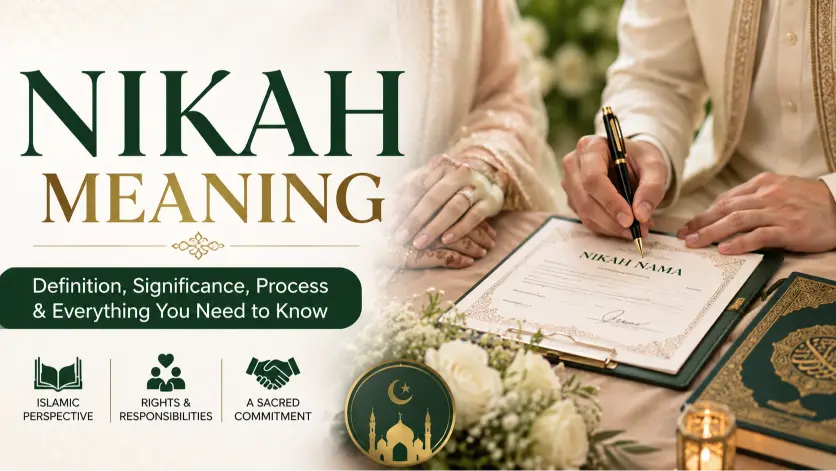
Marriage is one of life’s biggest milestones, but in Islam, it is much more than a celebration. It is a sacred commitment built on trust, compassion, respect, and shared responsibility. If you’ve searched for nikah meaning, you’re probably wondering whether Nikah simply means “marriage” or if it carries a deeper religious significance.
The answer is yest goes far beyond a wedding ceremony.
A Nikah is not just the event where two people get married. It is the official Islamic marriage contract that creates a lawful and spiritual bond between a husband and wife. While many people associate Nikah with beautiful ceremonies, elegant clothing, and family celebrations, its true importance lies in the agreement, commitment, and responsibilities accepted by both spouses.
Whether you’re a Muslim preparing for marriage, someone attending a Nikah for the first time, or simply curious about Islamic traditions, understanding the nikah meaning helps you appreciate one of the most respected institutions in Islam.
Updated for 2026, this guide explains what Nikah means, where it comes from, why it matters, and how it differs from a traditional wedding celebration.
What Does Nikah Meaning Mean?
Quick Answer
Nikah (Arabic: نكاح) means marriage or marriage contract in Islam. It is a legally and religiously recognized agreement between a man and a woman that establishes their marital relationship according to Islamic teachings.
Simply put, Nikah is the Islamic way of getting married.
Unlike some cultures where a wedding is mainly viewed as a celebration, Islam places greater emphasis on the contract itself. The ceremony is important, but the agreement between the couple is what officially establishes the marriage.
Definition of Nikah
The Arabic word Nikah (نِكَاح) literally refers to marriage.
In Islamic law (Sharia), Nikah is a formal contract between two consenting adults that grants both spouses specific rights and responsibilities.
The contract confirms that:
- Both individuals willingly agree to marry.
- The groom provides a Mahr (mandatory marriage gift).
- Witnesses validate the marriage.
- The marriage follows Islamic principles.
Rather than being a simple promise, Nikah is considered both a legal and spiritual covenant.
Pronunciation Guide
Many non-Arabic speakers wonder how to pronounce Nikah correctly.
Pronunciation:
Nee-KAH
IPA:
/niˈkɑːh/
The second syllable carries the emphasis.
Origin of the Word “Nikah”
Nikah comes from classical Arabic and has been used for centuries in Islamic teachings.
The word appears throughout Islamic scholarship and is closely connected to the teachings of the Quran and the Sunnah (the practices of Prophet Muhammad ﷺ).
Islam encourages marriage as a means of creating stable families, protecting moral values, and strengthening communities.
Because of this, Nikah is viewed not merely as a social custom but as an act of worship when entered with sincere intentions.
The Religious Significance of Nikah
Islam describes marriage as a relationship built upon three essential values:
- Love
- Mercy
- Tranquility
These principles appear in the Quran, emphasizing that spouses are meant to support one another emotionally, spiritually, and practically.
Nikah therefore represents much more than permission to live together—it establishes a lifelong partnership rooted in mutual respect and responsibility.
How the Meaning of Nikah Has Evolved
Historically, Nikah referred specifically to the Islamic marriage contract.
Today, people often use the word in different ways depending on culture.
For example, someone might say:
“Their Nikah is next Saturday.”
In this sentence, they are referring to the marriage ceremony.
Others may say:
“They already had their Nikah.”
Here, they mean the couple is officially married according to Islamic law.
Although everyday conversation sometimes uses Nikah to describe the ceremony itself, its original meaning remains the marriage contract that legally joins two spouses under Islamic principles.
Why Is Nikah Important?
Nikah serves several important purposes in Islam.
It:
- Creates a lawful marital relationship.
- Protects the rights of both spouses.
- Defines responsibilities within marriage.
- Provides emotional and financial security.
- Encourages stable family life.
- Promotes mutual respect and compassion.
- Strengthens communities through healthy families.
Because of these goals, marriage is highly encouraged in Islam for those who are ready and able to fulfill its responsibilities.
Is Nikah the Same as a Wedding?
Not exactly.
Many people confuse Nikah with the wedding celebration.
The two are related but different.
| Nikah | Wedding Celebration |
|---|---|
| Marriage contract | Celebration of marriage |
| Religious requirement | Cultural tradition |
| Makes the marriage valid | Celebrates the marriage |
| Requires consent and witnesses | May include customs, food, music, and guests |
| Focuses on legal and spiritual commitment | Focuses on celebration |
A couple may hold a Nikah in a mosque with only close family present and organize a large wedding reception weeks or even months later.
Likewise, some cultures combine both events on the same day.
How to Use Nikah Correctly in Conversation and Writing
Now that you know the nikah meaning, let’s look at how the word is actually used. While Nikah is an Arabic and Islamic term, it’s commonly used in English conversations among Muslims and in discussions about Islamic marriage.
Using the word correctly helps avoid confusion, especially since many people mistakenly use it to refer only to the wedding ceremony.
When to Use the Word “Nikah”
Use Nikah when you’re referring to:
- The Islamic marriage contract.
- The religious marriage ceremony where the contract is completed.
- A couple becoming married according to Islamic law.
- Discussions about Muslim marriage practices and traditions.
Examples
- “Their Nikah will take place at the mosque this Friday.”
- “We attended our cousin’s Nikah yesterday.”
- “The couple completed their Nikah before hosting the wedding reception.”
- “Islam requires a valid Nikah before husband and wife can live together.”
In all these examples, the word is used naturally and correctly.
When NOT to Use “Nikah”
Although Nikah means marriage in an Islamic context, it shouldn’t replace the word marriage in every situation.
For example, avoid saying:
❌ “The company held a Nikah event.”
❌ “Nikah means every type of marriage in every religion.”
Instead:
✔ “Nikah is the Islamic marriage contract.”
✔ “Marriage is the general English term.”
Remember, Nikah specifically refers to Islamic marriage, not marriage in every culture or religion.
Formal vs. Informal Usage
The word Nikah is appropriate in both formal and informal settings.
Formal
- Religious discussions
- Academic writing
- Islamic lectures
- Marriage documentation
- Legal discussions involving Muslim marriages
Example:
“The Nikah contract outlines the rights and responsibilities of both spouses.”
Informal
Friends and family often use it casually.
Examples:
- “Are you going to Ahmed’s Nikah?”
- “Their Nikah is next month.”
- “We just finished the Nikah ceremony.”
Using “Nikah” on Different Platforms
Today, people discuss Nikah across many online platforms. The tone may vary, but the meaning stays the same.
SMS & WhatsApp
Common messages include:
- “Nikah Mubarak! ❤️”
- “What time is the Nikah tomorrow?”
- “Please remember us in your duas after the Nikah.”
These messages are warm, respectful, and conversational.
Instagram posts often celebrate the occasion with captions such as:
“Alhamdulillah, our Nikah is complete. May Allah bless our journey together.”
Popular hashtags include:
- #Nikah
- #NikahDay
- #MuslimWedding
- #IslamicMarriage
- #NikahMubarak
Families frequently announce marriages with messages like:
“With the blessings of Allah, we are delighted to announce the Nikah of our son and daughter.”
Facebook posts tend to be more formal and family-oriented.
X (Twitter)
On X, users usually share brief congratulations or advice.
Examples:
- “Marriage begins with a beautiful Nikah.”
- “May every Nikah be filled with love and mercy.”
Discussions often focus on practical questions, such as:
- How does Nikah work?
- Is civil marriage enough?
- What are the conditions for a valid Nikah?
- Can Nikah be performed online?
These conversations are usually informational rather than celebratory.
Emoji Pairings
While Nikah is a religious occasion, people often use tasteful emojis to express happiness.
Common combinations include:
- 🤍
- 🌸
- 💍
- 🤲
- 🕌
- ❤️
Example:
“Nikah Mubarak! 🤲❤️ May Allah bless your marriage.”
Real Conversation Examples Using Nikah
Understanding nikah meaning becomes much easier when you see how people naturally use the word.
Example 1 – Between Friends
Aisha: Are you coming to my Nikah on Saturday?
Sara: Of course! I wouldn’t miss it. Congratulations!
What it conveys
The speaker is referring to her Islamic marriage ceremony and inviting a friend to celebrate.
Example 2 – Family Conversation
Mother: The Nikah starts after Asr prayer.
Son: We’ll leave early so everyone arrives on time.
What it conveys
The family is discussing the schedule for the marriage ceremony.
Example 3 – Workplace Chat
Ali: I’ll be taking Friday off.
Manager: Everything okay?
Ali: Yes, it’s my Nikah.
Manager: Congratulations! Wishing you both a wonderful future.
What it conveys
Even in professional settings, the word is understood as an Islamic marriage ceremony.
Example 4 – Group Chat
Fatima: Did you hear?
Noor: What happened?
Fatima: Omar’s Nikah was yesterday.
Noor: MashaAllah! May Allah bless their marriage.
What it conveys
Friends are sharing happy news about someone’s marriage.
Example 5 – Community Gathering
Guest: Is this the wedding reception?
Host: The Nikah was completed earlier. Tonight we’re celebrating with family and friends.
What it conveys
This example highlights the difference between the Nikah itself and the wedding celebration.
Common Mistakes & Misunderstandings
Although the term is widely used, many people misunderstand what Nikah actually means.
Mistake 1: Thinking Nikah Is Only the Wedding Party
This is probably the most common misconception.
Reality:
The celebration is optional in terms of religious validity. The Nikah contract is what officially establishes the marriage.
Mistake 2: Believing Nikah Means Any Marriage
Some assume Nikah is simply another word for marriage.
In reality, Nikah specifically refers to marriage according to Islamic teachings.
Other religions have different marriage traditions and terminology.
Mistake 3: Assuming a Nikah Requires a Huge Ceremony
Many people believe a lavish event is necessary.
In fact, an Islamic Nikah can be very simple.
A valid Nikah focuses on:
- Mutual consent
- Witnesses
- Mahr (marital gift)
- Marriage contract
Everything else is cultural rather than essential.
Generational Differences
Older Generations
Older Muslims often view Nikah primarily as a sacred religious obligation and emphasize simplicity, family involvement, and adherence to Islamic principles.
Younger Generations
Many younger Muslims also value the religious significance but often share Nikah announcements, photos, and celebrations on social media platforms. While the presentation may be more modern, the underlying meaning remains the same.
Cultural Differences
Although the Islamic requirements for a valid Nikah are consistent, cultural traditions vary around the world.
For example:
- South Asian weddings often include events like Mehndi and Walima.
- Arab weddings may feature different customs and celebrations.
- Turkish, Indonesian, African, and Western Muslim communities each have unique traditions.
These cultural practices can differ widely, but the Nikah itself follows the same core Islamic principles.
How to Clarify If Someone Doesn’t Understand
If someone asks, “What’s a Nikah?” you can explain it simply:
“Nikah is the Islamic marriage contract that officially joins a husband and wife according to Islamic teachings.”
This concise explanation is usually enough for someone unfamiliar with the term.
Nikah Across Different Cultures & Demographics
Although the nikah meaning remains the same in Islam, the way it is celebrated varies greatly around the world. Every culture adds its own traditions, food, clothing, and customs while preserving the essential Islamic requirements.
The Nikah itself is simple and based on Islamic teachings. The celebrations before and after it are often shaped by local culture rather than religion.
How Nikah Is Celebrated Around the World
South Asia (Pakistan, India & Bangladesh)
In South Asian communities, the Nikah is often part of a multi-day wedding celebration.
Common events include:
- Mehndi (Henna ceremony)
- Mayun or Haldi
- Baraat (Wedding procession)
- Nikah ceremony
- Walima (Marriage reception)
These customs are cultural traditions and are not required for a valid Islamic marriage.
Middle Eastern Countries
In many Arab countries, the Nikah may be performed in a mosque or family home.
Celebrations often include:
- Quran recitation
- Family gatherings
- Traditional meals
- Separate seating for men and women in some communities
The focus remains on simplicity, family, and blessings for the couple.
Western Countries
Muslim families living in countries such as the United States, the United Kingdom, Canada, and Australia often combine Islamic and local legal requirements.
Many couples:
- Complete the Nikah at a mosque.
- Register a civil marriage with the government.
- Hold a reception afterward.
This approach satisfies both religious and legal obligations.
Nikah Across Generations
Gen Z
Younger Muslims often share Nikah moments on social media using hashtags like:
- #Nikah
- #NikahMubarak
- #MuslimWedding
- #JustMarried
They tend to document the event with photos, reels, and short videos while still valuing the religious significance.
Millennials
Millennials generally balance tradition with modern preferences. They may opt for smaller ceremonies, personalized vows (outside the Nikah contract), or intimate receptions while ensuring the Islamic requirements are met.
Older Generations
Older Muslims often emphasize:
- Simplicity
- Religious values
- Family involvement
- Community support
For many, the Nikah is viewed primarily as a sacred covenant rather than a social event.
Is Nikah Formal or Informal?
Nikah is a formal religious term. It is appropriate in:
- Religious discussions
- Academic writing
- Marriage documentation
- Educational articles
- Everyday conversations among Muslims
Because it refers to an Islamic institution, it should be used respectfully.
Is Nikah Safe for Work (SFW)?
Yes.
Nikah is a religious and educational term. It is entirely appropriate for:
- Schools
- Universities
- Workplaces
- News articles
- Educational websites
- Professional discussions
Nikah vs. Civil Marriage
Many people wonder whether a Nikah is the same as a civil marriage.
The answer depends on the country.
| Feature | Nikah | Civil Marriage |
|---|---|---|
| Religious ceremony | ✅ Yes | ❌ No |
| Islamic contract | ✅ Yes | ❌ No |
| Government registration | Depends on the country | ✅ Yes |
| Spiritual significance | ✅ Yes | Usually no |
| Required by Islam | ✅ Yes | Depends on local law |
In many countries, Muslim couples complete both a Nikah and a civil marriage to meet religious and legal requirements.
Related Terms, Concepts & Alternatives
If you’re learning about the nikah meaning, these related terms can help you better understand Islamic marriage and family life.
| Related Term | Meaning |
|---|---|
| Mahr | A mandatory gift from the groom to the bride as part of the Nikah contract. |
| Walima | The wedding reception traditionally hosted after the Nikah. |
| Khutbah | A sermon that may be delivered during the Nikah ceremony. |
| Imam | A Muslim religious leader who may officiate the Nikah. |
| Wali | The bride’s guardian in certain Islamic legal traditions. |
| Talaq | The Islamic process of divorce initiated by the husband under specific conditions. |
| Khula | A form of divorce initiated by the wife through Islamic legal procedures. |
| Sharia | Islamic law that provides guidance on marriage, family, and other aspects of life. |
| Nikkah Nama | The written Islamic marriage contract signed by the couple and witnesses. |
| Muslim Marriage | The general English phrase referring to marriage according to Islamic principles. |
FAQs:
What does Nikah literally mean?
Nikah is an Arabic word that literally means marriage or marriage contract. In Islam, it refers to the formal agreement that legally and religiously joins a husband and wife through mutual consent.
Is Nikah the same as a wedding?
Not exactly. A Nikah is the Islamic marriage contract that makes the marriage valid according to Islamic teachings. A wedding reception or celebration is a cultural event that often takes place before or after the Nikah.
Who can perform a Nikah?
A Nikah may be officiated by an Imam or another knowledgeable Muslim authorized according to local customs and applicable legal requirements. The key requirement is that the marriage fulfills the necessary Islamic conditions, including mutual consent and witnesses.
Is a Nikah legally recognized?
Recognition varies by country. In some places, a Nikah alone has legal status, while in others, couples must also register a civil marriage to obtain legal recognition under national law.
Why is Mahr important in a Nikah?
Mahr is a required gift from the groom to the bride. It symbolizes respect, responsibility, and financial commitment, and it is an essential part of a valid Nikah according to Islamic teachings.
Conclusion:
Understanding the nikah meaning helps you see that it is far more than a wedding ceremony. It is a sacred Islamic marriage contract built on mutual consent, trust, compassion, and shared responsibility.
While wedding customs differ across countries and cultures, the heart of every Nikah remains the same: creating a lawful and respectful partnership guided by Islamic principles.
Whether you’re researching Islam, preparing for marriage, or simply expanding your knowledge, knowing the true Nikah meaning offers a deeper appreciation of one of the most important institutions in the Muslim faith.
💬 What other words or Islamic terms would you like to learn about? Share your questions in the comments, and explore more of our meaning guides to continue learning.

I’m Lina Roys, a passionate writer behind Storevian, where I make words, phrases, slang, and everyday expressions easy to understand. I create clear, engaging, and reader-friendly content to help people find the meanings they’re looking for, quickly and confidently.


