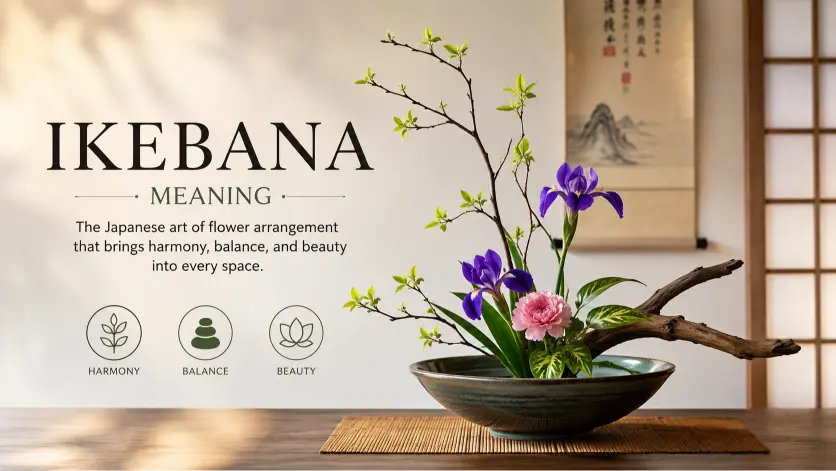
Imagine walking into a quiet room where a single vase holds just three carefully placed branches and a few blossoms. At first glance, it may seem simple but every stem has a purpose, every angle tells a story, and even the empty space carries meaning. That’s the beauty behind **ikebana meaning.
If you’ve searched for the ikebana meaning, you’re probably curious about more than just a dictionary definition. You may have seen the term in Japanese culture, interior design, meditation, art classes, or even social media and wondered why this centuries-old practice continues to inspire people around the world.
Unlike ordinary flower arranging, ikebana transforms plants into a form of artistic expression. It celebrates nature’s imperfections, values simplicity over abundance, and encourages mindfulness through thoughtful design. Whether you’re an art enthusiast, a student, or simply curious about Japanese traditions, understanding ikebana offers a deeper appreciation of one of Japan’s most treasured cultural arts.
In this guide, you’ll discover what ikebana really means, where it originated, how it’s practiced today, and why its philosophy remains relevant in modern life.
What Does “Ikebana” Mean?

Quick Answer
Ikebana means “living flowers” and refers to the traditional Japanese art of flower arranging that emphasizes harmony, balance, simplicity, and the natural beauty of plants rather than creating large decorative bouquets.
Simply put, ikebana is much more than placing flowers into a vase. It is an artistic practice where every flower, branch, leaf, and empty space contributes to a meaningful composition.
Rather than asking, “How many flowers should I use?” ikebana asks, “How can I express nature’s beauty with the fewest elements?”
This philosophy is what makes ikebana unique among floral arts.
Pronunciation
Ikebana
Pronounced:
ee-keh-BAH-nah
IPA:
/ˌiːkeɪˈbɑːnə/
Literal Meaning
The Japanese word ikebana (生け花) is made from two parts:
- Ikeru (生ける) — to make alive, arrange, or give life
- Hana (花) — flower
Together, they literally mean:
“Living flowers.”
The phrase reflects the idea that flowers continue expressing life even after being cut. Instead of simply decorating a room, an ikebana arrangement highlights each plant’s natural character and beauty.
The Origin and History of Ikebana
The history of ikebana dates back more than 500 years, though its roots stretch even further.
During the 6th century, Buddhism arrived in Japan from China and Korea. Along with Buddhist teachings came the tradition of placing floral offerings before temple altars. These early arrangements were simple acts of devotion rather than artistic creations.
Over time, Japanese monks refined these offerings into a structured art form. By the 15th century, specialized techniques and design principles had emerged, eventually giving rise to what we now know as ikebana.
As Japanese culture evolved, ikebana became closely connected with:
- Zen Buddhism
- Tea ceremonies
- Traditional architecture
- Seasonal celebrations
- Mindfulness practices
Today, ikebana is practiced in homes, schools, museums, botanical gardens, and cultural centers around the world.
How the Meaning Has Evolved

Originally, ikebana served primarily as a religious offering.
Today, its meaning has expanded significantly.
Modern practitioners view ikebana as:
- a creative hobby
- a meditative practice
- an expression of personal creativity
- a connection with nature
- an interior design element
- a respected fine art
Despite these changes, its central philosophy remains unchanged:
Nature should be respected—not controlled.
This timeless perspective is one reason why **ikebana meaning continues to resonate with people seeking calm, creativity, and balance in a fast-paced world.
How to Use “Ikebana” Correctly
Although “ikebana” is a Japanese word, it has become widely recognized in English, especially in discussions about art, culture, design, and mindfulness.
Here are a few examples of natural usage:
“She enrolled in an ikebana class to learn traditional Japanese flower arranging.”
“The museum hosted an exhibition celebrating the beauty of ikebana.”
“Minimalist interior designers often draw inspiration from ikebana.”
Ikebana teaches that empty space can be just as meaningful as flowers.”
Where You’ll See the Word
Today, the term frequently appears in:
- Japanese cultural events
- Art museums
- Botanical gardens
- Interior design magazines
- Floral design courses
- Meditation and wellness communities
- Home décor blogs
- Social media posts featuring minimalist aesthetics
Unlike many internet slang terms, “ikebana” is appropriate in both casual conversations and formal writing because it names a respected cultural art form rather than informal language.
How to Practice and Appreciate Ikebana
Knowing the **ikebana meaning is one thing—understanding how it’s practiced is another. Ikebana isn’t about filling a vase with as many flowers as possible. Instead, every element is placed with intention.
The goal is to create harmony between nature, the container, and the surrounding space.
Core Principles of Ikebana
Although different schools have their own techniques, most ikebana arrangements are based on these principles:
Balance
Balance doesn’t always mean symmetry. In ikebana, an arrangement often looks intentionally uneven, yet it still feels visually stable and peaceful.
Simplicity
Less is more.
A single branch paired with one flower can express more emotion than a bouquet of dozens of blooms.
Harmony
Every stem, leaf, flower, and empty space should work together rather than compete for attention.
Natural Beauty
Ikebana celebrates the unique shape of each plant instead of forcing flowers into perfect patterns.
Empty Space (Ma)
One of the most distinctive features of ikebana is the intentional use of empty space, known in Japanese as ma. The spaces between stems are considered just as important as the flowers themselves, creating a sense of calm and allowing each element to stand out.
Real-Life Examples of Ikebana

Understanding the philosophy becomes easier with examples.
Example 1: A Beginner’s Arrangement
A white lily stands tall in a simple ceramic vase.
A curved branch extends gracefully to one side.
Two green leaves complete the composition.
Instead of looking empty, the arrangement feels elegant and balanced.
Meaning: The design highlights simplicity, growth, and peace.
Example 2: Autumn Display
A maple branch with red leaves is paired with a single chrysanthemum.
The arrangement reflects the changing seasons rather than trying to hide them.
Meaning: Nature’s beauty includes change and imperfection.
Example 3: Modern Home Décor
A minimalist apartment features a black vase containing bamboo and orchids.
The arrangement complements the room without overwhelming it.
Meaning: Ikebana can blend traditional philosophy with contemporary design.
Example 4: Tea Ceremony
During a traditional Japanese tea gathering, a modest seasonal arrangement is placed in the alcove.
Guests quietly appreciate the flowers before the ceremony begins.
Meaning: Respect for nature enhances mindfulness and hospitality.
Example 5: Meditation Space
A meditation room contains only one branch of cherry blossom in a handmade vase.
The arrangement encourages focus rather than distraction.
Meaning: Beauty often comes from restraint.
Common Mistakes and Misunderstandings
Although ikebana has become more widely known, several misconceptions still exist.
Mistake 1: Thinking It’s Just Flower Arranging
This is the biggest misunderstanding.
Traditional flower arranging usually aims to create large, colorful displays. Ikebana is an art form that values symbolism, proportion, and thoughtful placement over abundance.
Mistake 2: Assuming More Flowers Are Better
Many beginners believe adding more flowers improves the arrangement.
In ikebana, removing unnecessary elements often creates a stronger composition.
Mistake 3: Ignoring Empty Space
People unfamiliar with ikebana sometimes think an arrangement looks incomplete.
In reality, the empty spaces are intentional and help create visual balance.
Mistake 4: Believing There Is Only One Correct Style
Ikebana includes many schools and styles, each with its own philosophy and techniques.
Some arrangements are highly traditional, while others embrace modern artistic expression.
Ikebana Across Different Cultures and Modern Life
Although ikebana originated in Japan, its influence now extends around the world.
In Japan
Ikebana remains an important cultural tradition.
It is taught through dedicated schools, practiced during cultural festivals, and displayed in homes, temples, and exhibitions.
Many people also study it as a lifelong artistic discipline.
In Europe and North America
Ikebana has become popular among:
- Floral designers
- Interior decorators
- Art students
- Botanical gardens
- Museum programs
- Mindfulness communities
Its minimalist aesthetic fits naturally with modern design trends.
On Social Media
Platforms like Instagram, Pinterest, and YouTube have introduced ikebana to a global audience.
Popular content includes:
- Arrangement tutorials
- Time-lapse videos
- Seasonal floral inspiration
- Home décor ideas
- Zen-inspired living spaces
Many creators combine traditional techniques with contemporary styles while respecting the art’s cultural roots.
Related Japanese Art Terms
If you’re interested in the **ikebana meaning, you may also enjoy learning these related Japanese concepts.
| Term | Meaning | Relation to Ikebana |
|---|---|---|
| Kado | “The Way of Flowers” | Another name for the practice of ikebana |
| Chabana | Tea ceremony flower arrangement | A simpler style used in tea ceremonies |
| Wabi-sabi | Beauty in imperfection | A philosophy reflected in many ikebana arrangements |
| Ma | Intentional empty space | One of ikebana’s most important design principles |
| Bonsai | Miniature tree cultivation | Another Japanese art celebrating nature |
| Chanoyu | Japanese tea ceremony | Often incorporates ikebana displays |
| Zen | Buddhist philosophy emphasizing mindfulness | Strongly influenced ikebana’s development |
| Kintsugi | Repairing pottery with gold | Shares the appreciation of imperfection and simplicity |
| Shodō | Japanese calligraphy | Another traditional Japanese artistic discipline |
| Origami | Paper-folding art | Like ikebana, it values precision, balance, and creativity |
These concepts together provide a deeper understanding of Japanese aesthetics and the appreciation of nature, simplicity, and intentional design.
FAQs:
What does ikebana literally mean?
Ikebana literally means “living flowers.” The word comes from the Japanese terms ikeru (“to make alive”) and hana (“flower”). Rather than simply arranging blooms for decoration, ikebana aims to express the life, movement, and natural beauty of plants through thoughtful composition.
Is ikebana the same as flower arranging?
Not exactly. While both involve arranging flowers, ikebana is considered a traditional Japanese art form with philosophical and spiritual foundations. It emphasizes harmony, asymmetry, minimalism, seasonal materials, and the relationship between flowers and empty space, whereas Western flower arranging often focuses on fullness and symmetry.
Why is empty space important in ikebana?
Empty space is an intentional design element in ikebana. It creates visual balance, draws attention to each stem or flower, and reflects the Japanese aesthetic principle of ma, which values the meaningful use of negative space. This simplicity helps evoke calm and mindfulness.
Can beginners learn ikebana?
Absolutely. Many people begin practicing ikebana through local workshops, online classes, or beginner-friendly books. Learning basic principles such as balance, proportion, and seasonal selection is more important than buying expensive flowers or tools.
Is ikebana still popular today?
Yes. Ikebana continues to thrive in Japan and around the world. It’s practiced by professional artists, hobbyists, interior designers, and mindfulness enthusiasts. Museums, botanical gardens, cultural centers, and international ikebana schools regularly host exhibitions and classes.
What flowers are used in ikebana?
Almost any plant material can be used, including:
- Cherry blossoms
- Chrysanthemums
- Orchids
- Lilies
- Roses
- Bamboo
- Pine branches
- Maple leaves
- Wild grasses
- Seasonal foliage
The emphasis is on choosing materials that reflect the current season and highlight each plant’s natural form.
Conclusion:
The **ikebana meaning goes far beyond “flower arranging.” It represents a centuries old Japanese art that celebrates harmony, simplicity, mindfulness, and the beauty of nature. Every branch, leaf, bloom, and even the empty space has a purpose.
Whether you’re exploring Japanese culture, looking for a creative hobby, or simply curious about the word, understanding ikebana offers a fresh perspective on how art and nature can work together. Its timeless principles continue to inspire people across generations and cultures.
Next time you see an ikebana arrangement, you’ll recognize that it isn’t just a decorative display—it’s a carefully crafted expression of balance, intention, and respect for the natural world.

I’m Lina Roys, a passionate writer behind Storevian, where I make words, phrases, slang, and everyday expressions easy to understand. I create clear, engaging, and reader-friendly content to help people find the meanings they’re looking for, quickly and confidently.


