Introduction
Have you ever heard someone say, “You’re being a little histrionic,” and wondered what they meant? It sounds like a complicated word, but you’ll encounter it in everyday conversations, news articles, psychology discussions, literature, and even social media.
Understanding the histrionic meaning can help you recognise when someone is describing behaviour that’s unusually dramatic or emotionally exaggerated. While the word often appears in discussions about personality and psychology, it’s also widely used in casual conversations to describe over-the-top reactions.
Updated for 2026, this guide explains the definition, origin, pronunciation, real-life examples, and proper usage of histrionic in simple language. Whether you’re a student, writer, English learner, or simply curious about vocabulary, you’ll leave with a clear understanding of when—and when not—to use this expressive word.
Table of Contents
- What Does Histrionic Mean?
- Origin of the Word
- Pronunciation
- Quick Definition
- How to Use Histrionic Correctly
- Real-Life Conversation Examples
- Common Mistakes (Coming in Part 2)
- FAQs (Coming in Part 2)
What Does Histrionic Meaning Mean?
Quick Answer:
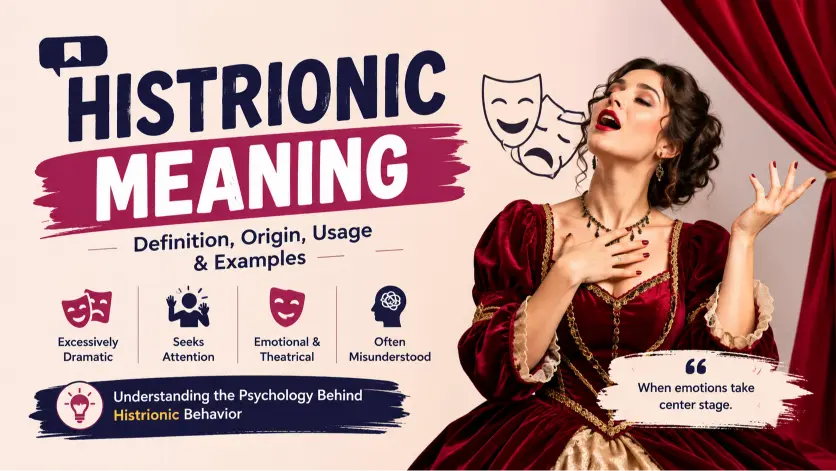
Histrionic describes someone or something that is overly dramatic, theatrical, emotionally exaggerated, or designed to attract attention. The word often suggests that the reaction is bigger than the situation actually requires.
In everyday English, histrionic is used when someone’s emotions or actions seem excessively dramatic.
For example:
- Someone screaming over a tiny spider.
- A politician giving an exaggerated emotional speech.
- A friend acting as though a small inconvenience is the end of the world.
The word doesn’t necessarily mean the emotions are fake. Instead, it suggests that the expression of those emotions is unusually theatrical or exaggerated.
Simple Definition
Histrionic (adjective):
Behaving in a way that is excessively dramatic, emotional, or theatrical, often to attract attention.
Pronunciation
Histrionic
Pronounced: his-tree-ON-ik
IPA: /ˌhɪstriˈɒnɪk/
Break it down like this:
His + tree + ON + ik
Origin of the Word
The word histrionic comes from the Latin word histrio, meaning actor or stage performer.
Originally, the word referred to acting or theatre.
Over hundreds of years, its meaning expanded beyond the stage. Today, instead of describing professional actors, it usually refers to people whose behaviour resembles exaggerated theatrical acting.
This evolution explains why the word carries ideas like:
- theatrical
- overdramatic
- exaggerated
- attention-seeking
- emotionally expressive
How the Meaning Has Changed Over Time
Originally:
Related only to theatre and acting.
Modern meaning:
Describes exaggerated emotional behaviour in everyday life.
Psychology:
The word also appears in mental health discussions, particularly in the term Histrionic Personality Disorder (HPD). However, everyday use of histrionic does not mean someone has this medical condition. Most people simply use it to describe dramatic behaviour.
That’s an important distinction because using psychological terms casually can sometimes create misunderstandings.
When Is “Histrionic” Used?
You’ll commonly hear it when describing:
- emotional reactions
- speeches
- political debates
- TV personalities
- celebrities
- dramatic storytelling
- social media reactions
- fictional characters
Example Sentences
- Her reaction to losing her keys was surprisingly histrionic.
- The actor delivered a wonderfully histrionic performance.
- His speech became increasingly histrionic as the debate continued.
- People online called the response unnecessarily histrionic.
- The novel features several histrionic characters who love attention.
How to Use Histrionic Correctly in Texts & Chat
Although histrionic is a formal English word, it’s becoming more common online, especially among people discussing politics, pop culture, psychology, books, and celebrity news.
Here’s how it’s used across different platforms.
In Text Messages
Usually playful or teasing.
Example
Alex: I waited five minutes.
Jordan: Five whole minutes?
Alex: Stop being histrionic 😂
Meaning: You’re exaggerating the situation.
On WhatsApp
Friends often use it jokingly.
Example
“Your voice note was so histrionic. I thought something terrible happened!”
The speaker means the reaction sounded much more dramatic than necessary.
On Instagram
People often use the word in captions discussing TV shows, celebrities, or emotional moments.
Example:
“The finale was wonderfully histrionic—and I loved every second of it.”
On X (Twitter)
The word frequently appears in discussions about politics, sports, and public events.
Example:
“The headlines feel unnecessarily histrionic today.”
This suggests the reporting is overly dramatic.
On Reddit
Reddit users often use histrionic in discussions about:
- psychology
- literature
- films
- relationships
- celebrity behaviour
Example:
“The character isn’t evil—just incredibly histrionic.”
In Discord
Gaming communities sometimes use the word jokingly when someone overreacts after losing.
Example:
“Relax. You’re being histrionic because we lost one round.”
When You Should Use It
Use histrionic when describing:
exaggerated reactions
theatrical performances
dramatic storytelling
emotional speeches
over-the-top behaviour
expressive fictional characters
When You Should NOT Use It
Avoid using histrionic:
- to diagnose someone with a mental health condition
- in professional performance reviews
- as an insult during serious discussions
- when someone’s emotional reaction is reasonable
Context matters. Someone experiencing genuine distress shouldn’t automatically be labelled histrionic.
Tone
Depending on context, histrionic can sound:
- humorous
- descriptive
- literary
- sarcastic
- mildly critical
It’s rarely considered a compliment unless you’re talking about theatre or acting.
Emoji Pairings
Online, people sometimes pair the word with:
🎭 Theatre mask
😂 Laughing face
🙄 Eye roll
🎬 Clapper board
🍿 Popcorn
These reinforce the idea of dramatic behaviour.
Real Conversation Examples Using Histrionic
Example 1 – Between Friends
Emma: I dropped one biscuit.
Lily: You acted like your whole week was ruined.
Emma: Maybe I was a little histrionic.
Meaning: Emma admits she exaggerated her reaction for humour.
Example 2 – Dating
Chris: You sent me eight texts because I replied late?
Taylor: I know… that was a bit histrionic.
Meaning: Taylor recognises they overreacted emotionally.
Example 3 – Family
Dad: Your brother made quite the entrance.
Mum: He’s always been histrionic.
Meaning: The family describes his naturally theatrical personality.
Example 4 – Workplace Chat
Manager: The client wasn’t angry.
Employee: The email sounded serious.
Manager: I think the wording was a little histrionic.
Meaning: The manager believes the email exaggerated the issue.
Example 5 – Gaming
: We lost one match
That’s a little histrionic.
Common Mistakes & Misunderstandings About Histrionic Meaning
Even though histrionic meaning seems straightforward, many people misunderstand how and when to use this word. Because it is also connected to psychology, it can sometimes be used incorrectly or sound harsher than intended.
1. Confusing “Histrionic” With Simply Being Emotional
A common mistake is assuming that anyone who shows strong emotions is being histrionic.
That’s not accurate.
Being emotional is a normal human reaction. Someone crying after bad news or feeling excited about an achievement is not automatically histrionic.
Histrionic usually suggests that the emotional display is:
- exaggerated
- theatrical
- attention-focused
- larger than the situation requires
Example:
Normal emotional response:
“I was upset because I failed my exam.”
Histrionic response:
“My life is completely destroyed forever because I failed one exam!”
The difference is the level of exaggeration.
2. Using It as a Medical Diagnosis
Another major misunderstanding is treating histrionic as a direct diagnosis.
Some people hear the word and immediately connect it with Histrionic Personality Disorder (HPD).
However, everyday usage is much broader.
Saying:
“That reaction was histrionic.”
does not mean:
“That person has a personality disorder.”
In casual English, it usually means:
“That reaction was overly dramatic.”
Using psychological labels casually can create unfair assumptions about people.
3. Thinking It Always Means Fake or Dishonest
Many people believe that if someone is being histrionic, they are pretending.
That isn’t necessarily true.
A person can genuinely feel an emotion while expressing it in an exaggerated way.
For example:
Someone may honestly feel disappointed but express that disappointment with dramatic language, gestures, or storytelling.
The emotion can be real—the presentation is simply excessive.
Gen Z Usage
Younger internet users often use the word humorously.
On TikTok, Instagram, and online communities, histrionic may describe:
- dramatic reactions
- exaggerated memes
- over-the-top celebrities
- funny emotional moments
Example:
“The way she reacted to a cancelled concert was so histrionic 😭”
Here, it is often playful rather than insulting.
Millennials Usage
Millennials may use the term more seriously, especially when discussing:
- workplace behaviour
- relationships
- news coverage
- social media arguments
Example:
“The online reaction feels a little histrionic.”
Meaning:
The public response seems exaggerated.
Older Generations
Older speakers may use the word more formally, often in writing, journalism, or criticism.
Example:
“The author’s histrionic style weakened the argument.”
Meaning:
The writing was overly dramatic.
Cultural Differences in Usage
In some cultures, expressive communication is normal.
A person who uses dramatic storytelling, big gestures, or emotional language may simply have a more expressive communication style.
Calling that person histrionic can sometimes sound judgmental.
Context matters.
A passionate speaker and an attention-seeking performer may look similar from the outside, but their intentions can be very different.
Is “Histrionic” Formal or Informal?
Histrionic is considered a formal vocabulary word, but people use it in both casual and professional conversations.
Formal situations:
✔ Academic writing
✔ Literature analysis
✔ Journalism
✔ Criticism
Example:
“The author’s histrionic writing style created a sense of urgency.”
Informal situations:
✔ Text messages
✔ Social media comments
✔ Friend conversations
Example:
“You’re being histrionic about your Wi-Fi going down 😂”
Is Histrionic Safe for Work?
It depends on the situation.
Using the word to describe a situation is usually acceptable:
✅ “The media coverage was somewhat histrionic.”
But using it directly toward a colleague can sound insulting:
❌ “You’re being histrionic.”
A safer workplace alternative might be:
- exaggerated
- overly dramatic
- emotional
- disproportionate
Histrionic Meaning Across Different Platforms & Communities
The internet has changed how people use descriptive words. Words that once appeared mostly in books or formal writing now appear in comments, memes, and online debates.
TikTok
TikTok users often use histrionic to describe dramatic reactions in:
- celebrity videos
- relationship stories
- reaction clips
- fictional scenes
Example:
“This character is so histrionic, and that’s why everyone loves them.”
Here, it may actually be a compliment because the character is entertaining.
On Instagram, the word often appears in:
- captions
- book reviews
- movie discussions
- fashion commentary
Example:
“The entire outfit is beautifully histrionic.”
Meaning:
The style is intentionally dramatic and attention-grabbing.
X (Twitter)
On X, histrionic is commonly used during debates.
Example:
“The response to this announcement is completely histrionic.”
Meaning:
The reaction is viewed as exaggerated.
Discord & Gaming Communities
Gamers often use it jokingly.
Example:
“Bro is being histrionic because he lost one game.”
Meaning:
The player is dramatically overreacting.
Related Words, Synonyms & Alternatives
Understanding similar words helps you use histrionic meaning more accurately.
| Word | Meaning | Difference |
|---|---|---|
| Dramatic | Showing strong emotions | More common and neutral |
| Theatrical | Like a stage performance | Can be positive or negative |
| Exaggerated | Made bigger than reality | Focuses on overstatement |
| Melodramatic | Excessively emotional | Often negative |
| Over-the-top | Extremely exaggerated | Casual internet phrase |
| Flamboyant | Noticeably expressive | Can be positive |
| Emotional | Showing feelings | Not necessarily dramatic |
| Attention-seeking | Trying to gain notice | Focuses on motivation |
| Grandiose | Impressively exaggerated | Often relates to ideas or self-image |
| Sensational | Designed to create excitement | Common in media contexts |
Synonyms for Histrionic
Depending on the context, you can replace histrionic with:
- dramatic
- theatrical
- exaggerated
- melodramatic
- over-the-top
- showy
- flashy
- sensational
Antonyms of Histrionic
Words with opposite meanings include:
- calm
- restrained
- understated
- composed
- realistic
- practical
- matter-of-fact
Quick Comparison: Dramatic vs Histrionic
| Dramatic | Histrionic |
|---|---|
| Normal emotional expression | Excessive emotional display |
| Can be positive | Often slightly critical |
| Used very commonly | More formal vocabulary |
| Applies broadly | Suggests theatrical exaggeration |
Example:
Dramatic:
“The movie ending was dramatic.”
Histrionic:
“The actor’s reaction was so histrionic that it felt unrealistic.”
FAQs:
What does histrionic mean in simple words?
Histrionic means overly dramatic, theatrical, or exaggerated in behaviour or expression. It describes reactions, speeches, or actions that seem bigger than the situation requires, often creating a strong impression or attracting attention.
Is calling someone histrionic an insult?
It can be, depending on the context. Calling someone’s behaviour histrionic often suggests criticism because it implies exaggeration. However, when describing acting, storytelling, or entertainment, it can simply mean dramatic or theatrical.
What is an example of a histrionic person?
A person who turns a small inconvenience into a major crisis, uses exaggerated language, or creates a dramatic scene over minor issues may be described as histrionic. The word describes behaviour, not a person’s entire identity.
What is the difference between histrionic and dramatic?
Dramatic is a broader and more neutral word for strong emotional expression. Histrionic usually suggests a more exaggerated, theatrical, or attention-focused style of behaviour.
Conclusion:
Words like histrionic can seem complicated at first, but the idea behind them is simple. The histrionic meaning describes behaviour, reactions, or expressions that feel overly dramatic, theatrical, or exaggerated.
The word does not always mean something negative. In acting, storytelling, or entertainment, being histrionic can create excitement and personality. In everyday conversations, however, it often suggests that someone is making a situation seem bigger than it really is.
Knowing the difference helps you use the word correctly. Whether you’re reading an article, watching a movie review, scrolling through social media, or improving your vocabulary, understanding words like histrionic makes communication clearer.
Want to master more interesting words and modern expressions? Explore more vocabulary guides and discover how language changes across conversations, culture, and the internet.

I’m Lina Roys, a passionate writer behind Storevian, where I make words, phrases, slang, and everyday expressions easy to understand. I create clear, engaging, and reader-friendly content to help people find the meanings they’re looking for, quickly and confidently.


