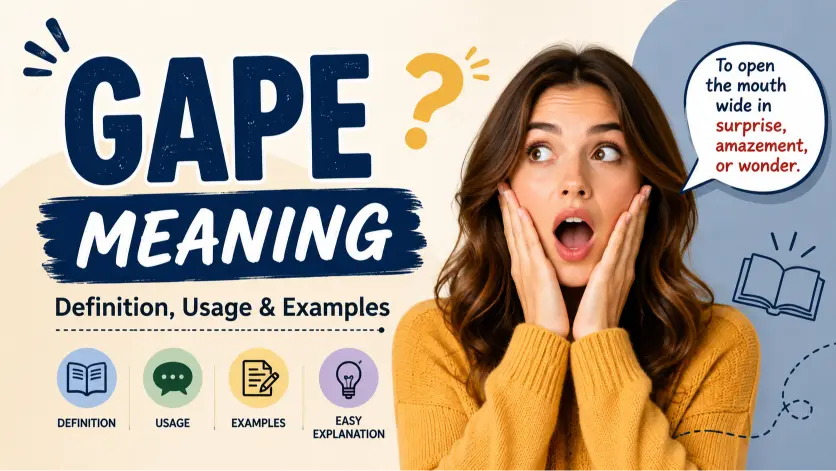
Have you ever seen someone witness an unbelievable magic trick or hear shocking news and suddenly freeze with their mouth hanging open? That’s exactly what the word gape meaning helps describe.
Although gape is a simple English verb, many people confuse it with words like gaze, stare, or glare. Understanding the difference can make your speaking and writing much more natural. Whether you’re reading a novel, studying English, preparing for an exam, or simply expanding your vocabulary, learning this word is worthwhile.
In this complete guide, you’ll discover what gape meaning is, where the word came from, how to pronounce it correctly, when to use it, common mistakes to avoid, and plenty of real-life examples. By the end, you’ll know exactly how to use gape confidently in conversations and writing.
What Does Gape Meaning Mean?
Quick Answer
Gape means to look at someone or something with your mouth open because you’re surprised, amazed, shocked, or astonished. It can also mean that something is wide open, such as a hole, wound, or crack.
At its core, gape describes a strong emotional reaction. Instead of simply looking at something, the person is so amazed that their mouth opens without realizing it.
Dictionary Definition
As a verb, gape commonly means:
- To stare with one’s mouth open because of surprise or wonder.
- To remain wide open.
- To form or create a large opening.
As a noun (less common), gape refers to a wide opening or gap.
Origin of the Word “Gape”
The word gape has a long history in the English language.
It comes from the Old Norse word gapa, meaning to open the mouth wide. Similar forms also appeared in Old English and Middle English, where the word described both people opening their mouths in amazement and physical openings in objects.
Over hundreds of years, the meaning has remained remarkably consistent. Today, it still carries the same core idea of opening widely, whether referring to a person’s expression or an object’s appearance.
Pronunciation Guide
Gape
IPA: /ɡeɪp/
It rhymes with:
- shape
- tape
- cape
- escape
Pronunciation Tip
Think of saying:
“Gay + p“
The “a” makes a long “ay” sound.
When Does Someone Gape?
People usually gape when they experience intense emotions, including:
- Surprise
- Amazement
- Shock
- Curiosity
- Disbelief
- Wonder
For example:
- Everyone gaped as the fireworks lit up the sky.
- The audience gaped at the magician’s final trick.
- Tourists gaped at the breathtaking waterfall.
- Children gaped when the dinosaur suddenly moved.
Notice that each example involves something unexpected or impressive.
How to Use Gape Correctly in English
The word gape is mostly used as a verb.
Common Sentence Patterns
Gape at + noun
Examples:
- She gaped at the enormous whale.
- We all gaped at the beautiful castle.
- They gaped at the winning goal.
Gape in surprise
Examples:
- He simply gaped in surprise.
- Everyone gaped in disbelief.
- She stood there gaping in amazement.
Gaping + noun
As an adjective, gaping describes something that’s wide open.
Examples:
- a gaping hole
- a gaping wound
- a gaping crack
- a gaping doorway
Example sentence:
The earthquake left a gaping crack across the road.
News Writing
Journalists sometimes use the adjective form.
Example:
Rescue workers searched through the gaping hole left by the explosion.
Academic Writing
While less common, the word appears in descriptive essays and literary analysis because it paints a clear picture of surprise or physical openings.
Tips for Using Gape Naturally
Use gape when:
Someone is visibly amazed.
Someone’s mouth is open because of surprise.
You’re describing dramatic scenes.
You’re writing descriptive stories.
Avoid using gape when someone is simply looking at something normally. In those cases, words like look, watch, or observe are usually better choices.
Gape vs. Similar Words
| Word | Meaning | Emotion |
|---|---|---|
| Gape | Mouth open from surprise | Strong surprise |
| Gaze | Look steadily with admiration | Calm |
| Stare | Look fixedly | Neutral or rude |
| Glance | Quick look | Brief |
| Peek | Secret or quick look | Curious |
| Glare | Angry look | Anger |
This distinction helps you choose the most accurate word depending on the situation.
Real Conversation Examples Using Gape
One of the best ways to understand gape meaning is to see how the word appears in everyday conversations. Notice that in each example, someone reacts with surprise, amazement, or disbelief.
Example 1: Between Friends
Alex: Did you see Emma’s new sports car?
Ryan: I did! I just stood there gaping at it for a minute.
Alex: Same here. It looks incredible!
What it conveys: Ryan was so impressed that he couldn’t hide his amazement.
Example 2: Family Conversation
Mom: Your little brother solved the puzzle in five minutes.
Dad: Seriously? I was gaping in surprise!
Mom: He’s getting smarter every day.
What it conveys: Dad was genuinely shocked by his son’s achievement.
Example 3: At School
Teacher: Sarah scored 100% on every exam this semester.
Student: The whole class just gaped at the announcement.
Teacher: Hard work really pays off.
What it conveys: Everyone reacted with admiration and surprise.
Example 4: Office Chat
Manager: We’ve just landed our biggest client ever.
Employee: Wow! Everyone in the meeting was gaping.
Manager: It’s an exciting day for the whole team.
What it conveys: The news was unexpected and impressive.
Example 5: Gaming Friends
: Did you really beat the final boss without taking any damage?
: Yep!
I’m honestly gaping right now.
It took hundreds of practice runs.
What it conveys: The speaker is amazed by an impressive gaming achievement.
Example 6: Watching a Magic Show
How did the magician make the car disappear?
No idea—I was just gaping the entire time.
That’s why he’s famous!
What it conveys: The performance left the audience completely amazed.
Example 7: Travel Experience
Traveler: Have you ever seen Niagara Falls in person?
Friend: Yes, and I spent the first few minutes just gaping at the view.
Traveler: Pictures really don’t do it justice.
What it conveys: The scenery was breathtaking enough to leave someone speechless.
Everyday Example Sentences
Here are more natural examples showing gape meaning in different contexts.
- Tourists gaped at the ancient castle.
- The children gaped as fireworks filled the night sky.
- She gaped when she opened her exam results.
- We all gaped at the incredible sunset.
- The audience gaped during the magician’s final trick.
- He stood there gaping in disbelief.
- A gaping hole appeared in the road after the storm.
- The old barn had a gaping doorway.
- Reporters described a gaping crack in the bridge.
- The crowd gaped as the athlete broke the world record.
Common Mistakes & Misunderstandings
Although gape is an easy word to learn, many English learners—and even native speakers—mix it up with similar words.
Here are the most common mistakes.
1. Confusing “Gape” with “Gaze”
This is by far the biggest mistake.
Gape
- Mouth open
- Strong surprise
- Shock or amazement
Gaze
- Calm, steady look
- Admiration
- Thoughtfulness
✅ Correct
She gazed at the stars.
He gaped at the exploding fireworks.
❌ Incorrect
She gaped at the sunset peacefully.
Unless the sunset shocked her, gazed is the better choice.
2. Using Gape for Every Type of Looking
Some learners think gape simply means “look.”
It doesn’t.
Instead, it describes a very specific facial expression.
Instead of saying:
❌ I gaped at my homework.
Say:
✅ I looked at my homework.
Unless the homework was unbelievably difficult!
3. Forgetting the Emotional Element
People usually gape because something is:
- shocking
- surprising
- amazing
- unbelievable
- impressive
Without emotion, gape sounds unnatural.
4. Misusing “Gaping”
Remember that gaping often describes objects, not people.
Examples:
- a gaping hole
- a gaping wound
- a gaping crack
This adjective emphasizes that something is wide open.
5. Thinking Gape Is Always Negative
Many people assume gape describes fear.
Actually, it can express many emotions:
- amazement
- excitement
- curiosity
- surprise
- admiration
- disbelief
Whether the emotion is positive or negative depends entirely on the situation.
Generational Differences
Different generations don’t necessarily use gape differently, but they may encounter it in different places.
Gen Z
You’ll often see gape in:
- TikTok captions
- YouTube comments
- Reaction memes
- Gaming discussions
Example:
“I literally gaped when the ending happened.”
Millennials
Millennials commonly use gape in:
- casual conversations
- social media posts
- blogs
- entertainment reviews
Gen X and Baby Boomers
Older generations are more likely to encounter gape in:
- newspapers
- novels
- magazines
- television news
- classic literature
The meaning remains exactly the same across all age groups.
Cultural and Regional Usage
Unlike many internet slang terms, gape is standard English and is widely understood in:
- the United States
- the United Kingdom
- Canada
- Australia
- New Zealand
- many English-learning countries
Because it appears in dictionaries and literature, it’s appropriate almost everywhere English is spoken.
Some cultures may prefer less expressive body language, but the word itself is universally understood among English speakers.
When Someone Doesn’t Understand “Gape”
If someone looks confused, simply explain it in plain English.
For example:
“Gape means looking at something with your mouth open because you’re really surprised.”
That’s usually enough for anyone to understand immediately.
You can even compare it to:
- being speechless
- being amazed
- staring in shock
These phrases help clarify the meaning quickly.
Gape Meaning Across Different Platforms & Demographics
Although gape is not an internet abbreviation or slang term, it’s frequently used online to describe reactions.
TikTok
Creators often use gape when reacting to:
- unbelievable transformations
- magic tricks
- celebrity surprises
- emotional stories
- jaw-dropping reveals
Example caption:
“I literally gaped at the ending 😲”
You’ll see it in:
- travel captions
- food photography
- luxury lifestyle posts
- wildlife videos
Example:
“Everyone was gaping at this incredible sunset.”
X (formerly Twitter)
People use gape when reacting to:
- breaking news
- sports moments
- award shows
- viral videos
Its short length makes it perfect for concise posts.
On Reddit, users often write:
- “I just gaped.”
- “The comments had me gaping.”
- “I sat there gaping.”
It’s especially common in storytelling subreddits where users describe surprising events.
Discord
Gamers frequently use gape after:
- impossible victories
- speedruns
- unexpected plot twists
- incredible plays
Example:
“Bro, I was gaping after that final boss fight.”
Is Gape Formal or Informal?
One of the strengths of the word gape is its versatility.
Formal:
- Literature
- Journalism
- Academic writing
- News reports
Informal:
- Conversations
- Social media
- Blogs
- Text messages
- Online discussions
Because it’s a standard English word, it’s considered acceptable in both settings when used appropriately.
Is Gape Safe for Work?
Yes.
Gape is completely safe for work (SFW) when used in its standard dictionary meaning. It appears in books, newspapers, educational materials, and professional writing.
However, be aware that in some niche online communities, the word can occasionally have unrelated adult meanings. In everyday English, educational contexts, and general communication, gape almost always refers to staring in amazement or something being wide open.
Related Slang, Words & Alternatives
If you’re learning gape meaning, it helps to understand similar words. While none are exact synonyms, each describes a different way of looking or reacting.
| Word | Meaning | When to Use It |
|---|---|---|
| Gaze | Look steadily with admiration | Looking at scenery, art, or a loved one |
| Stare | Look fixedly for a long time | Neutral, curious, or sometimes rude |
| Glance | Take a quick look | Briefly checking something |
| Peek | Look secretly or quickly | Curious or playful situations |
| Glare | Look angrily | Showing anger or disapproval |
| Gawk | Stare openly at something unusual | Informal; often considered rude |
| Ogle | Look with obvious attraction | Romantic or inappropriate contexts |
| Observe | Watch carefully | Formal writing or scientific contexts |
| Watch | Look attentively over time | Movies, sports, or performances |
| Be Speechless | Unable to react because of surprise | Emotional or shocking moments |
FAQs:
What does gape mean in simple words?
Gape means to look at someone or something with your mouth open because you’re surprised, amazed, or shocked. It can also describe something that is wide open, such as a hole, crack, or wound.
Is gape the same as stare?
No. While both involve looking at something, stare simply means looking fixedly. Gape specifically suggests that you’re so surprised or impressed that your mouth is open.
Is gape a formal English word?
Yes. Gape is a standard English word found in dictionaries and widely used in books, journalism, education, and everyday conversations. It works well in both formal and informal writing.
Is gape commonly used today?
Yes. Although it isn’t one of the most frequent English verbs, it’s still widely used in novels, news articles, blogs, travel writing, and social media whenever someone wants to describe amazement or a dramatic reaction.
Conclusion:
Learning gape meaning is an easy way to make your English more vivid and expressive. Rather than simply saying someone “looked” at something, gape paints a much clearer picture it shows that the person was so surprised or amazed that they couldn’t hide their reaction.
Remember that gape can describe both people and objects. People gape when they’re shocked or impressed, while objects like holes, cracks, or wounds can also be described as gaping when they’re wide open.
The next time you witness something unbelievable a breathtaking view, an incredible magic trick, or shocking news—you’ll know exactly which word to use. Gape is a versatile, memorable addition to your vocabulary that works in conversations, storytelling, and professional writing alike.
What’s the most surprising thing you’ve ever seen that made you gape? Share your answer in the comments below!

I’m Lina Roys, a passionate writer behind Storevian, where I make words, phrases, slang, and everyday expressions easy to understand. I create clear, engaging, and reader-friendly content to help people find the meanings they’re looking for, quickly and confidently.


