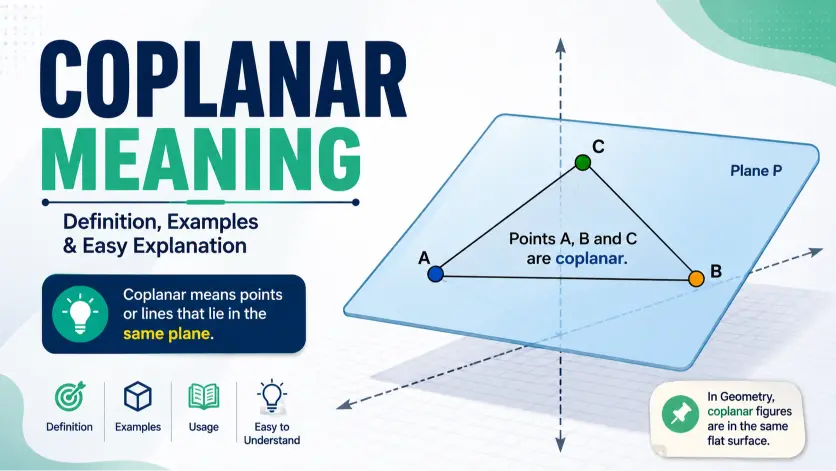
Have you ever been solving a geometry problem and come across the word coplanar? At first glance, it may sound like a complicated mathematical term, but the idea behind it is actually quite simple. Understanding the coplanar meaning can make geometry easier, whether you’re a student preparing for exams, a teacher explaining concepts, or simply someone curious about mathematics.
Updated for 2026, this guide explains the term in plain English with easy examples, pronunciation, and practical applications. Instead of relying on confusing textbook definitions, we’ll break the concept into simple steps that anyone can understand.
By the end of this article, you’ll know what coplanar means, how to identify coplanar points and lines, how it differs from non-coplanar objects, and why this concept is important in geometry and real-world design.
What Does “Coplanar” Mean?
Quick Answer
Coplanar means that two or more points, lines, or shapes lie on the same flat geometric plane. If every object can fit on one single plane without leaving it, they are considered coplanar.
Simply put, imagine placing several dots on a sheet of paper. Since the paper is flat, every dot lies on the same surface. Those dots are coplanar points.
If one of the dots is lifted above the paper, it is no longer on the same plane. The objects then become non-coplanar.
Simple Definition
The coplanar meaning in mathematics is:
Objects that exist or lie in the same geometric plane.
A plane is a perfectly flat surface that extends endlessly in every direction. It has length and width but no thickness.
Whenever multiple points, lines, or figures share that same plane, they are called coplanar.
Pronunciation
Coplanar
Pronounced: koh-PLAY-nar
Phonetic: /koʊˈpleɪ.nɑːr/
Breaking it down:
- Co = “koh”
- Pla = “play”
- Nar = “nar”
Say it slowly:
koh-PLAY-nar
Word Origin
The word coplanar comes from two Latin roots:
- Co- meaning “together”
- Planar, derived from planum, meaning “flat surface” or “plane”
Combined, the word literally means:
“Together on the same plane.”
This perfectly describes its use in geometry.
Understanding the Idea Visually
Imagine these situations:
Example 1: A Sheet of Paper
Draw three dots on a notebook page.
Since all three dots are on the same flat page, they are coplanar.
Example 2: A Tabletop
Place a book, a pencil, and a mobile phone on a table.
Because they all rest on the same flat tabletop, they are coplanar objects.
Example 3: A Cube
Think of the eight corners of a cube.
Not all eight corners lie on one flat surface. Some are on different faces.
These points are not all coplanar.
Coplanar Points
One of the most common uses of the term is coplanar points.
Definition
Coplanar points are points that all lie on the same geometric plane.
For example:
- Three points on a sheet of paper
- Four corners of a rectangle
- Vertices of a square
All of these are coplanar because they share one flat surface.
Example
Suppose points A, B, C, and D are drawn on a whiteboard.
Since the whiteboard is a flat plane, all four points are coplanar.
However, if point D is moved upward into three-dimensional space, the points are no longer coplanar.
Coplanar Lines
Lines can also be coplanar.
Definition
Coplanar lines are lines that exist on the same plane.
These lines may:
- intersect,
- be parallel,
- or overlap,
as long as they remain on one common plane.
Example
Imagine two roads crossing at an intersection.
Because both roads lie on the Earth’s flat surface (for practical purposes), they are considered coplanar.
In geometry, two intersecting lines are always coplanar because they meet on the same plane.
Why Is Coplanar Important?
Understanding the coplanar meaning helps students solve many geometry problems involving:
- Angles
- Planes
- Three-dimensional figures
- Coordinate geometry
- Engineering drawings
- Architecture
- Computer graphics
Many mathematical proofs assume that certain points or lines are coplanar. Recognising this relationship makes solving problems much easier.
Coplanar Meaning with Easy Examples
Now that you know the basic coplanar meaning, let’s see how the concept works in everyday situations and geometry problems. Examples make this topic much easier to understand than memorising definitions.
Example 1: Points on a Piece of Paper
Imagine drawing four dots on a blank sheet of paper.
- Point A
- Point B
- Point C
- Point D
Since the paper is a flat surface, all four points lie on the same plane. Therefore, they are coplanar points.
Why?
A sheet of paper represents a geometric plane, and every point drawn on it shares that same plane.
Example 2: A Tabletop
Place these objects on a dining table:
- A laptop
- A notebook
- A coffee mug
All three objects rest on the table’s flat surface. In geometry, you can think of their bottom surfaces as lying on the same plane.
This is a simple real-life example of coplanar objects.
Example 3: Four Corners of a Rectangle
A rectangle has four vertices.
- A
- B
- C
- D
Since the rectangle is flat, every corner lies on one plane.
These four points are coplanar.
Example 4: A Cube
A cube is a three-dimensional object.
The four corners on its top face are coplanar because they lie on one flat square.
However, all eight corners of the cube are not coplanar because some lie on different planes.
This is one of the most common examples teachers use to explain the difference between two-dimensional and three-dimensional geometry.
Example 5: Coordinate Geometry
Suppose these points are given:
- A (1, 2, 0)
- B (4, 2, 0)
- C (5, 6, 0)
Notice that every point has z = 0.
That means all three points lie on the same coordinate plane.
They are coplanar points.
Coplanar vs Non-Coplanar
Many students confuse these two terms. Here’s a simple comparison.
| Feature | Coplanar | Non-Coplanar |
|---|---|---|
| Definition | Lie on the same plane | Do not lie on the same plane |
| Number of planes | One common plane | Two or more different planes |
| Geometry | Two-dimensional relationship | Three-dimensional relationship |
| Example | Corners of a square | Corners of a cube |
| Easy way to remember | Same flat surface | Different flat surfaces |
Quick Memory Trick
Think of a classroom whiteboard.
Everything written on the whiteboard is coplanar because it shares the same flat surface.
Now imagine one sticky note floating in the air in front of the board. It is non-coplanar because it no longer lies on the board’s plane.
How to Identify Coplanar Objects
If you’re unsure whether points or lines are coplanar, follow these simple steps.
Step 1: Imagine a Flat Surface
Ask yourself:
Can every point fit on one perfectly flat surface?
If yes, they are probably coplanar.
Step 2: Look for Three-Dimensional Objects
Objects like cubes, pyramids, and prisms contain points on different faces.
Not every point in these shapes is coplanar.
Step 3: Check Coordinate Values
In coordinate geometry, points sharing the same plane satisfy the same plane equation.
For beginners, if several points all have the same z-coordinate, they usually lie on the same horizontal plane.
Step 4: Examine the Diagram
Many exam questions include diagrams.
Look carefully to see whether all points belong to the same face or surface.
If one point appears above or behind the others, it may be non-coplanar.
Common Mistakes Students Make
Learning the coplanar meaning becomes much easier once you avoid these common errors.
Mistake 1: Confusing Coplanar with Collinear
These terms sound similar but have different meanings.
Collinear means points lie on the same straight line.
Coplanar means points lie on the same plane.
Every set of collinear points is coplanar because a line lies in a plane.
However, not every set of coplanar points is collinear.
Example
Four corners of a rectangle are coplanar.
They are not collinear because they do not all lie on one straight line.
Mistake 2: Assuming Every Parallel Line Is Coplanar
Many students think all parallel lines are coplanar.
That’s not always true.
In three-dimensional geometry, two parallel lines can exist on different planes.
These are called skew lines, and they are non-coplanar.
Mistake 3: Ignoring the Third Dimension
Students often solve problems as if everything exists on a flat page.
But many geometry questions involve depth.
Whenever a question includes cubes, prisms, or pyramids, always think in three dimensions before deciding whether objects are coplanar.
Why Coplanar Matters in Mathematics
The idea of coplanarity is more than just a vocabulary word. It forms the foundation of many topics in mathematics and science.
Geometry
Students use coplanar concepts to solve problems involving:
- Angles
- Triangles
- Quadrilaterals
- Polygons
- Circles
- Coordinate geometry
Engineering
Engineers design bridges, machines, and buildings using planes and geometric models.
Knowing whether components are coplanar helps ensure structures fit together accurately.
Architecture
Architects create floor plans where walls, windows, and rooms are arranged on common planes before designing three-dimensional structures.
Computer Graphics
Video games, animations, and 3D modelling software rely on coplanar surfaces to render realistic objects.
Computer programs constantly check whether points belong to the same plane.
Robotics
Robots use geometric calculations to move accurately through three-dimensional space.
Coplanar points help define movement paths and object positions.
Everyday Life
Although you may not use the word “coplanar” in daily conversation, you encounter the concept everywhere:
- A picture hanging flat on a wall
- Books lying on a shelf
- Plates arranged on a dining table
- Tiles covering a floor
- Windows fitted into a wall
All of these involve objects sharing the same plane.
Related Geometry Terms
Understanding coplanar meaning becomes much easier when you know a few related geometry terms. Here’s a quick reference table.
| Term | Simple Definition | How It Relates to Coplanar |
|---|---|---|
| Plane | A flat surface extending infinitely in all directions | Coplanar objects lie on the same plane. |
| Point | An exact location with no size | Coplanar points share one plane. |
| Line | A straight path extending infinitely in both directions | Lines can be coplanar if they lie on the same plane. |
| Collinear | Points on the same straight line | Every collinear set is coplanar, but not every coplanar set is collinear. |
| Non-Coplanar | Objects that do not lie on the same plane | The opposite of coplanar. |
| Parallel Lines | Lines that never meet | They may or may not be coplanar in three-dimensional space. |
| Intersecting Lines | Lines that cross at one point | Two intersecting lines are always coplanar. |
| Coordinate Plane | A plane defined by the x- and y-axes (or other coordinate axes) | Used to plot coplanar points in coordinate geometry. |
| Three-Dimensional Geometry | The study of shapes with length, width, and height | Introduces non-coplanar objects. |
| Skew Lines | Lines that neither intersect nor are parallel because they lie on different planes | An example of non-coplanar lines. |
FAQs:
What is the meaning of coplanar?
Coplanar means that two or more points, lines, or shapes lie on the same geometric plane. If they can all fit on one flat surface without leaving it, they are considered coplanar. This concept is widely used in geometry, engineering, and computer graphics.
What are coplanar points?
Coplanar points are points that exist on a single plane. For example, the four corners of a rectangle are coplanar because they all lie on the same flat surface. If one point moves off that plane, the points are no longer coplanar.
What is the difference between coplanar and non-coplanar?
Coplanar objects share one common plane, while non-coplanar objects lie on different planes. A square’s four corners are coplanar, whereas all eight corners of a cube are not, because they belong to multiple planes.
Can two lines always be coplanar?
Not always. Two intersecting lines are always coplanar because they meet on the same plane. Parallel lines can also be coplanar if they lie on the same plane. However, skew lines exist in different planes and are therefore non-coplanar.
What is a real-life example of coplanar objects?
Books lying flat on a desk, plates arranged on a dining table, or tiles covering a floor are all examples of coplanar objects. They share the same flat surface, making them easy real-world illustrations of the concept.
Is coplanar only used in mathematics?
Although the term is most common in geometry, the idea of coplanarity is also important in engineering, architecture, robotics, computer-aided design (CAD), physics, and 3D computer graphics, where accurate positioning on planes is essential.
How do you identify coplanar points?
Imagine a perfectly flat sheet. If every point can lie on that sheet simultaneously, they are coplanar. In coordinate geometry, points that satisfy the same plane equation are also coplanar.
Conclusion:
The coplanar meaning is simple once you understand the idea of a geometric plane. Whenever points, lines, or shapes share one flat surface, they are called coplanar.
Whether you’re studying for a maths exam, reviewing geometry basics, or improving your vocabulary, recognising coplanar objects will help you solve problems with greater confidence. Remember the key comparison: coplanar means “same plane,” while non-coplanar means “different planes.”
Keep exploring geometry concepts one step at a time. The more examples you practise, the easier it becomes to visualise planes and identify coplanar relationships in both mathematical problems and everyd

I’m Lina Roys, a passionate writer behind Storevian, where I make words, phrases, slang, and everyday expressions easy to understand. I create clear, engaging, and reader-friendly content to help people find the meanings they’re looking for, quickly and confidently.


