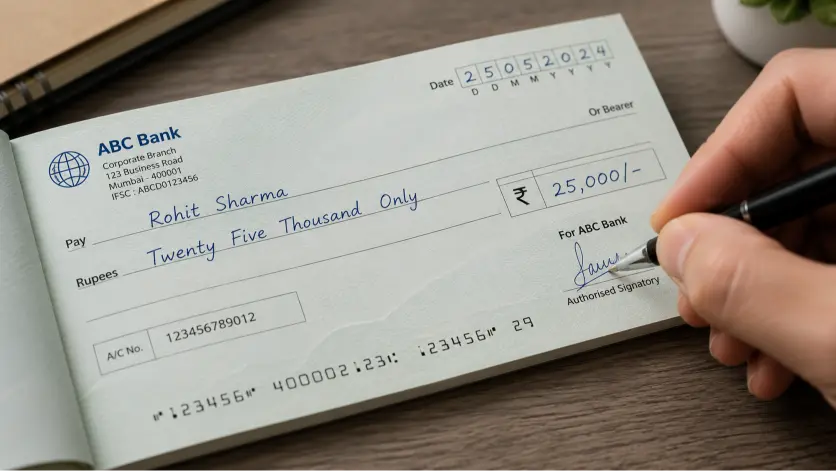
Have you ever received a payment by cheque or wondered what the word actually means? Although digital payments have become the norm, cheques are still widely used by businesses, governments, schools, landlords, and many individuals around the world. Knowing the cheque meaning can help you understand financial documents, complete banking tasks with confidence, and avoid costly mistakes.
A cheque is more than just a piece of paper. It is a legal financial document that authorizes a bank to pay a specific amount of money from one person’s account to another person or organization. Whether you’re opening your first bank account, receiving a salary, or learning financial vocabulary, understanding how cheques work remains an important life skill.
In this updated 2026 guide, you’ll learn the complete cheque meaning, where the word comes from, how to use it correctly, real-life examples, common mistakes to avoid, and answers to the most frequently asked questions.
What Does “Cheque” Mean?
A cheque is a written order instructing a bank to pay a specific amount of money from the account holder’s bank account to the person or organization named on the cheque.
In simple words, a cheque is a secure payment method that allows someone to transfer money without using cash.
Quick Answer:
A cheque is a signed financial document that tells a bank to pay a specified amount of money from the writer’s bank account to another person or business.
Pronunciation
Cheque: /tʃek/
It is pronounced exactly like “check.”
Origin of the Word “Cheque”
The word cheque has existed for centuries. It is believed to have evolved from old banking and commercial practices in Europe. Over time, banks adopted standardized paper payment orders that became known as cheques.
Today:
- Cheque is the preferred spelling in British English.
- Check is the preferred spelling in American English when referring to a bank payment document.
Although the spelling differs, both words have the same meaning in banking.
What Is Included on a Cheque?
A standard cheque usually contains:
- Date
- Payee’s name
- Payment amount in numbers
- Payment amount in words
- Signature of the account holder
- Bank details
- Account number
- Cheque number
- MICR code or routing information (depending on the country)
Every part helps the bank verify and process the payment safely.
How to Use “Cheque” Correctly
The word cheque is commonly used in banking, finance, education, real estate, and business communication.
Unlike internet slang or abbreviations, cheque is a formal financial term.
Common Situations Where People Use “Cheque”
Paying Rent
“I’ll send you the cheque tomorrow.”
The speaker plans to pay using a paper cheque instead of cash or an online transfer.
Business Payments
“The supplier accepted payment by cheque.”
Many businesses still accept cheques for invoices and large transactions.
Government Payments
“The refund cheque arrived this morning.”
Tax refunds, benefit payments, or insurance claims are sometimes issued as cheques.
School Fees
“Parents can pay the fees by cheque.”
Many educational institutions continue to offer cheque payments alongside digital methods.
Donations
“Please make the cheque payable to the charity.”
Charities often accept donations through cheques because they create a clear payment record.
When Should You Use the Word “Cheque”?
Use cheque when referring to:
- Bank payments
- Written financial orders
- Official documents
- Business transactions
- Government payments
- Rental agreements
- School or university payments
Examples:
I deposited a cheque yesterday.
She wrote me a cheque for $500.
The bank rejected the cheque because the signature didn’t match.
When Should You NOT Use the Word “Cheque”?
Don’t confuse cheque with words that sound similar.
For example:
❌ “Please cheque your email.”
Correct:
✔ “Please check your email.”
Remember:
- Cheque = money or banking document.
- Check = inspect, verify, examine, or review (in British English, “check” is also used as a verb).
Capitalization Tips
Normally write it in lowercase:
- cheque
- bank cheque
- personal cheque
- certified cheque
Capitalize it only at the beginning of a sentence or in official document titles.
Real Conversation Examples Using “Cheque”
These examples show how people naturally use the word in everyday conversations.
Example 1 — Between Friends
Sarah: Have you paid the security deposit?
Emma: Yes, I gave the landlord a cheque yesterday.
What it Means
Emma paid using a traditional banking method instead of cash or an online transfer.
Example 2 — At Work
Manager: Has the vendor been paid?
Accountant: Yes, the cheque was mailed this morning.
What it Means
Businesses often send cheques when processing invoices or official payments.
Example 3 — Family Conversation
Dad: Did Grandma receive her birthday money?
Son: Yes, we sent her a cheque because she prefers depositing it at her local bank.
What it Means
Some people, especially older adults, still prefer cheques over digital payment apps.
Example 4 — Bank Visit
Customer: I’d like to deposit this cheque.
Bank Teller: Certainly. Please provide your ID.
What it Means
Depositing a cheque adds the payment amount to the customer’s bank account after processing.
Example 5 — Charity Donation
Volunteer: Thank you for supporting our fundraiser.
Donor: I’ll write a cheque for $250.
What it Means
Many charities accept cheque donations because they provide a reliable record of the contribution.
Common Mistakes & Misunderstandings
Although the concept of a cheque is straightforward, many people—especially first-time bank users—make mistakes that can delay or even cancel a payment. Understanding these common errors will help you use cheques confidently.
1. Confusing “Cheque” with “Check”
This is by far the most common misunderstanding.
- Cheque refers to a written banking payment document (British English and many Commonwealth countries).
- Check is the American spelling for the same banking document.
However, in everyday English, check also means to inspect, verify, or examine.
Incorrect:
❌ Please cheque your spelling.
Correct:
✔ Please check your spelling.
Incorrect:
❌ I deposited my check yesterday. (This is only incorrect if you’re writing in British English.)
Correct (British English):
✔ I deposited my cheque yesterday.
Correct (American English):
✔ I deposited my check yesterday.
2. Forgetting to Sign the Cheque
A cheque without a signature is usually considered invalid.
Banks verify the account holder’s signature before releasing funds. If it’s missing or doesn’t match the bank’s records, the cheque may be rejected.
Tip: Always sign your cheque after filling in all other details.
3. Writing Different Amounts
The amount written in numbers and the amount written in words should always match.
For example:
Amount in figures:
$450.00
Amount in words:
Four hundred fifty dollars only
If these two amounts don’t match, the bank may refuse to process the cheque.
4. Leaving Blank Spaces
Never leave large blank spaces on a cheque.
Someone could potentially alter the amount or add extra words after you’ve signed it.
Instead, draw a line through any unused space after writing the amount.
5. Using the Wrong Date
Dating a cheque incorrectly can create delays.
Some banks won’t accept:
- Post-dated cheques before their date.
- Very old (stale) cheques after a certain period, depending on local banking rules.
Always double-check the date before handing over a cheque.
Generational Differences
People of different age groups often have different experiences with cheques.
Older Adults
Many older adults still prefer cheques because they’re familiar, provide a paper record, and are widely accepted for official transactions.
Common uses include:
- Pension payments
- Gifts
- Donations
- Rent
- Utility payments
Millennials
Millennials grew up during the transition to online banking.
Many know how to write a cheque but rarely need one.
They usually choose:
- Bank transfers
- Debit cards
- Mobile wallets
- Payment apps
Generation Z
Gen Z relies heavily on digital payments.
Many young adults have never written a cheque before opening their first bank account.
Because of this, they often search online for:
- cheque meaning
- how to write a cheque
- cheque vs check
- how to cash a cheque
Regional Differences
The spelling often depends on where you live.
Countries That Commonly Use “Cheque”
- United Kingdom
- Pakistan
- India
- Canada
- Australia
- New Zealand
- South Africa
Countries That Prefer “Check”
- United States
The financial meaning remains exactly the same.
How to Explain “Cheque” to Someone New
If someone has never used one before, you can explain it simply:
“A cheque is a paper instruction telling your bank to pay money from your account to another person.”
This short explanation is easy for students, beginners, and non-native English speakers to understand.
Cheque in Modern Banking
Although digital banking has transformed how we pay for goods and services, cheques still play an important role in many situations.
They remain useful because they:
- Leave a written payment record.
- Can be used for high-value transactions.
- Are accepted by many government offices.
- Work well for certain business payments.
- Help people who don’t regularly use online banking.
Many organizations continue to issue refund cheques, reimbursement cheques, and official payment cheques.
Types of Cheques
Understanding the different kinds of cheques can make banking much easier.
Personal Cheque
Issued from an individual’s personal bank account.
Example:
Someone paying rent to a landlord.
Business Cheque
Issued from a company’s bank account.
Usually used to pay:
- Employees
- Suppliers
- Contractors
- Service providers
Certified Cheque
The bank confirms that sufficient funds are available before issuing or certifying the cheque.
These are often required for large purchases.
Cashier’s Cheque (Banker’s Cheque)
Issued directly by the bank rather than an individual customer.
Commonly used for:
- Property purchases
- Vehicle purchases
- Large deposits
Crossed Cheque
A crossed cheque usually cannot be cashed over the counter.
Instead, it must be deposited into a bank account, providing additional security.
Cheque vs Cash
| Feature | Cheque | Cash |
|---|---|---|
| Physical payment | Yes | Yes |
| Requires bank account | Yes | No |
| Creates payment record | Yes | No |
| Suitable for large payments | Yes | Less suitable |
| Can be cancelled before clearing | Often yes | No |
Related Banking Terms & Alternatives
If you’re learning financial English, these related terms are worth knowing.
| Term | Meaning |
| Bank Draft | A payment guaranteed by a bank. |
| Money Order | A prepaid payment document. |
| Direct Deposit | Money sent electronically into a bank account. |
| Bank Transfer | Electronic movement of funds between accounts. |
| Wire Transfer | Fast electronic payment, often used internationally. |
| Debit Card | Card linked directly to a bank account. |
| Credit Card | Card allowing purchases on borrowed funds. |
| Mobile Payment | Paying with a smartphone or digital wallet. |
| Online Banking | Managing finances through the internet. |
| Routing Number | Number used to identify a financial institution. |
Related Search Topics
Readers interested in cheque meaning often also search for:
- cheque vs check
- how to write a cheque
- how to cash a cheque
- cheque book meaning
- crossed cheque meaning
- bearer cheque meaning
- account payee cheque
- stale cheque meaning
- post-dated cheque
- cancelled cheque meaning
FAQs:
What does cheque mean in simple words?
A cheque is a written instruction asking a bank to pay a certain amount of money from one bank account to another person or organization. It serves as a secure alternative to paying with cash.
Is cheque the same as check?
Yes. Both words refer to the same banking document. “Cheque” is used in British English and many Commonwealth countries, while “check” is the standard American spelling.
Can anyone write a cheque?
Anyone with a cheque book linked to a valid bank account can write a cheque, provided there are sufficient funds available and the cheque is completed correctly.
Why do people still use cheques?
Many businesses, government agencies, charities, and individuals continue using cheques because they provide a clear payment record and remain useful for certain official or high-value transactions.
How long does a cheque take to clear?
The processing time depends on the bank and country. Some cheques clear within one business day, while others may take several days before the money becomes available.
Can a cheque bounce?
Yes. A cheque may bounce if there isn’t enough money in the account, the signature doesn’t match, the cheque is damaged, or required information is missing.
Is writing a cheque safe?
Yes, when completed properly. Always write clearly, avoid leaving blank spaces, use permanent ink, and keep a record of every cheque you issue.
Conclusion:
Understanding the cheque meaning is still valuable, even in a world dominated by digital payments. A cheque is a secure banking document that instructs a bank to pay a specific amount of money from one account to another. While online banking and mobile payment apps have reduced its everyday use, cheques remain an important payment method for businesses, government agencies, educational institutions, and many individuals.
Whether you’re writing your first cheque, depositing one at your bank, or simply expanding your financial vocabulary, knowing how cheques work can help you avoid common mistakes and handle financial transactions with confidence. Remember that “cheque” is the preferred spelling in British English, while “check” is used in American English for the same banking document.
Now that you know the complete cheque meaning, you’re better prepared to understand banking forms, official documents, and everyday financial conversations. Have questions or experiences with cheque payments? Share them in the comments below, and don’t forget to explore our other banking and finance guides to continue learning.

I’m Lina Roys, a passionate writer behind Storevian, where I make words, phrases, slang, and everyday expressions easy to understand. I create clear, engaging, and reader-friendly content to help people find the meanings they’re looking for, quickly and confidently.


